
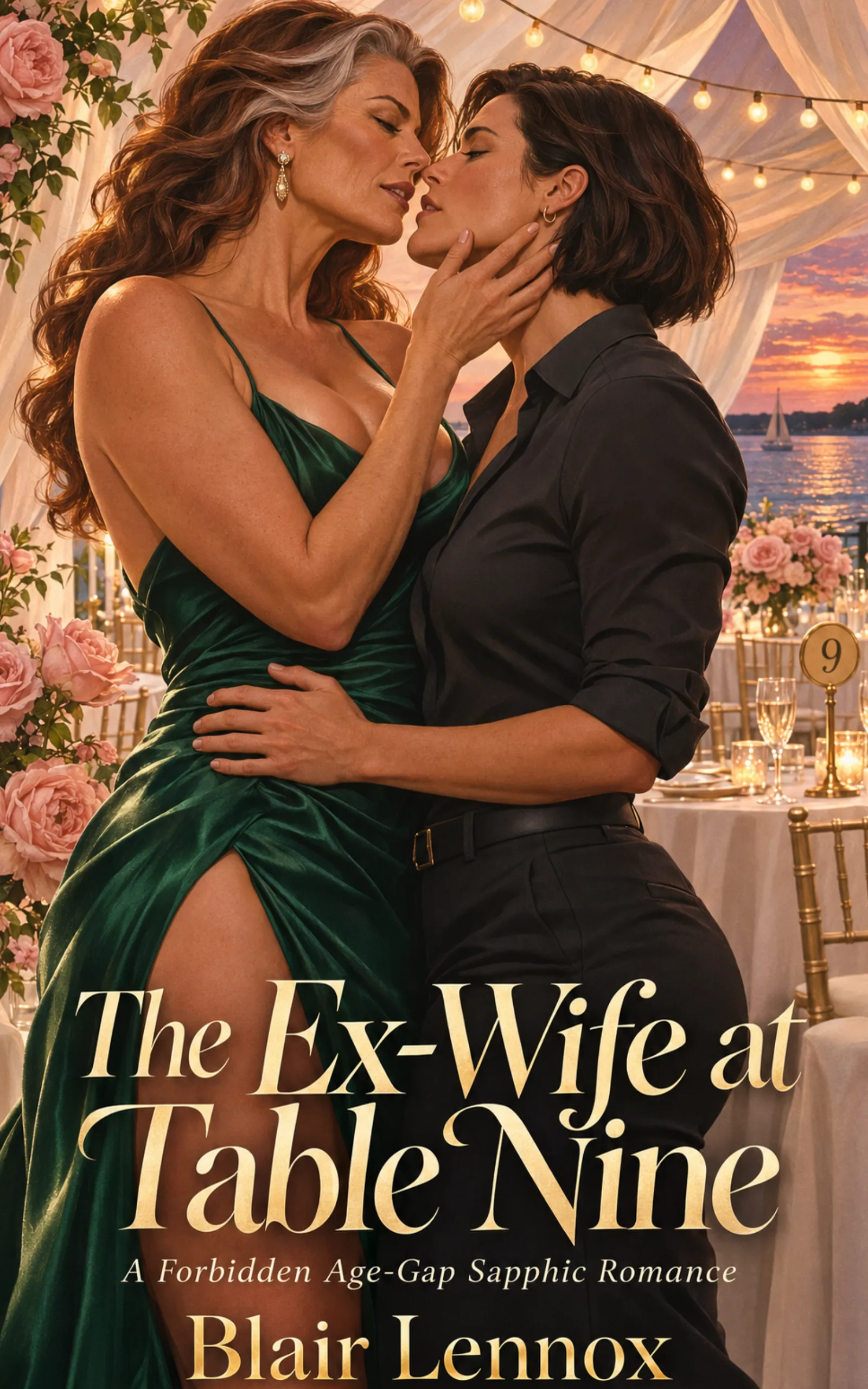
The Ex-Wife at Table Nine
A Sapphic Age-Gap Romance
by Blair Lennox
Available at all major retailers
Pairing: FF (Sapphic)
Heat: 🌶️🌶️🌶️🌶️🌶️ Inferno
Tropes: Age Gap (36 & 53), Wedding Planner × Groom’s Ex-Wife, Forbidden Attraction, Professional Boundaries, Late Bloomer, First Time with a Woman, Older Woman Initiates, Competence Kink, Secret Relationship, Found-Out Scandal, Light Bondage, Semi-Public, Second Chance, Found Family, Dual POV, HEA
Nothing happened at the wedding. They made sure of it.
The groom’s ex-wife is at table nine. Behind a pillar. Next to the cousins nobody likes.
Kit Rowan is paid to make sure Andrew Vale’s second wedding is flawless. She is not paid to notice that his ex-wife is the funniest, sharpest, most heartbreakingly composed woman in the room, or to stitch her back into a split dress in a supply closet while trying very hard not to look at her mouth.
Laurel Vale came to behave beautifully for one weekend. She did not come to find out, at fifty-three, what it feels like to want a woman so badly she forgets to breathe.
Nothing happens at the wedding. They make sure of it.
Then the contract closes, and Laurel calls the business line. Is there a waiting period for the planner?
What follows is oysters in a dive bar, a bedroom painted a green her ex-husband would have hated, a wedding-favor ribbon put to better use, and a night-blooming flower that waits all year and asks nobody’s permission.
But a wedding photographer caught the moment nothing happened, and the men who control most of Kit’s bookings are about to decide what it meant. Kit can protect her business by making Laurel smaller. Laurel has spent twenty-seven years being made smaller. She is finished with it.
The Ex-Wife at Table Nine is a scorching ~79,000-word sapphic age-gap romance with dual POV, a wedding planner who fixes everything but herself, a fifty-three-year-old heroine who is right on time, and an HEA guaranteed.
You’ll love this book if you enjoy:
✅ A supply closet, a split zipper, a needle held in her teeth, and one inch nobody crosses
✅ An older heroine who makes the first call, the first move and the pasta
✅ “Copy,” said at exactly the wrong moment, and never lived down
✅ Gold wedding-favor ribbon, an iron headboard, and a planner who finally lets someone else run the room
✅ A Victorian glasshouse after hours and a night guard’s flashlight on the other side of the glass
✅ A sister with a purple Sharpie, an ops manager with a spreadsheet, and a daughter who wants one day that is hers
✅ A place card that starts behind a pillar and ends at Table Two
✅ 🌶️🌶️🌶️🌶️🌶️ heat and an HEA guaranteed
⚠️ Content Warning: This novel contains extremely explicit sexual content (graphic FF scenes throughout, including oral, fingering, a strap-on, light bondage with ribbon, semi-public sex, phone sex and solo scenes), strong language and alcohol. It also depicts a past marital affair and divorce, a private photograph shared without consent, professional retaliation over a same-sex relationship, a temporary separation between the leads, grief for a long marriage, and a brief mention of a premature birth. Intended for readers 18+.
📖 Read Chapter One Free
Not sure yet? Read all of Chapter One right here.
Chapter One
KIT
At 3:07 on Friday afternoon, the florist cried in the walk-in cooler, and I had nine minutes to fix it before anyone with money noticed.
“Kit.” Dani’s voice came through my earpiece flat and calm, the way it always did when something was on fire. “Petal says the garden roses opened overnight. She’s using the word blown. She’s using it a lot.”
“Copy. Where is she?”
“In the cooler. With the roses. Crying on them.”
“Is the crying making them better or worse?”
“I’m not a botanist.”
I was already moving. Ferrin House sat at the end of a long oyster-shell drive outside St. Michaels, white clapboard and black shutters, a lawn rolling down to the Miles River like somebody had ironed it. The main house was all heart pine and old money. The kitchen wing behind it was where the real work happened, and I knew every door, every step that stuck, every outlet that tripped if you ran two coffee urns off it at once. I’d done twenty-two weddings here in four years. This was the most expensive.
The walk-in was forty degrees and smelled like wet stems and heartbreak. Petal, whose actual name was Margaret and who had been a florist for thirty years and earned every tear, sat on an overturned bucket holding a garden rose in each hand like she was weighing two dead birds.
“Look at them,” she said. “They’re finished, Kit. They’re wide open. Helena wanted cupped. She sent me a photo. Cupped.”
I crouched in front of her. The roses were, in fact, wide open. They were also enormous, blush-pink, ruffled to the edges, the kind of flower that looked like it had a scandalous past.
“Margaret,” I said. “Are they still pink?”
“Yes.”
“Do they still smell like that?”
She sniffed one, miserable. “Yes.”
“Then they’re not finished. They’re early. Pull the ones that are truly blown for the rehearsal tables tonight, because by candlelight nobody can tell the difference between open and dramatic. Keep the tightest ones in here at thirty-six degrees for the ceremony arch tomorrow. Anything in between goes in the bathroom arrangements, where women will stand in front of a mirror and decide they look like the flowers.”
She stared at me. Then she wiped her nose on her wrist and stood up.
“Thirty-six,” she said.
“Thirty-six. I’ll have Tomás bring you more buckets.”
“You’re a bully,” she said, and kissed my cheek, and I was back in the hallway at 3:13 with three minutes to spare.
“Florist resolved,” I said into my mic. “Tomás, buckets to the cooler. Six. Don’t argue with her.”
“Copy,” said Tomás.
“Dani, where’s Douglas Kemp?”
“Main lawn, with the venue manager. Walking the tent. Smiling at things.”
My stomach did the small tight thing it always did when I heard that name, which I hated, because Douglas Kemp had never been anything but pleasant to me. Commercial director, Harbor & Vine Hospitality. Harbor & Vine owned Ferrin House and four other venues between Annapolis and the Eastern Shore, and Douglas controlled their preferred-vendor list, which was the difference between a planner who booked the weddings people talked about and a planner who did baby showers at the Elks lodge. Sixty percent of Rowan Events’ good bookings came through that list. Dani had a color-coded spreadsheet about it that she kept making me look at.
And this weekend, the groom wasn’t just a client. Andrew Vale was a commercial developer with a minority stake in Harbor & Vine, which meant Douglas would be at the rehearsal dinner tonight with a glass of something and his eyes on everything.
My father had owned a hardware store in Dundalk for nineteen years. He’d known the name of every customer’s dog. One summer a kid sliced his hand open on a display saw, the local news ran it at six and eleven, and by Christmas the store was a cell phone outlet. One afternoon, he used to say, wiping down a counter nobody leaned on anymore. Nineteen years, and one afternoon.
I didn’t think about it every day. I thought about it every event.
I went out through the side porch into the sunshine and pasted on the face.
The reception tent went up Thursday and the tables went in this morning, which meant by Friday afternoon my staff could start building tomorrow in the space where it would happen. Thirty-two rounds under white canvas, a dance floor, the head table on a low riser facing the river. Two support poles ran through the middle of the tent, wrapped in greenery and fairy lights so nobody would notice they were poles. Escort cards went on a long mirrored table at the entrance, each one calligraphed in sepia ink, each one assigning a human being to a number.
I liked escort cards. People thought seating charts were about etiquette, but they were really about weather systems. You put the drinkers near the bar and the talkers near the dance floor and the divorced uncles very far from each other, and you got through the night without a front moving in.
Jada, my newest coordinator, was alphabetizing cards at the mirrored table. Douglas was at the far end of the tent with the venue manager, hands in his pockets, nodding at the lighting rig. He caught my eye and lifted a hand. I lifted one back. Pleasant. Pleasant.
“Kit.” Dani again. “Heads up. Guest on the lawn, early. Tall, navy dress, by herself. She’s walking toward the tent.”
“Rehearsal dinner’s not until six.”
“Tell her that.”
I turned around.
She was coming up the slope from the parking circle with a small leather bag over one shoulder and her shoes in her hand, which was the first thing I noticed: she’d taken them off for the grass, like a person who’d been to enough lawn weddings to know about heels and turf. The second thing I noticed was that she was tall, taller than me, and built soft and generous under a navy dress that was very well cut and very determined not to be interesting. Chestnut hair pinned up, gone silver at the temples. Sunglasses. A face I knew from the family photographs the bride had sent for the slideshow, where she’d been cropped out of half of them.
Laurel Vale. The first wife.
I’d seen her name on the guest list four months ago and thought, Oh, good for her, and then thought, Oh, God, Table 9, and then had a meeting with the client about it that I still thought about at night.
She stopped at the mouth of the tent and took off her sunglasses. Hazel eyes, a lot of green in them. Laugh lines. She looked at the tables, the poles, the riser. Then she looked down at the mirrored escort table, where Jada had just finished the V’s.
I watched her find her own name. Watched her pick the card up and read it, and read it again. Mrs. Laurel Vale. Table Nine.
Then she turned and looked at the tent until she found the number, and I watched her find that too.
Table 9 sat behind the east support pole, wedged against the canvas wall where the service path ran to the kitchen. From it, you could see the back of the pole, the side of the bar, and, if you leaned left, the head table in perfect, uninterrupted profile. Two of Andrew’s cousins from Delaware were seated there, along with a college roommate of Andrew’s who had already been flagged by the bar captain, and a woman who had once sold Helena a condo.
It had not been my seating chart. My seating chart had put Laurel at Table 4, with her sister, near her daughter and her daughter’s fiancé, with a view of the river and absolutely none of the head table. Helena had moved her on Tuesday. Helena had sent me a two-line email at 11:52 p.m. that said Moving L. to 9. Easier for everyone. I’d called Andrew’s office twice. Andrew’s office had said that seating was Helena’s domain.
Laurel set the card back down very precisely, exactly where it had been, and stood there with her shoes in her hand.
She didn’t make a scene. She didn’t even make a face. I’d seen mothers of brides go supernova over less. Laurel Vale just stood very straight and breathed through her nose, and something about the stillness was worse than shouting.
Then she found the woman with the earpiece and walked straight to me.
“You’re the planner,” she said. Not a question.
“Kit Rowan. Rowan Events.”
“Laurel Vale.” She offered her free hand. Her grip was warm and brief and firm. “I’m early. I’m sorry. I’m told the inn doesn’t give you the room until four, and I didn’t want to sit in a lobby being asked how I am.”
“You’re fine. Can I get you something? Water? There’s iced tea in the kitchen, and I can get you lemonade if you don’t tell the caterer I took it.”
“That’s kind.” She didn’t smile, but something near her mouth moved. “I’d like to ask a favor, and I want to be clear before I do that I know exactly how it sounds.”
“Okay.”
“I’m not going to ask you to move my table. I know who moved it, and I know you can’t move it back without her.” She held my gaze. “I’m sure there’s a version of me that would make you do it, and I’m sure she’d be very satisfying for about four minutes. I don’t want to be her. Tomorrow is about my children getting through a day.”
I didn’t say anything. People told you the most useful things when you let them finish.
“So here’s the favor.” She turned and looked at Table 9 again. “If I have to sit there, I’d like a chair from which I can see my daughter’s face. Not his. Hers. That’s all. One chair.”
I looked at the table. Then at the pole. Then at Table 6, where Claire Vale would be sitting tomorrow with her fiancé and his parents, two tables over from the head table, near the dance floor. From the chair currently marked Laurel, you’d see the pole and Andrew. From the chair on the opposite side, you’d see Claire, and you’d have your back to the riser.
“Give me ten minutes,” I said.
“I don’t want to be a problem.”
“You’re a guest,” I said. “Guests aren’t problems. Guests are the point.”
That earned me a look. A long, assessing one, like she was trying to decide if I’d said it because I meant it or because I said it to everyone. I did say it to everyone. I also meant it, which was the trick.
“Ten minutes,” she said. “I’ll go look at your river.”
She walked off down the lawn with her shoes still dangling from two fingers, and I watched her go a second too long. Then I went to work.
You can’t move a table without the client. You can, however, move a great many things that are not tables. I had Tomás pull the eight-foot boxwood arrangement off the east pole and rehang it on the north side, so instead of a wall of greenery blocking half of Table 9’s sightline to the dance floor, there was now a clear view across the floor to Table 6. I had Jada switch Laurel’s place card to the chair facing west, which put her back squarely to the head table. I moved the Delaware cousin who’d been flagged for a fistfight at a christening in 2019 to the seat on her left, where she’d have someone to be politely appalled by, and moved the college roommate with the bar captain’s note on him to the chair farthest from her and closest to the service path, where my staff could keep a hand on his elbow.
Then I took the little brass table number for 9 and turned it a few degrees so it faced the wall instead of the room.
It wasn’t a fix. It was the best you could do inside somebody else’s cruelty.
“You’re rearranging the ex-wife,” Dani said in my ear. She was on the lawn somewhere with eyes on everything. “Douglas just watched you do it.”
I glanced up. Douglas was looking right at Table 9, then at me. He smiled. I couldn’t tell what kind.
“I’m adjusting sightlines,” I said.
“Uh huh.”
“Seating is the client’s domain. Sightlines are mine.”
“Uh huh.“
I found Laurel at the bottom of the lawn, where the grass turned to sand and the dock ran out a hundred feet into the water. She was standing barefoot at the start of the boards, shoes beside her, arms crossed, looking at the river like it had personally disappointed her.
“Done,” I said.
She turned. “Already?”
“You’ve got a clear line to Table 6, your back to the riser, and a cousin on your left who will tell you everything about her colonoscopy if you ask her even one question. Don’t ask her one question.”
A short silence. Then she laughed, not loud, but real, startled out of her like she hadn’t planned it. “You’ve seated a lot of these.”
“Weddings?”
“Ex-wives.”
“A few.” I put my hands in my pockets. “Most of them don’t ask so nicely.”
“I’m very good at nicely.” She said it lightly, but it landed somewhere and stuck. “Twenty-seven years of practice. Thank you, Kit.”
She said my name like she’d been told it once and kept it on purpose.
“It’s nothing.”
“It’s a chair,” she agreed. “I know. I’m still grateful.” She bent to pick up her shoes. “I’ll be the one at Table 9 smiling so hard my face hurts. If you see my jaw lock, call a medic.”
“I’ll have one standing by.”
She walked back up the lawn toward the inn. I watched her for exactly as long as it took me to notice that I was watching her, and then I turned around and checked the dock lights, because somebody had to.
The rehearsal dinner was in the main house dining room, sixty-four people under a coffered ceiling, crab cakes and rockfish and Smith Island cake for dessert, because Andrew Vale was proud of being from Maryland in the specific way of men who’d left for Wharton and come back rich.
I watched it the way I watched every event, from the edges, in the doorways, through the kitchen pass, a step behind every swinging door. Andrew in a blue blazer, tall and silver and handsome in the way of men who owned boats, laughing with a hand on the back of whoever was nearest. Helena beside him in a cream dress that photographed beautifully and looked uncomfortable to sit in, her smile a beat too fast every time anyone said the word family. Claire Vale, twenty-eight, all elbows and nerves, holding her fiancé’s hand so tightly under the table that Nate kept flexing his fingers when she wasn’t looking. Her younger brother, Ben, in from Seattle that morning and already asking the bartender which nights the red-eye ran.
And Laurel at the far end of the long table, between her sister and the father of the bride, which was technically correct and practically insane.
The sister I liked immediately. Christine, fifties, sharp-featured, a laugh like a car alarm, already on her third glass of white by the salad course. Twice I watched her lean over and murmur something to Laurel that made Laurel’s mouth flatten to keep from laughing.
The toasts started at 8:40. Andrew’s best man told a sailing story nobody understood. Helena’s sister cried. Then Andrew stood, and the room went quiet the way rooms do for men who expect it.
He was good. I’ll give him that. He talked about second chances and the courage it took to be happy, and how lucky he was that the people he loved most had found room in their hearts, and then he turned his glass toward the far end of the table.
“And to Laurel,” he said warmly, “who has been nothing but gracious through all of this. You’ve taught all of us something about grace.”
Sixty-four heads turned.
Laurel lifted her glass and smiled. It was a beautiful smile. It reached every part of her face except the part that mattered. Christine’s hand disappeared under the tablecloth, and from the way Laurel’s shoulders eased half an inch, I assumed it had landed on her knee.
I’ve watched people get stabbed at weddings. That toast was a knife. Gracious through all of this. As if the affair and the divorce and the fast, glossy engagement had been weather, and Laurel had just been very good about carrying an umbrella.
She drank. She set the glass down. She said something to the father of the bride that made him laugh.
At 9:31, she excused herself.
At 9:38, I finally got a break.
The service entrance at Ferrin House was a screen door off the back of the kitchen, three concrete steps, a stack of milk crates, and a view of the river through a gap in the boxwood where the staff went to smoke and cry and eat standing up. I had a crab cake in a paper napkin, a cold one, left over from the passed apps. The crab cake was the best thing that had ever happened to me.
I’d taken two bites when the screen door opened behind me.
“Oh,” said Laurel Vale. “This is your spot.”
She was holding two champagne flutes. Both full.
“Technically it’s the dishwashers’ spot,” I said around a mouthful of crab. “They let me rent it.”
“I’ll go.”
“You don’t have to go.” I swallowed. “You’re just not supposed to be back here. Liability. If you trip on a milk crate, the insurance company will have opinions.”
“I’ll be very careful with the milk crates.” She came down the steps, not careful at all, and stopped beside me in the dark. The kitchen light through the screen fell gold across half her face. Up close, she smelled like something green and expensive. Her eyes were very bright. “I stole these. I thought I’d drink both of them out here by myself and then go back in and be exquisite. Would you like one?”
“I’m working.”
“I know. That’s why you should have one. You’ve been working for fourteen hours.”
“How do you know it’s fourteen?”
“Because I saw your car in the lot at seven when I drove past to see where the inn was,” she said. “I’ve been in hospitality eight years. I know what the person with the clipboard looks like at hour fourteen.”
I looked at the champagne. I looked at her. I took the glass.
“One sip,” I said.
“Of course.” She touched the rim of hers to mine, a small clear note in the dark. “To sightlines.”
“To sightlines.”
We drank. It was very good champagne. Andrew Vale had paid a hundred and forty dollars a bottle.
“Hospitality,” I said. “You said you’ve been in hospitality.”
“Sort of. I run visitor experience at Linden Hill. The botanical garden in the city.” She leaned back against the brick wall beside the door, glass held loosely against her collarbone. “Which is a very elegant way of saying I spend my days persuading donors that a conservatory full of ferns is worth fifty thousand dollars, and making sure the bathrooms are clean for the Tuesday garden club.”
“Those are the same job.”
“That’s what I keep telling my board.” She tilted her head. “Do you always eat standing up?”
I looked down at the crab cake. “Mostly.”
“Why?”
“Because if I sit down, I’ll fall asleep, and then somebody’s grandmother will die in the powder room and nobody will know where the defibrillator is.”
“Where is the defibrillator?”
“Front hall closet, top shelf, behind the umbrella stand. There’s another in the boathouse.”
She laughed, really laughed, head back against the brick, and the sound went off in my chest like a struck match. “God. Of course you know that.”
“It’s my job to know that.”
“I know. I like it.” She took a sip. “Do you know what everyone in that dining room has asked me tonight? Every single one of them?”
“How you’re holding up.”
“How I’m holding up.” She did a decent impression of a concerned cousin, hand on heart, eyebrows mournful. “As if I’m a bridge with a weight limit. As if they’re all very worried I’ll collapse into the river and someone will have to call the Coast Guard.” She looked at me sideways. “You haven’t asked.”
“You’re obviously holding up,” I said. “You’re holding up so hard you’ve got a cramp in your jaw.”
She stopped with the glass halfway to her mouth.
For a second I thought I’d blown it. You don’t talk to guests like that. You definitely don’t talk to the groom’s ex-wife like that, not during the rehearsal dinner, not with Douglas Kemp eating crab cakes forty feet away. My father’s voice somewhere in the back of my head: One afternoon.
Then her face cracked open.
She laughed so hard she had to put her hand over her mouth. She bent forward, champagne sloshing, laughing into her palm, her shoulders shaking, and when she came up her eyes were wet and her mascara was in danger and she was the most beautiful thing I’d seen in years.
“Oh, God,” she said. “I do. I have a cramp in my jaw. It’s been there since two o’clock. I think it’s permanent. I think I’m going to have to go to my daughter’s wedding next spring with my face stuck like this.”
“There are worse faces to be stuck with.”
The words were out before I could check them for weight. She heard it. I watched her hear it, the little catch, the way her eyes moved over my face like she was rereading a line.
“Careful,” she said softly. “I’m a recently divorced woman in a dark alley with stolen champagne. I’ll take compliments very seriously.”
“It’s not an alley. It’s a service entrance.”
“Is that better?”
“Not really.”
She smiled, slow. Not the beautiful dining-room smile. A different one, crooked at one corner, a little wicked. The real one, I thought. I’d have bet money on it.
The river made small sounds against the bulkhead. Through the gap in the boxwood, the dock lights I’d checked that afternoon laid a line of gold across the black water.
“Can I ask you something?” she said.
“You can ask.”
“The table. Nine. Did you put me there?”
“No.” I didn’t hesitate. “I had you at four. With your sister. River view.”
She was quiet a moment. “And then?”
“And then it changed.”
“That’s very discreet.”
“I’m a very discreet person.”
“I can tell.” She turned the flute in her fingers. “Thank you for not lying about it. I wouldn’t have blamed you.”
“I don’t lie to guests,” I said. “I just don’t tell them everything.”
“Is there a difference?”
“Ask me after the wedding.”
It came out wrong. Or it came out exactly right and meant something I hadn’t intended it to mean. After the wedding, like there’d be an after, like she and I would be somewhere other than a service entrance with a contract standing between us. I felt my face go hot in the dark and was grateful for the dark.
Laurel didn’t say anything. She just looked at me with those green-hazel eyes, a long, considering look, the way she’d looked at Table 9 that afternoon. Measuring the distance. Finding where she’d been put.
Then she smiled again, smaller. “I’ll hold you to that.”
Dani’s voice crackled in my ear. “Kit. Cake’s going out in six. Helena wants to know where the sparklers are.”
“Copy,” I said, too loud.
Laurel’s eyebrows went up. “Copy?”
“It means yes.”
“I know what it means.” That wicked corner of her mouth again. “I just didn’t know people said it out loud. Outside of movies about submarines.”
“I contain multitudes.”
“Clearly.” She held out her hand for my empty glass. I hadn’t noticed I’d finished it. One sip, I’d said. “Go. Find the sparklers. I’ll take these back before anyone notices they’re missing.”
“Nobody’s going to notice two glasses.”
“You’d be amazed what people notice at weddings.” She took the flute, and her fingers brushed mine, warm against the cold glass, there and gone. “Thank you, Kit. For the chair. And this. I haven’t laughed like that in a year.”
“You should do it more.”
“I’ll put it on my list.” She went up the steps and paused with her hand on the screen door, backlit by the kitchen, and looked back down at me. “Right under survive tomorrow.“
The door clacked shut behind her.
I stood alone at the bottom of the steps with the last bite of crab cake going cold in my napkin. I’d been on break for eleven minutes. I took four minutes for dinner on event nights, five if the bride was calm. Laurel Vale had stolen seven extra minutes from me without trying, and I hadn’t noticed a single one of them go.
“Kit.” Dani again, softer. “You okay? You went quiet.”
“I’m fine. Sparklers are in the blue bin under the gift table. Tell Tomás to bring the long lighter.”
“Copy.”
I threw the napkin away and checked my reflection in the stainless-steel prep table. Flushed from the kitchen heat. Nothing else.
Then I went back in through the swinging door and found her across the dining room in under three seconds without looking for her.
She was sitting beside her sister again, glass of water in front of her, listening to the father of the bride with her head tilted at an attentive angle. Andrew was laughing at the head of the table. Helena was looking at Laurel.
And Laurel was smiling. The beautiful, gracious, dining-room smile. The one that went everywhere except where it mattered.
I knew it now. Eleven minutes in the dark and I knew it the way I knew where the defibrillator was. I knew the real smile was crooked at one corner. I knew that when she was lying about being fine, the left side of her mouth pressed flat, just slightly, holding something back.
It was pressed flat now.
I stood in the doorway with a sparkler box in my hands and thought very clearly, Do not.
I filed it away where I filed everything I couldn’t use. Under contracts. Under clients. Under one afternoon.
Do not.
She looked up across sixty-four people and found me in the doorway, and the left side of her mouth softened, just for a second, just for me.
I turned around and went to light the sparklers.
Want to keep reading? The full novel is available now at all major retailers and direct from our store.
🔥 Want an EXCLUSIVE Bonus Chapter?
Second Wind — A scene TOO HOT for the bookstore
A year later, back at the cottage on Tilghman Island. This time Laurel packed the bag, read the tide tables and brought the gold ribbon. There’s a thunderstorm due at ten, a screened porch with nobody for half a mile, and a wedding planner who is about to stop knowing where anything is.
More from Blair Lennox
Browse all Blair Lennox books.

The Ex-Wife at Table Nine
The groom's ex-wife is at table nine. The wedding planner isn't paid to notice.

Off Script and Out of Clothes
America fell in love with them on screen. Off camera, it's forbidden.

Per My Last Orgasm
Her boss has broken five assistants. Assistant number six just emailed her a sex fantasy by mistake.

The Maid of Honor Clause
She asked her best friend to teach her how to finally come before the wedding. Falling in love wasn't in the contract.

My Best Friend’s Older Sister
She came to help clear her best friend's family home. She didn't plan on wanting the sister nobody forgave.

No Longer Her Assistant
For five years she ran the CEO's life. Now the CEO has to ask.
Never Miss a Release
Get new release alerts, exclusive bonus content, and reader-only giveaways.