
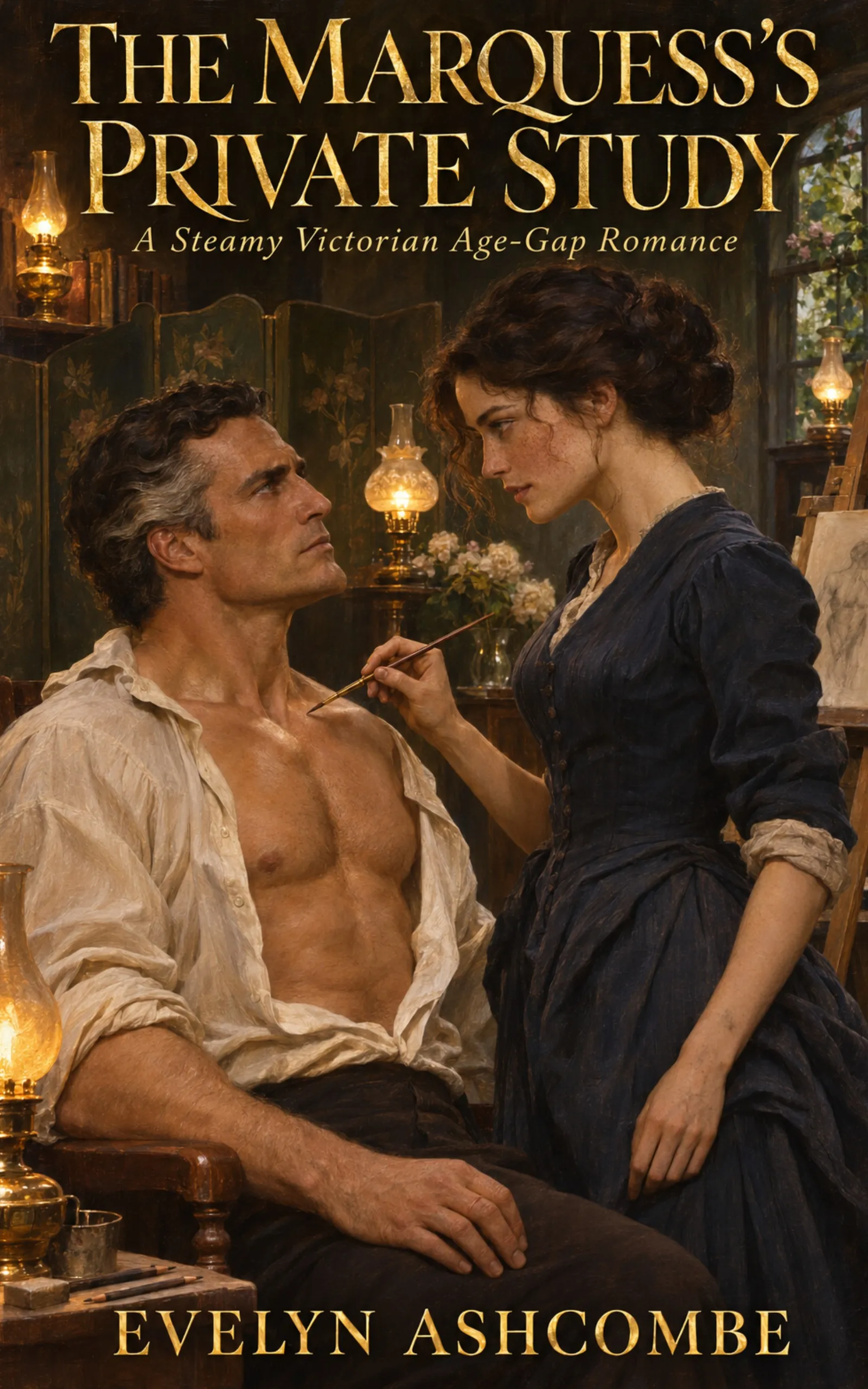
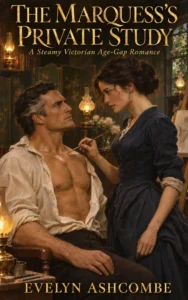
The Marquess’s Private Study
A Steamy Victorian Age-Gap Romance
by Evelyn Ashcombe
Shop the ebook · Shop the audiobook
Available at all major retailers
Pairing: MF
Heat: 🌶️🌶️🌶️🌶️🌶️ Inferno
Series: Standalone
Tropes: Age Gap, Widower, Artist & Patron, Silver Fox, Forced Proximity, Class Difference, Written Terms, Voyeurism, Body Worship, Dirty Talk, Competence Kink, Switch Dynamic, He Falls First, Grief Recovery, Grovel, Wedding
She came to paint his orchids. She stayed to draw the man.
Florence Beck has spent four years watching her best work published under other people’s names. So when the reclusive Marquess of Aldermere offers her a commission to record his famous orchid collection before it goes under the hammer, she has one condition: her name on every plate.
Gabriel Tarrant hasn’t wanted anything since his wife died. He certainly doesn’t want a sharp-tongued illustrator living in his garden house, correcting his catalogue, and asking questions about the debt he’s selling everything to pay.
But Florence keeps a private sketchbook. And the night Gabriel finds his own hands drawn in it, drawn as though she already knows how they’d feel, the polite distance between patron and artist goes up in steam.
She asks him to sit for her. He says yes.
Now the most controlled man in Surrey is learning exactly what it means to be looked at.
And the woman who refuses to belong to anyone is discovering how much she wants to be his, if he can learn that loving her doesn’t mean deciding for her.
The Marquess’s Private Study is a standalone Victorian age-gap romance with a 45-year-old widowed marquess, a 28-year-old botanical artist who negotiates everything, a glasshouse full of orchids, a nude sitting by lamplight, explicit on-page heat, no cheating, and a guaranteed HEA. Dual POV. Approx. 82,000 words.
You’ll love this book if you enjoy:
✅ A heroine who rewrites the contract and a hero who copies down every word of it
✅ A private sketchbook, a pair of hands drawn far too well, and a strap someone else fastened
✅ “May I?” asked before every single touch, and meant every time
✅ An undraped sitting by five lamps, a dry sable brush, and a marquess told to hold still
✅ A frost in the glasshouses, sixty-one plants, a chalk slate, and a first kiss against a warm brick wall
✅ A widower who has to learn that keeping her safe is not the same as asking her
✅ A grovel in a dry room at midnight with pen, ink, and seven clauses in her name first
✅ Victorian MF historical romance, 🌶️🌶️🌶️🌶️🌶️ heat, no cheating, HEA guaranteed
⚠️ Content Warning: This novel contains explicit sexual content (graphic MF scenes, including oral sex, manual sex, masturbation, a nude life-drawing sitting, a night where the heroine gives the orders, a hand over the mouth at her request, biting, mirror sex, and sex on a drawing table, against a door and in a glasshouse; all on-page sex is consensual and negotiated), the past death of the hero’s wife after childbirth and of their infant daughter, grief, a past unwanted advance from a publisher’s clerk, a family debt and a predatory in-law, gossip and threatened scandal, a hero who makes decisions on the heroine’s behalf without asking her, period attitudes toward women, class and money, and strong language. No cheating, no sexual violence, no dub-con. Intended for readers 18+.
📖 Read Chapter One Free
Not sure yet? Read all of Chapter One right here.
Chapter One: Florence
Seventy-two pounds. Half on signing.
Florence said it to the brass knocker, under her breath, because a knocker could not laugh at her. Rain sheeted off the portico a foot behind her back, and the portfolio under her arm, oilcloth over pasteboard with the corners mended twice, had begun to take on the weight and smell of a wet dog.
Seventy-two pounds. Not seventy. Not whatever his lordship thinks fair. Her father had once let a gentleman decide what was fair for six weeks of drawing lessons, and the gentleman had decided on forty shillings, and Henry Beck had thanked him for it. Florence had been fourteen and had watched her father bow over that money, and she had made a private vow on the spot that she had kept with very indifferent success ever since.
She knocked twice, firmly, the way a tradesman would not.
The door opened on a butler of great age and no expression. He took her name, and her wet umbrella, and made a small movement toward the portfolio that she prevented by the simple method of holding on to it.
“His lordship is in the library, Miss Beck.”
“Then I’ll go to the library.”
The house on Campden Hill was tall, white, and quiet in the expensive way, carpets thick enough to swallow a footstep whole. Gas hissed in brass brackets along the stairs. She counted the paintings as she climbed, from habit: a dull Dutch interior, two dead pheasants, a horse. Nobody in this family had ever bought a flower.
That was promising. A man who had never been taught what a botanical plate was worth might be taught. A man who thought he already knew was a great deal more expensive to correct.
She had spent the omnibus ride from the Church Street rooms building him. A collector: narrow, elderly, a velvet smoking cap, a magnifying glass on a ribbon, a habit of saying charming about things he meant to underpay for. Every orchid man she had ever met had been some version of that, and she had built her opening speech to fit him the way a glove fits a hand.
The butler opened the library door and said her name to the room.
The glove did not fit.
He was standing at the window with a letter in one hand, and he turned when she came in, and for a moment she simply looked at him the way she would look at a specimen nobody had warned her about.
He was big. Not stout; big, the way a door or a draught horse is big, built to take weight. Tall enough that the window seemed to have been hung for a smaller man. His coat was good and dark and sat across his shoulders with a faint air of strain, as though his tailor had measured him in a more modest year. His hair was dark and cut short and had gone grey at the temples, a clean, decided grey, not the apologetic kind. His face had been out of doors. It had lines at the eyes that came from squinting into weather, not from port.
And he was still. That was the thing that struck her hardest, after the size. Most men, when a woman came into a room, did something: tugged a cuff, cleared a throat, moved a chair as though the chair had insulted them. Lord Aldermere folded the letter once, set it face down on the sill, and stood perfectly still and looked at her, and the silence he made did not feel empty. It felt occupied.
“Miss Beck.” His voice was low and unhurried. “Thank you for coming out in this.”
“It was raining when you wrote, my lord. I assumed you knew.”
Something happened at the corner of his mouth. It did not become a smile. It considered the idea and declined it. “I did. Will you sit?”
“I’d rather lay out the work first, if you’ve a table that can bear getting wet.”
He looked at the portfolio, then at her, then crossed the room and swept a stack of estate papers off the long library table with one forearm, landing them on a chair in a heap that would have given a secretary palpitations. “It can bear it.”
She untied the tapes.
She had arranged the sheets in the order she had arranged them for six other gentlemen this year: three finished plates first, for the effect; then the structural studies, which were what a man who knew plants would actually want; then the fern proofs from the Holt volume last, because the ferns were her best work and her worst memory and she liked to have the portfolio closed again before her voice had to touch them.
He did not do what the six other gentlemen had done.
The six other gentlemen had turned the sheets the way men turn the pages of a menu, briskly, looking for the thing they’d already decided to order. Lord Aldermere drew out a chair, sat, put both forearms on the table, and looked at the first plate, a Lycaste she’d done for a Clapham nurseryman, for so long that Florence began, against her will, to count.
Ten. Fifteen. Twenty.
He moved his head a fraction, to take the lamplight off the wash. Thirty.
“You’ve enlarged the column,” he said.
“Four times. Beside it, lower left. The nurseryman didn’t care for it. He said it looked surgical.”
“He was wrong.” He turned the sheet, at last, with a care she noticed: one finger at the very edge, never on the paint. The next was a Masdevallia study with the sepals drawn open and pinned, the tails measured. He looked at that one longer.
She stood beside him because he had not invited her to sit again and she would not ask. From there she could see the side of his face and the line of his jaw, close-shaven, and the place where the grey at his temple went back into dark. She could see his hands on the table.
She had been drawing hands since she was nine years old. Her father had set her to it before flowers, because, he said, a hand is a flower that argues, and if you can draw one you can draw anything that grows. She knew what tendons did across the back of a hand when the fingers spread. She knew how the knuckle of the thumb sat.
She had not, in her considerable experience, seen a pair she wanted to draw this badly.
They were large and square across the palm, the fingers long, the nails cut short and blunt. A white seam of old scar crossed the second knuckle of his left hand. And under the nail of his right forefinger, in the house of a marquess, on a library table that had cost more than her year’s rent, there was a dark crescent of something that was unmistakably earth.
She looked away from it and found she was warm. The fire was not near her.
“These are very good,” he said, to the Masdevallia.
“I know, my lord.”
That did turn his head. He looked up at her from the chair, and having him below her, even by a foot, was a disorientation she had not prepared for. His eyes were dark grey, almost the colour of wet slate, and they did not move over her the way a man’s eyes usually moved over a woman standing near him. They stayed exactly where they were, on her face, with the same unhurried attention he’d given the sepals.
“Good,” he said. “Then we needn’t waste time on modesty. Sit down, Miss Beck. I’ll tell you what I want, and you’ll tell me what it costs.”
She sat.
What he wanted was simple to say and would be ferociously difficult to do.
“I have something over four hundred plants in three houses at Aldermere,” he said. “Cool, intermediate, and warm. Some of them are the best of their kind in England. A dozen of the best of those go under the hammer on the twenty-first of June, at a private sale by invitation, along with a good part of the rest.” He said it without inflection, as though reading a timetable. “Before they go, I want them recorded. Properly. Not a nurseryman’s catalogue. Twelve plates, with the structure shown as you show it here.” He touched the margin of the Masdevallia, an inch from the paint. “To stay with the house.”
“Twelve plants in bloom, in nine weeks, in Surrey.”
“Rusk, my gardener, can tell you which will flower and when. He knows them better than I do.”
He said that plainly, too, as a fact rather than a modesty, and she filed it away. “And the credit?”
“The plates would be catalogued as the Aldermere collection.”
“And the artist would be thanked.”
“Naturally.”
“In eight-point type,” said Florence, “at the foot of a preface.”
He didn’t answer. He waited, and the waiting had weight in it, and she understood that he had heard the edge in her voice and would not pretend he hadn’t, and would not rescue her from it either. He would simply let her finish.
So she did.
“If it is to be anonymous, my lord, it will need to be considerably better paid.”
“What would anonymous cost?”
“More than you’d care to spend to have me forget I did it.” She put both hands flat on the table, which was a thing she did when she wanted them not to shake. “But I’d rather not be anonymous at any price you’d pay. Here are my terms. My name on every plate, lower right, in my own hand. Reproduction rights reserved to me in writing. Under the Act of ’sixty-two the right to copy a painting passes to the man who buys it unless the artist reserves it on paper at the sale, and I’ve learned to read Acts of Parliament. You’ll own the plates. I’ll own the right to engrave them. Seventy-two pounds for the twelve, thirty-six on signing and thirty-six on delivery. Travel and materials separately, at cost, against receipts.”
She had said it to the knocker, to the omnibus window, to her own ceiling at three that morning. It came out level. She was absurdly proud of that.
Lord Aldermere sat back in his chair.
“Why does it matter?” he asked. “The name.”
It was not the question she’d braced for. She’d braced for that’s a great deal of money for a lady’s drawings and for the Act of ’sixty-two, how very modern of you and, worst, for the indulgent silence that meant he had stopped listening and was deciding how to say no kindly. She had armour for all of those.
He had asked it as though he wanted the answer.
“In 1876 I drew twenty-four ferns for Samuel Holt,” she said. “They were the best work I had ever done. Holt published them as drawn from nature by a lady, and every gentleman who admired them wrote to him asking for the lady, and Holt sent each of them his own man at his own rates. I have spent three years being a lady, my lord, and it has paid me nothing.”
Four sentences. She had meant to say fewer.
The fire shifted in the grate. Rain ran down the long windows in crooked threads. He looked at her across the corner of the table for a while with those slate eyes and said nothing at all, and Florence, who was very good at silences and had sat out bishops in them, found her face growing hot.
Then he set down the pen he’d been holding.
He reached past her shoulder, close enough that she smelled him for the first time, starch and rain and something green and bitter underneath, like the stems of cut things, and drew a clean sheet of laid paper from the stand. He uncapped the ink. He dipped.
And he began to write.
She realised what he was doing on the second line, because she could read upside down, a trick she’d learned reading publishers’ contracts across their desks while they explained to her what the contracts said. Memorandum of agreement between Gabriel Tarrant, Marquess of Aldermere, and Miss Florence Beck, of Kensington, artist.
Artist. Not lady. He had not asked her what word to use.
He wrote steadily, in black ink, in a hand that was large and plain and slanted very slightly forward, the hand of a man who wrote often and did not wish to be admired for it. Twelve finished plates, the subjects to be agreed with the head gardener. The name of the artist to appear upon each plate in her own hand. He did not pause. The right of reproduction and engraving reserved wholly to the artist, under the Fine Arts Copyright Act, 1862, the physical plates alone to pass to the purchaser.
He had taken it down word for word. Every one of hers, in the order she’d said them, without a single softening clause slipped in where she wouldn’t look.
She watched his hand move across the sheet and could not have looked anywhere else if the ceiling had come down.
The pen was absurd in it. A slim black thing, too small, like a child’s toy in a working man’s grip, and yet he managed it with a delicacy that made the back of her neck prickle. His wrist turned at the end of each line. The tendons moved under the skin exactly the way she would have drawn them, and then, on the long downstroke of the f in fee, did something she would not have thought to draw, a small sure flexion that made the whole hand seem briefly alive in a way paper never was.
Heat gathered low in her belly. It was not shy about it. It was not the polite warmth of admiration; it was weight, and it pooled, and it was entirely and specifically about the size of his hand against the paper and what that hand would feel like laid flat somewhere much softer than laid paper.
Florence sat very straight in her chair and thought about tariffs on imported pigment.
It did not help in the slightest.
The sum of seventy-two pounds, thirty-six to be paid upon signing, the balance upon delivery. He blotted it. He added a line she hadn’t asked for: The artist to have the sole use of such rooms at Aldermere as she shall require for the work. Then he turned the sheet around and slid it across the table to her with two fingers.
“Is that accurate?”
She read it twice, slowly, because she had been robbed by men in good handwriting before. It was accurate. It was more than accurate. It was hers, in his hand.
“Yes,” she said, and heard that her voice had gone low and slightly rough, and cleared it. “Yes, my lord. That’s what I asked for.”
“Then it’s what I’m offering.” He capped the ink. “Rooms. You’ll want to know about rooms.”
“I’ll want a north light and somewhere dry. Paper doesn’t survive a glasshouse.”
“There’s a garden office off the potting shed. Rusk keeps his seed lists there. I’ll have it cleared.” He said that the way he’d said everything, as though the clearing had already been done. “As to where you’ll sleep, there are two choices, and I’d sooner you knew both. There’s the house, which is large and mostly shut and has a housekeeper who will feed you and disapprove of you in equal measure. Or there’s the garden house. Two rooms at the end of the glasshouse range, brick, a stove, a bed. My mother had it built so she could sit up with the plants when they were ill. It’s closer to the work.” He paused. “You would be alone there. My sister keeps the Season in town, and I’m not a sociable host.”
“Alone suits me.”
“It suits a great many people until it doesn’t.” He said it without weight, but she caught something underneath it, the way one catches a dark spot under the surface of a pond. “Your aunt may come with you, if she likes. Or not at all, if she doesn’t.”
“My aunt would sooner go to the colonies than the country.”
“Then you’ll come alone,” he said, “and the garden house is yours, and if anyone in my household gives you cause to regret it, you’ll tell me.”
It occurred to her, with a small cold shock, that she had just been given everything she’d come for, and that nothing in her had any idea what to do next.
She began to gather the sheets.
She did it badly. Her hands were not quite steady after all, and the oilcloth was still wet at the corners, and when she lifted the stiff boards of the portfolio a single loose leaf slid out from between them, where she had never meant it to be, and skated across the polished table and over the edge, and came to rest on the carpet at his feet. Face up.
She knew which one it was before it landed. She had known when she packed. She had told herself she’d take it out.
It was a study from the Slade life class. Black and white chalk on grey paper, the size of a man’s forearm. The model was a dock porter called Aldous who sat Tuesdays and Fridays for two shillings a session and fell asleep if the room was warm. In her drawing he was not asleep. He stood with his weight on one leg and his arms raised behind his head, the whole long frame of him pulled up and taut, ribs and belly and the deep cut of muscle running down from his hip bones toward a drape of linen that was, by the regulations of University College London, knotted at his hips and not one inch lower.
She had not drawn the linen with any great interest. She had drawn everything above it as though her life depended on it.
Lord Aldermere bent and picked it up.
He did not hand it back.
He held it in both hands, by the edges, the way he’d held the orchids, and he looked at it. He looked at it far too long. She watched his eyes go down the paper, slowly, from the raised elbows to the throat to the chest to the long hard plane of the belly, and stop at the linen, and stay there one heartbeat more than they needed to, and then, as though it cost him something, go back up to the face.
The fire cracked. Somewhere downstairs a door closed.
Florence did not snatch it. She would have liked to. She would also, she discovered, have liked to see what his face did if she left it with him a little longer, and that second wish was so much stronger than the first that it frightened her into moving.
She held out her hand.
He gave it to her. Their fingers did not touch. She was aware of exactly how far they did not touch, and that he had arranged it that way.
“Your line is surer there,” he said quietly, “than on the ferns.”
She could have said a dozen things. It’s a class exercise. The Slade requires a figure portfolio. Every lady student does them. Any of them would have closed the door on this, politely, and they could both have walked back out into the safe weather of orchids and fees.
“Ferns don’t breathe, my lord,” she said.
He looked at her. She looked back. Neither of them pretended anything at all, and the not-pretending stood between them in the warm room like a third person who had come in without knocking.
Then he rose, and the moment shifted and was gone, or at least went somewhere she couldn’t see it.
“Take the agreement home,” he said, holding it out. “Read it with someone who’ll tell you I’m a scoundrel. If you still want it, sign it and send it to Sayer, my solicitor, the direction’s on the back, and he’ll pay the first thirty-six pounds the same day. If you don’t want it, send it back unsigned, and I’ll think none the worse of your work.”
“And of me?”
“I hadn’t been thinking of you as separable from it.”
She did not know what to do with that, so she put it in the portfolio with the Slade drawing, and tied the tapes.
He saw her down himself. The butler appeared at the foot of the stairs with her umbrella and an air of deep private grievance and was waved off, and it was the Marquess of Aldermere who held the front door open on the rain, and stood in it, filling it.
She was on the top step with the umbrella half up when he spoke again.
“The undraped figure, Miss Beck.” His voice was pitched low, under the rain, for her and not for the street. “Does the Slade permit it for its ladies?”
She turned. He was a shape against the gaslight of the hall, broad and dark and very still, and she could not see his expression, which was perhaps a mercy for them both.
“No, my lord,” she said. “We’re thought unable to bear it.”
A pause, long enough for one heavy drop to fall from the portico onto the brim of her bonnet.
“I very much doubt that,” said the Marquess of Aldermere, and closed the door.
“Alone,” said Aunt Margaret.
“In a garden house. With a stove.”
“Alone, in a garden house with a stove, on the estate of a widower who is not yet fifty, who keeps no company, who sees you out of his own front door himself, in the rain.” Margaret Beck set down the teapot with the particular gentleness she reserved for things she would have liked to throw. “You’ve left something out. You always leave something out when you’ve already decided.”
The rooms over the stationer’s in Church Street were small and smelt, at this hour, of paraffin and toasted bread and the wet wool of Florence’s skirts drying on the fender. Rain still ticked at the window. On the table between them, beside the toast rack, lay the memorandum of agreement, unfolded, with its black, forward-leaning hand.
“He wrote out my terms himself,” Florence said. “All of them. Read it.”
Margaret read it. She read it the way she had once read the accounts of the elderly invalid lady she’d been companion to for eleven years, with a pencil in her hand that she did not use and a face that gave nothing to anybody.
“Artist,” she said at the end.
“Yes.”
“Not lady.”
“No.”
Margaret put the paper down. “Men write out a great many things in their own hand, Florence. Love letters. Wills. Promissory notes for sums they’ve no intention of paying. Handwriting is not character.”
“Holt’s was very elegant.”
“Holt’s was very elegant,” Margaret agreed, unruffled, “and Holt robbed you. I’m not saying this one is a thief. I’m saying I don’t know what he is, and neither do you, and you’re going to go and live at the bottom of his garden for nine weeks.” She folded her hands. “A woman who lodges alone at a lord’s house is not an artist when she comes back. She’s a story. You know what kind.”
“I’ve been a lady for three years,” Florence said. “It paid me nothing. I’d sooner be a story with my name on every plate.”
“You say that now.”
“I’ll say it in June.”
Margaret looked at her for a long moment across the toast rack. She was not a sentimental woman. She had buried a husband and an employer and her husband’s brother, Florence’s father, and she had stood at each grave dry-eyed and gone home and made an inventory. It was the thing Florence loved most in her.
“What does he look like?” Margaret said.
Florence opened her mouth to say it hardly matters, and closed it again.
“Large,” she said.
“Large.”
“He looked at the Masdevallia for a full minute. I counted.” She heard her own voice and disliked how much was in it. “Nobody has ever looked at my work for a full minute, Aunt. Not even Papa. Papa looked for faults.”
“And what did this one look for?”
Florence thought of slate-grey eyes going slowly down a sheet of grey paper and stopping, one heartbeat too long, at a knot of chalk linen. Heat climbed her throat, and she bent to turn her skirts on the fender so that Margaret would not see it.
“I don’t know yet,” she said.
Margaret was quiet for a time. Then she reached across, took the pen from the stand, dipped it, and held it out handle first.
“Then sign it,” she said, “and go and find out. But you’ll write to me every Sunday, and if a single Sunday comes without a letter I’ll take the train to Dorking and walk the six miles in my good boots, and you know I hate the country.”
Florence signed.
Florence Beck. Her full name, at the foot of a page covered in his hand. She blotted it and looked at the two hands together, hers small and upright, his large and leaning, as though both of them had been in a hurry to arrive at the same place.
Later, in the narrow bedroom with the lamp turned down, she unhooked her bodice, and the long busk of her corset one cold steel hook at a time, and stood in her chemise in the dark with the rain on the glass.
She did not touch herself. She would not have known which thought to stop at if she had.
But she stood there a long while, one palm flat against her own belly through the thin linen, exactly where the heat had gathered in the library and had not yet entirely gone. And she thought of a pen like a toy in a working man’s hand. And a crescent of earth under a nail. And a low voice in a doorway, pitched for her alone, saying with perfect, unhurried certainty that she could bear a great deal more than anyone had ever let her try.
I very much doubt that.
Neither, God help her, did she.
Want to keep reading? The full novel is available now.
🔥 Want an EXCLUSIVE Bonus Chapter?
Except by Order of the Artist — A scene TOO HOT for the bookstore
November 1879, two months married. The studio sign says NOTHING WET. BY ORDER. Florence has laid out her whole palette, sent her husband a note under the soup, and decided to paint a plate from life: a rare specimen found growing wild in Surrey. Lower right, in her own hand, it will be signed.
More from Evelyn Ashcombe
Browse all Evelyn Ashcombe books.
The Countess’s Indecent Terms
She’ll share his bed for eight weeks. She will not be his wife again.
The Widow of Morrow House
Everyone says the house takes a bride. She is not going anywhere.
The Widow’s Private Viewing
She needed him to sell her secrets quietly. He needed her to stop keeping them.
The Marquess’s Private Study
She came to paint his orchids. She stayed to draw the man.

The Dollar Princess’s Revenge
Six years ago he denied her before three hundred people. Now she holds every note on his estate.
The Lady in the Next Room
A widow with a locked drawer. A runaway with a borrowed name. And a door with two bolts between them.
Never Miss a Release
Get new release alerts, exclusive bonus content, and reader-only giveaways.