
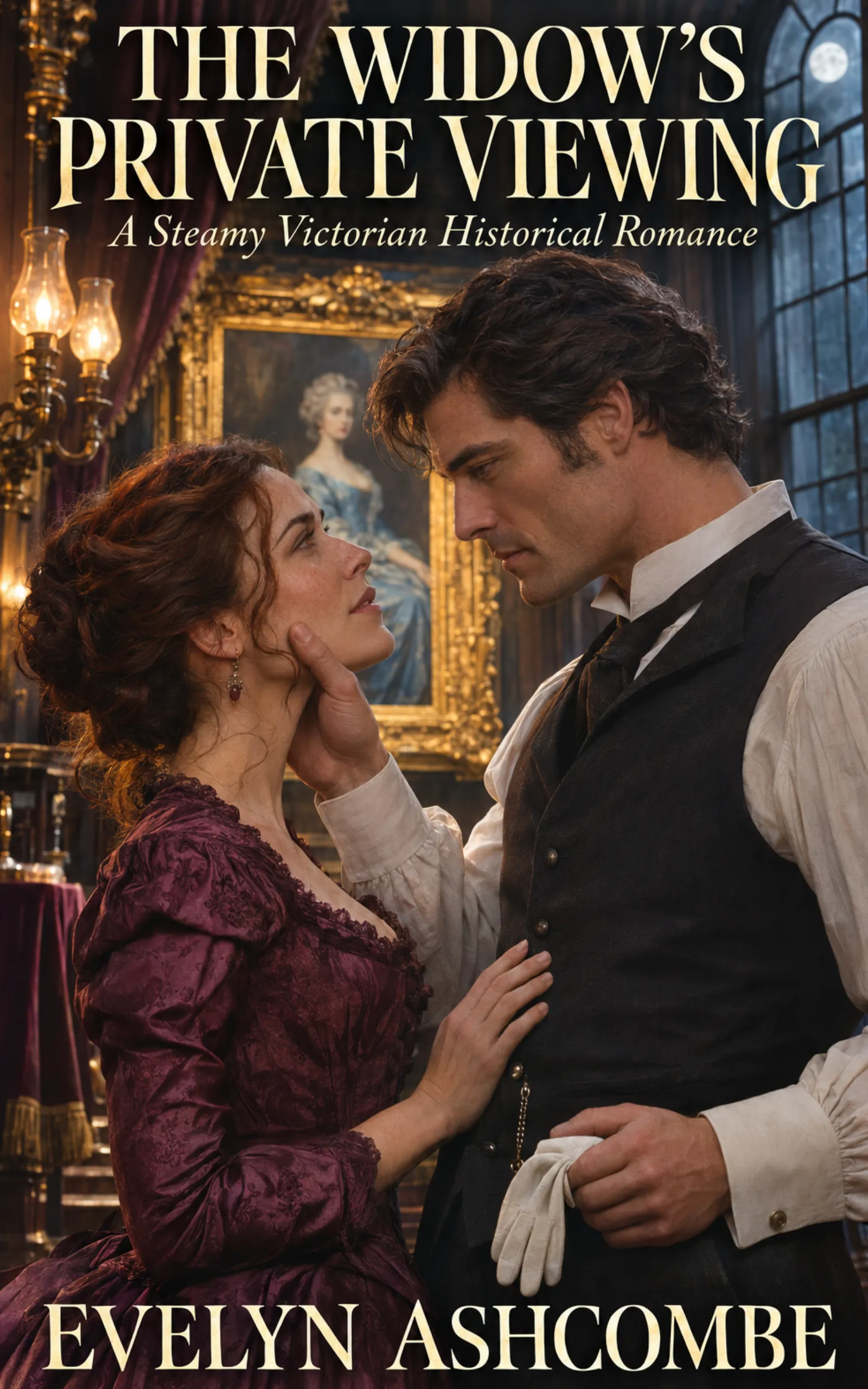
The Widow’s Private Viewing
A Steamy Victorian Historical Romance
by Evelyn Ashcombe
Shop the ebook · Shop the audiobook
Available at all major retailers
Pairing: MF
Heat: 🌶️🌶️🌶️🌶️🌶️ Inferno
Series: Standalone
Tropes: Widow’s Awakening, Class Difference, Secret Affair, Forbidden Romance, Aristocrat & Self-Made Hero, He Falls First, Ice Queen Melts, Older Heroine, Touch Starved, Sexual Awakening, Art-World Intrigue, Dirty Talk, Light Bondage, Competence Kink, Grovel, Wedding
She needed him to sell her secrets quietly. He needed her to stop keeping them.
London, 1886. Helena Vane, Dowager Countess of Wychford, has a title, a Mayfair address, and almost no money. Her late husband left his servants unpaid and his promises unkept, and Helena means to keep them herself, by quietly selling the paintings that are hers alone.
Nathaniel Mercer is the cabinetmaker’s son who became the sharpest auctioneer in St James’s. He doesn’t flatter countesses. He doesn’t sell lies. And he has never wanted a client the way he wants the cool, composed widow who walks up his stairs carrying her own parcel and asking for discretion.
Then he sees her prized Gainsborough, and the face in it belongs to his mother.
One kiss among the wrapped canvases. One rain-dark carriage ride. One night behind his locked door. Every secret they keep makes the next one harder to forgive.
And when the hammer falls, Helena will have to decide what she’s willing to put her own name to.
The Widow’s Private Viewing is a standalone Victorian historical romance with a 36-year-old widowed countess who has never once been touched properly, a 39-year-old self-made auctioneer who refuses to flatter her, a portrait with a stolen name, explicit on-page heat, no cheating, and a guaranteed HEA. Dual POV. Approx. 86,000 words.
You’ll love this book if you enjoy:
✅ A widow who has spent fifteen years being called cool, and the man who finds out exactly how hot she runs
✅ A rain-dark growler, one white cotton glove, and a detour round Hyde Park Corner
✅ Twenty-three hairpins taken out one by one, and the whole night behind a bolted door
✅ Sex on an auctioneer’s desk, a ruined sale calendar, and “a very large cup of tea”
✅ Garter ribbons, an oak armchair, and a hero made to beg
✅ A secret affair, a stolen name in a gilt frame, and two betrayals that land on the same day
✅ A grovel done properly, a sale done clean, and a garnet ring given among the wood shavings
✅ Victorian MF historical romance, 🌶️🌶️🌶️🌶️🌶️ heat, no cheating, HEA guaranteed
⚠️ Content Warning: This novel contains explicit sexual content (graphic MF scenes, including oral sex, manual sex, masturbation, sex in a carriage, on a desk, in a bath, against a wall and in a chair, light bondage with silk ribbons, a hand over the mouth, mirror sex and dirty talk; all on-page sex is consensual), a late husband’s emotional neglect and infidelity (off-page, past), grief and complicated relief after a spouse’s death, money worries and unpaid servants, the past death of the hero’s mother and aunt, secrets and a breach of trust between the leads, class prejudice, gossip and threatened scandal, period attitudes toward women, class and money, and strong language. No cheating between the leads, no sexual violence, no dub-con. Intended for readers 18+.
📖 Read Chapter One Free
Not sure yet? Read all of Chapter One right here.
Chapter One: Helena
The letter had been folded so many times that the creases had gone soft as cloth.
Helena Vane, Dowager Countess of Wychford, flattened it on the blotter with the side of her hand and read it a third time, because the first two readings had not made it say anything different.
My lady,
I write again on the matter of the sum promised me at Michaelmas, and before that at Lady Day, and before that by his lordship himself in the summer of ’eighty-three. I do not write to complain. I write to inform you that I refused a place with a family in Brighton in November on your ladyship’s assurance, and that the lady has since engaged someone else. My sister’s husband has been good, but a man’s patience with his wife’s sister is not a bank. I should be glad to know, plainly, whether I am to expect the money or whether I am to stop expecting it. Either answer would serve. It is the not knowing that does not.
Your obedient servant, Ruth Bellamy
Plainly. Mrs. Bellamy had underlined it once, with a pen that had nearly gone through the paper.
Helena set the letter aside and drew her account book toward her. It was a plain thing bound in green cloth, nothing like the morocco ledgers Edmund’s man of business had kept, and it had the advantage over those ledgers of being true. She turned to the page she had been avoiding since Christmas and did the arithmetic again in pencil, though she knew the answer.
Rent on Hill Street, to Lady Day: a hundred and twelve pounds ten. Coals. Wax lights, because Edmund had disliked the smell of gas and she had not yet found the courage to disappoint a dead man. Wages for a household of nine. Against all of it, the income from Aunt March’s investments, paid quarterly, which would keep a small house very comfortably and kept this one the way a single candle keeps a ballroom.
And beneath all of it, in a column of its own, the list she had written out in October and not been able to cross a single line from.
Mrs. Bellamy — £38 wages owing. £20 per annum, promised. Joseph Pike — £14. A reference. Hannah, Price, the two Dawsons — wages to quarter-day. Small sums promised. Which he promised. Which I repeated.
Six hundred and fifty pounds, near enough. Not a fortune. Edmund had spent more than that on a weekend at Newmarket and come home charming about it.
None of it was hers to owe. Mr. Fenwick had been very clear: the debts of the late earl’s household were the debts of the late earl’s estate, and the claims of servants would be met in their order, which was to say late and in part. She was under no legal obligation whatsoever.
She had stood in the servants’ hall at Wychford in the August heat, with Edmund three days dead upstairs and the house smelling of lilies, and she had told nine frightened people that they would be looked after. She had said it because Edmund had said it to them first, the summer before, with his hand on Joseph’s shoulder and that warm, careless laugh — you’ll all be seen right, I give you my word — and she had stood beside him and nodded, the way she always nodded.
Fifteen years of nodding. It turned out a person could build an entire life out of it.
She closed the account book.
Augusta found her in the hall half an hour later, buttoning her gloves.
Cousin Augusta March was sixty-one, widowed, round and unhurried, and possessed of the kind of gaze that took inventory without seeming to. She lived with Helena on terms neither of them examined too closely: Augusta lent respectability and Helena lent a roof, and both of them pretended this was a favour running the other way.
Augusta looked at the flat parcel under Helena’s arm, wrapped in an old Paisley shawl. She looked at Helena’s walking costume — grey wool, grey braid, the lavender ribbon at her throat that was the single concession half-mourning permitted. She looked at the absence of a maid.
“You’re taking the little Dutchman somewhere,” Augusta said.
“I’m taking him to be valued.”
“By whom?”
“By a man named Mercer. Mercer and Barlow, in Ryder Street.”
“I don’t know them.”
“No one we know knows them. That is rather the point.” Helena settled her hat. “I’m told they sell honestly and quickly and they don’t talk.”
“Told by whom?”
“By Mr. Fenwick’s clerk, who sold his mother’s clocks through them and was astonished to be paid on the day promised.”
Augusta’s mouth twitched. “And you mean to carry it yourself. Through St James’s. Like a girl delivering hats.”
“I mean to see how they treat a woman who carries her own parcel.” Helena opened the door herself, before Wilkins could reach it, and the February air came in grey and raw and tasting of coal smoke. “If they’re polite to the parcel and rude to me, I’ll know. If they’re polite to me and rude to the parcel, I’ll know that too.”
“And if they’re polite to both?”
“Then I shall be very much surprised,” said Helena, “and I’m not certain I remember how.”
Ryder Street was narrow and respectable and smelled of wet stone. Mercer & Barlow occupied a tall, flat-fronted house with its name in plain gilt over the door — no flourish, no crest, no By Appointment. Through the long windows Helena could see a gallery hung close with pictures under the yellow bloom of gas, though it was barely three in the afternoon. London in February did not trouble itself much with daylight.
Inside, it was warm, and quiet in the way of rooms where money was discussed in low voices. A young clerk with spectacles and a valiant attempt at side-whiskers came out from behind a counter.
“Good afternoon, madam. Have you an appointment?”
“I have a picture.” She set the parcel on the counter and drew out her card.
He read it. She watched the coronet register — the slight widening of the eyes, the involuntary straightening of the spine, as if the little engraved strawberry leaves had reached up and adjusted his collar.
“Lady Wychford. Of course. Forgive me. If your ladyship would care to sit, I’ll fetch Mr. Barlow directly, he’ll certainly wish to—”
“Mr. Barlow,” said a voice from the stairs, “has gone to his luncheon, and will be sorry to have missed a countess. I shan’t be.”
Helena turned.
He was coming down the last few steps without hurry, a sheaf of proofs in one hand, and her first impression was of a man who did not waste anything — not movement, not words, not the space he occupied. He was tall and broad through the shoulders, dressed in a dark frock coat so precisely cut that it took her a moment to realise it was the best-made coat in the building. Dark hair, close-cropped, beginning to silver at the temples. A face that was not handsome so much as decided. Grey eyes, and they had looked at her parcel before they looked at her card, and at her before they looked at either.
“Nathaniel Mercer,” he said, and inclined his head. Not a bow. Not quite. “Thank you, Pratt. I’ll take it.”
“Sir, Mr. Barlow did say that any titled—”
“I know what Mr. Barlow said.” There was no edge in it, only certainty. “Lady Wychford has come about a picture, not a peerage. Will you come up?”
She had been prepared for deference, which she knew how to manage, and for condescension, which she knew how to freeze. She had not been prepared to be taken at her word. It was a peculiar sensation, like a stair being exactly where one’s foot expected it.
“Thank you,” she said, and lifted the parcel herself before Pratt could.
Mr. Mercer’s eyes moved to the shawl and back to her face, and something passed across his mouth that was nearly amusement and nearly approval and was gone before she could decide which.
He did not offer to carry it.
His office was on the first floor at the back, and it surprised her.
She had expected clutter — the magpie chaos of a dealer’s den, pictures stacked against walls, plaster casts and broken frames. Instead it was a working room as clean as a surgeon’s. A broad table under a north window, covered in green baize. An easel. Shelves of catalogues in long, orderly rows, their spines labelled by year. A desk with two inkwells, a blotter, a magnifying glass on a brass arm. The only ornament was a small cabinet in the corner, walnut, with doors so finely fitted that the seam between them was a single dark hair.
“Put it there,” he said, nodding at the baize, “if you’d be so kind.”
She did. Then she watched him take a pair of white cotton gloves from a drawer and draw them on.
He did it the way another man might wind his watch — without thinking, with a small, unconscious exactness, smoothing each finger down to the knuckle. The gloves were spotless and fitted close. On anyone else they would have looked fussy. On him they looked like a declaration: I do not touch what I value carelessly.
Helena found she had stopped breathing, and resumed.
He unwrapped the shawl, folded it, and set it aside — folded it, she noticed, more neatly than she had. Then he lifted the picture to the easel and stepped back, and for a long moment he simply looked.
It was a little river view, a foot and a half across: flat green water, a church spire, three cows standing in the shallows with an air of profound philosophical commitment. It had hung in Aunt March’s morning room for twenty years, and Helena had loved it as a girl because the middle cow appeared to be on the verge of saying something important.
He tilted it toward the window. He turned it and examined the back, the stretcher, a scrap of old label, with the magnifying glass held close. He did not speak, and did not seem to feel any need to, and the silence stretched until it had weight and texture, like a held note.
Edmund had never been able to bear a silence. He filled them the way some men filled glasses — automatically, generously, until they overflowed.
Mr. Mercer let this one go on until he was finished with it. Then he turned to her.
“It’s a pleasant picture,” he said, “by a man who painted a great many pleasant pictures. Late seventeenth century, Dordrecht or near it. The follower of a follower. It’s in sound condition, someone had it cleaned with more love than skill about forty years ago, and the frame is later and better than it deserves.” He paused. “Thirty guineas. Forty on a good afternoon, if two people in the room have aunts who kept cows.”
For three full seconds, Helena was insulted.
It arrived hot and immediate, a flush at her collar, the instinct of fifteen years as the Countess of Wychford: how dare you speak so of something of mine. It got as far as her tongue.
Then it went out like a match in the rain, and what was left behind was relief so sharp it was almost giddy.
He had told her the truth. Not the number she wanted and not the number he thought she wanted. Just the number. He had not called it a gem or a little treasure or most charming, my lady, the way every man who had ever valued anything at Wychford had done, while Edmund beamed and the figures in the ledgers swelled like dough.
“Thirty guineas,” she repeated.
“Perhaps thirty-five. I don’t flatter pictures, Lady Wychford. It does them no kindness in the end. The buyer finds out, and then it’s the picture they resent.”
“And the vendor?”
“The vendor generally resents me.” He drew off the gloves, one finger at a time, with the same unhurried care. “I find I can bear it.”
She watched his hands come out of the white cotton. They were large, long-fingered, square at the tips — not a gentleman’s hands, she thought, or not only. There was a faint pale scar across the base of his left thumb, an old one, a neat white seam. They were the hands of someone who had made things before he sold them.
She had not looked at a man’s hands in that particular way in a very long time. She was not certain she had ever looked at Edmund’s in that way at all. His had been soft and well-kept and always on their way somewhere else — to a glass, a card, the small of some other woman’s back across a ballroom. These hands lay still on the green baize, and waited.
A warmth moved through her that had nothing to do with the fire. She felt it gather low, under the boned front of her corset, quiet and unmistakable, and she was so astonished by it that for a moment she simply sat with it, the way one sits with an unexpected guest.
Good God, thought Helena. At thirty-six. In an office. Over a cow.
She looked up and found him watching her.
Not her hands. Not her figure, though she felt his attention there too, the way one feels the sun move onto one’s shoulders. Her face. He was watching the colour climb into her face with the same absolute attentiveness he had given the picture, and he did not look away when she caught him at it. He only went on looking, steady and grey and patient, as though she, too, were something that would tell him the truth if he gave it enough silence.
“You’re disappointed,” he said.
“I’m relieved.”
One dark brow rose.
“I have had pictures valued before, Mr. Mercer.” She folded her hands in her lap, which helped. “My husband had a great many things valued. The men who did it called him my lord every third word and found each object more remarkable than the last.”
“And how did that serve him?”
“It served the men admirably.”
That startled a laugh out of him — short, low, entirely unguarded — and the sound went straight through her like a key turning.
He offered her tea. She refused it. He asked whether she would mind if he took notes, and she said she would mind very much if he did not, and he looked at her a second time, differently.
Then she took out her own notes, and his mouth curved.
She had written her questions out the night before on two sheets of Hill Street paper, and she worked through them without apology. What was his commission? Ten per cent of the hammer price to the vendor; the buyer paid the hammer and nothing more. When was the vendor paid? Within a month of the sale, less carriage, insurance and the cost of the catalogue entry. What happened if a lot did not sell?
“If it fails to reach its reserve, it’s bought in,” he said. “We return it, and you pay a small fee for the privilege of taking your own picture home.”
“So I may pay you for failing.”
“You pay me for trying. Failing is free.” He leaned back. “I’d advise against reserves that are a wish rather than a figure. A wish in the catalogue looks like vanity in the sale room, and buyers can smell it.”
“And who sets the figure?”
“You do. I advise. If you won’t take the advice, I’ll write it down that I gave it and do as you say.”
“Is that how you treat all your vendors?”
“It’s how I treat the ones I respect.” He said it without emphasis, as one might say it’s raining. “The others I treat precisely the same, but I enjoy it less.”
He discussed money as if it were weather — a fact to be dressed for, not a vulgarity to be stepped around. He named sums aloud. He looked her full in the face while he did it. No one had ever looked her in the face while discussing money; they had looked at Edmund, or at the carpet, or at some point just over her left shoulder where a lady’s ignorance of such things presumably hovered like a halo.
It went to her head a little, like champagne on an empty stomach.
“You have very good questions,” he said, when she reached the end of her second sheet.
“You sound surprised.”
“I’m never surprised by good questions. I’m surprised by people who’ve bothered to write them down.” His gaze dropped to the pages in her hand, then lifted. “You’ve done this before.”
“I have run a house of forty servants and a London house of twenty for fifteen years, Mr. Mercer. I have negotiated with coal merchants, wine merchants, upholsterers, architects, the Bishop of Chichester and the Bishop of Chichester’s wife, who was the more formidable. I have never sold anything.” She paused. “I should like to learn how before I need to know.”
“Before you need to.” He turned the phrase over. “Which suggests you will.”
She had walked into the trap with her eyes open, and was faintly pleased with herself for noticing.
“The little Dutchman is a test,” she said.
“Of the picture?”
“Of you.”
“And how am I doing?”
“So far,” said Helena, “you have let me carry my own parcel.”
Something kindled in the grey eyes, slow and dark and pleased. She felt it land on her skin.
“I thought you’d rather,” he said. “I’m sorry if I was wrong.”
“You weren’t.”
“No,” he agreed quietly. “I didn’t think so.”
The fire settled in the grate. A cart went by in the street with the hollow clatter of iron on wet setts. Neither of them looked away. It went on a moment too long to be anything but deliberate — and then, because she was a grown woman and not a girl at her first ball, Helena drew a breath and spoke.
“I have more,” she said. “Pictures. A collection. Landscapes, mostly, of about the quality you see. Two decorative pieces. Some drawings. And one portrait of rather more importance. They were left to me by my aunt. They were never my husband’s and they are not the Wychford family’s.”
He had gone very still again — not the stillness of looking, but of listening hard.
“I wish to consign them to you,” she went on. “All of them, in the spring. On one condition.”
“Name it.”
“Anonymity. Entire. The catalogue will describe the vendor as a lady. Nothing more. Not a lady of title. Not the property of a noble family. Not from a distinguished collection in Sussex.” She held his eye. “A lady. Full stop.”
“That will cost you money,” he said at once. “You know that. A countess’s name on a lot is worth a third again to the right sort of fool.”
“I don’t want the right sort of fool. I want the money from the wrong sort, quietly.”
“Why?”
She had prepared a very good answer — a widow’s wish to refurbish, a fresher drawing room. A perfectly respectable lie. It would have satisfied every hostess in Mayfair.
She looked at the man across the green baize, who had told her the middle cow was worth thirty guineas, and found she could not make herself say it.
“Because I require money, Mr. Mercer,” said Helena. “Not new curtains.”
The words sat in the clean, quiet room. She heard them there. She had never said anything of the kind aloud in her life.
He did not look away from her and he did not soften his face into pity, and she thought she might have struck him if he had.
“How much?” he asked.
“Is that necessary?”
“It’s necessary if you want me to tell you whether what you have will reach it. I’d rather tell you now than in May.”
“A little over six hundred pounds.”
He considered. “For a house in Hill Street?”
“For promises,” she said, “made in my hearing. Which I repeated. To people who believed them.”
Something moved behind his eyes then — she could not read it, and that unsettled her more than anything yet. It was not pity. It looked almost like recognition.
“Then we’d best get it for them,” he said.
He laid out his terms and they were plain. He would view the collection at her house, in daylight. He would give her an honest estimate, lot by lot, and she would not like all of it. The sale would be a mixed-owner sale on a Saturday in early May, her pictures one property among several. Mr. Barlow would sign the agreement, as senior partner.
“And I will touch nothing,” he said, “until I have a letter from your solicitor setting out your title to every piece.”
She stiffened. “You doubt my word?”
“I don’t doubt your word. I doubt the world.” He leaned forward, forearms on the table, and his voice dropped half a tone, which made her want to lean forward too. She didn’t. It was a near thing. “Lady Wychford, every month someone brings me a picture that belongs, in all honesty, to their father, or their brother, or their husband’s trustees, or a settlement made in 1820 that nobody’s read since. They aren’t thieves. They simply never asked. And when the sale’s done and the money’s paid, a man with a lawyer turns up at my door, and I’m the one who sold another man’s property. So I ask. Every time. I’d ask the Queen.”
“Would she answer?”
“She’d send someone,” he said gravely, “who’d answer at great length.”
The laugh got out of her before she could catch it. It was a real one, unladylike, from the chest — the laugh Augusta occasionally provoked over the breakfast things and no one else had heard in years. Mr. Mercer looked at her as she laughed as if it were the most interesting thing that had happened in the building all week.
She stopped. Her face was warm. Everything was warm.
“You’re very sure of yourself,” she said.
“I’m sure of my method. That isn’t the same thing.” He held her gaze. “Myself I’m only sure of on alternate Tuesdays.”
“It’s Monday.”
“Then you’ve caught me at a disadvantage.”
“I doubt that very much, Mr. Mercer.”
“So do I,” he said softly. “But I’m enjoying the possibility.”
There it was — out in the room between them, so naked that she felt her pulse leap against the lavender ribbon at her throat. It was not a compliment. He had paid her none. It was something more dangerous than a compliment: a plain statement of pleasure, delivered by a man who did not, by his own account, flatter.
She ought to have frozen him. She had done it to better men — or at any rate to richer ones.
Instead she said, “So am I,” and watched it land.
He did not smile. His eyes did. Then he sat back, very deliberately, and picked up his pen, and it was like watching a man close a door he would rather have left open.
“Mr. Fenwick, then,” he said. “Lincoln’s Inn?”
“New Square.”
“I’ll write to him myself today, if you’ll permit it.”
“I’ll permit it.”
He wrote a line in a hand that was small, upright, and perfectly legible. She found herself watching the pen, and his fingers on the pen, and the pale scar on his thumb catching the gaslight as he wrote, and she thought — quite clearly, with no preamble whatever, in the plain voice of her own mind — I wonder what those hands are like when they’re not careful.
The thought was so improper and so specific that she felt it like a touch. Not on the cheek. Lower. A slow, deliberate pressure where her thighs met beneath the layers of wool and cambric and silk. She shifted in her chair, and the bones of her corset creaked faintly, and he heard it. She knew he heard it. His pen paused for the space of a heartbeat, and then went on.
Thirty-six, she thought, appalled and delighted. A widow eighteen months. In half-mourning, in an auctioneer’s office, at a quarter past three in the afternoon.
Edmund would have laughed. Edmund had always found her composure very amusing. My cool Helena, he used to say at dinner, to the table at large, you could put her in a snowbank and she’d lower the temperature. And everyone laughed, and she smiled, because smiling was what one did, and afterwards he came to her room and was quick and pleasant and asleep, and she lay looking at the canopy and wondering whether there was something wrong with her, or only with the arrangement.
She did not think she was cool now. She thought she might be on fire under the grey wool, and that if he touched her wrist she would go up like paper.
He sanded the letter, folded it, set it aside. Then he looked up.
“The little Dutchman,” he said. “Will you leave him with me?”
“For the spring sale?”
“For whatever you like. But I’d rather the middle cow didn’t go back out into the weather.”
She looked at the picture on the easel. The middle cow regarded her with its air of being about to say something of great importance.
“He’s yours until May,” she said.
“Mine to sell,” Mr. Mercer corrected. “Never mine.” He rose, and she rose with him, and he came around the table to the door and opened it for her — and stopped, his hand on the brass knob, so that she had to pass close to him to go through.
She was aware of everything. The clean starch of his collar. Linseed and cedar and good soap. The size of him in the narrow doorway, not crowding her, only there, solid as a wall she might put her back against. His breath moved the air near her temple.
She did not hurry.
“Lady Wychford,” he said, low.
She stopped on the threshold and turned her head. They were very close. She could see a fleck of darker grey in his left eye, like a flaw in glass, and the place on his jaw where the razor had gone a fraction too close that morning.
“I’ll do everything you’ve asked,” he said. “The anonymity. The discretion. A lady, full stop. You have my word on it, and I don’t give my word as easily as men who don’t keep it.”
“Thank you.”
“But there’s one thing I must ask you, and I’d rather ask it now, before I’ve seen a single frame. You’ll not like it.”
“I’ve disliked a great many things in my life, Mr. Mercer. I’m rather practised.”
His eyes moved over her face, slow, unhurried, as if he were reading the back of a canvas for the truth beneath the label.
“Before I sell anything of yours, Lady Wychford,” he said, “do you own these pictures — or are you merely permitted to keep them?”
Want to keep reading? The full novel is available now.
🔥 Want an EXCLUSIVE Bonus Chapter?
When the Hammer Falls — A scene TOO HOT for the bookstore
October 1886, four months married. A note on the back of a bid form says Ryder Street, nine o’clock, the side door. Helena has hung something of her own on the end wall of the gallery, she has unfinished business against the north wall, and tonight the ivory hammer is hers.
More from Evelyn Ashcombe
Browse all Evelyn Ashcombe books.
The Countess’s Indecent Terms
She’ll share his bed for eight weeks. She will not be his wife again.

The Widow of Morrow House
Everyone says the house takes a bride. She is not going anywhere.
The Widow’s Private Viewing
She needed him to sell her secrets quietly. He needed her to stop keeping them.

The Marquess’s Private Study
She came to paint his orchids. She stayed to draw the man.

The Dollar Princess’s Revenge
Six years ago he denied her before three hundred people. Now she holds every note on his estate.
The Lady in the Next Room
A widow with a locked drawer. A runaway with a borrowed name. And a door with two bolts between them.
Never Miss a Release
Get new release alerts, exclusive bonus content, and reader-only giveaways.