
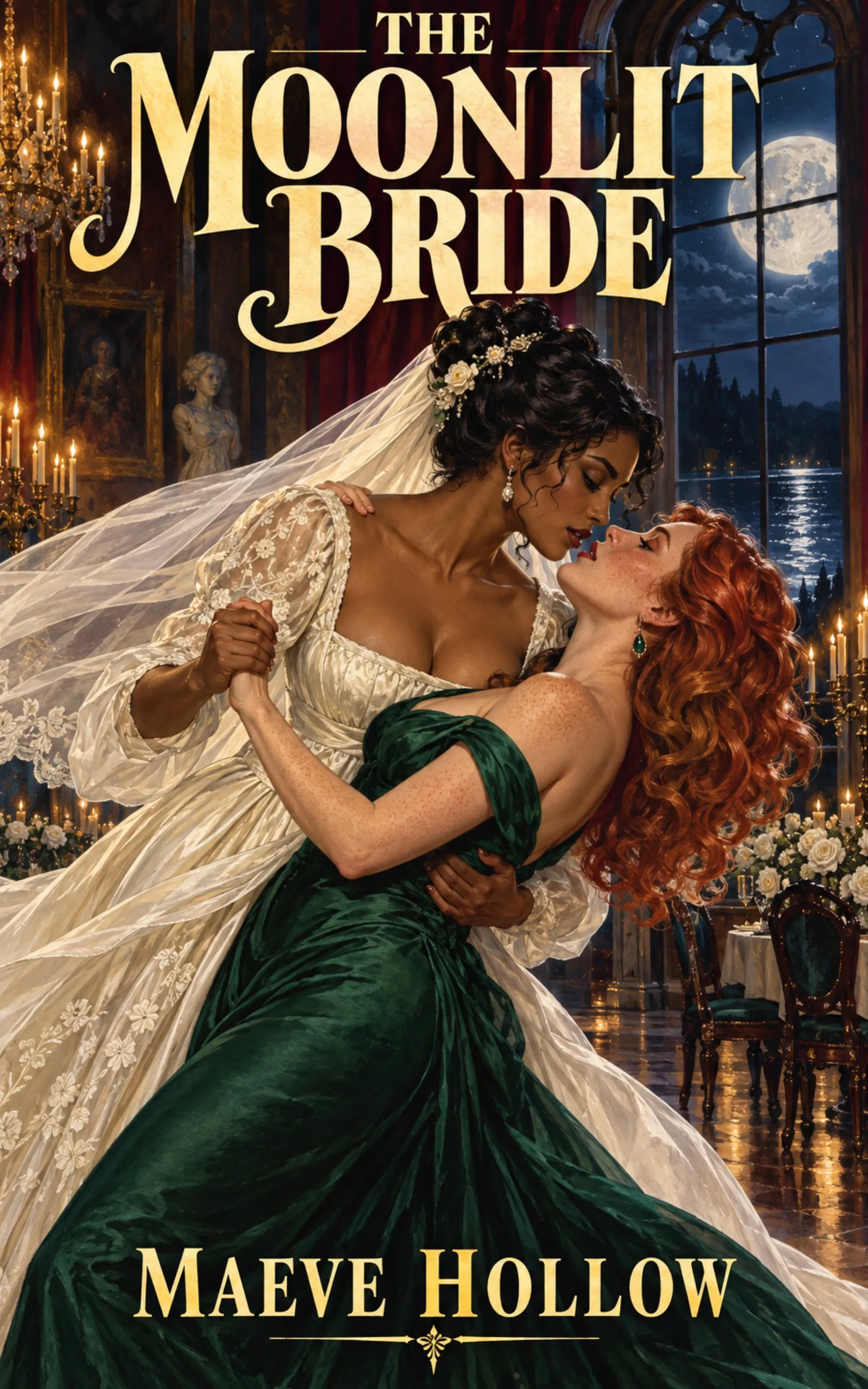
The Moonlit Bride
A Sapphic Gothic Paranormal Romance
by Maeve Hollow
Shop the ebook · Shop the audiobook
Available at all major retailers
Pairing: FF (Sapphic)
Heat: 🌶️🌶️🌶️🌶️🌶️ Inferno
Series: The Blackthorn Brides, Book 1
Tropes: Cursed Bride, Fake Engagement, Only One Bed, Forced Proximity, Touch-Starved Immortal, Immortal × Mortal, Haunted Manor, Gothic, Ghost Wedding Party, Competent Heroine, Contract Written on Her Skin, She Always Asks First, Found Family Among the Dead
The house can tell when a kiss stops being pretend.
Rowan Ellis has handled runaway grooms, feuding in-laws, and a bride who set her own veil on fire.
She has never handled a wedding party that died in 1815.
The job at Blackthorn Manor pays enough to save her business: finish a ceremony abandoned two centuries ago. Then she meets the bride. Lenora Vale is two hundred and forty-one years old, wickedly dry, achingly beautiful, and has not been touched in longer than Rowan has been alive.
Every full moon, the wedding starts again. Every full moon, it ends in blood.
Rowan’s solution is professional, temporary, and completely sensible: pose as Lenora’s new fiancée until they can find the loophole in the marriage contract.
There is just one problem. The contract’s hidden clauses are written on Lenora’s skin, and they only appear when she comes undone.
So Rowan will have to read every word.
The Moonlit Bride is a high-heat sapphic gothic romance with a cursed bride, a fake engagement, only one bed, a haunted wedding party with opinions, a wedding planner who treats the dead as clients, a lot of on-page spice, and a guaranteed HEA. Book 1 of The Blackthorn Brides.
You’ll love this book if you enjoy:
✅ A cursed bride who is 241 years old, wickedly dry, and has never once been asked what she wants
✅ A wedding planner heroine at 33, soft and freckled and frighteningly competent, who asks the dead whether they still require place settings
✅ A fake engagement the house believes, and only one bed in the bridal suite
✅ A marriage contract written on the bride’s skin in silver, one clause at a time, and only when she comes
✅ “Ask first, every time,” a stop word, and terms written up on a whiteboard
✅ A glasshouse full of moonflowers, a copper bath, a study desk, and a heroine who has to learn to take
✅ A haunted wedding party with opinions, a housekeeper who knows it by the sheets, and a ghost ex who wants her out
✅ A curse broken with a wedding planner’s fix, 🌶️🌶️🌶️🌶️🌶️ heat, HEA guaranteed
⚠️ Content Warning: This novel contains explicit sexual content (graphic FF scenes, including a strap-on), consensual power exchange, a supernatural curse in which a heroine is repeatedly killed and revived (on-page stabbing and blood), a historical massacre and drownings recounted on the page (including the death of a child), ghosts and the dead, a coerced historical marriage and women conveyed as property in a contract, a love interest withholding information from her partner (the story treats it as a breach), manipulation by an antagonist, and strong language. Intended for readers 18+.
📖 Read Chapter One Free
Not sure yet? Read all of Chapter One right here.
Chapter One
The gate at Blackthorn Manor was the first thing all week that had opened for me without an argument.
No keypad. No intercom. No groundskeeper in a golf cart wanting to know which party I was with. Just twelve feet of black iron, spiked along the top and standing ajar over a gravel lane, as though somebody had stepped out a couple of centuries ago and meant to be right back.
“Describe it,” Tamsin said through the car speaker. “Slowly. I’m eating a sad salad at my desk at three in the afternoon and I need this.”
“Big gate. Iron thorns twisted through the bars. Stone posts with a carving on top that used to be either a lion or a pineapple.”
“Any signage? ‘Blackthorn Manor, weddings and corporate retreats, ask about our off-season rates’?”
“There’s a crow.”
“A crow isn’t signage, Ro.”
“It’s looking at me like it is.”
I put the car in park with the bumper a yard short of the posts and slid the contract out of my planner, where it lived behind the red tab. Red was for money. The paper was Voss & Hale letterhead, Boston, heavy enough to shingle a roof, and I had read all eleven pages four times, partly because I write a vicious contract myself and I respect the craft. This one was exquisite. Eighty-five thousand dollars. Half on signature, which had landed in the Ellis & Evergreen account at 9:02 that morning and was the only reason four people I liked were getting paid on Friday.
In exchange, I was to “bring to completion a wedding ceremony interrupted under difficult circumstances” at “a private heritage property in Berkshire County.”
No date. No headcount. No budget, which in my experience means either unlimited or imaginary.
“Tell me again what the lawyer said when you asked for the date,” Tamsin said.
“That the bride would brief me.”
“And the guest list?”
“The bride would brief me.”
“And the caterer, the rentals, the officiant, the—”
“Tam.”
“I’m only saying. Eleven years, and I have never seen a planner’s fee that size on a wedding with no caterer. Either somebody’s feeding these people or nobody’s coming.” Lettuce crunched. “I made your calls, by the way. Three florists in Harrow Falls, both rental houses in Pittsfield, and the tent guy who hates us. Nobody has an order for Blackthorn. Nobody has ever had an order for Blackthorn. The woman at Petal & Stem asked me if it was still standing.”
I looked up the lane. Maples leaned over it from both sides, already going the color of rust, and the gravel ran under them and around a bend and gave nothing away.
“Something’s standing,” I said. “They have a gate.”
“You know you don’t have to take the weird one. Not just because Margaret Aldridge told the entire Pioneer Valley you ruined her son’s wedding.”
“I seated two hundred and forty people in ninety minutes with the quartet stuck on the Pike. One of them turned out to be the groom’s father’s girlfriend. I’m a planner, not a private investigator.”
“And they still owe us sixty grand.”
“And they still owe us sixty grand. Which is why I’m at a gate with a crow.”
She was quiet for a second, and I knew that quiet. It was the one she used right before telling me the truth.
“You’re at a gate with a crow,” Tamsin said, “because a stranger said the word need and you had your keys out before she got to the period. I say this with love. It’s the same thing Carys used to—”
“You’re breaking up.”
“I am not breaking up, you coward, I have four bars—”
But she was, as it happened. I had let the car roll forward while she talked, and the signal died before my back wheels cleared the posts. One moment my partner was diagnosing me over romaine. The next the screen said No Service and the only sound was gravel under the tires.
In the mirror, the crow watched me go.
The lane ran most of a mile. Woods, then a long flash of water through the trunks, flat and black as a switched-off screen, and then the trees stepped back and there was the house.
I have worked in a great many beautiful old buildings, and nearly all of them are liars. They’ve got a Viking range in the scullery and a ballroom floor laid in 1998. Blackthorn was not lying about anything. It was gray stone, three tall stories of it, with more chimneys than any building needs and long windows that held the afternoon sky without letting me see past it. A covered walk ran from the east wing down to the lake, where a small stone chapel sat so close to the water it seemed to be standing in it. Every hedge was clipped. Every pane was whole. Nothing was derelict, and that bothered me a good deal more than ruin would have.
Because a venue with a wedding coming looks like a construction site. There are box trucks. There’s a porta-john somebody’s trying to hide behind a hydrangea. There’s a man named Gary yelling about load-in.
I got out of the car and made the list standing up, pen on planner, the way I do when my stomach knows something my head hasn’t caught up to.
1. No vendor vehicles.
2. No tire tracks but mine.
3. No staff. No dog. No radio. No sound.
4. Front door open.
It was, too. A foot or so, like the gate.
I knocked anyway, because my mother raised me right, and then leaned in. “Hello? Rowan Ellis, Ellis and Evergreen Events. Ms. Voss should have told you to expect—”
“She didn’t,” said a voice from above me. “She never does. I think she feels it would spoil things.”
The hall went up two floors to a ceiling I couldn’t make out, and the staircase came down the middle of it wide enough for six bridesmaids abreast. A woman was sitting halfway up with her bare feet on the marble and a paperback open face-down on her knee.
I notice people for a living. It’s half the job: who’s been crying, who’s been drinking, which aunt is about to say something at the rehearsal dinner. So I noticed her the usual way first. Thirty or so. Tall, even folded onto a stair. Old jeans gone white at the knees and a man’s dress shirt with the cuffs turned back over long brown forearms. Dark hair in a braid as thick as my wrist. Eyes so dark I couldn’t find where the pupils started. The kind of tired I only ever see on the third day of a wedding weekend, when sleep is no longer the thing that would help.
Then she stood up, and I noticed her the other way.
It went through me low and warm and deeply unprofessional. She had a mouth built for the word no, and I had a sudden, vivid wish to find out what it took to get a yes out of it. She was looking at me with that mouth set in a line, as if she had met me before, many times, and I’d been a disappointment on each occasion.
“Ms. Vale?” I said, in a perfectly steady voice, because I’m a professional and a liar.
“Lenora.” She came down the stairs without hurrying. “You won’t be here long enough to need the rest.”
I put my hand out at the bottom. She looked at it for a long moment, the way you’d look at a meal after a fast, and then she folded her own hands behind her back.
“I don’t,” she said. “Forgive me. It’s nothing to do with you.”
“Not a problem.” I put the hand in my pocket to give it something to do. On her left hand, before it disappeared, I had caught a ring: a dull silver band with a dark stone, and a groove worn pale in the skin below it. She’d been turning it with her thumb. People do that with rings that don’t fit. “I’m told you’ll brief me.”
“Were you.” A flicker at the corner of her mouth, not quite amusement. “What did Helena tell you? Precisely, if you can.”
“That a ceremony was interrupted under difficult circumstances. That the family wishes it completed. That the client values discretion.”
“That’s very nearly honest. She’s improving.”
“When was it interrupted?”
“Some time ago.”
“And the other party? I’ll need to meet them. I like to hear what both people want before anyone tells me what the mothers want.”
“He’s dead,” Lenora said.
She said it the way you’d say he’s in Hartford. I have had brides cry on me, faint on me, and in one case bite me, and I kept my face exactly where it was.
“I’m so sorry.”
“You needn’t be. He’s very consistent about it.”
Okay. Grief does strange things to people’s sentences. And all at once the contract made a kind of sense, the missing date and the missing vendors and the lawyer who wouldn’t say anything plainly. A fiancé had died. A bride had stopped the clocks. Somebody in the family with money and a guilty conscience wanted her to have the day anyway, in some form, so she could put it down.
I could work with that. I once ran a vow renewal where one of the spouses attended in an urn, and there wasn’t a dry eye in the tent.
“Then we’ll do it your way,” I said. “Whatever completed means to you. Small. Quiet. Nobody walks you anywhere you don’t want to go.”
That landed somewhere. I watched it land. Her eyes went over my face slowly, hairline to chin, like she was checking a column of figures and had found a number she didn’t expect.
“What an extraordinary thing to promise,” she said. “You’d better see the room before you promise anything else.”
She led. I followed her down a long gallery and did not look at the way she walked, for at least four of the forty paces. The shirt was too big across her shoulders, and where the collar slid I saw the edge of a scar on the left one, old and thick, like a knot in a rope. I looked at the paneling after that.
“Standard intake,” I said to her back, because quiet makes me talk. “Colors?”
“White. I wasn’t consulted.”
“Music?”
“A quartet. They’re terribly set in their ways.”
“And is there anything you absolutely don’t want?”
She stopped so short I nearly walked up her heels. She didn’t turn around. I watched the question go through her shoulders.
“Do you know,” she said, “you’re the first one who has ever asked me that.”
“What’s the answer?”
“The wedding,” said Lenora, and walked on.
I have heard that from a bride twice before. Both times I had a car brought round to the kitchen door, and I’d do it again.
At the double doors I dug out my tape measure, and she stopped dead.
“Is that a pocket?”
“There are two.”
“In a dress.”
“It’s the only reason I bought the dress.”
Lenora considered my hips with open, aching envy, and I felt it in places that were not my pockets. “I spent the better part of a century in gowns without anywhere to keep so much as a key,” she said. “I’d have done murder for that.”
“The better part of a century.”
“It felt like it.” She pushed the doors open.
I’ve set a lot of rooms. I had never walked into one that was already finished.
The ballroom ran the length of the east wing, tall windows down one side and the lake lying black behind every one of them. Four long tables under white damask. Silver laid six pieces deep at each place, crystal in threes, a folded card on every plate. Candelabra marched down the linen with new candles in them, the wicks still white. And flowers: garlands of white roses and myrtle swagged from table to table, urns of them at the windows, more blooms than I could have sourced in a week with an open checkbook. At the far end a low dais held four chairs and four music stands, and a cello leaned in one of the chairs like a guest who’d come early.
No dust. Not on the crystal, not on the floor.
“Who did your flowers?” I asked.
“No one you could telephone.”
“Who set the room?”
“It sees to itself.”
I took that for staff she didn’t want poached, and went to the nearest garland. Every rose was at the exact peak of open. Not one bruised petal, not one dropped leaf, and there wasn’t a drop of water or a block of foam under any of it. I touched one. It was cool and dry, like the page of an old book, and it had no scent at all. What the room smelled of was a candle the second after it’s been pinched out.
The back of my neck took a note.
“Hold this for me?” I offered her the tab end of the tape. “I need the width, and I’ve only got the two arms.”
She regarded the little steel hook exactly as she’d regarded my hand. Then she came and took it by the very tip, so that our fingers were an inch of yellow ribbon apart and no nearer. She smelled of cold air and old paper, and under that of warm skin, which I had no business noticing.
“What am I to do with it?”
“Stand at that wall and be the dumb end.”
“I beg your pardon.”
“Term of art. One of us reads the number. The other stands still and looks pretty.”
“I see.” She backed away across the parquet, paying the tape out between us, her eyes on mine the whole distance. “I have been the dumb end of a great many arrangements, Miss Ellis. Nobody was ever so candid about it.”
Thirty-eight feet, to the inch. I wrote it down. She didn’t let go at once and neither did I, and the steel hummed between us, very faintly, like a string somebody had plucked. I’d have blamed my hand, except that my hands don’t shake.
Then she opened her fingers, and the tape came home with a snap I felt to the elbow.
I walked the tables because that’s what my feet do. Forty covers to a table. A hundred and sixty. The cards were in copperplate, real ink, gone brown. Mrs. Josiah Carrow. Capt. Thos. Vale. Miss Ash. A knife at the Carrow setting sat a hair out of true, and I squared it with one finger without thinking.
“I wouldn’t,” Lenora said. “They only put it back.”
“They?”
She had drifted back to the doors, as if the room had a clock in it that only she could hear. The window light was on her, and she looked like something someone had kept very carefully for a very long time.
“Miss Ellis.”
“Rowan.”
“Rowan.” My name in her mouth was a slower word than I’m used to. “Whatever Helena is paying you, keep it. I’ll write and say you were diligent. But I want you on the far side of that gate before the sun goes down.”
“Sunset’s at 6:41.”
Her brows went up.
“Golden hour,” I said. “Photographers. I always know.”
“Then you know how long you have.”
“I know that when a client wants me gone before I’ve walked the venue, there’s something in the venue.” I tried the tall door behind the dais. Locked, and cold to the palm in a way brass shouldn’t be in September. “Where does this go?”
“The chapel walk. It opens when it cares to.”
“Is the problem structural?”
“In a manner of speaking.” She almost smiled, and for a second it changed her whole face, and I wanted to see it finish more than I’d wanted anything in a year. She didn’t let it. “I’m asking you. I do it seldom and I’m told I do it badly. Go home, Rowan Ellis. You have a kind face. It’s a liability in this house.”
She left me there. Bare feet, no sound. At the doors she glanced back, once, and not at my face.
“It was a real pleasure,” she said gravely, “to see the pockets.”
Here is what a sensible woman does. She gets in her car with forty-two thousand five hundred nonrefundable dollars in the bank, drives back to Northampton, and lets a sad, lovely eccentric keep her dining room the way she likes it.
Here is what I did. I looked at my watch, saw ten to five, and thought: I have never left a venue without a floor plan in my life.
Forty minutes. An hour, tops. It was the least I owed her for the money, and if some small traitor part of me was already drafting a reason to come back with graph paper, I didn’t have to look at it.
So I worked. Green tab, fresh page. I taped the length on my own, hook on a chair leg: a hundred and four feet. I counted windows and exits and outlets, and found none of the last, not one, in a hundred and four feet of baseboard. I counted the covers again and got a hundred and sixty again.
What I got on the second pass, and hadn’t on the first, was the foot of the fourth table. Three place cards stood there beyond the last setting, in a row on bare damask. No plates. No silver. No chairs.
The first was typed, on an old manual with the a clogged solid. Miss Clara Whitcomb.
The second was in blue ballpoint, in the round quick hand of somebody who took a lot of telephone messages. D. Reyes.
The third was blank, and it was new. Every other card in that room had gone the color of weak tea. This one was bright white and sharp at the corners, the kind of stock I buy by the ream.
I didn’t pick it up. I couldn’t have told you why. I pick up everything.
I photographed the garlands for my florist instead, and that was when the floor of my stomach went.
On my phone, the roses were black.
Not shadowed. Rotted. Slumped brown heads on stems like wet string, petals in drifts on linen that showed gray and spotted in the picture. I lowered the phone. White roses, perfect, peak. I raised it. Compost.
I did it four times. Then I put the phone in my left pocket, very gently, the way you set down a thing that might go off.
It’s the light, I wrote in my planner, which was a lie, and I underlined it.
I should say that I have a known defect. When a tent pole snaps, when the best man swings at the groom, when four tiers of buttercream meet a flagstone floor, my pulse drops. Everything in me goes wide and quiet and efficient. Carys used to say it was the least human thing about me. It has saved eleven receptions and, I’m fairly sure, cost me one engagement.
It came on now. I went calmly back along the first table to see what else I’d missed, and at the Carrow place I stopped.
The knife was a hair out of true again. Exactly as I’d found it.
My watch said 6:38.
I’d have sworn I had most of an hour left. That’s inventory for you. It eats time, and I have always let it.
I looked up. The windows over the lake had gone the red-gold I can usually price by the hour, and it was draining out of the glass while I watched.
Go, I thought, quite clearly. Now. Walk.
I got six steps.
The candle nearest the door lit by itself.
There wasn’t any drama in it. A small soft sound, like fingers snapping under a pillow, and there was a flame where there hadn’t been one. Then the next. Then they went down all four tables in a run, away from me, a hundred little snaps overlapping until the whole room stood in gold and every prism in the chandeliers threw it back.
And the roses breathed out.
Scent rolled over me so thick I tasted it, rose and myrtle and hot beeswax, and under it roasting meat, wine, hair powder, the warm crowded smell of a couple of hundred people who had dressed with care. Behind me, on the dais, the cello gave out one long open note. Nobody was holding the bow.
I turned around slowly, because nothing good has ever come of turning around fast.
A girl walked through the chapel door.
Through it. The door stayed shut, cold brass latch and all, and she came out of the wood the way you’d step through a curtain of rain: a high-waisted white gown, long gloves, a wreath of myrtle pinned in fair hair, and a posy held in front of her at exactly the regulation height. She was perhaps twenty. I could see the door panels through her bodice.
She saw me, and stopped, and looked me up and down in pure horror.
“You’re in boots,” she said.
“I am,” I agreed.
“You are standing where the Carrows sit.”
“I’ll move.”
“And you aren’t on the list.”
I thought of a bright white card at the foot of the fourth table.
“That,” I said, “we may have to discuss.”
A second one came through at her shoulder, dark and round-cheeked, and gaped at me with frank delight.
“Is that the new one? Oh, Prudence, she has freckles.”
“Don’t stare, Hetty. It only encourages them.”
More were coming behind. Two more wreaths. A man’s dark sleeve. Somewhere past the wall, a great many feet on stone, and a murmur like a theater filling.
“I did tell you.”
Lenora was in the doorway to the gallery. Still the jeans, still the shirt, but she had one hand locked on the frame so hard the tendons stood out, as though something had hold of her other arm and was being patient about it. The ring on her finger wasn’t dull anymore. It shone like a coin at the bottom of a well.
She looked at me with those dark, tired eyes, and what was in them was not fear for herself. It was the expression of a hostess whose worst relatives have arrived early.
My pulse was fifty-five. My hands were steady. I uncapped my pen.
“Fine,” I said. “Dead guests.”
I flipped to a fresh page.
“Do they still require place settings?”
Want to keep reading? The full novel is available now.
🔥 Want an EXCLUSIVE Bonus Chapter?
The Honeymoon Suite — A scene TOO HOT for the bookstore
Maine in April. Lenora has finally seen the ocean, the inn has upgraded them to a room with a name, and a parcel from San Francisco has waited four months to be opened. She has been a bride twenty-six hundred times. Nobody ever sent her on the honeymoon. Hands on the window.
More from Maeve Hollow
Browse all Maeve Hollow books.

The Portrait of Lady Ash
She's been painted shut for 159 years. The woman who cleans her is the first to ask permission.
The Coven’s Last Human
Every thirty years, the town keeps one woman. This year it chose me.
The Vampire’s Private Detective
She hired me to solve a murder. Hers. In 1798.
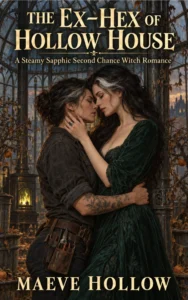
The Ex-Hex of Hollow House
The Hollow House Romances
She left me twenty years ago. She hasn't aged a day. And her house wants to keep me.
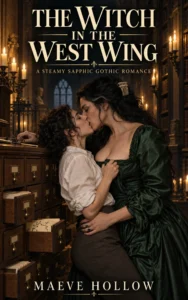
The Witch in the West Wing
The Ravenscroft Archives
Seven wards hold her. Seven surrenders will set her free.
Never Miss a Release
Get new release alerts, exclusive bonus content, and reader-only giveaways.