

The Witch in the West Wing
A Sapphic Gothic Witch Romance
by Maeve Hollow
Shop the ebook · Shop the audiobook
Available at all major retailers
Pairing: FF (Sapphic)
Heat: 🌶️🌶️🌶️🌶️🌶️ Inferno
Series: The Ravenscroft Archives, Book 1
Tropes: Immortal Witch × Mortal Skeptic, Gothic, Haunted Library, Dark Academia, Touch Starved, Forced Proximity, Ask Me Nicely, Ice Queen Comes Undone, Power Exchange, Switch Dynamic, Magic with a Price, She Falls First
Seven wards hold her. Seven surrenders will set her free.
Conservator Elspeth Ward believes old books are only dangerous when they are moldy, misfiled, or held together with nineteenth-century glue.
Then the west wing of Ravenscroft Library opens at midnight.
Behind its iron gate waits Dr. Isolde Thorne: brilliant, wickedly composed, and supposedly executed for witchcraft in 1784. She has not been touched in two hundred and forty-two years. By the oldest law in the room, she cannot lay a finger on Elsie unless Elsie asks.
Seven wards hold Isolde’s prison shut. Each one was built to silence something women were never meant to want out loud, and each one breaks the same way: when a woman asks for it anyway.
Elsie is very good at asking precise questions. She is about to get very good at asking for other things.
But every ward that falls opens another pair of painted eyes in the Founders’ Hall. And nobody has told Elsie what happens to the woman holding the key when the seventh one breaks.
The Witch in the West Wing is a high-heat sapphic gothic romance with an immortal witch, a stubborn archivist, a haunted library that catalogues frightened women, ink that writes what you won’t say, a safeword out of a printer’s manual, a lot of on-page spice, and a guaranteed HEA. Book 1 of The Ravenscroft Archives.
You’ll love this book if you enjoy:
✅ A sapphic witch romance with an immortal nobody has touched since 1784
✅ A haunted library that only opens at midnight and listens to everything
✅ “Ask me nicely”: she cannot lay a finger on you until you say it out loud
✅ A skeptic heroine who brings salt, a notebook and numbered terms to a haunting
✅ Seven wards, seven very different scenes, and ink roses counting them down her arm
✅ An ice-cool top who gets taken apart in front of a mirror by the midpoint
✅ Power exchange that switches, a safeword that stops the whole building, consent as the plot
✅ Real consequences when she lies, 🌶️🌶️🌶️🌶️🌶️ heat, HEA guaranteed
⚠️ Content Warning: This novel contains explicit sexual content (graphic FF scenes, including a strap-on), consensual power exchange, light bondage, orgasm control and writing on skin, magical imprisonment, memory theft, an attempted non-consensual memory erasure and sustained lies of omission by a love interest (the story treats both as violations), the public reading of a character’s sexual history as attempted humiliation, references to historical persecution and execution for witchcraft, past killings, and the past death of a lover. Intended for readers 18+.
📖 Read Chapter One Free
Not sure yet? Read all of Chapter One right here.
Chapter One
The taxi would not take the hill.
“Road floods,” the driver said, popping the trunk without leaving his seat. “College won’t pay to fix the drain. You want the top, you walk.”
So Elspeth Ward arrived at Ravenscroft College the way she suspected most people left it: on foot, in the rain, carrying everything she owned that mattered. One suitcase. One aluminum tool case holding eleven hundred dollars’ worth of bone folders, micro-spatulas and Japanese tissue. One contract, folded into her inside pocket, that promised six months of work and mentioned the possibility of permanent appointment in a clause so hedged it might as well have been written in pencil.
She was thirty-one years old. She had a master’s degree in conservation, a canceled wedding, and four hundred dollars in checking. She could manage a hill.
The library sat on the crest like a guest who had been asked to leave and declined. Gray stone gone black in the wet, a square central tower, two long wings flung out east and west. The east wing had windows. The west wing had the outlines of windows, bricked up so long ago that the mortar had weathered to match the stone.
A woman waited under the portico, holding an umbrella she made no move to share.
“Ms. Ward. You’re four minutes late.”
“Your road’s underwater.”
“It generally is.” She was in her fifties, iron-gray hair cropped close, cardigan buttoned to the throat, a ring of keys at her hip heavy enough to stun livestock. “Miriam Vale. Director of Special Collections. You report to me. You do not report to the donor committee, whatever they tell you, and they will tell you a great deal. Wipe your feet.”
Elsie wiped her feet. Rain ran out of her hair and down the back of her collar. Her glasses fogged the second she stepped inside, and she pulled them off and resented, as she always did, how much softer the world got without them.
“Is there somewhere I could—”
“No. Walk with me. I’ll say this once.”
Dr. Vale walked the way she talked, with nothing wasted. Elsie squelched after her through a vestibule and into the main hall, and got an impression of height, green-shaded lamps, and the good dry smell of leather and old paste under a wet-wool smell that was mostly herself.
“Nothing leaves the building. Not a leaf, not a photograph of a leaf. You work in pencil. If I find a pen in your workroom I’ll assume you are either careless or malicious, and I have no use for either.”
“I’ve been doing this for nine years.”
“Then the rule will be familiar.” A door, a key, another door. “No one from the committee enters your workroom unless I am standing in it. If one of them turns up with coffee and a warm interest in your career, you send for me.”
“That’s specific.”
“It’s experience.”
Students bent over laptops glanced up as they passed and glanced away. None of them was any concern of Elsie’s, which was one of the things she had liked about the job on paper. She was nobody’s teacher here and nobody’s student. She had been hired to stabilize and catalogue the Marchbanks bequest, two hundred and fourteen boxes of family papers nobody had opened in a century, before the college put the best of it under glass for a donor gala in the spring. A contractor. A pair of hands.
“About the permanent post,” she said.
Dr. Vale didn’t slow. “Rare Books. It exists. It is in the committee’s gift, not mine. I’d advise you not to want it where anyone can see.”
“I want health insurance where anyone can see.”
That earned her a glance. Not warmth. A recalculation.
“The committee chose you,” Dr. Vale said. “I read your file. The Aldous psalter. The flood recovery in Albany. You’re very good. Had it been my decision, I would have hired someone worse.”
Elsie laughed, then understood it wasn’t a joke. “That’s a hell of a welcome.”
“It wasn’t one.”
“Can I ask what’s in the west wing? From outside it looks—”
“There is no west wing. There’s a west wall. The floor plans will bear me out.” She said it the way people recite a phone number they’ve been made to memorize. “Through here.”
Here was a long paneled gallery, and Elsie stopped walking.
Seven portraits hung down its length, life-size, in heavy gilt frames. Seven women in the dress of two and a half centuries ago, gray silk and black wool and white lace at the throat, hands folded over books or keys. They were good paintings. The lace alone must have taken weeks.
Every one of the women had her eyes closed.
Not damaged. Not overpainted. Elsie went close enough to see brushwork, and the lids had been laid in from the first sitting, each lash a single deliberate stroke. Seven sitters posed upright and composed and painted as if asleep. Or as if they had been told not to look. Walking past them felt like walking past a row of people pretending.
The brass plates under the frames had been polished for so many years that the lettering had worn to a shimmer. She could pick a date out of the nearest, 1771, and no name at all.
The seventh was different. Younger than the rest, thirty-five at most, and where the others kept their books shut she had a key lying loose in her open palm, as if offering it. She was also the only one of the seven the painter had allowed to smile. With her eyes closed it looked less like pleasure than like someone enjoying a secret at a funeral.
“Founders’ Hall,” Dr. Vale said from the far door. “The college was established in 1771 by the seven women you are staring at.”
“Why are their eyes shut?”
“A Ravenscroft tradition.”
“That’s not an answer. That’s a brochure.”
“It’s the answer you’ll get.” The keys were in her hand again. “I said there were rules. You’ve had three. The fourth is the one people argue with, so I’ll be plain. You will be out of this building by midnight. Not packing up at midnight. Out, on the far side of the front doors, with them shut behind you.”
Elsie waited for the reason. Insurance. Alarms. A night guard with a union.
Nothing came.
“I’ve got two hundred and fourteen boxes and six months,” Elsie said. “Wet treatments don’t keep office hours. If I’ve got a leaf under weight at ten to twelve—”
“Then it dries badly, you mend it in the morning, and I won’t hold it against you.” Dr. Vale’s voice didn’t rise. It flattened. “I would hold the other against you a great deal.”
“What happens at midnight?”
“The building is locked.”
“By who?”
For the first time Dr. Vale’s eyes left her. They went down the row of sleeping faces, one after another, all the way to the seventh, and came back with nothing in them at all.
“Your workroom is this way,” she said. “Do try to dry off before you touch anything.”
By four that afternoon Elsie had dry socks, a pot of terrible coffee, and a firm professional opinion that somebody had been lying in this building for a very long time.
The workroom was better than she’d let herself hope: a north-lit table long enough to lay out a map, a fume cupboard, a standing press older than the Constitution, and along the west wall a bank of rolling stacks, the hand-cranked kind, gray steel on floor rails. Someone in the seventies had bolted them straight over the paneling.
She started where she always started, not with the boxes but with the paperwork about the boxes. Accession registers. Donation ledgers. The old sheaf catalogues, bound in calf gone to red powder at the hinges. A collection told you what it was. The records told you what somebody wanted it to be, and the gap between the two was the job.
Here the gap was wide enough to drive a hearse through.
Accession numbers that skipped forty entries and picked up again without comment. A donation ledger with a whole gathering cut out, the stubs left neat as teeth. Entries pasted over with slips of later paper, and when she held the leaf to the lamp the original line showed through, faint and backwards. All forty missing accessions belonged to a single year. She checked it three ways.
1784.
And then there was the name.
She found it first in a manuscript catalogue of 1790, in a list of lectures formerly given at the college. A Course of Natural Philosophy, in Twelve Parts, as delivered by and then a black knot where someone had scratched the lecturer out so hard the nib had gone through the page.
She found it again in 1803. In 1826. In a shelf list from 1911, typed, with the scratching-out done by hand over the typescript.
Elsie tilted the 1790 leaf under the raking light until the furrows of the first pen stood up through the scribble. Iron gall ink bit into paper as it aged. You could bury a word. You couldn’t unwrite it.
I. Thorne.
“Who did you piss off?” she asked the page, and penciled the name on her pad, and then sat looking at the scratch marks instead.
This was the part of the work she left off her résumé, because there was no professional way to phrase it. Handwriting talked to her. Not what it said. How it was meant. She could look at a signature and tell whether the signer had been bored or frightened. She could pick the one sincere letter out of a bundle of dutiful ones by the pressure on the downstrokes. She had known Clara was leaving from a grocery list, three weeks before Clara said a word.
The scratchings-out were all the same. Left to right, then a tight crosshatch, then one hard diagonal to finish. The same pressure. The same patience. The same cold, tidy, deeply personal dislike, in 1790 and in 1911.
Which was a span of a hundred and twenty-one years, so it was a house style. A habit handed down from one librarian to the next, like a bad recipe. Obviously.
She wrote same hand? in the margin, looked at it, and rubbed it out.
She thought about taking it to Dr. Vale. She got as far as the door. I would have hired someone worse. A director who wanted a conservator too dull to notice things was not a director who wanted to hear what had been noticed, and Elsie had a contract with a hedge in it. She went back to the table.
The card cabinet stood in the corner where the rolling stacks ended, sixty brass-handled drawers in quarter-sawn oak. She went to it for the 1826 cards and stopped with her hand out.
Bottom row, far left. Fifty-nine drawers had handles worn pale and paper labels curling in their holders. The sixtieth had a handle with no wear on it, an empty holder, and a face cut from a different tree. It was close. Somebody had taken trouble. But the grain ran a few degrees off true, and the finish was shellac where the rest was wax.
It didn’t pull. It wasn’t a drawer at all. It was a panel, held by four slotted screws rusted into their seats.
Nothing leaves the building. Dr. Vale hadn’t said a word about what was already in it.
Elsie took the smallest screwdriver from her tool case and knelt on the boards.
The screws came out orange and unwilling. The panel came away on a draft of cold air that smelled of cloves and something scorched, and behind it sat a real drawer, shallow, lined in green baize, packed tight with cards.
Handwritten, every one, in a slanting copperplate gone brown at the edges. She lifted the first by its sides.
Thorne, I. On the Properties of Ink Under Duress. W.W. 2.
She checked the shelfmark against the college’s scheme, then checked again. There was no W.W. There had never been a W.W.
Harrow, P. Commonplace book, with pressed flowers and one lock of hair. W.W. 4.
Anon. A True Catalogue of Women Unmade by This College. W.W. 6.
The Seven Silences, with Their Several Remedies. W.W. 1. Not to be read aloud.
Forty-odd cards. Not one title she recognized, not one that appeared in any register on the table behind her, and she had just spent six hours with those registers. Books that did not exist, on shelves that did not exist, entered by someone with lovely handwriting and a sense of humor.
The hand bothered her. She couldn’t get a reading from it. There was always something, haste or boredom or pride, and here there was only a kind of pressure coming back, like laying her palm on a window and feeling someone on the far side fit theirs to the same place.
The last card was blank.
Same cream laid stock as the others, same punched hole for the rod. Nothing on it. She turned it over. Nothing. She turned it back.
There was a dot of ink in the upper left corner.
It had not been there. She was nearly sure. Then she was entirely sure, because as she watched the dot drew itself down into a stroke, wet and black and shining, and the stroke curved, and the letters came up through the paper the way a bruise comes up through skin.
You are late.
Elsie did not drop the card. She was quite proud of that afterward.
She did what you do. Held it to her nose: oak gall, gum arabic, the vinegar bite of iron ink mixed that morning, nothing like lemon juice or any other trick a bored undergraduate could cook up in a dorm. Touched the tail of the e and came away with a black smear. Wet. On a card that had sat behind four rusted screws for longer than she’d been alive.
“Okay,” she told the empty room. “Very good. Hilarious.”
Something that developed on contact with air, then. Somebody on staff who felt the new contractor needed taking down a peg and had gone to frankly unhinged lengths to do it. She had met archivists. It wasn’t impossible.
She put the card back in the drawer, the drawer back in the dark, and the panel back over it with all four screws.
Her fingertip stayed black. She scrubbed it at the sink until the skin was raw, and the ink didn’t so much as fade.
At 11:58 that night she was still in the building, and she blamed the cookbook.
Box nine of the Marchbanks bequest had held a household receipt book from the 1760s that had, at some point, sat in two inches of water. She’d opened it at dusk to find the first gathering fused into a block and a bloom of mold along the gutter, and you did not leave that overnight. So: leaves eased apart with a steel spatula, interleaved, humidified, and now the worst of them lay relaxing between blotters under a sheet of plate glass. It had to come out at the right moment or it would dry cockled forever.
Ten more minutes. She would be eight over Dr. Vale’s deadline, and Dr. Vale could take it out of the health insurance.
The library had emptied hours ago. The lamps beyond her door had gone dark section by section until her table was the only lit thing on the floor, and the rain had settled into a long even hiss against the north windows. She wrote up her treatment notes. In pencil. She was a professional.
Leaf 3: tide line at gutter, ink stable. Leaf 4: adhered to 5, released mechanically. Do not rush.
“‘Do not rush,’” said a woman’s voice. “Excellent counsel. Do you ever take it?”
Elsie’s pencil stopped.
The voice had come from the rolling stacks. Not loud. Low and unhurried, English run through something older, each consonant set down like a card on a table.
“‘Leaf four, adhered to five, released mechanically.’ With that little steel blade. You stop breathing when you use it, did you know? Three leaves tonight, and three times I thought I should have to remind you.”
Nobody could see her notebook. The page was under her own hand.
“The building’s closed,” Elsie said. It came out steadier than her pulse. “If this is about the card, it was a good trick and I’d love to know how it’s done. If you’re security, I’ve got ten minutes on a wet leaf and then I’m gone.”
“I am not security.” A laugh, soft and a little rough at the edges, as though it hadn’t had much use lately. “And you opened my drawer. You took the cards up by their sides, so that your fingers shouldn’t mark them. It has been a great while since anyone troubled to be gentle with a thing of mine. I noticed. I notice everything in this building. I’ve had so little else to do.”
Heat went up the back of Elsie’s neck, which was absurd. It was a voice. She put the pencil behind her ear and stood.
“Who are you?”
“That’s a poor question. It lets me answer anything I please. Ask a better one.”
“I don’t take direction from people I can’t see.”
“No? A pity. You’d do it beautifully.” A pause, and the amusement in it had weight, like a thumb laid against the pulse in her wrist. “You have my ink on your forefinger. You scrubbed at it until the skin was raw, and you have spent the whole evening stroking it with your thumb whenever you stop to think. I’m sorry for the stain. Rather less sorry than I ought to be.”
Elsie closed her hand into a fist. Her thumb had been on it that very second.
“Fine. Where are you?”
“Much better. Behind the shelving, through the gate, at the end of the passage. I would come to you, but I’m prevented. You’ll have to do the walking.”
“There’s no gate. There’s a wall. I’ve seen the outside of it.”
“There was a wall,” the voice agreed, “until midnight.”
Elsie looked at her watch. 12:00. So did the clock over the door. She would have sworn she’d checked a moment ago.
“Is this where you tell me not to be afraid?”
“I wouldn’t insult you. Be as afraid as you like. Only be curious as well. I’ve waited a long time for someone who was both.”
Something clanked inside the paneling.
The crank on the nearest stack began to turn. Nobody was turning it. It went round once, slowly, with a sound like a winch, and the whole gray range rolled left on its rails, eight feet of steel and half a ton of bound periodicals gliding aside as if on oil. The next range followed. And the next.
Behind them there should have been oak, and behind the oak the outer wall, and behind that the rain.
There was a gate.
Black iron, twice her height, wrought into thorned stems so exact the thorns looked sharp. It stood open the width of a hand. Past it ran a corridor that could not be there, far too long for the wall that held it, shelved from floor to vault and lit by candles that burned bolt upright in a draft now lifting the loose curls off Elsie’s neck. Cloves. Scorching.
She took her glasses off, cleaned them on the hem of her sweater, and put them back on.
Gate.
She had a list of reasons to leave, and it was a good list. Dr. Vale was on it. So was the contract, and the leaf under glass, and every sensible thing she had ever told herself about not walking toward whatever frightened her. Clara would have said she didn’t have it in her to do anything else. Clara had said a lot of things.
“I’m not scared of you,” Elsie told the corridor, which was a lie, and picked up her flashlight, which was at least practical.
“Of course you aren’t.” Warm as a palm between her shoulder blades. “Bring the light, if it comforts you. It won’t work past the gate, but I do like a woman who comes prepared.”
The iron was cold enough to sting. The gate swung without a sound. One step beyond it the flashlight died in her hand.
She counted steps, because counting was something to do. Forty. Sixty. The spines on either side carried no titles, and twice a book eased itself out an inch as she went by, like a cat lifting its head. She didn’t look at those. Somewhere overhead a page turned, slowly, the sound of someone settling in with a book, and she had the distinct and ridiculous sense of being the thing read. At ninety the passage opened out, and she lost count.
The room was round. A reading room, domed and galleried, three stories of books climbing into the dark. At its center, under the eye of the dome, lay a circle of bare flagstone bounded by a ring of iron set flush into the floor, wide enough to hold a table, a chair and a lamp.
It also held a woman.
She wore green: a gown of bottle-dark silk cut for another century, tight through the waist, square and low at the neck. Above the neckline a thin silver scar ran beneath her left collarbone like a line ruled in pencil. Her hair was black, pinned with combs the color of old bone and coming down regardless. She had a ring on every finger. She was not far short of forty, and she wasn’t beautiful in any way Elsie had a category for. She was the kind of handsome that made you want to check the provenance. Long mouth. Dark, heavy-lidded eyes, wide open, fixed on Elsie with an attention so complete it landed like a hand at the small of her back.
She stood with the toes of her slippers an inch inside the iron, exact as a diver at the end of a board. Elsie understood, without being told, that the inch mattered.
Elsie’s body, which had not consulted her, went warm from the collar down.
The woman looked at the dead flashlight. At the sweater, the pencil behind the ear, the blackened fingertip. Her gaze took its time coming back up, and by the end of the trip one corner of that long mouth had lifted.
“You took your time, Miss Ward.”
Want to keep reading? The full novel is available now.
🔥 Want an EXCLUSIVE Bonus Chapter?
The Ladder — A scene TOO HOT for the bookstore
On the second night Isolde stood at the foot of a library ladder, not allowed to touch, and told Elsie exactly what she would do if she were asked. Elsie wrote it down. Two months later, same ladder, she asks for all of it, in order. Then for the improvements.
More from Maeve Hollow
Browse all Maeve Hollow books.

The Portrait of Lady Ash
She's been painted shut for 159 years. The woman who cleans her is the first to ask permission.
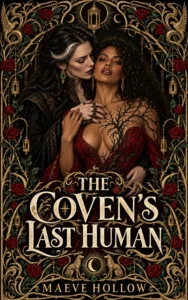
The Coven’s Last Human
Every thirty years, the town keeps one woman. This year it chose me.
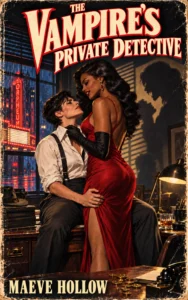
The Vampire’s Private Detective
She hired me to solve a murder. Hers. In 1798.

The Ex-Hex of Hollow House
The Hollow House Romances
She left me twenty years ago. She hasn't aged a day. And her house wants to keep me.

The Witch in the West Wing
The Ravenscroft Archives
Seven wards hold her. Seven surrenders will set her free.
Never Miss a Release
Get new release alerts, exclusive bonus content, and reader-only giveaways.