

The Heir’s Last Order
A Dark MM Mafia Bodyguard Romance
by Rafe Calder
Shop the ebook · Shop the audiobook
Available at all major retailers
Pairing: MM
Heat: 🌶️🌶️🌶️🌶️🌶️ Inferno
Series: The Vescari Succession, Book 1 (standalone, HEA)
Tropes: Bodyguard Romance, Mafia Heir, The Kill Order Secret, Age Gap (Nine Years), Forbidden Love, Mutual Pining, Forced Proximity, Betrayal and Grovel, Protector Hero, Touch Him and Die, Morally Grey Hero, Hurt/Comfort, Praise Kink, Switch Dynamic, Size Difference, Found Family
My father’s last order was my death. The man he gave it to is the only one I trust.
My father ordered my death. Then someone killed him first.
The night Massimo Vescari is shot in his own study, I open his safe and find a single sheet of letterhead in his black ink: my name, the word removed, the word quietly. And under his signature, in blue ballpoint, two initials I would know anywhere.
R.K. — accepted.
Roman Kessler ran my father’s security for six years. Two years ago, on a terrace above the Halcyon ballroom, I kissed him once at midnight and he told me to go inside. Ten days before my father died, he was thrown out of the house and nobody will tell me why.
Now every man on my door answers to someone who wants me gone. I have thirty days to win a council vote for my father’s chair. And the only man in Saint Orison I’m sure didn’t help put my father on that carpet is the man who signed an order to kill me.
So I call him. I put my father’s revolver under his jaw and give him my terms: work for me, protect me, and never keep a secret from me again.
He swears it. He bleeds for me in a back lane full of broken glass. He takes me apart against a window thirty-one floors above the harbor and feeds me toast at three in the morning. He makes me believe I am the one thing in this city nobody gets to touch.
Until fifty-eight minutes of footage shows up at a council table, and every captain in the family watches him stand outside my door with a gun in his hand.
I can survive my family.
I don’t know if I can survive what Roman did with my father’s last order.
The Heir’s Last Order is a dark MM mafia bodyguard romance with a reluctant heir, his father’s former security chief, a kill order with both their names on it, a thirty-day succession war, a nine-year age gap, praise kink, a switch dynamic, on-page violence, a lot of on-page spice, no cheating, and a guaranteed HEA. Dual POV. Standalone.
You’ll love this book if you enjoy:
✅ A cold, left-handed heir who folds his father’s kill order twice and keeps it over his heart
✅ A six-foot-four bodyguard who stood outside that door for fifty-eight minutes with the safety off, and could not go in
✅ “Is that an order?” / “No. It’s a request.”
✅ A revolver under the jaw, six bullets tipped into a palm, and “Never point this at anything you aren’t willing to lose.”
✅ Eleven crooked stitches at a kitchen island, and the kiss that comes after
✅ Praise kink at a private firing range: “Good. That was good, Adrian.”
✅ A protector who has never let anyone hold him, finally letting someone have him
✅ A secret that detonates in front of the whole council, and a grovel that begins with a knock instead of a door
✅ Touch him and die, a rescue in a flooded cold store, 🌶️🌶️🌶️🌶️🌶️ heat, no cheating, HEA guaranteed
⚠️ Content Warning: This novel contains explicit sexual content (graphic MM scenes, including a gun used in a charged confrontation before any sex, a hand held at the throat by request, edging, rimming, rough sex, sex in a moving car and a firing-range office, barebacking after testing on page, and both leads topping and bottoming; all on-page sex is consensual), on-page violence (a drive-by ambush that kills a beloved driver, multiple shootings, a lead character killing a man to save his partner, a man shot dead at a council table), the off-page murder of a parent with the aftermath shown, a body recovered from the harbor, a kidnapping and the captive held and bruised, a written order to kill a lead character and a lead who accepted it, forged evidence and financial fraud, a parent who loved conditionally, grief, arson, alcohol, and strong language. No sexual violence, no dub-con, no cheating. Intended for readers 18+.
📖 Read Chapter One Free
Not sure yet? Read all of Chapter One right here.
Chapter One: Adrian
The tape across his father’s study door wasn’t police tape.
It was yellow and it said CAUTION in thick black letters, and someone in the household had pulled it off a roll in the garage at four in the morning because Bastian had said, gently, that the room should be kept exactly as it was. Nobody in this house had ever known how to keep a room any other way than by putting something across the door.
Adrian stood ten feet from it with a cup of coffee he hadn’t touched and listened to the rain hit Bellwether Hill like it had a grudge against the roof.
“They’re here,” Elena said behind him.
“All of them?”
“Domenico, Celia, Luca. Bastian’s been here since six.” She came to stand at his shoulder, reading glasses swinging on their chain against the black silk of her blouse. Her lipstick was red. Of course it was. His cousin would wear red lipstick to the end of the world and dare it to comment. “They’re in the front parlor. They’re going to look at you like you’re a horse they might buy.”
“I know how they’re going to look at me.”
“Then stop staring at the door. It makes you look like a boy waiting for his father to come out.”
He turned his head. Elena didn’t flinch, but her mouth softened at one corner, which for her was a hug.
“Sorry,” she said. “No. I’m not. Go.”
He put the coffee on a side table that had belonged to his great-grandmother and walked to the parlor with his spine straight and his hands empty, because a man with something in his hands looked like he needed something to hold.
The front parlor of Bellwether House had been built to impress men who arrived by carriage. Dark oak, a fireplace big enough to stand in, portraits of Vescari men who had all, at one point or another, had someone killed. The fire was lit. The room smelled of wet wool and cigar smoke that had soaked into the panels long before Adrian was born.
They stood when he came in. That was something.
Domenico Serra reached him first—fifty-three, barrel-chested, a North Quay man down to the salt in the creases of his knuckles. He took Adrian’s hand in both of his and held it a beat too long.
“Your father was a hard man,” Domenico said. “But he was ours.”
“Thank you.”
Celia Aranda didn’t take his hand. She nodded from beside the fireplace, work boots planted on a rug worth more than her truck, grey braid over one shoulder. Mercer Reach didn’t do condolences. Mercer Reach did we’ll see.
And then Luca Ferretti, smiling, the gold crucifix at his throat catching the firelight. Thick neck. Pleasant face. Eyes like a pair of shut windows.
“Adrian.” He gripped Adrian’s shoulder. “Anything you need. You know that.”
“I know that.”
“Terrible thing. Inside his own house.” Luca shook his head slowly. “I’ve got men on every door now. Nobody gets near you.”
“I noticed.”
Something moved behind the windows. Then it was gone, and Luca was patting his shoulder again and stepping back to the drinks cart.
His uncle was by the window, of course. Bastian Vescari had always liked a window—something to look out of thoughtfully while other people talked. Silver hair, reading glasses folded into the pocket of a camel cashmere sweater, the face of a man who’d spent thirty years being the reasonable one. He came to Adrian and kissed him on both cheeks, and his hand on the back of Adrian’s neck was warm and dry.
“You haven’t slept,” Bastian said quietly.
“Neither have you.”
“I’m old. I’m allowed.” He kept his hand where it was a moment longer, and Adrian let him, because the whole room was watching and because twenty years ago this man had brought him a boxed set of Patrick O’Brian novels on a Tuesday for no reason at all. “Sit. Let’s get this done so everyone can go home and grieve properly.”
They sat. Adrian took his father’s chair by the fire. He felt the room register it—a tiny shift, like pressure before a storm. Bastian took the chair beside it without comment.
Domenico cleared his throat. “I’ll be blunt, because it’s what I’m good at. My people want to know what happens now. The North Quay contracts. The Harrow Line shipments. Whether Monday looks like last Monday.” He looked at Adrian. “What happens, Adrian?”
“Nothing changes, Dom,” Bastian said. “Nothing at all. Massimo set things up to run—”
“That’s not true.”
Adrian didn’t raise his voice. He never did. He’d learned at fourteen that his father could out-shout anyone alive but that silence made him nervous, and he’d been using it ever since.
The fire popped. Bastian’s mouth stayed slightly open for half a second before he closed it and smiled.
“Everything changes,” Adrian said. “My father is dead. He was shot in his study, in this house, eleven hours ago, and whoever did it walked in and walked out. If anyone in this room thinks that changes nothing, they should say so now so I know who isn’t paying attention.”
No one said anything.
“Here’s what doesn’t change. North Quay gets paid on the first. Mercer Reach gets paid on the first.” He looked at Celia, who looked back without blinking. “Nobody touches your crews, your yards, or your contracts without coming through me. That’s what my father’s designation means, and I’m not going to pretend it means less because it makes the room more comfortable.”
Domenico’s eyebrows went up and stayed there. Celia’s mouth did something that might, in a better light, have been approval.
Luca laughed softly from the drinks cart. “Grief makes a man sharp.”
“So does a corpse in the house.” Adrian turned his head. “Elena will act as counsel through the confirmation. Records, procedure, the vote. Any questions about process go to her.”
Elena, by the door, inclined her head like a queen accepting a crown she’d already been wearing.
“Of course,” Bastian said, warmly, as if it had been his idea. He laid a hand on Adrian’s forearm. “Of course. Elena’s the best we have.” His thumb moved once over the fabric of Adrian’s sleeve. “You’re doing beautifully.”
Adrian looked down at the hand, then up at his uncle’s face, and for one disorienting second he couldn’t tell whether he wanted to lean into it or break the fingers.
He did neither. He straightened his cuff, and Bastian took his hand back.
Elena caught him in the butler’s pantry twenty minutes later, after the captains had been fed sandwiches and coffee and the polite lie that this was a gathering of mourners. She shut the door behind her and leaned on it.
“You cut him off.”
“He was answering for me.”
“I know. I loved it. Don’t do it again for at least a week.” She slid her glasses on and pulled a folded sheet from her jacket. “Gate log and the corridor roster. You’ll want to sit down.”
“I’ll stand.”
“Fine, be tall about it.” She held the paper so he could see. “Study corridor last night was Pietro Vanni. He was on until midnight. At eleven-forty he radioed that he was going to the kitchen for something to eat. Cook says nobody came to the kitchen. Gate cameras were down for maintenance from eleven to one, which is a very convenient time for a camera to need maintenance.”
Adrian read it twice. His father had been found at twelve-twenty. “Where’s Pietro now?”
“Nobody knows. He went home at one, apparently, and didn’t go home.”
“Who put him on the corridor?”
Elena looked at him over the glasses.
“Say it,” he said.
“Luca’s roster.”
He breathed in through his nose. The pantry smelled of silver polish and lemons. “And who’s on my door today? Who drove me here this morning? Who’s standing outside this pantry right now?”
“Adrian.”
“Say it, Elena.”
“Luca’s roster.” She folded the paper and put it away. “All of it. Your father’s household security has run through Luca since Massimo moved Roman out ten days ago.”
There it was. The name went through him like a wire pulled tight.
“Why did he move Roman out?”
“I don’t know. Nobody does. One day Roman was chief of security, the next he was running night shift at a yard in Mercer Reach and your father wouldn’t say his name at dinner.” She hesitated, which Elena never did. “Bastian said there was a disagreement.”
“About what?”
“He didn’t say. I didn’t think it was my business.”
“It’s mine,” Adrian said, and took out his phone.
He had never deleted the number. He’d thought about it, on several drunk nights and one very sober one, and every time he’d put the phone face-down on the nearest surface and gone to bed angry.
Elena’s eyebrows climbed. “Are you sure?”
“No.”
It rang twice.
“Kessler.”
Two years. Two years, and the voice still landed somewhere under his sternum and stayed there. Low, rough at the edges, like gravel that had been rained on.
“It’s Adrian.”
A silence. Not empty—full. He could hear wind on the other end, a truck reversing, the metal clang of a yard.
“I’m sorry about your father,” Roman said finally.
“Come to the house.”
“I don’t work there anymore.”
“You do now.”
Another silence. Adrian pictured him—he didn’t want to, and he did it anyway—standing in the rain somewhere with the phone against his jaw.
“Forty minutes,” Roman said, and hung up.
Elena was watching him with an expression he didn’t like at all. “Your ears are red.”
“It’s warm in here.”
“It is absolutely not warm in here.” She pushed off the door. “I’m going to go tell Bastian. I want to see his face.”
It took Roman thirty-four minutes.
Adrian knew because he’d been checking his watch in the front hall like an idiot, pretending to read the condolence cards stacked on the console table. The rain had thickened into something almost solid. Through the tall windows beside the door he watched a dented grey pickup come up the drive—not a Vescari car, not anything his father would have allowed on the gravel—and park crooked by the fountain.
The man who got out didn’t run. He walked through the rain like it was his idea.
Adrian opened the door himself before the guard could.
Roman Kessler came up the steps and stopped on the threshold, and the doorway, which had admitted ambassadors and cardinals and two governors, suddenly looked too small.
Six foot four. Shoulders that made the canvas work jacket strain at the seams, rain darkening it almost black. Grease on one cuff. Close-cropped hair silvering at the temples, more silver than two years ago, and grey in the stubble along a jaw that could have been cut with a chisel by somebody who was angry about it. The scar through his left eyebrow. Water ran off the end of his nose, down the hard line of his throat, under his collar.
His eyes went over Adrian once, head to foot. Not the way the captains had looked at him, measuring. The way a man checks a body for bullet holes.
Then they came back to his face and stopped there.
New Year’s Eve. The terrace above the Halcyon ballroom, two years ago, snow coming down slow and fat in the floodlights. Adrian had had two glasses of champagne, which wasn’t enough to blame, and he’d been standing next to Roman for an hour while his father worked the room inside, and at midnight, when the whole city went up in fireworks over the harbor, he’d turned and pressed his mouth to the corner of Roman’s jaw. Just there. Just once. Stubble against his lips, the heat of skin in the cold, a pulse jumping hard under his mouth.
Roman hadn’t moved. Then he’d said, very quietly, Go inside, Mr. Vescari, and walked off the terrace, and for two years they had said nothing to each other that couldn’t have been printed in a newspaper.
Adrian’s body remembered all of it. His body, which had not been consulted, went hot and stupid and tight, and he hated it with a cool, clear hatred.
“You’re dripping on my father’s floor,” he said.
“Your floor now.” Roman stepped in. The guard by the door—one of Luca’s, young, thick-necked—shifted, and Roman looked at him for exactly one second. The guard found something interesting to do with his radio.
“Come with me.”
He took Roman to the morning room at the back of the house, the only room on the ground floor with a door that locked from the inside, and shut them in. Rain sheeted down the glass. The room was cold and smelled of his mother’s old lilies, which were silk and had outlived her by ten years.
Roman stood in the middle of the carpet and dripped. He didn’t sit. He didn’t look around. His hands hung loose at his sides, big and scarred, the knuckles flattened where they’d been broken and badly set.
Adrian had thought about those hands more than was dignified. He thought about them now, and his mouth went dry.
“I’m sorry,” Roman said. “About Massimo.”
“You said that on the phone.”
“It’s still true.”
“Is it?” Adrian folded his arms. “He threw you out of this house ten days ago. Nobody will tell me why. Bastian says a disagreement. So I’m going to ask you once, and I’d like a real answer. Why did my father send you away?”
Something moved in Roman’s face. Not much. A muscle in the jaw, a flicker at the corner of one eye. If Adrian hadn’t spent two years not looking at him, he’d have missed it.
“We disagreed about how something should be handled.”
“What thing?”
“A security matter.”
“That’s not an answer.”
“It’s the one I’ve got right now.”
Adrian walked closer. Close enough to smell him—rain and engine oil and under it something warm and clean that he had no business recognizing. Roman didn’t step back. He didn’t step forward either. He just stood there and let Adrian come, the way a wall lets weather come.
“The corridor guard last night walked off his post at eleven-forty,” Adrian said. “The gate cameras were conveniently dead. My father was found at twelve-twenty with two holes in his chest. And every man on my door this morning, every man who drove me here, every man who’ll stand outside my bedroom tonight, answers to Luca Ferretti.”
Roman’s eyes went very dark.
“So I don’t care right now why you and my father disagreed,” Adrian said. “I’ll care tomorrow. Tonight I need one person in this house who I’m sure didn’t help put my father on that carpet.”
“You’re sure of me?”
“I’m sure you were in Mercer Reach being humiliated by a night-shift schedule. That’s an alibi.” He paused. “And I’m sure you’ve never once in six years told me what I wanted to hear. That’s almost as good.”
The corner of Roman’s mouth moved. Not a smile. The ghost of the place a smile would go.
“Your uncle won’t like it.”
“My uncle isn’t paying you.”
“Luca’ll like it less.”
“Then Luca can come and tell me so.” Adrian stepped in one more inch. There was hardly any air left between them now. Rain dripped from Roman’s jaw and hit the lapel of Adrian’s charcoal suit and soaked in, a dark spot spreading over his heart. “Here’s what I want, so there’s no confusion. You work for me. Not my uncle. Not Luca. Not my father’s ghost or whatever he wanted. Me. You report to me. You answer to me. If Bastian gives you an instruction, you bring it to me before you even think about it.”
Roman looked down at him. Nine years and four inches and something that felt a great deal larger than either. His gaze dropped—just for a moment—to Adrian’s mouth.
Adrian felt it like a hand.
“Is that an order?” Roman asked.
His voice had gone lower. Rougher. Adrian’s cock, the traitor, stirred against his thigh, and he stood there in his father’s house on the day of his father’s death with his heart hammering and his face perfectly, beautifully still.
“Yes,” he said.
Roman held his eyes for a long moment.
“Then yes,” he said.
Bastian found them in the front hall. Of course he did.
“Roman.” His uncle’s voice was mild as milk. “This is a surprise.”
“Mr. Vescari.”
“Adrian, could I—” Bastian touched his elbow, steering him two steps toward the stairs, voice dropping into the intimate register he’d used when Adrian was nine and had broken a window. “Your father had reasons. I wouldn’t presume to say what they were. But he had them, and I’d hate for you to make a decision today, of all days, that you might—”
“If he had reasons,” Adrian said, “he can tell me what they were.”
Bastian blinked.
It was the cruelest thing Adrian had said in years, and it was the best thing, and he watched it land in his uncle’s soft grey eyes and spread there like ink in water.
“Of course,” Bastian said, after a moment. “Of course. You’re upset.”
“I’m employing someone.” Adrian turned. “Mr. Kessler, the house is yours. I want my detail rebuilt by morning.”
“Tonight,” Roman said.
He walked past Bastian without looking at him, and the young guard by the door straightened up as if someone had run a current through his spine.
Midnight.
The house had gone quiet in that particular way big houses do when everyone inside them is lying awake. Elena had gone home. Bastian had gone up to the guest wing at eleven with a glass of his father’s Armagnac and a hand on Adrian’s shoulder and we’ll talk properly tomorrow. Renzo hadn’t come home at all—he’d sent a text at nine, can’t do it tonight, can’t be in that house, I’m sorry, and Adrian had read it four times and not answered.
Somewhere below him, Roman was moving through the house. Adrian couldn’t hear him. He just knew, the way you know when someone’s standing behind you.
He stood in front of the study door and pulled the yellow tape off in one long tear.
The room was cold. Someone had opened the window to let out the smell, and rain had blown in across the sill and darkened the edge of the Persian rug. The desk was clean. They’d taken the blotter. They’d scrubbed the carpet where his father had fallen, and the scrubbing had left a paler patch in the deep red pattern, roughly the shape of a man.
Adrian didn’t look at it for long.
He knew where the safe was. Everybody in the family knew where the safe was—behind the bookcase to the left of the fireplace, the third shelf of leather-bound Dickens that nobody had read since the Truman administration. He swung the case out on its hinge. Steel door. Brass dial.
He’d never been given the combination.
He stood there with his fingers on the cold dial, thinking. His father’s birthday. The date the family had come to Saint Orison. The date Massimo had made his first million, which he’d celebrated every year with a dinner Adrian had been required to attend.
Then, because he was tired and grief makes a man stupid in specific directions, he tried his mother’s.
The bolt slid back with a heavy, oiled click.
He stood very still for a moment with his hand on the handle. Ten years she’d been dead. Ten years his father hadn’t said her name above a mutter. And this—this—was the number he’d chosen to guard everything that mattered.
Adrian didn’t know what to do with that, so he did nothing with it. He opened the door.
Cash, banded in thick bricks. Deeds in folders with green tabs. A velvet box he knew held his grandfather’s watch. His mother’s rosary, the crystal beads pooled in a saucer as if she’d only just set it down. Three ledgers. A gun—an old revolver, oiled, loaded, his father’s sense of humor.
And on top of the ledgers, a cream envelope with his name on it in his father’s sharp, slanting hand.
Adrian.
His heart did something unpleasant. He thought, for one ridiculous moment, that it might be a letter. That the old bastard had known, somehow, and written something down for him. I was proud of you. I was wrong. Something.
He opened it under the green desk lamp.
It was one sheet of heavy paper. The Vescari letterhead, embossed. His father’s handwriting, every word in black ink, pressed so hard the nib had scored the paper.
My son Adrian has been selling this family’s waterfront to outsiders behind my back. I have seen the proof. He is to be removed before he can take the chair. Quietly. The matter is to be treated as settled. No one in the family is to be told.
— M. Vescari
The date beneath it was twelve days ago.
Adrian read it three times. The words stayed the same. Selling. Removed. Quietly. He had never sold his father so much as a parking space. His father had not even done him the courtesy of the word killed. He had written it the way he wrote instructions about a contractor who’d overbilled, and he’d signed it, and he’d put it in the safe behind his dead wife’s birthday, and then he’d come down to dinner and asked Adrian to pass the salt.
His hands were perfectly steady. That was the strange thing. He’d always assumed that if his father ever finally said what he thought of him, it would knock him flat. Instead there was just a long, high ringing, like the moment after a gunshot in a closed room.
Then his eyes went to the bottom of the page.
Below his father’s signature, in a different ink—blue ballpoint, pressed hard, in square, blocky capitals he had seen on every security log and shift roster in this house for six years—someone had initialed it.
R.K. — accepted.
The ringing stopped.
Adrian stood in his father’s study with the rain coming in over the sill and read those four letters until they stopped being letters. Until they were just the shape of a hand. A big, scarred hand with flattened knuckles, holding a cheap blue pen, writing accepted under an order to kill him.
He thought of Roman’s eyes dropping to his mouth. Is that an order?
He thought of thirty-four minutes. A dented pickup. Rain running down that throat.
You’re sure of me?
Adrian folded the order in half, then in half again, sharp creases, the way his father had taught him to fold anything important. He opened his jacket and slid it into the inside left breast pocket, flat against his ribs, where he could feel it every time he breathed.
Then he closed the safe, spun the dial, swung the Dickens back into place, and turned off the lamp.
Two floors below him, the man his father had chosen to kill him was walking through the dark house, checking every lock.
Want to keep reading? The full novel is available now.
🔥 Want an EXCLUSIVE Bonus Chapter?
Off Duty — A scene TOO HOT for the bookstore
One year on. Roman’s birthday. Adrian takes his gun, his earpiece and his phone at the door and gives him the whole night with no orders at all, on one condition: Roman has to ask for every single thing he has never let himself want. A black silk tie. A headboard rail. And a man who has guarded every door of his life finally letting someone else keep watch.
More from Rafe Calder
Browse all Rafe Calder books.

The Heir’s Last Order
My father's last order was my death. The man he gave it to is the only one I trust.

Crown Him in Blood
He handed me a loaded gun so I'd follow him home. He never told me what else he was carrying.

The Rival’s Ring
The ring was supposed to stop a war. The man who put it on me was supposed to stay my enemy.

The Assassin’s Alibi
Someone put us in the same bar. Nobody put us in the same bed.
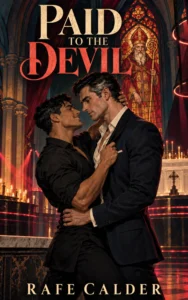
Paid to the Devil
Kings of Harbor City
He owns every debt in Harbor City. I'm the only thing he keeps off the books.

His Rival’s Bodyguard
Kings of Harbor City
My father died with his name on his lips. Now he's the only man keeping me alive.
Never Miss a Release
Get new release alerts, exclusive bonus content, and reader-only giveaways.