
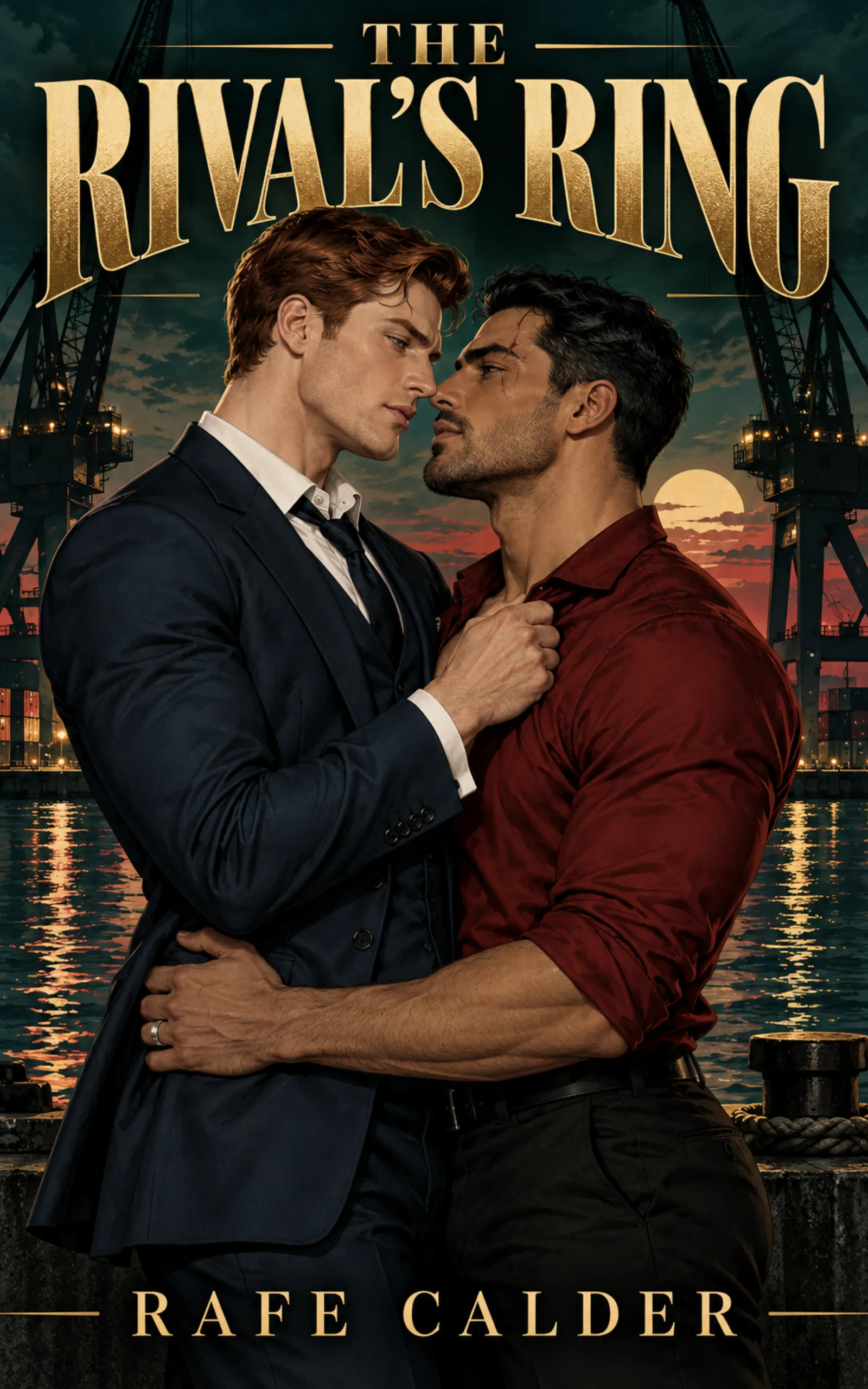
The Rival’s Ring
A Dark MM Mafia Romance
by Rafe Calder
Shop the ebook · Shop the audiobook · Shop the paperback
Available at all major retailers
Pairing: MM
Heat: 🌶️🌶️🌶️🌶️🌶️ Inferno
Series: Standalone
Tropes: Fake Engagement, Rival Mafia Heirs, Enemies to Lovers, Rivals to Lovers, Marriage of Convenience, Second Chance (One Night Six Years Ago), Forced Proximity, He Falls First, Touch Him and Die (Both Ways), Possessive Heroes, Morally Grey × Morally Grey, Switch Dynamic, Suit Kink, Hurt/Comfort, Light Bondage, Praise and Control
The ring was supposed to stop a war. The man who put it on me was supposed to stay my enemy.
Maximo Alvarez has wrecked three of my negotiations, broken a man’s jaw outside my office, and spent six years looking at me like he remembers exactly how I sound when I lose control.
He does remember. That is the problem.
Now he wants to put a ring on my finger.
Not because he loves me. Because someone is stealing from both our families, bodies are washing up along the river, and Blackwater is one bad night from war.
Our engagement is a treaty with photographs. Eight weeks. One penthouse. Two bedrooms. Fourteen clauses. Smile for the cameras, kiss on schedule, and make every enemy we have believe we cannot be divided.
Simple.
Until he learns how I take my coffee.
Until I stop sleeping when he is gone.
Until the first time he calls me his without an audience.
I can negotiate anything.
I never planned to negotiate with the part of me that wants this marriage to be real.
The Rival’s Ring is a standalone dark MM mafia romance with rival heirs, a fake engagement, a corridor forty-one feet long, a ring with a secret cut inside it, two morally grey men who are possessive in both directions, on-page violence, a lot of on-page spice, no cheating, and a guaranteed HEA. Dual first-person POV. Standalone.
You’ll love this book if you enjoy:
✅ A cold, three-piece-suited lawyer who writes fourteen clauses to keep a man forty-one feet away, then breaks clause fourteen himself in a town car
✅ A boxer heir with scarred hands who knows every driver’s name and makes the coffee right on day two
✅ “Nobody else. Either of us. Start to finish.”
✅ One night in a boathouse six years ago that neither of them will name
✅ Hand wraps, a locked dressing room, and “Say whose.”
✅ “He’s the man I’m marrying. Choose your next sentence accordingly.”
✅ A betrayal written in a mortgage note, and a grovel paid in full at the county recorder’s window
✅ A man who has only ever bled for love learning to ask for it out loud
✅ Touch him and die, both ways, 🌶️🌶️🌶️🌶️🌶️ heat, no cheating, HEA guaranteed
⚠️ Content Warning: This novel contains explicit sexual content (graphic MM scenes, including rough sex, wrists bound with boxing hand wraps, a necktie used for control, rimming, angry sex during a separation, sex while a partner is injured, and both leads topping and bottoming; all on-page sex is consensual), on-page violence (a knife attack, a firebombing that injures a man, an armed attack and arson on a dock, gunshot wounds, a lead character shooting the antagonist, a lead slashed with a knife), the murders of two men off-page with their bodies discovered, an implied off-page execution, organized crime, bribery and financial fraud, a parent who uses affection as currency, emotional manipulation by a trusted father figure, police questioning, alcohol, and strong language. No sexual violence, no dub-con, no cheating. Intended for readers 18+.
📖 Read Chapter One Free
Not sure yet? Read all of Chapter One right here.
Chapter One: Finn
Commissioner Walter Pruitt is sweating through a shirt that was never good to begin with.
I let him. Behind his head, rain sheets down thirty-one floors of glass, and beyond the glass the river cranes stand in the fog like a row of gallows. Blackwater in March. Everything out there is the color of a nickel.
“Three containers.” I turn a page of the file in front of me. I don’t need to read it; he needs to watch me read it. “Forty-footers, sealed, logged into bonded storage at Carrow Wharf on the ninth. By the eleventh, gone. Every bonded load on this river passes your Harbor Road checkpoint on its way out, and your office keeps the camera footage and the seal register.”
“There’s a process, Mr. O’Rourke. A request goes to the records clerk, and the clerk—”
“I filed the request Monday. Today is Thursday.”
“These things take time.”
“They take four hours. I’ve timed your office before.” Another page. “What takes four days is deciding who you’re more afraid of.”
His mouth closes. Opens again.
“Your mother and I have always had an understanding.”
“You and my mother have an invoice. I’ve read it. It’s generous, and it’s eleven years long, and nowhere in it does she pay you to make me wait.”
Pruitt is a small man in a brown suit who has accepted my family’s money for over a decade. Sometime this winter he started accepting someone else’s. I don’t know whose yet, but I know roughly what it came to, because he is suddenly current on a great many debts.
“You have a house on Lake Marren,” I say. “Second mortgage through Blackwater Savings and Trust, taken out to cover your son’s legal trouble in Ohio. In January you were five months behind.” I slide a single sheet across the walnut. “You aren’t behind anymore.”
He doesn’t touch the paper.
“I’m pleased for you. But Blackwater Savings sold a block of residential notes last week, and the buyer is a holding company whose board I sit on. As of Friday, your lake house belongs, in every way that matters, to me.” I cap my pen. “I would prefer never to think about it again. I’d prefer to be thinking about camera footage.”
“That’s a threat.”
“It’s a mortgage. A threat would have mentioned your son by name.”
He wets his lips. “And if the footage shows something your family won’t like?”
“Then I’ll dislike it in private, and you will still have a lake house.” I square the edges of the file. “You’re confusing me with a man who needs the answer to be convenient. I need it to be accurate. The inconvenient ones I can usually sell.”
I let him sit in that. I have never needed to raise my voice in this room. My mother raised hers enough for both of us, and I learned early which one of us people stopped listening to.
The insult is that the containers aren’t even mine. They are Alvarez cargo, parked in my family’s bonded yard under an arrangement older than I am, because even people who loathe each other need somewhere to put things. Now they have vanished from behind an O’Rourke lock, and by tomorrow every man on the Alvarez docks will have decided we took them.
“Five o’clock,” I tell Pruitt. “The footage and the register, on a drive, in my hand.”
“I can’t promise—”
The door opens.
Nobody opens that door without knocking. There is an assistant outside it who has been with me four years, and a security detail that costs more than the commissioner’s lake house.
Maximo Alvarez walks into my conference room as if he holds the lease.
Through the closing gap behind him I catch one glimpse of my assistant on her feet with a hand pressed to her mouth, and one of my security men studying the ceiling. So he has charmed the one and stared down the other. By my estimate it took him under ninety seconds.
There’s rain on his shoulders and in his hair. Charcoal suit, no tie, collar open at the throat; good wool, cut with room through the back so he can throw a punch without splitting a seam. He is built the way the cranes are built, heavy across the top and steady at the base, and the old scar through his left eyebrow gives him the look of a man perpetually about to ask a question he already knows the answer to.
Pruitt has half risen. Maximo glances at him. “Don’t get up.”
Pruitt sits as though a hand pushed him.
“Alvarez.” I stay in my chair. “There’s a desk in the lobby. On the desk is a book. People write their names in the book, and then they wait to be invited.”
“I wrote my name.” He’s crossing the room, unhurried. “Your man downstairs took my gun and gave me a look. I liked the look. Very thorough.”
“And then you were asked to wait.”
“I waited in the elevator.”
There are fourteen chairs at this table. He doesn’t take one. He sits on the edge of the table itself, two feet from my left hand, one foot planted on my carpet and his thigh across the corner of a slab of walnut I had shipped from Vermont. The wood ticks under his weight.
He smells like rain and cold air and, underneath, something warm that I refuse to identify.
I have catalogued him for six years the way I catalogue any opposing party: habits, weaknesses, appetites. He takes his coffee with a criminal amount of sugar. He favors his right shoulder in wet weather. He has never once looked at me without making it obvious that he is looking.
“Get off my table.”
“In a minute.” His gaze travels down my waistcoat and back up, taking its time. “The gray three-piece. Somebody’s getting ruined. You only wear the gray for funerals and foreclosures.”
“It’s Thursday. It can be both.”
“That’s my boy.”
“I am not your anything.”
“No,” he agrees, and drops a folded sheaf of paper onto my file, square in the middle of Pruitt’s mortgage. “Harbor Road checkpoint, outbound, night of the tenth. Line forty.”
I don’t reach for it. “That’s a Port Authority record.”
“Yeah.”
“I have been asking for that record since Monday.”
“I asked Tuesday.” His eyes go to the commissioner. Brown, level, patient as a held breath. “Walter sells to everybody. Don’t you, Walter.”
Pruitt has gone the color of the weather.
So that’s two of us paying him and a third I haven’t found. I unfold the pages without hurrying and find line forty. 2:14 a.m. Three tractors, three bonded forty-footers, container numbers I’ve been staring at for four days. Seal checks waved through. And in the plate column, three registrations I recognize, because I have spent six years learning everything that carries his name.
“Those are Alvarez Freight plates.”
“They are.”
“Your trucks collected your own cargo from my yard in the middle of the night, and you’ve come here to show me the proof.” I look up at him. “As strategies go, it’s novel.”
“Those three tractors were in my shop on Dray Street that night with the engines out of them. I’ve got four mechanics who’ll swear to it and a parts invoice long enough to put you to sleep.” He taps the plate column with one blunt finger. The knuckle above it is split and half healed. “Somebody hung my plates on their rigs, drove up to your gate, and your yard handed over my freight. Then your yard log got written to say the boxes never moved. I’m guessing that’s what yours says. Never moved.”
It is precisely what mine says. I have read that log nine times. Three containers in on the ninth, undisturbed, a supervisor’s initials beside each entry, tidy as a schoolboy’s.
I fold the pages closed. “Commissioner. Five o’clock stands. You may go.”
Pruitt goes. He doesn’t quite run. The door shuts behind him with a soft, expensive click, and then there is only the rain, and thirty-one floors of air, and the one man in this city I have never managed to out-wait.
I stand, because he is taller than I am sitting down, and I won’t have it.
It doesn’t help. On my feet I have an inch on him and I’m close enough to count the raindrops in his hair.
“You could have sent this by courier,” I say.
“You’d have spent a week deciding I forged it.”
“I may still.”
“No, you won’t.” The corner of his mouth moves. “You read line forty and went quiet. You only go quiet when something’s true.”
“You don’t know what I do.”
“Six years, counselor. I know what you do.” He holds up a thumb. “The Halloran cold stores. I had that lease priced, papered, and blessed, and you dug up a drainage easement from 1958.” A finger. “The dredging contract.” Another. “Marlowe Street. I paid for that license twice, and you still got it pulled on a fire-code variance.”
“Four.”
The scarred eyebrow lifts. “Four what?”
“Four deals. You never found out about the fourth.”
“Which one was the fourth?”
“I’m not going to tell you. It’s the only one I enjoyed.”
He laughs. It’s low and it comes from the chest, and it does something to the backs of my knees that I intend to take up with them later.
“You’re enjoying this one,” he says.
“I am enduring this one.”
“You stood up.”
“You were looming.”
“I’m sitting down, counselor.”
“You loom seated. It’s a gift.”
“You broke a man’s jaw on my front steps,” I say, because a list ought to run both ways.
“Your process server.”
“He was serving process.”
“He put his hand on my sister to do it.”
“He touched her elbow.”
“And I touched his jaw.” A shrug that moves a great deal of shoulder. “I paid his dental. You sent the bill itemized.”
“I itemize everything.”
“I know. It’s the sexiest thing about you, and that’s a crowded field.”
I don’t react. I have a great deal of practice at not reacting, and most of it is his fault.
“And Pier 9,” he says.
His voice hasn’t changed. Nothing in his posture has changed. But the room has, the way a room does when somebody opens a door you had nailed shut.
“Four-month injunction,” he goes on, mild as milk. “Environmental review. You’d been a lawyer about a month, and you shut my pier like you’d been waiting your whole life to do it. I never did ask you why.”
“You have never asked me anything.”
“No.” He leans in. Not far; six inches. Enough that I can feel the heat coming off him through two layers of wool, enough to see where the rain has darkened his collar. “I guess I figured you’d already told me.”
And it hits me whole.
Rain hammering a tin roof. Creosote and river mud and wet wool, a stack of canvas boat covers under my back, my funeral suit open to the waist. I am twenty-four, and I have never been touched by anyone who wasn’t a little afraid of my last name.
He isn’t afraid of anything. He has already had me in his mouth, on his knees on the wet boards with my fingers knotted in his hair, taking my cock to the root and pulling off a breath before I could finish, laughing when I cursed him for it. He has already opened me on two slick fingers, with more patience than I believed a man his size could own, until I was rocking down onto his hand and ordering him to get on with it.
Now his hand is on my throat, not squeezing, only resting there, his thumb under the hinge of my jaw so I have to look at him while he pushes into me. He’s thick and he’s slow and it burns in a way that sets my thighs shaking against his ribs. He watches my face the entire time. When he’s all the way in, I make a sound I didn’t know I owned.
Tell me, he says against my mouth.
I tell him. I tell him everything. More. Harder. Don’t stop, don’t you dare stop. My heels dig into the small of his back. He hooks my knee over his elbow and the angle changes, and I lose the ability to give instructions at all. He fucks me deep and steady with the rain coming down like applause, and by the time he wraps his fist around my cock I am already begging, not in sentences, only please and his name, his name, until I come so hard the rafters go white, spilling over his knuckles and my own stomach while he groans into my neck and follows me over.
Afterward he kept his hand where it was. I could feel my own pulse knocking against his palm. He fell asleep with his face in my neck and one heavy arm across my ribs, and I lay under it for an hour, wide awake, learning the weight.
I left before dawn with my shoes in my hand.
Seven days later I filed for the injunction. I drafted it myself, at night, and I remember the exact relief of watching the judge sign it. There, I thought. That is how little it meant.
“Counselor.”
The conference room. The rain. Maximo Alvarez on my table, thirty-four now and broader, with new lines beside his eyes, looking at me precisely the way he did then.
I have uncapped my pen. I don’t remember doing it. Below the edge of the table, where he cannot see, I am half hard in bespoke trousers, and I have told a harbor commissioner to be back here by five.
“If there’s a point,” I say, and my voice comes out as flat and dry as a deposition, “I’d be grateful if you reached it.”
He looks at my mouth for one second longer than is civil. His hand has come to rest on the walnut half an inch from my hip. He doesn’t close the distance. He never has, not once in six years; he only ever comes near enough that the choice would be mine, and then waits to see whether I’ll make it.
I don’t.
“You’re flushed,” he says quietly. “Right here.” He doesn’t touch my throat. He touches his own, two fingers under the hinge of his jaw, exactly where his thumb used to sit.
“It’s warm in here.”
“It’s sixty-four degrees in here. You keep it cold so people sign faster.”
Then he sits back, and the air returns to the room.
“Point is, somebody robbed me using your yard. And I think somebody’s robbing you using mine.”
“I beg your pardon?”
“Your card rooms on the east bank. The cash comes over Thursdays. Your couriers cut through my terminal because it saves them twenty minutes on the bridge, and I let them, because I like knowing what your Thursdays weigh.” He says it without a trace of apology. “Since January, the bags have been coming through light.”
I keep my face exactly where it is.
Nobody outside my family knows the Thursday count has been short. I’ve known for five weeks. My mother has known for four, and she has spent every one of them asking which Alvarez I intend to hold responsible.
“You weigh my couriers.”
“I count what crosses my ground. You’d do the same.”
“I do the same.”
“I know. Your guy at the Dray Street diner drinks a lot of coffee for a man who never orders food.” He picks my pen cap up off the table and turns it in his fingers. He has a boxer’s hands, scarred across every knuckle, and they are absurdly gentle with small objects. “So. My freight goes missing out of your lock. Your cash goes missing on my ground. Each of us has a parent asking whose throat to cut. That doesn’t strike you as tidy?”
“It strikes me as a motive for each of us to rob the other.”
“Sure. Or a reason for somebody else to make it look that way.” He sets the cap down beside my hand, close enough that his knuckle grazes my wrist. It isn’t an accident. Nothing he does with his body is an accident. “You’re the smartest man I know, and I can’t stand you. So you tell me. If I wanted your Thursday money, would I take it on my own dock?”
“No.”
“If you wanted my boxes, would you lift them out of your own yard and leave your name on the lock?”
“I would have had them stolen off the truck that delivered them, and I’d have sent you a note of condolence.”
“That’s what I said. Word for word, nearly.” His smile is brief and far too pleased. “My father didn’t love hearing it.”
“Your father would like me dead.”
“My father would like you on his payroll. He just figures dead is cheaper.”
I look down at the checkpoint log. Line forty. A lie with his name on it, lying on top of a lie with mine.
Someone wants us in separate rooms, each holding half the arithmetic. And the only reason I can see it at all is that he walked through my door without knocking and sat where he wasn’t invited.
“Suppose I believed you,” I say slowly. “What is it you imagine happens next?”
“Next, you and me sit down and compare—”
Two sharp raps, and the door is opening before the second one lands.
Cormac Doyle has run my family’s security since I was at boarding school. He’s forty-three, gray at the temples, built like a bank vault, and he has knocked on this door and waited for my answer every working day for six years.
He has never before come through it with his right hand inside his jacket.
“Finn.” His eyes stay on Maximo. “A word. Outside.”
“Say it here.”
“I’d rather not.”
“I gathered. Say it here.”
A muscle jumps in his jaw. He crosses the carpet at an angle that keeps his body between Maximo and the only exit, and puts a phone in my hand without once glancing down at it.
It takes me a moment to understand the photograph. A concrete landing, wet. River weed. A tarpaulin folded back from a face I know.
Tommy Brannagh. Twenty-six. He has carried the Thursday count for my family for three years, and every December he sends my mother a card with a picture of his dog in a paper crown.
His eyes are open. So is his mouth. Someone has wedged a disc between his teeth, about the size of a silver dollar: red clay ringed in black, with an anvil stamped in the center.
I’ve seen that stamp. It’s on the door of a converted steelworks on the south bank, and on every chip that changes hands inside it on fight night.
“The Tannery Steps,” Cormac says. “A dredge crew pulled him out forty minutes ago. He left the east bank with last night’s count around eleven and never reached the bridge. Bag’s gone.” A pause. “That’s a Foundry chip in his mouth.”
“I can see what it is.”
“Then you can see why Mr. Alvarez isn’t leaving the building.” His hand has not come out of his jacket. “His gun’s in a drawer downstairs. I’ve two men on the elevators and one on the stairs. And I’d take it kindly if he got his arse off the furniture and showed me his hands.”
“They’re on my knees, Doyle.” Maximo doesn’t shift. “They’ve been there since you came in. Count the fingers if it helps.”
“A lad comes up out of the river, and the man whose mark is in his mouth happens to be sitting in our boardroom, being charming. That’s a fine place to be standing when the news breaks.”
“It’d be a stupid place. You’d have me boxed on the thirty-first floor with no gun.” Maximo’s voice stays even. “Show me.”
“I’ll show you the inside of—”
“Cormac.”
He stops. He doesn’t like it, but he stops.
I should be thinking about my mother, who will have this photograph within the hour, and about what she will want done by nightfall, and to whom. I should be weighing how it looks: the heir to the family, alone in a locked room with an Alvarez while one of our own was being dragged out of the water.
I’m watching Maximo instead.
He hasn’t measured the distance to the door, or to Cormac, or to the heavy glass carafe eighteen inches from his right hand, which is what I would be measuring. He simply holds out his palm. And against every instinct I was raised with, I put the phone in it.
Cormac makes a noise like a man swallowing a nail.
Maximo studies the photograph for a long time. Not the chip. The face.
“How old?”
“Twenty-six.”
“He have people?”
“A mother on Garrow Street,” I say. “A dog.”
“And the chip.” I can hear how level my own voice is, and I distrust it. “Explain the chip.”
“House red. Hundred-dollar. There’s eleven thousand of them in circulation, and a cashier who’ll hand you one for a hundred bucks and a smile.” He hasn’t looked up from the photograph. “Anybody who ever bought a ticket could have put that in his mouth. That’s why it’s a chip, and not something of mine you’d have had to steal.”
Something moves behind his eyes and is put away. He turns the phone over and sets it face down on the walnut, carefully, the way you would lay down a thing that could still be hurt.
“Somebody go get the dog.”
Nobody in the room has an answer for that. The rain fills the silence. A killer who signs his work does not leave the signature in the victim’s teeth and then stroll, unarmed, into the dead man’s house. He does not volunteer that he’s been weighing the bags. And he does not ask about the dog.
It is too neat. All of it. I knew that before Cormac finished his sentence, and I resent how much I want it to be true.
Maximo looks up. Past Cormac’s shoulder, past the hand in the jacket and six years of everything we have done to each other, as though there were no one else on the thirty-first floor.
“That’s not mine. And you already know it, counselor, or Doyle would have shot me by now.”
Want to keep reading? The full novel is available now.
🔥 Want an EXCLUSIVE Bonus Chapter?
The Boathouse — A scene TOO HOT for the bookstore
Six years before the ring, the night of Desmond Callahan’s wake. A dead man’s whiskey, a tin roof in the rain, a law student who walks out of a parlor first, and the fighter who follows him down to the water. Maximo’s side of the one night neither of them will name, all of it, right up to the morning he wakes up alone.
More from Rafe Calder
Browse all Rafe Calder books.

Crown Him in Blood
He handed me a loaded gun so I'd follow him home. He never told me what else he was carrying.
The Rival’s Ring
The ring was supposed to stop a war. The man who put it on me was supposed to stay my enemy.
The Assassin’s Alibi
Someone put us in the same bar. Nobody put us in the same bed.
Paid to the Devil
Kings of Harbor City
He owns every debt in Harbor City. I'm the only thing he keeps off the books.

His Rival’s Bodyguard
Kings of Harbor City
My father died with his name on his lips. Now he's the only man keeping me alive.
Never Miss a Release
Get new release alerts, exclusive bonus content, and reader-only giveaways.