

Crown Him in Blood
A Dark MM Mafia Romance
by Rafe Calder
Shop the ebook · Shop the audiobook
Available at all major retailers
Pairing: MM
Heat: 🌶️🌶️🌶️🌶️🌶️ Inferno
Series: Standalone
Tropes: Mafia Heir, Reluctant Heir, Inheritance with a Deadline, Age Gap (25 × 37), Consigliere × Heir, Bodyguard, Morally Grey × Morally Grey, He Falls First, Touch Him and Die, Praise Kink, Hurt/Comfort, Suit Kink, Safe Word, Power Exchange, Switch Dynamic, Light Bondage, Scar Worship, Hotel Romance, Forced Proximity, One Bed, Grovel
He handed me a loaded gun so I’d follow him home. He never told me what else he was carrying.
Twelve years ago, my father’s men put my mother and me in a car and drove us out of Saint-Veyre. I was thirteen. I built a life six hours south: a twenty-two-room inn, a sign we painted with the wrong paint, a mortgage we never once paid late.
Then Nikolai Sokolov walks into my lobby on a Tuesday night in January and tells me three names and one word.
Dead.
My father and both my brothers, shot at their own Sunday table. I’m the last name on the trust. I have thirty days to claim a crime family I want nothing to do with, or it falls to the creditors and the wolves. Ten minutes later a man tries to put a bullet in my head in my own linen corridor, and the consigliere kills him without disturbing his breathing.
So I get in the car. I take his gun. I take the creditor’s chair at a table of killers. I take a hotel back from a captain with four questions and a cup of bad coffee.
And I take him. In a storm, fourteen floors over the ice. On his knees on a bathroom floor. In front of a mirror, with my father’s ring on my hand.
He swore he’d never lie to the people he works for.
He never said he’d tell me the truth.
Because somebody walked my brothers’ killers into that house. And somebody put my mother in that car twelve years ago. And the only man in this city I trust with my life is the one standing between me and both answers.
Crown Him in Blood is a standalone dark MM mafia romance with a reluctant heir, a dangerous consigliere twelve years older, a thirty-day clock, a safe word that gets used, two morally grey men, on-page violence, a great deal of on-page spice, no cheating, and a guaranteed HEA. Dual first-person POV.
You’ll love this book if you enjoy:
✅ A small-town innkeeper who reads a criminal court like a hotel lobby, and takes it
✅ A six-foot-four consigliere in black gloves who kneels for no one, and then kneels
✅ “The ring is metal. I’m swearing to the man.”
✅ Praise kink that comes out of a man who has never once said a soft thing in his life
✅ One penthouse, one bed, a blizzard, and “Hold still”
✅ A safe word picked as a joke over roast chicken, and the night it saves them both
✅ A secret written in a mortgage, and a grovel paid in full, in writing, on her terms
✅ “You did that already. You stand here. Next to me.”
✅ Age gap, bodyguard, touch him and die, 🌶️🌶️🌶️🌶️🌶️ heat, no cheating, HEA guaranteed
⚠️ Content Warning: This novel contains explicit sexual content (graphic MM scenes including oral sex, rimming, mirror sex, a necktie used for restraint and control, a scene of angry, punishing oral sex that is stopped by the safe word, sex while a partner is recovering from an injury, and both leads topping and bottoming; all on-page sex is consensual), on-page violence (stabbings, a neck broken by hand, gunshot wounds, a siege on a hotel, a lead character shooting a man in defense of the other, and a lead character executing the antagonist), the off-page murder of the hero’s father and half brothers, an abduction with physical restraint, arson that injures a man, a death staged as a suicide, blackmail and coercion, organized crime, financial fraud, the past coercion of a parent into leaving her home, emotional manipulation, a 12-year age gap, alcohol, and strong language. No sexual violence, no dub-con, no cheating. Intended for readers 18+.
📖 Read Chapter One Free
Not sure yet? Read all of Chapter One right here.
Chapter One: Remy
The ceiling over room six started raining at nine-forty on a Tuesday night, and I took it personally.
By nine-forty-four I had the water shut off at the second-floor valve, a mop bucket under the worst of it, and a couple from Ohio relocated to room eleven with a bottle of the good cabernet and my most sincere face. By nine-forty-six there was a voicemail in with Hal the plumber that said seven a.m., I’ll have coffee, I’ll have cash. By nine-fifty I was back behind the front desk with wet cuffs, talking a groomsman out of the bar.
“It closed at nine,” I told him.
“It’s a wedding.”
“The wedding is Thursday. Tonight is a Tuesday with a theme.”
He swayed and gave that real thought. Fourteen of them had booked out most of the Alder House for a midweek January elopement, because midweek January was when we were half price and the falls froze into something worth photographing. They’d been lovely. They’d also been drinking since four.
“One bottle,” he said. “For the room. I’ll Venmo you personally.”
“I’ll send up bourbon and six glasses if you carry the bride’s grandmother’s bag to room three on your way. She’s locked herself out twice and she’s too proud to ring the bell again.”
His whole face lit. People love being handed a job. That was most of what I knew about hospitality, and it had carried my mother and me for twelve years: find out what somebody actually wants, give them a dignified way to get it, and write it down so the morning shift isn’t surprised.
He took the bag and the key. I reset the card terminal, which had picked tonight to forget what money was, initialed the incident log for the pipe, and added a line to the breakfast sheet about Ohio’s comped mimosas.
Twenty-two rooms. I knew which stair creaked, which radiator knocked, and which of the housekeepers was hiding a bad knee. I was twenty-five and I ran this building the way other men my age ran fantasy leagues, and I’d have told anyone who asked that I was happy.
Nobody asked. It was a Tuesday.
The front door opened at two minutes past ten and let in about a yard of January.
I looked up with the smile already loaded. Evening, welcome to the Alder House, I’m afraid we’re—
He had to dip his head for the lintel. That was the first thing. The door was a hundred and ten years old and built for smaller people, and he came through it like he’d assessed it from the porch and decided it wasn’t a threat.
Black overcoat, snow melting on the shoulders. A charcoal suit under it that fit the way suits only fit when a tailor has been frightened into excellence. Dark hair going gray at the temples, early, the kind of gray that looks like a decision. Six-four at a guess, and broad enough that the lobby rearranged itself around him. He didn’t stamp his feet or blow on his hands or glance at the fire. He looked at the staircase, the hall to the kitchen, the dining room arch, the window. Then at me.
And stopped.
It lasted less than a second. I work a front desk; I read faces for a living. Something crossed his and was put away, the look of a man who’s opened a drawer expecting a pen and found something that was not a pen.
I’ve been looked at by men before. I know the version that means hello. This wasn’t that, or it wasn’t only that, and whatever it was went straight down my spine and settled low in my stomach like a swallow of the bourbon I’d just sent upstairs.
Inconvenient. I was at work.
“Good evening,” I said. “We’re full tonight, but I can call the Birchmont down the road and—”
“I’m not checking in.”
Low voice. Unhurried. A trace of something at the edges of the consonants that had been sanded down a long time ago and hadn’t quite gone.
He crossed the lobby. No bag. Black leather gloves, which stayed on. And when he set one hand on my desk, there on the inside of his left shirt cuff was a spot the size of a dime, rust-brown and dry.
You notice stains, in my job. You learn which ones are wine.
You notice gloves, too. Guests peel them off at the door, finger by finger, grateful for the fire. He kept his on like the room was something he hadn’t agreed to touch yet.
“Remy Laurent,” he said. It wasn’t a question.
“That’s what the name tag says.”
“You’re not wearing one.”
“It’s a small town. They’d find it pretentious.” My pulse was doing something stupid. “Can I help you, Mr….?”
He took a card from his breast pocket and laid it in front of me, square to the edge of the blotter. Heavy cream stock. LAURENT HOLDINGS. N. Sokolov, Executive Risk Director.
I hadn’t seen my own last name embossed on anything in twelve years.
Sokolov. I knew it the way you know the name of a street near a house you lived in as a kid. One of my father’s young men. Tall, always in a doorway, never once spoke to the children. I couldn’t have picked his face out of a lineup. I was fairly sure I’d have remembered this one.
Something under my ribs went very quiet.
“I’m going to say three names,” he said. “Then one word. Then I’m going to stand here while you decide how much of it you believe.”
“That’s a hell of an opener for a timeshare.”
Nothing moved in his face. His eyes were gray, the flat patient gray of the lake I grew up beside and didn’t think about.
“August Laurent. Étienne Laurent. Luc Laurent.”
My father. My brothers. Half brothers, to be exact, by a first wife who’d died before I existed. I’d shared a house with them for thirteen years and a table with them rarely.
“Dead,” said the man in my lobby.
The fire popped. Upstairs somebody laughed, and a door shut.
I was aware that I was still smiling a little, the professional one, because nobody had told my face.
“I’m sorry,” I said. “Could you be more specific?”
“Sunday evening. At dinner, in the house. All three. It was quick, and it was done by people who knew the room.”
“Done.”
“Shot, Mr. Laurent.”
I get polite when I’m overwhelmed. My mother says it’s the most alarming thing about me. I felt it come down now like the grille over the bar: a clean, cool, helpful calm, and a long way behind it a thirteen-year-old in the back seat of a car, watching a house get smaller.
I hadn’t spoken to my father since that car. He’d sent a check every birthday until I turned eighteen, and my mother had fed each one through the office shredder, one a year, like a rite. I didn’t know what I was supposed to feel. I could sense the shape of it, the way you sense a step in the dark before your foot finds it.
“I see,” I said. “And you are what, in relation to this?”
“I was your father’s consigliere.”
He said it the way another man would say accountant. In my lobby, under the watercolor of the falls, eight feet from the brochure rack.
“That isn’t what the card says.”
“The card is for banks.”
“And you drove all this way to tell me in person. That’s considerate. There are phones.”
“Phones are how people learn where you are.” His gaze went past me to the key cabinet, the office door, and back. “I drove six hours because the people who cleared that table will remember there’s a fourth name on the trust. I’d like you to be somewhere else when they do.”
“I’d like proof.”
“Of course.”
If anything, he seemed relieved. He drew a long envelope from inside his coat and set it beside the card. Three certified copies, Veyre County Medical Examiner, raised seals. Name, date, time. Under cause of death, all three read pending.
I read each one twice. My hands were steady, which I resented.
“These could be forged.”
“They could. Forgeries would have the cause filled in.”
It took me a second to realize that was a joke, or the fossil of one.
“I’m going to make some calls,” I said. “You’re going to stand over there by the fire where I can see you, and you’re not going to speak to my guests.”
“Yes, Mr. Laurent.”
Two words. I went looking for the irony in them and couldn’t find any. A man that size, with that voice, saying yes like it was a position he could hold all night. I filed my reaction to it under later, and then, with more discipline, under never.
My mother was in Chicago at an innkeepers’ expo, learning about booking software against her will. She picked up on the second ring.
“What broke?”
“Room six. It’s handled. Mom, are you sitting down?”
I told her. There was a silence, and then one breath, drawn in and held.
“All three,” she said.
“That’s what he says.”
“Who’s he?”
I looked at the card. I looked at the man beside my fireplace, who had put his back to the one stretch of wall that gave him both doors, hands folded, snow drying on his coat.
“Some executive from the holding company. Risk director, if you believe the stationery.”
“August kept a whole floor of those.” Her voice had gone thin and careful, a tone I knew from exactly one subject. “Remy. Listen to me. An inheritance is not an obligation. You don’t owe that family a phone call, let alone a trip. Whatever he’s brought for you to sign, don’t. Call Walt. Tonight, at home, I don’t care what time it is.”
“Mom—”
“I’m getting the first flight out. Lock the office.”
“It’s a hotel. Locking things is sort of against the ethos.”
“Remy.”
“I’ll call Walt.”
She didn’t say she was sorry they were dead. I noticed. I didn’t blame her.
Walt Brennan had done our liquor license, our closing, and one small-claims brawl with a linen supplier. He answered sounding like a man in a bathrobe, listened without interrupting, and exhaled through his nose.
“Son, that is so far outside what I do, I’d be committing malpractice by clearing my throat. But I clerked with a woman who practices in Saint-Veyre. Leila Mercer. She has spent fifteen years not being owned by your father, which up there is a specialty. Give me five minutes.”
From across the lobby, without raising his voice: “I have a list of attorneys, if it would save time.”
“I bet you do. I’ll use mine.”
Something happened at the corner of his mouth. It wasn’t a smile. It was the place a smile would go if he kept any.
“Good,” he said.
Leila Mercer called at ten thirty-one from a number I didn’t know. Quick voice, wide awake.
“Mr. Laurent. Walt says there’s a man in your lobby. Describe him.”
“Tall. Gloves. Looks like he’s never been surprised in his life.”
A pause. “Sokolov came himself? All right. First thing: it’s true. All three of them, Sunday. There’s nothing in the papers because nobody in this city prints a word about that house until the house approves it. I’m sorry for your loss, if it is one. Second thing: has he handed you anything?”
He was already crossing the floor. A second envelope, thicker, with wax over the flap. Actual wax, an L pressed into it.
“He’s about to.”
“Don’t—”
“Mr. Laurent.” Nikolai Sokolov put it in my palm, and his gloved fingers closed mine around it for the half second it took to be sure I had it. Warm leather. A grip that could have gone on closing. “Notice under the Laurent Family Trust. You’ve been served.”
“—take it,” Leila finished. “Wonderful. Open it. Photograph every page and send them to this number.”
I did. She read for ninety seconds while I listened to her breathe and the consigliere went back to his wall.
“Okay. Short version, because you’ll be getting the long one for the rest of your life. You’re the surviving issue. The controlling trust is yours if you accept it in person, in front of the trustee, who is your aunt Sabine, and the family’s council recognizes you. You have thirty days from service. He just served you, so that clock is about a minute old. If nobody’s seated by day thirty, the trust dissolves to its creditors. Hotels, warehouses, the port. Sold off in pieces.”
“And if I decline?”
“Same result, faster. You’re allowed to. I want that on the record. You are completely allowed to hang up, go to bed, and be a hotel manager.”
“That’s my plan.”
“Then here’s my advice, and tonight it’s free. Sign nothing. And don’t get in a car with that man until I’ve made some calls of my own. Give me till morning.”
I thanked her. I set the phone face down on the blotter, squared it to the edge the way he’d squared his card, and looked up.
“I’m declining,” I said. “I want to be clear, and I want to be nice about it. We do a good breakfast. You’re welcome to it before you drive back.”
He didn’t argue. I’d braced for arguing. I’d had a whole speech racked up about boundaries and business hours.
“May I ask one question first?”
“You may ask.”
“If I’d come to tell you they’d left you nothing. Would you still be declining?”
I opened my mouth and found the answer wasn’t where I’d left it.
“That’s a rude question,” I said.
“Yes.”
“I’d have offered you the breakfast either way.”
“I believe that.” He glanced at the incident log, open on the desk where I’d left it, my initials still wet beside pipe, rm 6. It was a strange thing for a man like that to bother reading. “You understand that declining doesn’t take you out of the way.”
“For thirty days. I’ll look both ways crossing the street.”
“They won’t wait thirty days. A dead heir and an absent heir read the same on paper, and dead is cheaper.”
“Who’s they?”
“I don’t know yet.”
It cost him something to say. I saw it go through him, a tightening at the hinge of the jaw, there and gone. Whatever else this man was, he was not accustomed to that sentence.
“Mr. Sokolov. I have a leak in room six, fourteen wedding guests, and a plumber at seven. I was put out of that house when I was thirteen. Nobody up there has needed me for twelve years, and I’ve returned the favor. Good night.”
I went through the staff door before my face could do anything he’d get to watch.
The corridor behind the kitchen is the real Alder House. Ice machine, linen shelving, the back stairs, the delivery door with its wire-glass window. No watercolors. I put both hands on a shelf of bath sheets and let my head hang and tried the sentence out.
My father is dead.
Nothing. A locked room.
Étienne. Who’d looked through me for thirteen years the way you look through a waiter. Nothing.
Luc.
Luc, who when I was nine had spent one whole afternoon teaching me to skip stones off the breakwater, and never did it again after Étienne laughed.
That one got under the grille. I breathed through it with my forehead against terry cloth that smelled like our detergent, and I was fine, I was very nearly fine, when the kitchen door at the far end of the corridor swung open.
Mr. Dunn. Room fourteen, ground floor. He’d checked in at four, cash, one night, not with the wedding. He’d asked me twice what time I got off shift. I’d assumed he was working up to buying me a drink and I’d had a kind no ready.
He was wearing his coat. Indoors, zipped. And gloves, thin ones, the sort you can’t buy at our hardware store.
“Mr. Dunn. I’m afraid this is staff only.” My voice came out bright as a bell. “Did you need more towels?”
“You’re Remy Laurent.”
Second man tonight to tell me my own name.
“So the towels are a no.”
His right hand came out of his jacket holding a pistol with a long, fat barrel, and I had time to think, stupidly, that’s the quiet kind, and no time for anything else.
A palm landed flat on my sternum.
It came from behind me and to the left, and it moved me the way you’d move a chair, neither rough nor gentle, back and sideways into the shelving. I hadn’t heard the staff door. I hadn’t heard a footstep.
“Stay,” Nikolai Sokolov said.
The gun coughed. The stack of bath sheets beside my head jumped.
He was already past me. It’s a short corridor, and he took it in three strides without seeming to hurry. He caught the gun arm at the wrist and turned it, and something inside it gave with a sound like a green branch. The pistol hit the rubber mat. Dunn’s mouth opened and a black glove closed over it. Sokolov walked him into the wall, almost courteous about it, and his other hand came out of his coat with something narrow in it and went in under the hinge of the jaw.
That was all.
Nobody shouted. The ice machine dropped a load of cubes.
He kept the man upright while it finished, a forearm across the chest, patient, like somebody holding a door for a slow guest. And I saw his face. I’ve gone back to it since more often than I’d like. There was nothing in it. No anger, no effort, no pleasure. Attention. The face of a man reading a gauge.
Then his eyes came up over the dead man’s shoulder and went over me. Head, throat, chest, hands. A fast, hard inventory. That had something in it, and it was worse.
“Are you hit.”
“No.”
“Look at the towels and tell me again.”
I looked. There was a neat scorched hole through four bath sheets, about a foot to the left of where my ear had been.
“No. I’m—no.”
He wasn’t taking my word for it. He crossed back to me with a dead man’s weight still hanging off one arm, and with his free hand he put two gloved fingers under my chin and turned my face to the light. Left temple. Ear. The side of my throat, where he pushed my collar down with his thumb and looked, and looked, and found nothing but my pulse making a fool of me against the leather.
“Cotton,” he said, and brushed something off my cheekbone. A shred of scorched towel. “You’re all right.”
“I’d like that in writing.”
“You’ll have it.”
He lowered Dunn to the mat, face to the wall, as if the man might want privacy. He wiped the narrow thing on Dunn’s coat and it went away into his own. Then he took out a phone and said two words into it.
“Back door. One.”
I understood the stain on his cuff then. I understood I’d been making small talk with it.
“He’s dead,” I said.
“Yes.”
“In my linen corridor.”
“I’ll replace the towels.”
I laughed. It came out wrong, high and cracked, and my knees picked that moment to resign. His hand was under my elbow before I’d finished discovering the problem, and it was taking a lot more of my weight than I would ever have admitted to.
Up close he smelled like cold air and wool, and under that something darker. Cedar. Gun oil. I was twenty-five years old, a man had just tried to shoot me in the head, another man had killed him three steps away without disturbing his own breathing, and my body, the absolute traitor, registered the hand on my arm and the size of him and the terrible steadiness and wanted to lean.
I noted that. I hated it. I straightened up.
“He checked in at four,” I said. “You got here at ten.”
“Yes.”
“So they didn’t remember me tomorrow. They remembered me this morning.”
“Yes.” A beat. “I was late.”
He said it flat, but the word had weight on it, the dragging weight of something he’d said to himself before. I didn’t know what to do with that. I put it with the cuff.
“If I stay, they send another one. Here.” I was getting very polite again. I could hear it. “Where my mother sleeps. Where there are currently fourteen people and a grandmother.”
“Yes.”
“You could lie to me. It’d be quicker.”
“It would. I don’t lie to the people I work for. It’s inefficient.”
“You don’t work for me.”
“As of ten thirty-four, I do.”
The wire-glass window in the delivery door went dark as someone stepped up to it. Two men in coveralls with a heating company’s name stitched on the chest. They didn’t look at me. They looked at him, got a nod, and began unrolling something gray across my floor.
“Twenty minutes,” he told me. “Your overnight clerk won’t smell bleach.”
“Dottie can’t smell anything. Thirty years of Virginia Slims.”
“Fifteen, then.”
I pressed the heels of my hands against my eyes until I saw colors. When I lowered them he was still watching me, and he had not once in this entire conversation told me what to do. I noticed that too. I notice who’s steering.
“If I go with you,” I said. “If. It’s to get whoever this is away from my building. It isn’t a yes to the rest.”
“Understood.”
“My lawyer told me not to get in a car with you.”
“Your lawyer is good.”
“Give me the gun.”
His head tilted a quarter inch. “Which one.”
“Jesus. Yours. Not his.”
There it was again, the drawer and the thing that wasn’t a pen. He looked at me for a full, slow breath, and I had the distinct sensation of being reappraised by someone who didn’t do it often.
Then he reached under his coat, drew a matte black pistol, turned it over in his glove, and held it out with the barrel angled at his own chest and the grip toward me.
“It’s loaded. One in the chamber. The safety is here. Down is live. Keep your finger outside the guard until you’ve decided.”
“Decided what?”
“That’s the idea.”
It was heavier than I expected and warm from his body. That did something to me as well. I was beginning to resent how many things did.
“Have you held one before?” he asked.
“I’ve held a nail gun.”
“Similar principle. Less forgiving.”
Dottie came on at eleven, shaking snow off her scarf. I walked her through room six, Hal at seven, the Ohio mimosas, the grandmother’s spare key on hook three.
“I have to go north for a few days,” I said. “Family.”
She looked past me at the man waiting by the door. Then she looked at me, with three decades of night desk in her eyes.
“That kind of family?”
“Apparently.”
“Take a hat.”
I took a hat. I took my coat, my charger, and the gun, which rode in my pocket like a second, colder heart.
There was a black sedan at the curb with the engine running and the snow already sliding off its hood. He opened the passenger door. The front one, not the back.
“I thought men like you put people in the rear,” I said. “Tinted glass. Child locks.”
“The back seat is for things I’m delivering.”
“And I’m what?”
He considered it with the snow coming down between us, landing in his hair and staying there.
“Armed,” he said.
He stood holding the door, and he didn’t touch me.
I looked at the Alder House. Twenty-two rooms. The porch light. The sign my mother and I had painted ourselves, the first spring, with the wrong kind of paint.
Then I got in, took the pistol out of my pocket, and held it in my lap in both hands like something that might spill.
He pulled away from the curb. He didn’t glance at it once.
He’d handed a stranger a loaded gun so I’d feel safe enough to follow him. It didn’t occur to me to ask what else he was carrying.
Want to keep reading? The full novel is available now.
🔥 Want an EXCLUSIVE Bonus Chapter?
Checkout — A scene TOO HOT for the bookstore
The wedding night. Nine seconds of brass elevator doors, a box tied with black ribbon, a gilt mirror, two plain gold rings, and a front desk that calls at eleven to ask when they’re checking out. Nikolai’s side of the night he finally stops guarding anything.
More from Rafe Calder
Browse all Rafe Calder books.

Crown Him in Blood
He handed me a loaded gun so I'd follow him home. He never told me what else he was carrying.
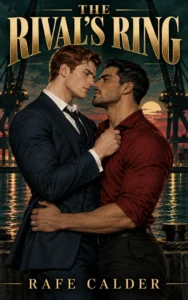
The Rival’s Ring
The ring was supposed to stop a war. The man who put it on me was supposed to stay my enemy.

The Assassin’s Alibi
Someone put us in the same bar. Nobody put us in the same bed.

Paid to the Devil
Kings of Harbor City
He owns every debt in Harbor City. I'm the only thing he keeps off the books.

His Rival’s Bodyguard
Kings of Harbor City
My father died with his name on his lips. Now he's the only man keeping me alive.
Never Miss a Release
Get new release alerts, exclusive bonus content, and reader-only giveaways.