
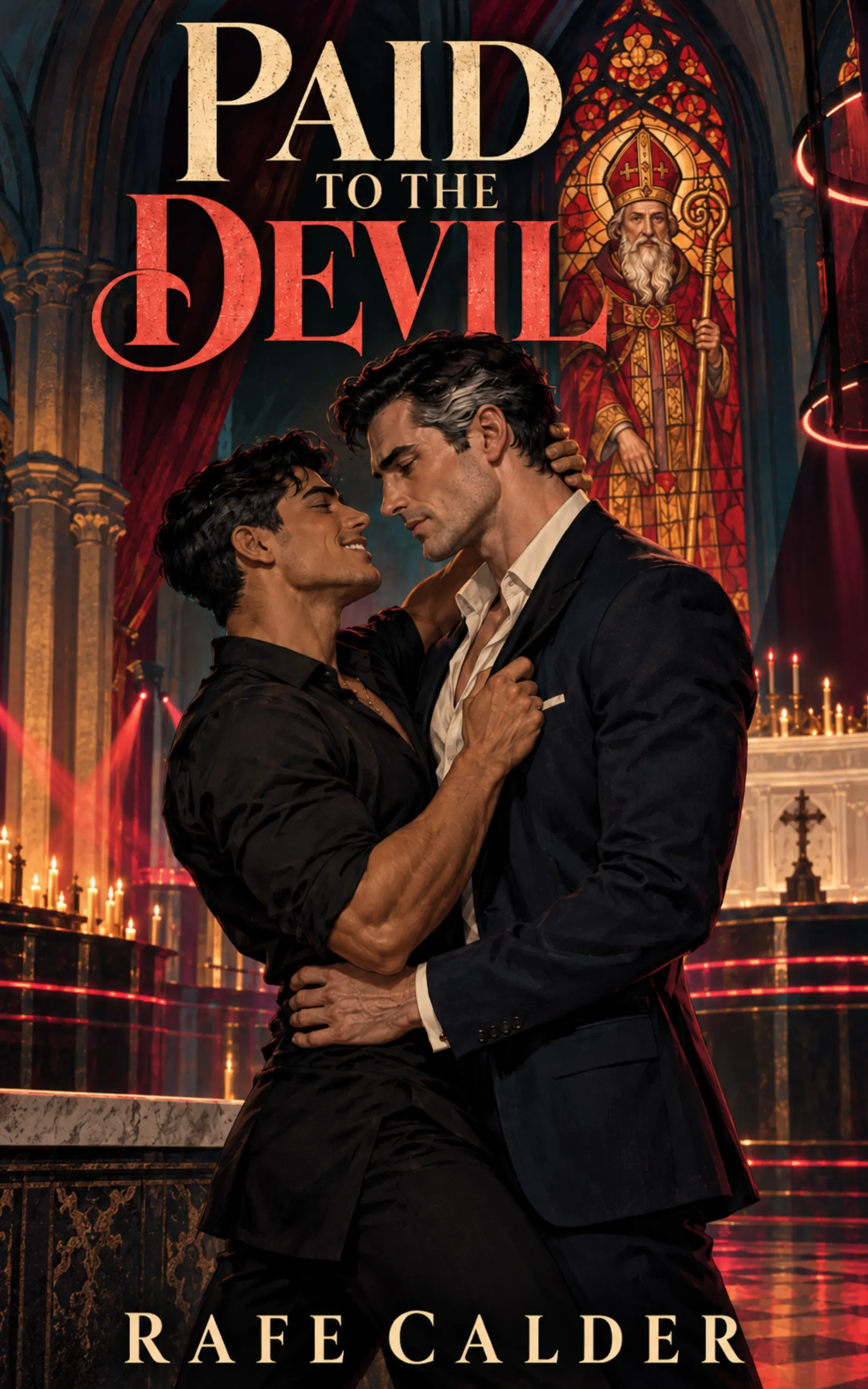
Paid to the Devil
A Dark MM Mafia Romance
by Rafe Calder
Shop the ebook · Shop the audiobook
Available at all major retailers
Pairing: MM
Heat: 🌶️🌶️🌶️🌶️🌶️ Inferno
Series: Kings of Harbor City, Book 2
Tropes: Mob Banker × Nightclub Owner, Age Gap, Forced Proximity, Thirty-Day Contract, Possessive Older Man, Brat and Tamer, Praise and Control, Touch Him and Die, Protector, Enemies to Lovers, He Falls First, Morally Grey Hero
He owns every debt in Harbor City. I’m the only thing he keeps off the books.
My father left me three things: a nightclub, a funeral bill, and a debt big enough to bury me next to him.
Then Dorian Vale walked into what was left of my bar at four in the morning and offered me thirty days.
Thirty days of his protection. Thirty days on his arm in rooms where men decide who keeps breathing. Thirty days to prove my father didn’t steal four million dollars from the most dangerous people on the waterfront.
They call him the Devil because he never forgets what he’s owed. He’s eleven years older than me, he’s never raised his voice in his life, and he has one rule he made very clear before I signed.
I don’t take bodies as payment, Mr. Reyes. If you’re ever on your knees for me, it will be because you asked.
So I asked.
Now I’m in his bed, in his ledger, and in the crosshairs of the men who actually took that money. And the Devil who swore he’d never buy me just did something behind my back that I’m not sure I can forgive.
Because my father didn’t steal Dorian’s money.
He hid it from the man who did.
Paid to the Devil is a dark, high-heat MM mafia romance with an eleven-year age gap, a possessive older banker and the mouthy bartender who can’t be bought, forced proximity, a thirty-day contract with one clause that matters, on-page violence, a lot of on-page spice, no cheating, and a guaranteed HEA. Dual first-person POV. Book 2 of Kings of Harbor City. Can be read as a standalone.
You’ll love this book if you enjoy:
✅ A mob banker who has never raised his voice and keeps every debt in green ink
✅ A mouthy nightclub owner who pours a fourteen-month-waitlist rum on a collector’s shoes
✅ One rule: he doesn’t take bodies as payment, so you’ll have to ask. In a complete sentence
✅ A waterfront chapel turned nightclub: an altar bar, confessional booths, and a choir loft behind one-way glass
✅ Eleven-year age gap, praise, control, “eyes on me,” and a gray silk tie on a walnut headboard
✅ A hand on the back of the neck in a room full of dangerous men
✅ A dead father’s second set of books, hidden inside a plaster saint
✅ The Devil learning to ask first, and to give up control exactly once
✅ He falls first, no cheating, 🌶️🌶️🌶️🌶️🌶️ heat, HEA guaranteed
⚠️ Content Warning: This novel contains explicit sexual content (graphic MM scenes, including praise, edging, consensual power exchange, light bondage with a necktie, and sex without condoms after on-page testing), on-page violence (vandalism, a break-in, an armed assault, a gunshot graze, a man struck in the face with a bottle), threats and intimidation of employees, the death of a parent (before the book opens, recounted) and complicated grief for a dishonest father, organized crime, embezzlement and financial coercion, a love interest who makes a major financial decision behind his partner’s back (confronted and repaired on page), the past murder of two people under a character’s protection (recounted), an implied off-page killing, alcohol, and strong language. No sexual violence, no dub-con, no cheating. Intended for readers 18+.
📖 Read Chapter One Free
Not sure yet? Read all of Chapter One right here.
Chapter One: Mateo
At eleven forty on a Saturday night I had six hundred people inside a dead church, and every one of them wanted something from me.
Not a complaint. Being wanted is the one thing I’ve always been good at.
“Two palomas, a Negroni, and whatever the fuck a sexy water is,” Jun yelled down the bar.
“Soda, lime, and a wink. Charge her nine dollars.”
“For water?”
“For the wink.”
I had three shakers going and a fourth order in my head, and my hands knew the work so well I could spend my attention on the room. That’s the actual job. Any idiot can pour. What you get paid for is knowing that the bachelorette party by the pillar is one round from crying, that the two finance boys at the rail are going to fight or fuck and haven’t decided which, and that the ice well on the left is going to run dry in eleven minutes unless somebody finds Petey.
“Petey! Ice!”
“On it, boss!”
He was not on it. He was nineteen and staring at a go-go dancer. I threw a lime at his head and he became on it.
Saint was built in 1891 as the Seamen’s Mission of Pier 9, a place for sailors to pray before the harbor killed them. A hundred and thirty years later the congregation was gone, the roof leaked, and the city was going to let the whole thing slide into the water. I bought it at twenty-five with every dollar I’d saved since I was sixteen, a loan I had no business qualifying for, and a level of confidence that should have been medicated.
I kept the bones. The nave is the dance floor now, all that vaulted dark with the bass climbing up into it. The two confessionals along the east wall got velvet curtains and bottle service, and people pay four hundred dollars to sin in them, which I think is funny and my sister thinks is going to get me struck by lightning. The choir loft is my office, behind a sheet of one-way glass, so I can look down on all of it like a small, underpaid god.
And the altar is the bar.
Twenty-two feet of marble on a raised step. Best seat in the house, and the only place in the world I’ve ever felt completely sure of myself. Above it, where the cross used to hang, a stained-glass St. Nicholas stands with one hand raised over a ship. Patron saint of sailors. On Saturdays I light him red from behind, and he glows over the whole room, blessing every bad decision in it.
“Mateo.”
I knew the voice before I turned. Deep, amused, attached to a shipping lawyer named Grant who had a jaw like a cinder block and tipped like he was apologizing for something.
“Counselor.” I slid a coaster in front of him. “Usual?”
“Depends.” He leaned in on his forearms. Good forearms. Rolled cuffs, heavy watch, a little silver coming in at the temples. “What time does the owner get off?”
“The owner gets off whenever he feels like it. He closes at two.”
Grant laughed, low, and let his eyes drop to my mouth and stay there. I built his old-fashioned without looking at it and let him look at me, because it was free and it kept him ordering the eighteen-dollar bourbon.
A month ago I’d have said yes. I’d have taken him up the back stairs at two fifteen and let him bend me over my own desk with the house lights coming up through the glass, and I’d have enjoyed the hell out of it, and I’d have had him out the side door by three with a kiss and no phone number. That was the system. It worked great. Nobody ever stayed long enough to ask me for anything.
Tonight I looked at that jaw and those hands and felt nothing at all below the belt. Somebody had cut the power to the whole block.
“Rain check,” I said, and set the drink down. “That’s still going on your tab, though. I’m flirting, not running a charity.”
“You wound me.”
“You’d pay extra for that.”
He lifted the glass to me, and I was already three steps down the bar.
Three weeks. That was how long it had been since they put my father in the ground at Holy Cross, and that was how long I’d been running on espresso, spite, and a customer-service smile.
Nadia came through the service gate with a tablet in one hand and the expression she’d been born with, which was I told you so, issued in advance.
“Door’s at five-eighty. Kofi’s holding the line. Fire marshal says six-fifty, and I say six hundred, because I’d like to go one calendar year without lying to a man in a uniform.”
“Six-twenty.”
“Six hundred.”
“Six-ten, and I’ll do the liquor order myself tomorrow.”
“You’ll do the liquor order yourself tomorrow anyway. You haven’t slept more than four hours a night since the funeral, and you’ve reorganized the walk-in twice.” She set the tablet on the marble and looked at me over it. Thirty-five, shaved head, gold hoops, a stare that had ended bar fights without her standing up. “When’s the last time you ate something that wasn’t a garnish?”
“I had olives.”
“Mateo.”
“Several olives.”
“I’m ordering you a sandwich, and you’re going to eat it in front of me like a toddler.”
“God, I love it when you’re bossy.”
“I’m the wrong gender for that to get you anywhere.” She took the tablet back. “Six hundred.”
She was gone before I could counter. I’d hired her out of a hotel bar uptown three years ago by promising she’d never have to wear a blazer again, and she’d been saving my life on a weekly basis ever since.
I reached for the mezcal, and my knuckles brushed the other St. Nicholas.
He lived on the back bar between the amaros and the register. Two feet of chipped plaster with a paint job like a carnival prize. Red robe, gold miter, one eye slightly bigger than the other, so he always looked like he was judging your order. My father had carried him in under his arm on opening night, an hour late and smelling like somebody else’s cigar.
For luck, mijo. Every ship needs one.
Then he’d kissed my forehead, borrowed two hundred dollars out of the till, and left before the first set.
That was Luis Reyes, start to finish. He showed up with a gift and left with your wallet, and somehow you were the one saying thank you.
His contribution to Saint was that he handled the bank. That was the deal. He knew a guy, he got me the loan, and on the first of every month I wired him the payment and he passed it along. It worked for three years, which should have been my first clue, because nothing involving my father had ever worked for three years.
The week I buried him, I got a letter. Four months in arrears. Four payments I’d made and he’d kept.
I hadn’t told Elena. I hadn’t told Nadia. I’d reorganized the walk-in. Twice.
I flipped my bar blade across my knuckles, caught it, and popped the cap off a beer.
“You’re a shitty lucky charm,” I told the saint.
He judged my order.
I felt Pike before I saw him.
A room has a pulse, and when you’ve stood at the center of one long enough, you notice when it skips. A pocket of quiet opened near the doors and moved through the crowd in a straight line, people stepping out of its way without knowing why. Kofi’s voice came through my earpiece, tight.
“Boss. Four coming in. They didn’t pay and I didn’t stop them. You’ll see.”
I saw. Three of them were built like loading equipment. The fourth was the one who mattered.
Mid-forties. Soft through the middle and hard everywhere it counted, in a camel overcoat nobody had told him was too warm for a nightclub. Thinning sandy hair. A pleasant, forgettable, insurance-adjuster face. He walked up the altar step like he’d been invited and laid one hand flat on my marble.
“Mateo Reyes.”
“That’s what it says on the liquor license.” I gave him the smile. “What can I get you?”
“Gareth Pike.” He didn’t offer the hand. “I was a business associate of your father’s.”
“Then you have my condolences. Most of his business associates ended up needing them.”
His eyes crinkled. He liked that, and I didn’t like that he liked it. “He told me you were funny.”
“He told people a lot of things. Drink?”
“I’m working.” He drew an envelope out of the overcoat, set it on the bar between us, and squared it with one fingertip. “Your father held a line of credit with some people I represent. Private people. At the time of his unfortunate passing, the balance stood at two million, three hundred thousand dollars.”
The bass dropped out for a bar and came back in. I stood there with a shaker sweating in my fist.
Then I laughed. It was a good one, too. Convincing. “Two point three. My father. Luis Reyes drove a nine-year-old Buick and died owing me two hundred bucks from opening night.”
“I don’t doubt it.”
“So you’ve got the wrong dead guy.”
“I’ve got his signature.” Pike tapped the envelope. “And I’ve got his son, operating a business his father helped capitalize, on a property carrying a commercial note that is, as of this month, one hundred and twenty days delinquent. Six hundred and ten thousand outstanding. My clients have taken an interest in that as well.”
Cold went down the back of my neck one vertebra at a time. Nobody knew about the note. I had not said that number out loud to another human being.
“That’s between me and my lender.”
“Lenders sell paper, Mr. Reyes. It’s what paper is for.” He said it gently, a man explaining an ATM to a child. “I’m not unreasonable. Two point three, plus the note brought current. You have fourteen days.”
“And if I don’t happen to have three million dollars in my other pants?”
“Then on the fifteenth day, I own a church.” He glanced up at the red saint, then around the room, slow. Pricing it. “Lovely bones. Shame about the zoning.”
“Debts don’t inherit.” My voice came out even. I was proud of that. “I tend bar. I’m not stupid. You can’t hang a dead man’s marker on his kid.”
“In a courtroom, no.” He agreed so easily it scared me worse than an argument would have. “We’re not in a courtroom. We’re on the waterfront.”
He took out his phone.
For a second I thought he was going to show me something. Instead he raised it, unhurried, and took a picture of Jun.
Jun froze with a bottle in each hand.
Pike turned ten degrees. Petey, hauling an ice bucket, caught the flash full in the face. Click. Imani up in the DJ booth. Click. Dre at the service well, who had a two-year-old at home and a wife on nights at Harbor General. Click. He was thorough about it. He panned across my floor like a man taking inventory, and every person he pointed that lens at was somebody whose rent I paid.
“Pretty staff,” he said. “Young. I like to know who I’m dealing with.”
My hand had closed around the bar blade. I made it open.
I will joke through a root canal. I joked at my mother’s wake, and I joked at my father’s, and I’d been planning to joke my way through this too, right up until that phone came out. But I have one line, and everybody who’s ever worked for me knows exactly where it is.
“Sir.”
Nadia had come up the step on his blind side, tablet tucked under her arm, calm as a Tuesday. “We don’t allow photography of staff. I’ll need you to delete those and step away from the bar.”
Pike looked at her the way he’d looked at the building.
“And you’d be the manager.” He lifted the phone. Click. Then he reached out with his free hand, took her chin between his thumb and two fingers, and turned her face toward the light like he was checking a horse’s teeth. “Nadia, isn’t it? Brooks. Marlow Street. Third floor, in the back.”
Nadia didn’t move. Her eyes cut to me, and they said, very clearly, do not.
So I didn’t. I did the other thing.
“You know what, Gareth?” I let go of the steel and showed him every tooth I owned. “You’re right. I’m being rude. A man comes all the way down to the pier, he’s working, he’s thirsty. Let me pour you something special.”
I turned my back on him, which took everything I had, and reached past the plaster saint to the top shelf.
Santa Aldonza Twenty-One. Guatemalan rum, finished in sherry casks. There were maybe forty bottles of it in Harbor City, and I’d sat on a waitlist fourteen months for mine. I poured three fingers into a crystal rocks glass, heavy and slow, so he could watch the legs run down the inside.
I carried it out through the service gate myself, like he was royalty, and stopped a foot in front of him. He was shorter than he’d looked from behind the marble.
He let go of Nadia’s face and held his hand out for it.
“On the house,” I said, and turned my wrist.
A hundred and ten dollars’ worth of rum went down the front of his trousers and all over a pair of tan suede loafers.
Suede. I could have kissed him.
Nobody within ten feet of us was dancing anymore.
“Shit,” I said. “Butterfingers. That’s going to stain. Kofi!”
Kofi was already there, six foot five of former longshoreman with his hands folded in front of him. Behind him stood the two off-duty cops I paid to hold up my doorframe on weekends, who had finally gotten bored enough to wander over. Pike’s three forklifts looked at the badges clipped to their belts and did some arithmetic.
“Mr. Pike was just leaving,” I said. “He skipped the cover, so go ahead and comp that. I’m feeling generous.”
Pike studied his shoes for a long moment. When he looked up, the pleasant face was still on, but there was nobody home behind it.
“Fourteen days.” He picked the envelope up off my bar, tucked it into my shirt pocket, and patted it twice, right over my heart. “You’ve got your father’s smile, you know. He had it right up until he didn’t.”
Then he walked out on his own, squelching, and the hole in the crowd closed up behind him.
I turned around. Every member of my staff was staring at me.
“What?” I clapped my hands once. “It’s Saturday! Jun, you’ve got a rail six deep. Imani, baby, give me something filthy. Petey, mop.”
The bass came back up. The room breathed. Ninety seconds later, nobody on that floor remembered there’d been a hole in it.
Nadia hadn’t moved. There were two white marks on her jaw where his fingers had been.
“He knew my address,” she said.
“I know.”
“Mateo. What the hell was that?”
“A misunderstanding. I’ll handle it.”
“That’s the exact sentence you say right before you stop sleeping for a month.”
“Then you should be used to it by now.”
I squeezed her shoulder and went back behind my altar. I poured drinks until two, and I didn’t let my hands shake once.
By four in the morning, Saint was a church again.
That’s the part nobody sees. House lights up, floor tacky, six hundred people’s worth of perfume and sweat going stale in the rafters. No music. Only the ice machine, and the harbor slapping at the pilings under the floorboards. I’d sent everybody home in pairs. Kofi walked Nadia to her car and texted me a thumbs-up, and I told him to tail her all the way to Marlow Street, and he wrote back already am.
I sat down on the altar step with the cash drawer in my lap and counted.
It had been a great night. One of the best since we opened, honestly. Door, bar, bottle service, both confessionals booked back to back by a birthday party that drank like they had a grudge against their own livers. I counted it twice, banded it, and wrote the figure on the deposit slip.
Twenty-three thousand, four hundred and twelve dollars.
I looked at that for a while.
Then I did the other math. The kind I’m good at, the kind I do in my head while I’m shaking a daiquiri. Take out payroll. Take out the liquor order, the DJ, the cops on the door, the insurance, the linen service, the guy who resurrects the walk-in every time it dies. On a great Saturday, Saint cleared me maybe nine grand. Four great Saturdays a month, if nobody got sick and nothing broke.
Six hundred and ten thousand to keep the doors. Two point three million on top of that, for a debt that wasn’t mine, to a man who knew which floor my manager slept on.
Fourteen days.
I could sell the sound system. I could sell what was left of the Aldonza. I could sell my car, which was worth less than the sound system. I could call Elena, who would know exactly what to do, and who would look at me with our mother’s eyes while she did it and say what did he do this time, Teo, and then I’d have to tell her I had handed Luis Reyes money every month for three years and never once asked for a receipt.
I pulled the envelope out of my pocket. One sheet, a column of numbers, and at the bottom, my father’s signature. I’d have known it anywhere. He always made the L too big, like he was trying to convince somebody.
“You son of a bitch,” I said out loud.
The words went up into the vault and didn’t come back.
I waited for the joke.
There’s always a joke. That’s how I’m built. Something goes wrong and a line shows up right on time, and I say it, and everybody laughs, and that’s the whole act. If they’re laughing, nobody’s looking at how scared you are. I’d had one for the arrears letter. I’d had one for the casket. Finally, a box he can’t talk his way out of. I’d said it to the funeral director, and the poor man had looked at me like I needed a priest.
I sat on the floor of the only thing I’d ever built and waited, and nothing came.
My mother’s watch said 4:17. Thin gold, scratched crystal, on a leather strap I’d had to replace because her wrist was half the size of mine. Rosa Reyes worked doubles at the cannery for nineteen years and never borrowed a dollar from anyone. She would have loved this place. She’d have crossed herself coming through the doors and then asked me where I kept the good tequila.
I pressed the heels of my hands into my eyes until I saw colors.
Somebody knocked.
Three raps on the front doors, evenly spaced. Not a drunk. Drunks pound.
I was on my feet with the bar blade in my fist before I’d decided to stand. Which was stupid. It’s a flat piece of steel for opening beer. But it was that or the deposit bag.
I went down the nave in my socks, past the confessionals, and put my eye to the seam between the doors.
One man. Slim, gray suit, gray tie, at four in the morning, on a pier. A black sedan idled at the curb behind him with its lights off. He was holding a box in both hands like an altar boy.
I opened up six inches and kept my shoulder behind the wood. “We’re closed.”
“Mr. Reyes.” It wasn’t a question. “Delivery.”
“From who?”
He held the box out. Matte black, no ribbon, about the size of a shoebox stood on end. When I didn’t take it, he simply waited, with the patience of somebody who got paid by the hour to outlast people like me. The neon buzzed over our heads. S-A-I-N, and then the T, stuttering, the way it had for a year because I couldn’t spare six hundred bucks to fix it.
I took the box.
“Good night, sir,” said the suit, and he went back to his car, and that was all. No message. No threat. The sedan pulled away dark and didn’t switch its headlights on until it reached the corner.
I threw both bolts, carried the thing back up the nave, set it on the marble under St. Nicholas, and stood there looking at it like it might tick.
It didn’t tick. I lifted the lid.
Santa Aldonza Twenty-One. Sealed, wax over the cork, nested in black silk.
My stomach turned over.
Forty bottles in the city. Fourteen months on a waitlist. And five hours ago I’d poured three fingers of it over a man’s shoes in front of six hundred people. Somewhere in that crowd, somebody had been watching closely enough to read the label. Somebody had watched me do it, thought it over, and gone out in the middle of the night to find another one, just so I’d know.
There was a card tucked under the neck of the bottle. Heavy black stock, three lines, written by hand in dark green ink. Small, upright letters. Not one wasted stroke.
Vale Capital.
Monday. 9 a.m.
Bring your books.
No signature. It didn’t need one.
I knew the name. Everybody did. You heard it the way you hear about weather, said low, by people looking somewhere else. Vale bought the note on the Corrigan brothers’ fish house, and now it was condos. Vale sat down for one lunch with the man who ran half the unions on the east docks, and that man retired to Florida the same week, very suddenly, for his health. Nobody could tell you what Dorian Vale looked like. They could tell you he had never once raised his voice. They could tell you he kept a ledger, by hand, and that your name was either in it or it wasn’t, and there was no third thing.
My father used to go quiet when that name came up. Luis Reyes, who never shut up a day in his life.
Nobody called him the Banker, or the Boss. On the waterfront they called him the Devil, and they didn’t say it like a joke.
I laid the card down next to twenty-three thousand dollars and a plaster saint with one eye bigger than the other.
Pike had given me fourteen days and a number. That, I understood. That was a shakedown, and I’d grown up around those.
This man had sent me a gift. And I’d learned before I could walk what a gift costs.
Everyone on the waterfront knows what it means when the Devil asks to see your books.
Want to keep reading? The full novel is available now.
🔥 Want an EXCLUSIVE Bonus Chapter?
Dead Monday — A scene TOO HOT for the bookstore
Six months after the last chapter, the Devil loses a bet. The price is one dark Monday in an empty church: no rules of his, no complete sentences, one word at a time, and his own gray silk tie around his wrists on the rail of the DJ booth. Mateo does the counting this time. Nobody has to be quiet.
More from Rafe Calder
Browse all Rafe Calder books.

Crown Him in Blood
He handed me a loaded gun so I'd follow him home. He never told me what else he was carrying.
The Rival’s Ring
The ring was supposed to stop a war. The man who put it on me was supposed to stay my enemy.

The Assassin’s Alibi
Someone put us in the same bar. Nobody put us in the same bed.
Paid to the Devil
Kings of Harbor City
He owns every debt in Harbor City. I'm the only thing he keeps off the books.

His Rival’s Bodyguard
Kings of Harbor City
My father died with his name on his lips. Now he's the only man keeping me alive.
Never Miss a Release
Get new release alerts, exclusive bonus content, and reader-only giveaways.