
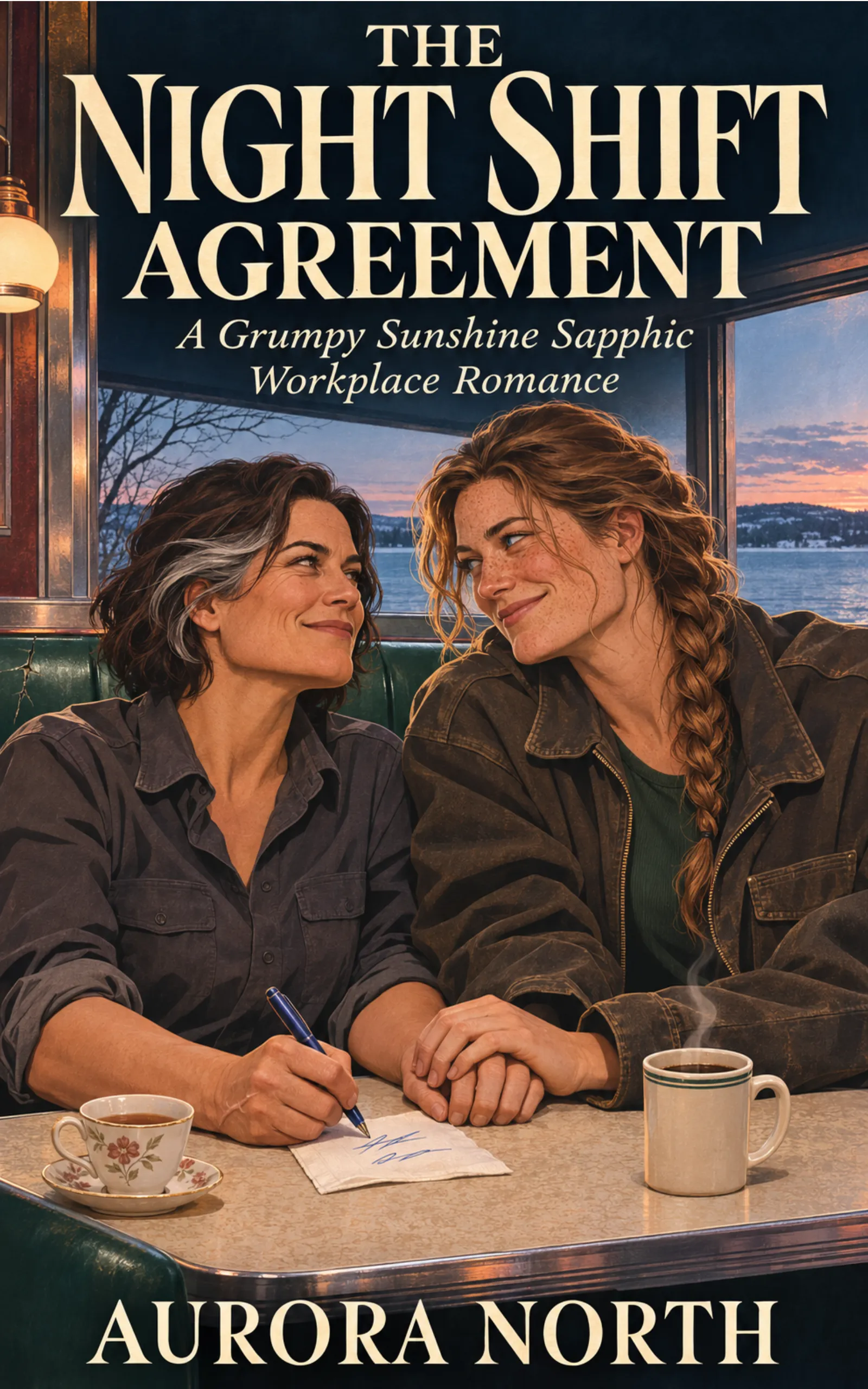
The Night Shift Agreement
Sapphic Age-Gap Grumpy/Sunshine Workplace Romance
by Aurora North
Available at all major retailers
Pairing: FF (Sapphic)
Heat: 🌶️🌶️🌶️🌶️🌶️ Inferno
Tropes: Age Gap, Grumpy/Sunshine, Coworkers to Lovers, Secret Relationship, Snowed In, One Bed, Older Heroine, Competence Kink, Voice & Instruction Kink
Nothing at the plant. Nobody knows. Off the clock, ask for what you want.
Dawn Mitchell has run the overnight shift at the Bellhaven water plant for six years. She likes complete handovers, quiet control rooms, and coworkers who don’t mistake silence for an invitation.
Erin Walsh transfers onto her crew with a thick braid, a freckled grin, and a frankly irritating habit of being good at the job. She doesn’t chatter. She doesn’t need Dawn’s help. She repeats every instruction back perfectly, with a little smile that makes Dawn forget the instruction.
So they make rules. Five of them, written on a diner napkin at seven in the morning: nothing at the plant, nobody knows until they both say so, and off the clock, ask for what you want.
Then a lake-effect storm traps Erin at Dawn’s house with one bed, and asking turns out to be the easy part.
Because Dawn Mitchell will give Erin anything: her bed, her nights, her undivided, devastating attention. Anything except the one thing that matters, a say in the decisions Dawn makes alone.
You’ll love this book if you enjoy:
✅ A grumpy, competent older heroine who never hurries anything
✅ A sunshine heroine who sees straight through her
✅ Coworkers to lovers with strict rules and a secret relationship
✅ Snowed in, one bed, and a radio voice that says repeat it back
✅ Instruction, voice and competence kink (🌶️🌶️🌶️🌶️🌶️)
✅ HEA guaranteed
⚠️ Content Warning: This novel contains explicit sexual content (graphic FF scenes including strap-on play, vibrator edging, light restraint and phone sex), strong language, workplace relationship disclosure, references to a past breakup and a parent’s death, and relationship conflict. Intended for readers 18+.
📖 Read Chapter One Free
Not sure yet? Read the full first chapter right here.
Chapter One: Dawn
Dawn Mitchell could tell who had worked day shift by the handwriting in the log before she read a single word of it.
Marty Kowalczyk wrote like a man signing a check he couldn’t cover. Big loops, slanting downhill, every line drifting toward the margin as though it wanted to clock out early. Tonight it had. The last four hours of the day log were a single entry:
All normal. F4 wash 1520 (man). See me.
See me. Marty had left at six because his daughter had a volleyball thing, and the afternoon operator had covered the last hour, and the afternoon operator was Hollis, who was retiring in February and had stopped writing anything down around Labor Day.
So there was no one to see.
Dawn set her tea on the console — left side, handle out, nowhere near anything with a circuit board — and pulled up the trend screen for filter four. 6:41 p.m. Nineteen minutes until handover. She liked to have the whole plant in her head before anyone tried to hand it to her.
The control room at Harbor Road was a long horseshoe of screens under a dropped ceiling, the old SCADA displays all gray-on-gray, like the software had been designed by someone who had heard of color and disapproved. Through the window on the left wall, the filter gallery ran away in a row of concrete bays and steel railings, lit a flat sodium yellow. Behind the building, the lake had already gone black. It did that early in October. By Christmas it would be black by five, and the wind off it would come through the seams of the intake building like it had a personal grievance.
She loved it here. She would not have said so out loud to anyone, because it would have come out sounding like something she’d need to explain, and she did not like explaining things that were simply true.
Filter four had been washed manually twice since Saturday. She frowned at the headloss curve, made a note, and glanced at the corkboard by the door.
The memo had gone up Friday. CONTROLS SYSTEM UPGRADE — PROJECT KICKOFF. Kestrel Automation, new SCADA, new screens, training to be scheduled, cutover targeted for January. Below the printed text, in Paul Turner’s blunt pencil: Volunteers for documentation review, see me.
Below that, in red pen, in Linda Park’s small furious capitals: POST IT.
Dawn’s mouth moved at one corner. She picked up her tea.
The new transfer started tonight.
Paul had told her Friday, standing in the doorway of the control room with his car keys already in his hand. Walsh. Erin. Eight years at Corrin Falls, same license grade as you, good references. She’s going to be fine, Dawn. Don’t scare her.
I don’t scare people.
You scared Kyle.
Kyle had narrated his own sandwiches. Kyle had once spent forty minutes of a night shift explaining the plot of a movie he had not finished watching. Dawn had not scared Kyle. She had simply stopped answering him, and eventually Kyle had bid onto days, where there were more people to absorb him.
Transfers came in two kinds. Quiet ones who needed telling where everything was. And talkers, who needed telling nothing and told you everything. Dawn had survived both. She preferred the first. She expected the second, because the universe rarely consulted her.
At 6:52 the control room door opened.
The woman who came through it had to duck slightly under the frame of the inner door, which Dawn noticed first and resented second, for no reason she could have defended. Five-nine, maybe more. Sturdy through the shoulders. Light brown hair in a thick braid pulled forward over one shoulder of a plant-issue jacket so new it still had fold creases across the chest. Freckles across the bridge of her nose. A travel mug of coffee roughly the size of a fire extinguisher.
“Walsh,” the woman said. “Erin. You’re Mitchell?”
“Dawn.”
“Dawn.” A nod, like she was filing it.
Dawn waited for the rest. The so how long have you been here, the I’ve heard so much about you, the wow, this setup is so different from Corrin Falls that would bloom into twenty minutes on the virtues of Corrin Falls.
Instead, Erin Walsh set her coffee down on the far side of the console — right side, handle out — leaned over Dawn’s shoulder to look at the trend screen, and said, “Filter four’s been washed by hand twice since Saturday. Is that a local habit, or is it hitting headloss early?”
Dawn turned her head.
Erin was close. Not rudely close. Close the way you lean in to read a screen. Close enough that Dawn could smell coffee and cold air and something under it, clean and faintly green, like crushed stems.
“Both,” Dawn said. “Marty doesn’t trust the timer. And it’s been running dirty since they rebuilt the underdrain in August.”
“So I should watch it. Not wash it.”
“Watch it.”
“Okay.”
And then Erin straightened up, pulled the day log across the console toward her, and read it.
That was all. She read it. Marty’s downhill handwriting, the chemical feed rates, the lab results from the afternoon grab samples. She read with her lower lip caught lightly in her teeth and one finger tracking down the margin, and she did not say a single word for four full minutes.
Dawn knew it was four minutes because she counted. She had nothing else to do with the silence. It sat there between them and did not need anything.
That was the first thing that threw her.
Hollis gave the verbal handover at seven, the way he had given it for twenty-two years: standing up, coat on, car keys in his fist.
“Water’s wet. Lake’s still there. Four’s being a bitch, but Mitchell knows. Don’t touch my chair.” He looked at Erin. “You the new one?”
“I’m the new one.”
“God help you. She’s the best operator in the building and she says about nine words a night.”
“I can work with nine words,” Erin said.
Hollis barked a laugh and left. Tom Rivera came in on the tail of the cold air he let out, cheeks red from the lot, already talking.
“You’re the new one! Tom. Hi. Welcome. Don’t let her scare you.”
“I don’t scare people,” Dawn said.
“She scares people,” Tom told Erin, earnestly.
Erin looked at Dawn. Dawn looked back. Something happened at the corner of Erin’s mouth, not quite a smile — a smile considering whether it was worth the trouble.
“She hasn’t scared me yet,” Erin said.
“Give it till three a.m.,” said Tom, and went to hang up his coat.
Night crew B was four people, three on any given night. Linda was off tonight, her son’s band concert, which she had scheduled around since August because Linda scheduled things the way other people breathed. So it was Dawn, Tom, and the new one. Twelve hours. A city of sixty thousand people asleep and thirsty, and the three of them between it and the lake.
Paul had asked her to walk Erin through the building. Not train her — Paul had been careful about the word. Erin held the same license grade Dawn did and had eight years on her own plant’s floor. She did not need training. She needed to know where Harbor Road kept its things and which of its old pipes had opinions.
So at eight, Dawn took her on the walk-down.
The filter gallery first, the long echoing run of it, water moving under the grating with a sound like breath. Then the chemical feed room with its drums and pumps and laminated warning placards. The clearwell hatch. The high-service pump room, where the big motors hummed at a pitch Dawn could feel in her back teeth. The lab, small and bright and smelling of reagent.
Erin asked questions. That was the second thing.
Not the kind of questions people asked to fill air. The other kind. Where does the backwash waste go — lagoon or sewer? Who calibrates these, you or the afternoon guy? If the radio dies in the intake building, is there a hardline? Short questions, and then she shut up and listened to the whole answer, and when Dawn stopped talking she did not rush to fill the gap. She looked at whatever Dawn had pointed at for another second, as if she were fixing it in place.
In the high-service room, Erin pushed her sleeves up to her elbows to read a pump nameplate behind a guard. Her forearms were strong and lightly freckled, and there was something dried and pale gray rimming one thumbnail and caught in the creases of her knuckle.
Dawn looked at it a beat too long.
“Clay,” Erin said, without looking up. “Pottery class. Tuesdays. I’m terrible at it.”
Dawn said nothing.
Erin read the nameplate, nodded to herself, and pushed her sleeves back down. “I’m getting better at being terrible, though. My mugs used to fall over. Now they just lean.”
Dawn did not ask anything else. She filed it. Tuesdays. Clay. Mugs that lean. She filed it the way she filed the pressure on the number two pump and the hairline crack in the north wall of the chemical room, under things that are true about this building now, and she walked on.
She had worked with attractive women before. Linda was objectively beautiful and had once threatened to file a grievance over the thermostat. It had never been a problem. Dawn kept her attention where it belonged, and it stayed there, and the job got done.
That was all this was. A good operator, a new face. The rest of it — the green smell, the lip caught in her teeth, the steady blue way she looked at things — was not data. Dawn noted it and did not log it.
At eleven, Tom was out at the intake building and Dawn keyed the radio.
“Tom. On your way back, pull a grab at the clearwell and call me the residual. Repeat it back.”
The radio crackled. “Grab at the clearwell, call you the residual.”
“Thank you.”
When she set the radio down, Erin was watching her from the other end of the console, chin propped on her fist.
“You do that with everybody?”
“Closed loop,” Dawn said. “Everybody hears the instruction twice. Nobody hears it wrong.”
“Corrin Falls just yelled.”
“How’d that go?”
“We had a guy wash the wrong filter for three weeks.”
Dawn’s eyebrows went up before she could stop them.
“He was very confident,” Erin said gravely. “Confidence goes a long way at Corrin Falls.”
Dawn turned back to her screen so her face would have something to do. Behind her, quiet and unbothered, she heard Erin pick up her enormous coffee and drink.
At one in the morning, filter four’s effluent turbidity ticked up a hair, nothing dangerous, the kind of number that meant watch me. Dawn frowned at it, and opened her mouth to say Walsh, can you—
Erin was already standing.
“Filter four turbidity,” Erin said, pulling the log sheet toward her and clicking her pen. “Logged hourly till oh-four-hundred.”
Word-perfect. Unprompted. Every syllable of the instruction Dawn had not given yet, handed back to her before she’d finished building it.
And at the very end, at the corner of her mouth, a small smile.
Not a big one. Not a performance. It was the smile of a woman who knew exactly what she had just done and was quietly pleased with herself about it.
Something in Dawn went still.
Her hand stopped on the mouse. A slow, low warmth moved through her, starting somewhere under her sternum and settling much lower, and for one long second she did not do anything at all except look at Erin Walsh’s mouth.
Then she looked back at the screen.
“Good,” she said.
Erin walked out toward the filter gallery with the log sheet tucked under her arm. Dawn watched the trend line for filter four for a full minute without seeing a single number on it.
Not your business, she told herself, in the voice she used on the radio. Repeat it back.
The worst stretch of a night shift was three to four in the morning. The plant was running itself, the rounds were done, the coffee was stale, and your body began to send you angry little memos about what time it was.
Dawn did the crossword. She did it in pen, in the folded back section of the paper she bought at the gas station on Harbor Road every night, and she did it at three a.m. because it gave her hands something to do and her brain something to chew that wasn’t headloss.
Tonight eight across was giving her trouble.
Saying little. Eight letters. She had the second letter, A, from alas, and nothing else. She tapped the pen against the page. Against the page. Against the page.
From the other end of the console, without looking up from her log sheet, Erin said, “Taciturn.”
Dawn looked up.
Erin made a notation, checked the clock, made another. “Eight across,” she said. “You’ve been tapping your pen on it for four minutes.”
Dawn looked down at the grid. T-A-C-I-T-U-R-N. It fit. It fit so precisely, crossing alas and nacre and thorn, that it was clearly the answer, and also clearly a description, and Erin had delivered it in the exact neutral tone Dawn used to read pump pressures.
Dawn wrote it in.
“I wasn’t stuck,” she said.
“Okay.”
It was not the okay of agreement. It was the okay of a woman setting a thing down on a shelf where both of them could see it.
Tom came back from the break room with a fresh cup and a granola bar in his teeth. Erin got up to refill her coffee, came back, and paused beside Dawn’s mug, looking down at the tea bag tag hanging over the rim.
“Earl Grey,” Erin read. “On nights.”
“Every night.”
“No coffee?”
“Coffee makes me talk.”
Erin looked at her for a long moment, completely solemn. “God forbid,” she said.
Tom laughed so hard he choked on the granola bar.
Dawn did not laugh. She was a professional. But something happened in her chest that felt very much like the first stage of one, an upward catch she had to physically press down, and she had to look out the window at the black lake until it passed.
At four, on the walk back from the clearwell, Erin fell into step beside her in the cold. The sky over the plant was clear for once, the stars sharp and hard and numerous, the way they only got after midnight in October when the town’s lights were down to porch lamps.
“I like this part,” Erin said. “Nights. The whole city’s asleep and we’re the reason the faucets work when they wake up.” She tipped her head back. “Nobody knows we’re here. I like that, too.”
Dawn didn’t answer. She didn’t need to. Erin didn’t seem to expect it.
They walked back in silence, and it was the second silence of the night that hadn’t needed anything from her. Dawn was beginning to find that unsettling.
Paul called at 6:04.
He was up every day at five, coffee in a thermos by five-fifteen, at his desk by seven, and he had long since learned that the fastest way to get something done at Harbor Road was to call the night line before the day crew walked in and the building got loud.
“Dawn. Good, you’re there.”
“I’m always here.”
“Ha. Yeah.” Papers rustled. “Listen. Kestrel’s doing their documentation review on the seventeenth. It’s a Saturday, I know. They need someone who knows the old system cold, go through the tag database with their engineers, eight hours, maybe nine, I was going to see if you knew anybody who—”
“I’ll do it.”
“—might be willing to — oh. Okay. Great. Dawn, you’re a lifesaver. I’ll put you down.”
“Fine.”
“You’re the best. Get some sleep.”
He hung up. Dawn wrote 10/17 — Kestrel doc review — 0800 in the back of her notebook, under three other dates, and closed it.
From the far end of the console, eyes on the log, Erin said, “Do you ever let him finish the sentence?”
Dawn looked over.
Erin was not looking at her. She was initialing a lab entry, very neatly.
“He was going to ask,” Dawn said.
“He was going to ask if you knew anybody.” Erin finished her initials. “You don’t know what he was going to ask. You just knew you’d say yes.”
“It’s eight hours.”
“It’s a Saturday. We’re off the seventeenth.” Erin turned a page. “I looked at the rotation.”
“I don’t mind.”
“Okay,” said Erin.
There it was again. That okay. Set down on the shelf. Left there.
Dawn looked at her a moment longer than she should have, and then she pulled a blank handover sheet off the stack and began to write.
Her handovers were famous, in the small and unglamorous way that anything at a water plant could be famous. Numbered items. Every open issue, every reading worth a second look, every piece of equipment that was technically fine but had a mood. Marty had once said he could frame them. Marty had once actually framed one, as a joke, and hung it in the break room; it had stayed up for two years until someone spilled chili on it.
At seven, she walked the day crew through it, item by item, in a clear level voice. Filter four. The pump bearing on two. The residuals. The chlorine delivery due Thursday. The open item was the open item, and she handed it off so cleanly that there was nothing left on her side of the line.
Erin stood a little behind her and listened to the whole thing.
When it was over and the day crew had taken the plant and Dawn turned to get her coat, Erin was still watching her. Not the way people usually did, waiting for her to finish so they could leave. The way she’d looked at the pump nameplate. Fixing something in place.
The lot at 7:10 a.m. was raw and gray and smelled like the lake. Wind came across the asphalt in long cold pushes. The sky over the clearwell building had gone the color of dishwater with a pink stain along the bottom, which was as much sunrise as Bellhaven was going to get in October.
Dawn was halfway to her truck when she heard it.
Click. Click-click-click.
The sound a car makes when it has nothing left to give.
Three spaces down, in an elderly green Subaru with a Corrin Falls Water Authority parking sticker still on the windshield, Erin Walsh turned the key one more time — click — and then hit the steering wheel with the heel of her hand and said something through the glass that made Dawn’s eyebrows climb.
Dawn changed course.
By the time she reached the Subaru, Erin had climbed out and popped the hood and was standing with both hands braced on the fender, glaring at the battery like it had insulted her mother.
“I replaced it,” Erin said. “In April.”
“Cold snap last night. Your alternator might be going.”
“My alternator is not going. My alternator and I have an understanding.” Erin pushed a loose strand of hair off her forehead with her wrist. “Do you have—”
Dawn was already walking back to her truck. The jumper cables lived behind the bench seat, coiled over-under and tagged, because of course they did. She pulled the truck around nose to nose with the Subaru, popped her own hood, and held out the cables.
She meant to explain the order. She’d explained it to Tom twice and Kyle four times.
Erin took the cables out of her hands and clamped them before Dawn could open her mouth. Fast. Sure. Red on the dead battery. Red on Dawn’s. Black on Dawn’s. Black on a bare bolt on the Subaru’s engine block, away from the battery, exactly where it belonged.
She glanced up, caught Dawn watching, and the corner of her mouth went up.
“Red to dead,” Erin said. “Red to donor. Black to donor. Black to ground.” The smile deepened, just slightly. “Want me to repeat it back?”
Dawn’s mouth wanted to do something. She did not let it.
“No,” she said.
“You sure? I’m very good at it.”
“Start your car, Walsh.”
Erin laughed — low, surprised out of her — and got in. The Subaru coughed, caught, and settled into a rough, grumbling idle. Erin climbed back out and pulled the clamps in reverse order, which Dawn noted with a feeling she refused to classify as approval, and then she coiled the cables. Over-under. Properly.
She held them out.
Dawn took them, and for a second both their hands were on the same loop of cable. Erin’s fingers were cold-reddened across the knuckles and warm underneath, and the dried clay on her thumbnail brushed the side of Dawn’s hand.
Neither of them let go right away.
Then Erin did.
“Let me buy you breakfast,” she said. “There’s a diner, right? Tom said. June’s?”
“You don’t owe me breakfast.”
“Pretty sure that’s how jumper cables work.”
“It’s how parking lots work. Nobody owes anybody for a jump.”
Erin tilted her head and studied her, the same way she’d studied filter four’s curve. The wind pulled at her braid. The pink at the bottom of the sky had climbed into her freckles.
“That’s a very bleak worldview, Mitchell.”
“It’s a practical one.” Dawn slung the cables over her shoulder. “Drive it at least twenty minutes before you shut it off. Let it charge.”
“Twenty minutes.” Erin put two fingers to her temple in a lazy salute. “Yes, ma’am.”
“Don’t call me ma’am.”
“Noted,” said Erin, and grinned — a real one this time, the whole thing, wide and freckled and wholly unbothered — and got into her car.
Dawn stood in the lot holding a coil of cable and watched the Subaru pull out onto Harbor Road, exhaust smoking white in the cold, until it was gone.
Her house was eight minutes from the plant. She had timed it, the first week she owned it, because that was the kind of thing she did.
She pulled into the driveway and turned off the engine, and then she didn’t get out.
The bungalow sat there in the thin gray light, brick and square and hers. Turbs was in the front window, a gray lump on the back of the reading chair, glaring at the truck with the flat, total disapproval of an old cat whose breakfast was four minutes late. Behind the curtains was a quiet house — too quiet, the last three years, though she’d stopped noticing it, mostly, the way you stop noticing a pump until it changes pitch.
She sat with her hands on the wheel.
She thought about the four minutes of silence while Erin read Marty’s terrible handwriting. She thought about Tuesdays, clay, mugs that lean. She thought about taciturn, delivered in the voice Dawn used for pump pressures. About the okays, set down on a shelf where both of them could see them.
Mostly she thought about the smile.
That small one, at the corner of Erin’s mouth, at one in the morning. Logged hourly till oh-four-hundred. Handing Dawn’s own instruction back to her before she’d finished building it, perfect, closed loop, and quietly pleased with herself about it.
Dawn’s body remembered that smile better than her brain wanted it to. The slow drop of warmth. The hand going still on the mouse.
It was not her business. It was a coworker. It was a new face and a good operator and a Subaru with a bad battery, and there was nothing in any of it that needed to go in a log.
She sat there until the windshield fogged over anyway.
Then she went inside, fed the cat, drew the blackout curtains in the bedroom, and lay down in the dark at 7:41 in the morning, and for the first time in six years of nights, Dawn Mitchell could not get to sleep.
Want to keep reading? Get The Night Shift Agreement at all major retailers.
🔥 Want an EXCLUSIVE Bonus Chapter?
Open Items — A scene TOO HOT for retailers. A rented cottage on the Maine coast, fog on the harbor, and a handover sheet in Erin’s slanting hand listing exactly what she wants. Five numbered items. Dawn reads them out loud. Then she makes Erin repeat every one of them back.
More from Aurora North
Browse all Aurora North books.

Wingwoman Down
She asked her best friend for dating lessons. Every lesson proved the men were never the point.

Hands Off My Workbench
She builds things to last. She builds things to fool you. Neither of them is faking this.

The Away Game
She's never stayed anywhere longer than a season. The mechanic isn't going anywhere.

The Woman in the Main House
She owns the house. She doesn't own me. That's exactly the problem.

The Night Shift Agreement
Nothing at the plant. Nobody knows. Off the clock, ask for what you want.

Straight Sets
In tennis, love means nothing. Alison Hale is about to find out it means everything.
Never Miss a Release
Get new release alerts, exclusive bonus content, and reader-only giveaways.