

The Away Game
A Sapphic Sports Romance
by Aurora North
Free with Kindle Unlimited
Pairing: FF (Sapphic)
Heat: 🌶️🌶️🌶️🌶️🌶️ Inferno
Tropes: Athlete × Mechanic, Basketball Romance, Sports Romance, Opposites Attract, Nomad × Rooted, Tall Girl/Short Girl, Size Difference, Competence Kink, Blue Collar Heroine, Strangers to Lovers, Spain Setting, Found Family, Praise Kink, Dirty Talk, Switch Dynamic, Strap-On, Mirror Sex, Long Distance, Grovel, Dual POV, Standalone
She’s never stayed anywhere longer than a season. The mechanic isn’t going anywhere.
Reese Wallace has spent seven years playing defense for whichever Spanish club needs her, living out of furnished flats and leaving every city with nothing she can’t fit in two duffel bags. Nobody chants her name. She likes it that way.
Then her brakes start screaming.
Danielle Cooper fixes bikes out of a dented van called La Abuela under the orange trees of Puerto Clara’s market square. She doesn’t follow basketball. She doesn’t care who Reese is. She’s thirty-one, she’s two thousand euros short of the workshop she’s been saving for, and she is done with people who have one foot out the door.
So when the tall American comes back the next Saturday without the bike, Danielle asks the obvious question. What needs fixing?
Nothing, Reese says.
One dinner turns into a night in the back of a van in the rain. One night turns into a season of stolen Sundays, a cold marble counter, a wardrobe mirror and a woman who badly wants to stop being careful. And the season is ending, with a two-year contract four hours away for Reese and a lease Danielle has waited years to sign.
Neither of them is giving up the life she built. The only question is whether they can build one more, on a train timetable, in pencil.
The Away Game is a high-heat, standalone sapphic sports romance with a pro basketball player, a bike mechanic, a sunlit Spanish port city, dual POV, no cheating and an HEA guaranteed. Explicit content. 18+.
You’ll love this book if you enjoy:
✅ A six-foot-two pro guard and the much shorter mechanic who tells her to bend down
✅ Screaming brakes, a wrench salute across a market square and a first date at a harbor restaurant
✅ Competence kink both ways: one reads a game like a diagram, one can hear a bad bearing across a square
✅ A rooted woman who refuses to do all the work again, and a nomad who learns to get on the train
✅ A van in the rain, a marble kitchen counter, a wardrobe mirror and a forty-year-old carpenter’s workbench
✅ Found family: a baker best friend, a formidable Spanish mother and a whole market square that knows exactly what’s going on
✅ A long-distance HEA built on a spreadsheet, a jar of mountain honey and ticket stubs in pencil
✅ No cheating, 🌶️🌶️🌶️🌶️🌶️ heat and an HEA guaranteed
⚠️ Content Warning: This novel contains extremely explicit sexual content (graphic FF scenes throughout, including oral, fingering, face-sitting, scissoring, a strap-on, mirror sex, a hand at the throat, hair pulling, sex in a van and on a workbench, and dirty talk), strong language and alcohol. Also includes a past serious sports injury, references to a parents’ divorce and a past long-distance breakup, and a career-driven separation. No cheating between the leads. Intended for readers 18+.
📖 Read Chapter One Free
Not sure yet? Read all of Chapter One right here.
Chapter One: Reese
The kid covered his ears.
He couldn’t have been more than six, bundled into a puffer jacket two sizes too big and holding his grandmother’s hand on the promenade, and when Reese squeezed the front brake to avoid a pigeon, the noise that came out of her bicycle made him clap both mittens over his head and stare up at her like she’d done it on purpose.
His grandmother stared too. So did the pigeon, which had not moved.
“Perdón,” Reese said, to all three of them, and rolled on with her teeth still humming.
It had been like this for a week. She’d bought the bike in October from a teammate who was leaving mid-season for a club in Poland, a heavy blue city bike with a wicker basket, a kickstand that worked on alternate Tuesdays, and a bell that had never once rung. Pabellón Marítimo was eleven minutes from her apartment by bike and twenty-five by a bus that existed mainly as a rumor, so the bike had seemed like the adult choice. It had been the adult choice. Then on Monday the brakes had started to squeak. By Wednesday they shrieked. By Friday, Inés had refused to ride next to her on the way to shootaround, on the grounds that she was a professional athlete with a duty to protect her hearing.
This morning, Inés had sent a link with no greeting at all.
There’s a bike van on the market square on Saturdays. Please. For all of us.
Reese had played nine minutes the night before. Two rebounds, a charge drawn on a girl who outweighed her by twenty pounds, one entry pass she was still privately proud of. Marítimo had won by six. Her left hip held a dull, plum-colored ache where someone’s screen had found it in the third quarter, and her calves had the specific heaviness of a body that had been told to sprint, then sit, then sprint again, for two hours. She had nothing until a six o’clock recovery session. A whole Saturday sat in front of her, empty and bright and slightly accusing.
So she pushed the bike the last block on foot, out of respect for the elderly, and turned into the Plaça del Mercat.
The square was already busy. The market hall’s iron doors stood open, breathing out oranges and fish and wet sawdust. A queue curled out of the bakery and halfway around the fountain, and the air had a warm, burnt-sugar weight that made Reese’s stomach announce itself loudly.
The van sat on the far side, under the orange trees.
It was white and dented and not young, a Citroën with a long scrape down one flank someone had tried to touch up with paint that didn’t quite match. RUEDA LIBRE was lettered along the side in green, and under it, smaller, reparación de bicicletas a domicilio. The sliding door stood open. A workstand folded out from the frame, and in it, clamped by the top tube with its back wheel in the air, was a delivery bike with an insulated box still strapped to the rack. A small speaker on the dashboard was playing something with an accordion in it, low enough that it was more mood than music.
And a woman was working on the chain.
Reese got in line. It was a short line, just an old man in a flat cap, holding a racing bike so old the paint had faded from red to the color of a bruised peach, and the delivery rider himself, a skinny kid in a reflective vest, hovering at the woman’s shoulder and talking fast.
The woman wasn’t looking at him. She was looking at the chain, and she had one hand on the pedal, turning it backward in slow revolutions, while the other hand ran a rag along the links as they passed through her fingers. She listened to the rider without interrupting. Then she said something, quick and dry, and the kid laughed and stopped talking.
Reese had a professional relationship with waiting. Outside a coach’s office, in a tunnel before the lights went up. She was not a person who got restless.
She watched the woman’s hands and got restless.
They weren’t delicate. That was the first thing. They were square and capable and moved without wasted effort, the knuckles red from cold water or soap, the nails cut short and clean. A thin, pale scar curved across the inside of her left wrist, old and shiny, the kind of mark that had a story behind it. She worked with her grey sleeves shoved up past the elbow, and her forearms had the kind of quiet, functional muscle that didn’t come from a gym. When she took a chain tool from the shelf behind her she didn’t look for it. Her hand just went there, and it was there.
The rest of her was harder to take in all at once because Reese kept getting stuck on details. Dark hair cut just below the jaw, clipped off her face with a plain black clip that was losing the fight. Canvas work trousers with oil worn into the knees. A black T-shirt under the open hoodie. She was not tall. Five-six, maybe, and sturdy with it, solid in the hips, planted on the cobbles like it would take a truck to move her. Her mouth was full and very serious while she worked, the bottom lip caught a little in her teeth.
Reese looked at that for a while. Then made herself look at the bakery.
The chain came apart, went back together, slid onto the cassette. The woman spun the cranks, shifted through the gears by hand with a series of soft, satisfied clicks, and released the clamp. The delivery kid paid, thanked her twice, and was gone into traffic before his kickstand stopped bouncing.
“Don Ernesto,” the woman said, and the old man stepped up.
Something happened then that Reese didn’t understand, which was that the woman’s whole face changed. The seriousness didn’t leave so much as warm through. She took the old racing bike from him like it was something precious, ran her thumb down the downtube, said something that made the old man puff up like a pigeon himself. She checked his tires, adjusted something at the front derailleur, dripped oil from a little bottle onto his chain and wiped the excess with a rag, all in the space of four minutes and with an ongoing conversation about, as far as Reese could tell, his granddaughter’s wedding.
He paid in coins. She tucked a business card into his hand along with his change, from a little stack in a tin on the shelf, and patted the bike’s saddle as he wheeled it away.
Then the hazel eyes turned on Reese.
“Hola. What’s wrong with it?”
It was said in Spanish, and Reese answered in Spanish, and there was no reason, there was really no reason at all, that her brain should have offered up nothing useful in either of her languages.
“It makes a noise,” she said.
The woman waited.
“A bad noise.”
“Okay,” the woman said, with the patience of someone who had heard every possible way a person could fail to describe a problem. “What kind of bad?”
“Like a… high. Kind of a…” Reese made a gesture. It did not help. She gave up and switched to English, out of pure self-preservation. “Honestly, it’s easier if I show you.”
“Go on, then.”
The English came back to her without a beat of hesitation, and with an accent that went straight past Reese’s ears and into the back of her neck. Northern English, flattened at the vowels, nothing she’d expected from a woman under orange trees on a Spanish market square.
Reese rolled the bike forward a few feet and squeezed the front brake.
The scream bounced off the market hall. Two men at the café turned around. A dog somewhere began barking and did not stop. In the bakery queue, a woman in a fur-lined coat crossed herself.
The mechanic closed her eyes for a second.
“Right,” she said. “Yes. That’s bad.”
“I did tell you.”
“You told me it was a noise.” She came around the stand and crouched by the front wheel. “That’s not a noise. That’s a cry for help.” She squeezed the lever herself, slowly, watching the pads meet the rim, and the lever came almost all the way back to the bar before anything happened. She made a face. Then she ran her thumb along the braking surface of the rim and held it up. It came away grey. “How long’s it been doing this?”
“A week. Ish.”
“And you kept riding it.”
“It still stopped.”
“It stopped because God loves you.” She flipped the brake caliper with one finger and showed Reese the pad, worn down so far the grooves had disappeared, its face shiny and hard as a piece of plastic. “Your pads are gone. Your rim’s glazed, see that, like glass? That’s what’s singing. And your cable’s stretched so far you’re stopping with about a millimeter of grip and whatever’s left of your faith.” She stood, wiping her thumb on a rag. “You’ve been stopping on noise and hope.”
Reese laughed. It surprised her, how loud it was. She didn’t laugh loud in public as a rule. She’d learned early that a tall woman laughing in a crowded place got looked at.
The mechanic didn’t look at her like that. She looked at her like she’d said exactly what she’d meant to say and was pleased it had landed.
“Can you fix it?”
“Course I can fix it. New pads, I’ll clean up the rims, reset the cable.” She was already pulling a small parts drawer from inside the van. “Twenty-five minutes. Maybe thirty. There’s coffee over there if you want it.”
“I’ll stay.”
The mechanic glanced at her, a quick read, and shrugged. “Suit yourself.”
She lifted the bike into the stand one-handed, which Reese noticed, and clamped it, which Reese also noticed, and went to work.
Reese found a spot against the trunk of the nearest orange tree, out of the way but not too far out of the way, and told herself she was watching to learn something.
She was not learning anything. She was watching the way the woman’s shoulders moved when she leaned in. The way her tongue touched the corner of her mouth while she threaded a new cable through the housing. The way she held a hex key between her teeth while both hands were busy, then took it out and pointed it at Reese without looking up.
“You’re American.”
“Ohio.”
“Sorry.”
“Everybody says that.”
“Everybody’s right.” The hex key went back into her teeth. Around it: “You’ve been here a while, though. Your Spanish is good.”
“Seven years in Spain. Two here.” Reese tipped her head. “You’re English?”
“Half.” The old pads came off and went into a tin with a clatter. “Dad’s from Leeds. I got his accent and his tolerance for bad weather and nothing else useful.”
“And your mom?”
“Born four streets from here.” She jerked her chin north, toward the old quarter with its peeling façades and laundry strung between balconies. “I came over at fifteen, sulked about it till about seventeen, and then I never left.”
“Never?”
“Why would I?” She said it simply, like the question had a self-evident answer, and fitted the first new pad into place.
Reese didn’t have a reply to that. She’d never stayed anywhere long enough to have one.
“Siete!”
She turned. A man in his forties was crossing the square toward her with a little girl in tow, the girl swaddled in a sea-green Marítimo scarf that went up over her nose. The man was beaming. The girl was not. The girl looked like she had been woken up for this.
“Siete, ¿verdad? Wallace?”
“That’s me,” Reese said, in Spanish, and smiled the smile.
He’d been at the game last night. He’d been at all the games. That charge in the third quarter, did she know how good that was? Reese thanked him. She did know. Would she mind a photo, for Lucía? Lucía was a big fan. Lucía, from behind her scarf, looked like a hostage.
Reese crouched to Lucía’s height, which took a while, and Lucía peeked at her over the green wool and then very slowly pulled it down off her face and smiled a gap-toothed smile, and the dad took four photos and said “una más” and took two more. Reese signed the scarf with the dad’s pen. Lucía said, very quietly, “You’re really big.” Reese said, “I know. Sorry.” Lucía giggled and hid again.
When they’d gone, she straightened up and found the mechanic watching her, a pair of pliers loose in one hand.
“Are you famous?”
Reese considered how to answer that honestly.
“Locally,” she said. “Mildly.”
“For what?”
“Basketball.”
The mechanic looked at her for one more second. Taking in the height, Reese assumed. The shoulders, the length of her legs, whatever it was that people saw when they put her body together with the word.
“Huh,” she said, and turned back to the brakes.
That was it. That was all. Huh. No follow-up question, no what position, no oh, my nephew plays, no how tall are you exactly. Just the pliers squeezing a cable end into place and the accordion music winding on from the dash.
Reese stood there feeling something she couldn’t immediately name and then, slowly, could.
In Puerto Clara, she was not a celebrity. Nobody stopped her in the supermarket. But she’d been on Marítimo’s posters for two seasons, the bus shelter outside the arena, the back of the matchday program, and people recognized her often enough that she’d stopped noticing the moment it happened. The little pause. The aren’t you. The way she turned, every time, into the version of herself that had a number on her back.
The mechanic had not paused. She’d looked at Reese and seen a woman with a broken bike.
It was the best thing that had happened to her all week, and she’d won a basketball game.
“What do you do on a Saturday?” the mechanic asked, sometime later. She had both wheels off now, and a square of fine emery cloth folded over her fingers, and was sanding the glaze off the rim in long, even strokes. “Your day off. You get days off?”
“Sometimes.”
“So what do you do with them?”
“Ice,” Reese said. “Nap. Watch film.”
“Film like a film?”
“Film like footage of me getting beaten on a back-door cut.”
The mechanic stopped sanding. “That’s not a day off. That’s maintenance.”
“Says the woman fixing bikes on a Saturday.”
“This is my job.” She went back to the rim. “You’re paying me so you don’t have to do maintenance on your day off. That’s the whole arrangement. That’s the deal.”
“So I should, what? Go do something fun?”
“I’m not your mum,” the mechanic said. “But yeah. Have you seen the sea? It’s right there. It’s been there the whole time.”
Reese looked past the van, past the end of the square, to the gap between buildings where the street opened onto the promenade and a strip of hard, glittering blue lay under a sky with nothing in it.
She’d run along it. Every morning in preseason, she’d run along it. She wasn’t sure she’d ever looked at it.
“Your chain’s bone dry, by the way,” the mechanic said. “Do you ever oil it?”
“Was I supposed to?”
The look she got for that could have stripped paint.
“Do you want me to do it?”
“Yes.”
“You didn’t ask what it costs.”
“Do it anyway.”
The mechanic snorted, and for the first time something tugged at her mouth that wasn’t quite a smile but was standing right next to one. She took the little oil bottle off the shelf and ran a bead down the chain while she spun the crank, one smooth drop to each link, then wiped it down with the rag until it shone dark and clean.
Reese watched those hands work the rag along the chain, the grip and slide of them, the absolute calm certainty, and had a thought that had no business being in her head at ten-forty in the morning in a public square.
She turned and looked at the bakery again. The queue was down to six. A woman behind the counter, curly-haired and aproned, was yelling cheerfully at someone through the doorway.
When she looked back, the bike was out of the stand.
“Right,” the mechanic said. “Get on.”
“Why?”
“Because whoever set up this saddle was about a foot shorter than you, and when you rode in your knees were doing this.” She demonstrated, splaying her knees out like a frog, which was rude and accurate. “Get on.”
Reese got on.
“Stand on the pedals, then sit. Heel on the pedal at the bottom. No, your heel.”
Reese put her heel on the pedal. Her knee bent a good deal more than it should have. The mechanic made a satisfied little noise in her throat and leaned in to loosen the seat post clamp, and with her other hand, absently, the way she’d touched Don Ernesto’s saddle, she took hold of Reese’s hip to hold her steady.
Her palm was warm through Reese’s jeans. Her fingers sat right on the bone. It was the hip with the bruise, and for a second it pulsed, low and sore, under the pressure.
Reese stopped breathing.
“Up,” the mechanic said, and Reese lifted off the saddle, and the post slid higher with a soft metal hiss. “Down. Sit.”
The hand was still on her. It tightened slightly, squaring her hips over the frame, nudging her a half-inch to the left, and the mechanic’s head was right there at her shoulder, close enough that Reese could smell her: chain oil and orange peel and some plain, clean soap. A strand of dark hair had come loose from the clip and hung against her cheek.
“Leg straight at the bottom,” the mechanic murmured, mostly to herself, and slid her other hand down to Reese’s knee to check the angle.
Reese, who spoke two languages fluently and could curse in four, lost all of them.
“Better?” the mechanic asked.
“Cool,” Reese said.
There was a pause.
Cool. She’d said cool. Like a sixteen-year-old. Like a sixteen-year-old who had been asked a question by a substitute teacher she had a crush on. She felt the heat climb up the back of her neck and hoped to God the collar of her coat was covering it.
The mechanic tightened the clamp, gave the saddle a firm twist to check it, and stepped back. If she’d noticed anything, nothing in her face said so. “Go round the square. Use the brakes. Properly. Not like you’re scared of them.”
Reese rode around the square.
It was a different bike. That was the only way to describe it. It moved under her like it had been waiting, all this time, for someone to stop insulting it. Her legs reached the bottom of the stroke and pushed, and the bike went. She took the corner by the fountain, scattering a small cloud of pigeons, and when she squeezed the brakes at the café it stopped clean and quiet, just the faint whisper of rubber on metal, so smooth she nearly went over the bars from surprise.
She rolled back to the van.
“It doesn’t scream,” she said.
“It doesn’t scream,” the mechanic agreed.
“That’s incredible.”
“It’s brake pads.” But she looked pleased. She was trying not to and she looked pleased, and there was something at the corner of her mouth, a little crease low in her cheek, where Reese had a feeling a dimple would be if she ever actually smiled. Reese wanted, with a stupidity she hadn’t felt in a decade, to see it.
“How much?”
The mechanic picked up a small handheld card machine, its screen cracked across one corner, and tapped at it with her thumb. “Pads, cable, labour, the chain. Thirty-eight.”
“That’s it?”
“I can make it more if you want to feel better about yourself.”
Reese tapped her card. The machine beeped and chattered and printed a curling receipt, and the mechanic tore it off and asked, “Name? For the booking log.”
“Reese.”
“Reese what?”
“Wallace.”
She wrote it in a battered notebook in neat, square capitals. No reaction. Not a flicker. She tore the top copy off, slid a business card from the tin into the fold of the receipt, and held them out.
The card was cream and plain. RUEDA LIBRE, and a little wheel drawn in green, and under it Danielle Cooper, and a phone number.
“Danielle,” Reese said.
“That’s me.” She tapped the card. “For when it makes a noise again.”
“And if it doesn’t?”
Danielle looked up at her. Hazel, Reese decided. Green at the center and gold at the edges, with dark lashes, set in a face that gave very little away. She held the look for a beat longer than she had to.
“Then you won’t need it, will you,” she said.
Then a man with a child’s bike under one arm and a flat tire in his hand stepped up behind Reese and said, “¿Danielle?” and Danielle’s eyes slid past her, and the moment, if it had been a moment, was over.
Reese tucked the receipt and the card into her coat pocket and swung back onto the bike.
She made it to the corner before she turned around.
Danielle was crouched by the child’s bike, levering the tire off the rim with two plastic levers, talking to the man without looking at him. She didn’t look up.
Fine. Of course. Reese was a customer. She’d paid thirty-eight euros and been sent on her way with a card, the same card Don Ernesto had gotten, from the same little tin, which presumably held a hundred more just like it. There was no reason for anyone to look up.
She rode on to the edge of the square, where the street dipped down toward the water, and turned around again.
This time Danielle was standing. Wiping her hands. Looking right at her.
Across the whole width of the Plaça del Mercat, with the market crowd moving between them, she lifted a wrench in a short, dry salute.
Reese nearly rode into a bollard.
At six, the recovery room under Pabellón Marítimo smelled the way it always did: chlorine and rubber mats and the menthol rub the physio used on everyone’s hamstrings. Reese sat in the cold tub up to her ribs, arms folded on the rim, watching the clock on the wall do absolutely nothing.
Ten minutes at eleven degrees. It never got easier. You just got better at waiting.
Inés lowered herself into the tub beside her with a long, agonized hiss through her teeth. “Did you go?”
“I went.”
“And?”
“It doesn’t scream.”
“Oh, thank God.” Inés tipped her head back against the tiles. She was twenty-seven and sunny and possessed of the kind of relentless sociability that Reese found exhausting and secretly relied on. “Was it the van? The one in the square?”
“Yeah.”
“Was it good?”
Reese thought about the hands. The hex key between her teeth. Have you seen the sea? It’s right there. The warm palm on her bruised hip, and the brief, efficient squeeze that had squared her up on the saddle like she was a piece of equipment that needed adjusting.
“It was fine,” she said.
Inés turned her head and looked at her for a long moment.
“You’re smiling,” she said.
“I’m not.”
“You are. You’re smiling into a cold tub. Nobody smiles in here. Teresa cries in here.” Inés’s eyes narrowed. “Who was it?”
“It was a bike mechanic, Inés.”
“Was the bike mechanic hot?”
Reese sank lower in the water until it touched her chin. The cold bit at her jaw. It did nothing, she noticed, for the heat in her face.
“Oh my God,” Inés said, delighted, and went on saying it for most of the remaining eight minutes.
Afterward, in the locker room, Reese dressed slowly, the way her body demanded after the cold, and picked up her phone in its scuffed black case.
The card was tucked behind it, inside the case. She’d put it there in the square without really deciding to. Cream and plain, the little green wheel.
She turned it over in her fingers.
She could call. People called mechanics. That was what the card was for.
She went through the bike in her head the way she went through film, frame by frame. The brakes were perfect. Stopped silent, stopped hard, stopped exactly where she told them to. The chain was oiled. The saddle was set to the millimeter. The wheels ran true. The bell still didn’t ring, but she’d never asked about the bell, and she was not, under any circumstances, going to call a woman she’d known for forty minutes to tell her about a bell.
There was nothing wrong with the bike.
Reese sat on the bench in the emptying locker room with the card in her hand and the whole sea-green length of Pabellón Marítimo quiet above her head, and understood, with the clarity she usually saved for the last two minutes of a close game, that this was the problem.
Everything worked.
She didn’t have a single reason to see Danielle Cooper again.
She was going to have to find one.
Want to keep reading? The full novel is available now, free with Kindle Unlimited.
🔥 Want an EXCLUSIVE Bonus Chapter?
Wallace 7 — A scene TOO HOT for the bookstore
The night of the Girona game. A red Valdemora shirt dropped in a doorway, and the one thing Reese couldn’t stop thinking about for twenty-six minutes on court. Danielle isn’t being careful tonight. She’s being greedy.
More from Aurora North
Browse all Aurora North books.

Wingwoman Down
She asked her best friend for dating lessons. Every lesson proved the men were never the point.
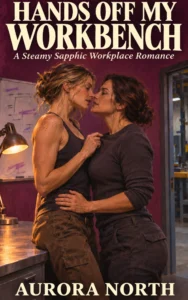
Hands Off My Workbench
She builds things to last. She builds things to fool you. Neither of them is faking this.

The Away Game
She's never stayed anywhere longer than a season. The mechanic isn't going anywhere.

The Woman in the Main House
She owns the house. She doesn't own me. That's exactly the problem.

The Night Shift Agreement
Nothing at the plant. Nobody knows. Off the clock, ask for what you want.

Straight Sets
In tennis, love means nothing. Alison Hale is about to find out it means everything.
Never Miss a Release
Get new release alerts, exclusive bonus content, and reader-only giveaways.