

Straight Sets
Sapphic Late-Bloomer Sports Romance
by Aurora North
Available at all major retailers
Pairing: FF (Sapphic)
Heat: 🌶️🌶️🌶️🌶️🌶️ Inferno
Tropes: Doubles Partners to Lovers, Late Bloomer, Bisexual Awakening, Older Heroines, Tennis Romance, Bedroom Bets, Praise Kink
In tennis, love means nothing. Alison Hale is about to find out it means everything.
Alison Hale is forty-two, fourteen months divorced, and finally doing something just because she wants to. She signed up for the Linden Park spring doubles ladder with a nice, safe, beginner partner.
Then her nice, safe partner quits, and the only player left who needs someone at her level is Fran Doyle.
Fran is a mail carrier with sun-freckled forearms, a worn-in cap, and a habit of fixing everything within reach. She came back to tennis for a low-stakes season, not to fall for the funny, fiercely competitive divorcée who apologizes for every missed ball and then lobs the next one straight over her head.
Alison has never wanted a woman before. She’s pretty sure she’s wanted this woman since the first practice. And once she finds the nerve to ask Fran out, the sex is a revelation: playful, filthy, and wildly competitive.
But when a shot at a big summer tournament comes Alison’s way, Fran has opinions, and Alison has a secret. To finish the season together, two stubborn women will have to learn the hardest skill in any partnership: playing on the same side.
You’ll love this book if you enjoy:
✅ An over-40 heroine discovering exactly what she wants
✅ Doubles partners to lovers with a four-word rule on court
✅ First-woman bisexual awakening, owned out loud
✅ A freckled, blue-collar mail carrier who learns to ask instead of fix
✅ Loser’s-choice bets, locker-room showers and a green silk scarf (🌶️🌶️🌶️🌶️🌶️)
✅ HEA guaranteed
⚠️ Content Warning: This novel contains explicit sexual content (graphic FF scenes including strap-on play, light bondage and blindfolding with a safeword), strong language, divorce and controlling-ex dynamics, and relationship conflict. Intended for readers 18+.
📖 Read Chapter One Free
Not sure yet? Read the full first chapter right here.
Chapter One: Both
The shoes were the problem.
Alison Hale sat in her Corolla in the Linden Park lot with the engine off and her brand-new court shoes on her feet—white as a dentist’s brochure, a hundred and thirty-nine dollars of commitment—and read the email for the third time.
Hi Alison!! So this is TERRIBLE timing but I got the transfer to Charlotte (!!!) and I start on the 12th, so I have to withdraw from the ladder. I already told Marjorie. I’m SO sorry. You’re going to be amazing!! xo Deb
Two exclamation points on the bad news. Three on the good. Deb had punctuated Alison’s abandonment like a birthday card.
She could drive home. That was the beauty of a parking lot—it was built to be left. She could back out past the chain-link fence and the row of old maples just starting to fuzz green at the tips, take Monroe to Park Avenue, climb to her second-floor apartment, and spend the evening the way she’d spent most Tuesdays for fourteen months: productively. Laundry. The dead basil on the balcony. Her mother’s voicemail, which would contain advice about something Alison had not yet mentioned to her.
Nobody would know except Priya, and Priya would forgive her by Friday.
Through the windshield, six hard courts lay in two neat rows, green going chalky at the baselines. On court one, two women in matching visors were arguing about whether a ball had been out, with the stamina of a long marriage. Somewhere farther down, a ball was being hit very hard and very regularly against something that didn’t hit back.
Eleven Saturday mornings in the indoor bubble out in Henrietta. A forty-dollar can of balls she hadn’t opened. And the shoes. She’d bought the shoes without asking anyone if they were worth it. She’d stood in the store and thought, I want these, and then she’d bought them, and it had felt so illicit she’d half expected an alarm to go off at the door.
She got out of the car.
The Linden Park clubhouse smelled like sunscreen, old carpet, and the inside of a ball can. There was a noticeboard crusted with flyers, a humming drinks fridge stocked with Gatorade and someone’s Tupperware labeled DO NOT, a row of folding chairs, and Marjorie Kowalski, who was fifty-eight, wore a whistle she had never once been seen to blow, and held a clipboard the way some women held a handbag—as though it contained her identity and possibly a weapon.
“Hale,” Marjorie said, before Alison had finished saying hi. “You got Deb’s email.”
“I did. I assume that means I’m—I mean, I completely understand if I’m out, I’d hate to throw off the whole bracket, or the ladder, or whatever the correct—”
“You’re not out. You’re short.” Marjorie flipped a page. “Ladder rule. Combined self-rating for a pair has to be seven-point-oh or under. You’re a three-oh.”
“I think that might be a clerical error. My instructor was being generous. Or he was trying to get rid of me, honestly, I hit him in the—”
“Three-oh is three-oh.” Marjorie ran her pen down a column of names. “Which means I can put you with anybody rated four-oh or under who doesn’t already have a partner.” The pen stopped. “That’s one person.”
Alison’s stomach did a small, unwelcome somersault. “Oh. Okay. Is she—are they—is she nice?”
Marjorie considered this as if it were a novel question in the history of tennis. “She’s a four,” she said finally, which appeared to be her complete answer. She tipped her chin toward the window. “Fran Doyle. Court four. She’s been hitting against the backboard for twenty minutes waiting for me to find her a three. Congratulations. You’re a three.”
“Does she know she’s getting a—”
“She knows the rule.” Marjorie was already turning away. “Go introduce yourself. Roster sheet’s on the board. It locks Friday. Nobody gets an exception.”
Court four was at the far end, past the bickering visors, and the woman on it was the source of the regular, violent thwock Alison had heard from the parking lot.
She was hitting forehands against the practice wall that ran behind the last two courts—not hard, exactly, but with such effortless repetition that the ball seemed to be on a string. Step, turn, swing, the ball cracking back off the green plywood and returning to her racket as if it had been trained to. She was tall and built along long lines, with the calves of someone who walked for a living. Navy T-shirt. Black shorts. A navy baseball cap so worn it had gone soft and pale along the brim, pulled low, a tuft of dark hair escaping at the back. Her forearms were tanned and freckled, densely, the way some people’s were when they spent their lives outdoors and had stopped fighting it.
The woman caught the ball in her left hand without looking and turned.
Green-gray eyes under the cap. A face that wasn’t unfriendly so much as closed for business, like a shop with the lights on and the sign flipped. Somewhere around forty. Not pretty, exactly. Something more precise than pretty, all cheekbone and jaw.
“You’re Deb’s partner,” the woman said.
“Deb’s former partner. Deb is in Charlotte. Allegedly.” Alison held out a hand, realized she was holding her racket in it, switched hands, and held out the other one. “Alison Hale. I’m sorry, I should say up front—I’m not very good.”
The handshake was dry, brief, and firm, and Fran Doyle’s palm was callused along the base of the fingers in a way that Alison felt for several seconds afterward.
“Fran,” she said. “Let’s hit.”
“Right. Yes. Hitting. That’s what we’re—sorry, obviously.”
Fran’s eyebrows moved approximately one millimeter.
They took opposite baselines. Fran bounced a ball and sent it over in a soft, high, ridiculously courteous arc. Alison stepped in, swung, and sent it sideways onto court three, where it rolled to a stop at the feet of a retiree in a bucket hat.
“Sorry!” Alison called to the retiree. Then, to Fran: “Sorry.”
The retiree tossed the ball back with great dignity.
Fran fed another. Alison, overcorrecting, hit it with all the frame and none of the strings, and it dribbled into the bottom of the net with a sad little pfft.
“Sorry,” Alison said.
Fran walked to the net, collected the ball, and looked at her. Not unkindly. Assessingly. The way you might look at a used car someone was very enthusiastically trying to sell you.
“That’s three,” Fran said.
“I’m sorry?”
“Apologies. You’ve done three. We haven’t had a rally.” She rolled the ball over the top of the net into her own palm. “New rule. You get two more this season. Spend them wisely.”
Alison opened her mouth. Shut it. Opened it again. “Two? For the entire season?”
“Two.”
“That seems—I mean, as a policy, that seems a little draconian for someone who’s—”
“Two,” Fran said again, and walked back to her baseline, and Alison could have sworn the back of her neck looked amused.
It got better, which wasn’t saying much, because it had been nowhere to go but up.
Fran kept the ball in a narrow, merciful lane, waist high, three feet inside the baseline, and after a few minutes Alison’s body remembered the eleven Saturdays in Henrietta. Turn the shoulders. Racket back early. Watch the ball onto the strings. She started making contact. Then making contact with intention. Then—four in a row over the net, then six, then a rally of eleven that she counted in her head like a child counting jumps on a trampoline.
She was sweating already. The April light was going gold and slantwise across the courts, and her ponytail was sticking to the back of her neck, and her face—she could feel it—was doing the thing it always did when she exerted herself for more than ninety seconds, going the color of a stop sign.
Fran, on the other side of the net, barely looked like she was breathing.
“Want to play some points?” Fran asked. “No score that matters. I just want to see how you move when it’s not a drill.”
Alison wanted to say absolutely not. What came out was, “Sure.”
Fran served easy. Alison lost the first two points so efficiently they were more like administrative errors. On the third, Fran came forward behind a short ball, and Alison, who had been told in Henrietta that when someone came to the net you should make them uncomfortable, panicked and swung as hard as she had ever swung at anything in her life.
She did not hit it where she was aiming. She was not entirely sure she’d been aiming.
The ball went flat and fast and low and hit Fran Doyle square in the meat of her left thigh with a meaty smack.
“Oh my God.” Alison dropped her racket. Actually dropped it; it clattered. “Oh my God, I’m so sorry—are you—I’m so sorry—”
Fran had folded slightly at the waist, one hand pressed flat over the spot, which was already blooming pink beneath the hem of her shorts. She straightened. She looked at the ball rolling away toward the fence. She looked at Alison.
“That’s one,” she said.
“That does not count. That was a medical apology. That’s an exemption.”
“There are no exemptions.” Fran rubbed her thigh with the heel of her hand, slow, kneading, and Alison’s eyes followed the motion before she could tell them not to—the long muscle under freckled skin, the hard flat line of it. “Pick up your racket. Your point, by the way. You hit me. That counts.”
“I don’t want a point I got by assault.”
“Then win the next one.”
Fran served again—faster this time, kicking higher—and something in her that had been asleep since roughly the Obama administration sat up and said, Oh, she’s going to try now?
She got her racket on it. Got it back, deep enough. Fran hit a crosscourt forehand that Alison chased down with more desperation than form, and then Fran was coming in again—that long easy stride, already at the service line, already closing the net, and there was nothing to do, no angle, no gap, nothing in the whole green world except that tall body taking up all the space in front of her.
So Alison went over it.
She didn’t think. Later she would have no memory of deciding. She just opened the racket face and lifted under the ball, and it went up, up, a lazy yellow comet climbing against the sky, and Fran turned and started backpedaling and then simply stopped and stood there with her head tipped back watching it sail over her, and it came down six inches inside the baseline, kicked up a puff of chalk, and bounced into the fence.
The silence afterward had texture.
Alison stood at the baseline with her racket still up near her ear. A small part of her, the oldest and most tired part, had already drafted an apology. Sorry—I didn’t mean—that was lucky—I’m sorry. She could feel it lining up behind her teeth. It had been lining up behind her teeth for twenty years. Apologizing for the window seat. For the restaurant she’d picked when Daniel didn’t like it. For the paint color, for being tired, for the weather.
She closed her mouth around it. Swallowed it whole.
She did not apologize.
Fran turned around.
And her face—her closed-for-business, sign-flipped face—cracked. It went wide open from the inside, all at once, like somebody had kicked the shop door in. She grinned, and it was a big, crooked, completely unguarded grin, a little too wide on one side, and it changed everything about her. She looked ten years younger. She looked like trouble.
“You were going to say sorry,” Fran said.
“I absolutely was not.”
“You were. Your whole face was doing it. Your eyebrows were apologizing.”
“My eyebrows have a mind of their own. I don’t control them. They’re—they’re independent contractors.”
Fran laughed. It came out of her like it had surprised her—a short bark and then a real laugh, head back, one hand on her hip—and Alison laughed too, helplessly, until she had to bend over with her hands on her knees, her face hot as a stovetop, her lungs burning, the whole stupid gold evening tipping sideways.
“Okay,” Fran said when she’d recovered, wiping her eye with the back of her wrist. “Okay. You hit that lob like you meant it.”
Alison straightened. Pushed a damp strand of hair off her forehead. “I meant it a little.”
Fran looked at her for a beat longer than the moment needed. Then she bounced a ball, twice, and said, “Again,” and Alison’s heart did something she decided to blame on the cardio.
They played for another forty minutes. Alison lost most of the points and won enough of them to be dangerous to herself. She double-faulted three times in a row and said nothing. She hit one forehand so clean it rang, and Fran said, “Nice,” just that, and Alison carried the word around in her chest for the rest of the session like a stone in a pocket she kept touching.
By the time the court lights buzzed on over five and six, she had sweated through her shirt, the back of her neck was gritty, and her thighs were trembling in a way that promised tomorrow would be educational.
“That’s enough,” Fran said. “You’ll hate me on the stairs at work.”
“I already hate you on the stairs at work. Prospectively.”
Fran did the almost-smile again—the corner of her mouth only. Alison was beginning to realize she was going to spend a significant portion of her life trying to get the other one.
The women’s locker room at Linden Park was a narrow cinderblock room painted a green that had been fashionable once, probably in a hospital. Two rows of dented lockers. Two long wooden benches worn smooth and pale by decades of tennis-skirted thighs. A single shower stall at the back with a curtain that had given up. It smelled like Dial soap and damp concrete.
Alison found her locker—the door had a dent in the middle the exact size and shape of a forehead, which should have been a warning—and started fishing for her water bottle. Fran dropped her bag on the bench two lockers down, pulled her cap off, and ran a hand through her hair. It was dark and short at the back, longer on top, and it stood up in every direction, sweat-spiked and careless.
Then she crossed her arms, gripped the hem of her soaked navy T-shirt, and peeled it up and off over her head in one long movement.
It was nothing. It was a woman taking off a shirt in a women’s locker room. Alison had been in locker rooms her whole life. Gym class, college pools, a spa where everyone walked around naked discussing their Pilates instructors. Bodies were bodies. She had never once in forty-two years been undone by a sports bra.
This one was black. Plain. Racerback. It was the shoulders that were the problem.
They were broad and square and freckled, freckled everywhere—not just the forearms, but across the tops of her shoulders and down over her shoulder blades in a dense, warm spray, like someone had flicked cinnamon off a brush. Her back was long, and when she bent to unzip her bag, the muscles along her spine moved under the skin in two lean ridges. There was a bead of sweat sliding down the shallow groove between them. There was a flat, pale strip of stomach above her shorts and the clean line of a hipbone. There was—
Alison whipped her head toward her own locker so fast that she drove her temple directly into the edge of its open door.
The sound was spectacular. A deep, resonant bonnnng of skull on steel, like someone striking a church bell with a cantaloupe.
“Ow—fuck—ow—”
“Whoa. Hey.” Fran was there in two strides. “Hey. Let me see.”
“I’m fine. I’m totally—that door came out of nowhere—”
“It’s been there since 1987.” A hand under Alison’s jaw, warm and steady, tipping her face up toward the bad fluorescent light. “Look at me.”
Alison looked at her.
It was a mistake. Fran was close enough that Alison could see a tiny pale scar through her left eyebrow and the gray bleeding into the green of her irises, close enough to smell her—sweat and sunscreen and something under it, clean and warm, like laundry dried outside. Her collarbones were freckled too. There were freckles on her sternum, a faint scatter disappearing beneath the black fabric, and Alison’s brain, which was presumably concussed, began to wonder exactly how far down they went.
“Follow my finger,” Fran said.
Alison followed her finger. Left. Right. Up. Fran’s thumb moved, featherlight, over the rising lump at her temple, and the tiny brush of it went through Alison like a dropped plate—a bright shattering all the way down her spine and pooling, unmistakably, somewhere low in her belly. Her nipples went tight against her damp shirt. Her thighs, which had been trembling from exertion, began to tremble for a slightly different reason.
Adrenaline, said the part of her that had a filing system. Blunt-force trauma. Low blood sugar.
“No blood,” Fran murmured. “You’re going to have a hell of a lump. Any nausea?”
“Only emotionally.”
There it was again—the crack in the shopfront. Just a flash this time. Fran let go of her chin, and Alison’s skin went cold in the shape of her fingers.
“Stay there,” Fran said, and walked out, still in the sports bra, into the clubhouse, where Alison distinctly heard Marjorie say “Doyle” in a tone of profound institutional disapproval. She came back with a frozen bottle of blue Gatorade from the fridge.
“Hold that on it. Ten minutes. I’m going to shower.”
“Are we allowed to take those?”
“Marjorie keeps a ledger.” Fran slung a towel over one freckled shoulder. “I’m two dollars in arrears. It’s the most exciting thing in her life.”
The curtain hissed shut. The water came on, groaning through the old pipes, and then steady.
Alison sat down hard on the bench with the frozen Gatorade pressed to her temple and stared at the opposite wall, where someone had written LINDA CHEATS in Sharpie, very small, near the floor.
The thing was, she had a good life. She kept saying that to people, so it had to be true.
She had a one-bedroom on Park Avenue, second floor, with crown molding and a radiator that knocked and a narrow balcony overlooking a ginkgo tree. She’d picked it eleven days after signing the separation papers, alone, in about twenty minutes, because of the balcony. Daniel had hated balconies. He said they were for smokers and people who wanted to be looked at. When the leasing agent opened the French doors onto that narrow stripe of sunlight, Alison had stepped out and put both hands on the iron railing and thought, very clearly, Mine, and then felt so guilty about the thought that she nearly told the agent she’d think about it.
She’d signed that afternoon. She’d bought basil, thyme, and rosemary the next weekend. Currently, all three were dead. She was working on it.
She had a good job. Mortgage processing at Brightwater, a squat glass building off 490 where she spent her days making sure that people who wanted houses had handed over every last scrap of paper the underwriters needed to give them one. She could smell a missing paystub across a parking lot. She could not approve a single loan, and she was fine with that; approval was someone else’s job. Alison’s job was making sure nothing fell through the cracks. She was a professional crack-checker. She had been, she sometimes thought, a professional crack-checker in every area of her life.
She had a calendar. Oh, she had a calendar. It lived on her phone, color-coded with the zeal of the recently divorced. Green for work. Blue for her mother, who expected Sunday dinner and a weekly phone call and, ideally, a full report on Alison’s cholesterol. Orange for the dentist, the eye doctor, the car. Purple for Priya.
For the first eight months after the divorce went final, there had been red, too. Red was the lawyers. Red was the afternoon Daniel stood in their old kitchen and explained, with real patience, why the dresser her grandmother had left her made more sense in his new place than in hers, and Alison had nodded, and the dresser was still sitting in a storage unit in Henrietta, in her name, on his schedule.
The red was gone now. But when Priya had grabbed her phone over brunch in January and scrolled through it, she’d gone quiet, which for Priya was alarming.
“Al,” she’d said finally. “Where are you?”
“What do you mean? I’m everywhere. I’m in every color.”
“No, you’re at every color. Every single one of these is something you do for someone else.” Priya had slid the phone back across the table with one manicured finger, the way you’d return a lost wallet to a stranger. “Where’s the thing you do because you want to? Where’s the stupid thing? The selfish thing? The thing with no point?”
Alison hadn’t had an answer. She’d gone home and sat on her balcony beside the dead basil and tried to remember the last thing she’d done purely because she wanted to, and gotten all the way back to a bike ride she took the summer she was twenty-six—before Daniel, before the house, before she’d learned to say whatever you want so smoothly it sounded like her own idea.
The next morning she’d signed up for beginner tennis at the bubble in Henrietta. She’d picked it because she’d been halfway decent in high school gym, and because it was gloriously pointless.
She’d made it a color. She’d made it yellow.
The shower shut off. The pipes coughed. Alison realized she’d been sitting with a melting Gatorade pressed to her head for long enough that blue water was running down her wrist, and that during the entire time she’d been thinking about her life, some disloyal back room of her brain had been thinking about freckles.
About how far down they went.
She splashed cold water on her face at the sink. The woman in the mirror was red-cheeked, damp, and wild-eyed, with a ponytail listing badly to the left and a goose egg rising at her hairline like a second, smaller, angrier head.
You’re forty-two years old, she told her reflection. You hit your head. You’re dehydrated. You liked that she was good at something. That’s all that is.
Her reflection, unhelpfully, went redder.
Fran came out of the locker room ten minutes later, while Alison was standing at the noticeboard pretending to read a flyer about a lost cat named Admiral.
Her hair was wet, slicked back and darker, already starting to stand back up on top. She’d changed into jeans and a plain gray T-shirt, and her cap was in her hand, and she smelled like the same cheap clubhouse soap as everyone else and somehow didn’t smell like it at all. She stopped beside Alison at the roster sheet.
SPRING DOUBLES LADDER, it said across the top in Marjorie’s ruthless block capitals. Two columns of names. Ratings beside each. Halfway down, Hale, A. — 3.0, and next to it, Deb’s name, struck through with a single line so firm it had nearly torn the paper.
A pen hung from a length of string thumbtacked to the cork.
“How’s the head?” Fran asked.
“Fine. Thriving. I’m thinking of naming it.”
Fran picked up the pen. Clicked it. Her thumb hovered. The almost-smile was there, faint, in one corner of her mouth, but her eyes, when they slid to Alison, were completely serious—level and green-gray and searching, the look of somebody turning a ball over in her hand before she decided where to put it.
“One question,” Fran said. “Before I sign.”
Alison’s stomach tightened. “Okay.”
“Are you here to have fun? Or are you here to win?”
It was obviously a test. Alison knew the right answer. The right answer was fun—gracious, humble, low-maintenance, the answer of a woman who didn’t want to be any trouble, who’d be grateful for whatever she got and apologize for the rest. It was the answer she’d been giving to every version of this question for twenty years.
She thought about the lob. The puff of chalk. That big, crooked grin breaking open over the net, and the sound of her own laughter in the gold evening, and how badly—how shamefully, ferociously badly—she’d wanted the next point.
“Is both an option?” she said.
Fran looked at her for a long moment.
Then she put the pen to the paper, and in the empty slot beside Alison’s name, in clean, upright capitals, she wrote DOYLE, F. — 4.0.
“Both,” Fran said, clicking the pen shut, “is the only option I’m interested in.”
Want to keep reading? Get Straight Sets at all major retailers.
🔥 Want an EXCLUSIVE Bonus Chapter?
Item Nine — A scene TOO HOT for retailers. Provincetown, June. Fran planned one entire day, laminated, nine items long. The last item just says Alison. Slowly. Windows open. And this time, Fran isn’t the one in charge.
More from Aurora North
Browse all Aurora North books.

Wingwoman Down
She asked her best friend for dating lessons. Every lesson proved the men were never the point.
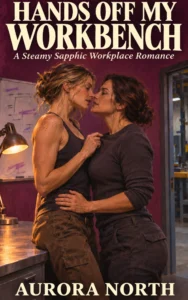
Hands Off My Workbench
She builds things to last. She builds things to fool you. Neither of them is faking this.

The Away Game
She's never stayed anywhere longer than a season. The mechanic isn't going anywhere.

The Woman in the Main House
She owns the house. She doesn't own me. That's exactly the problem.
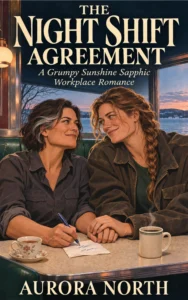
The Night Shift Agreement
Nothing at the plant. Nobody knows. Off the clock, ask for what you want.

Straight Sets
In tennis, love means nothing. Alison Hale is about to find out it means everything.
Never Miss a Release
Get new release alerts, exclusive bonus content, and reader-only giveaways.