
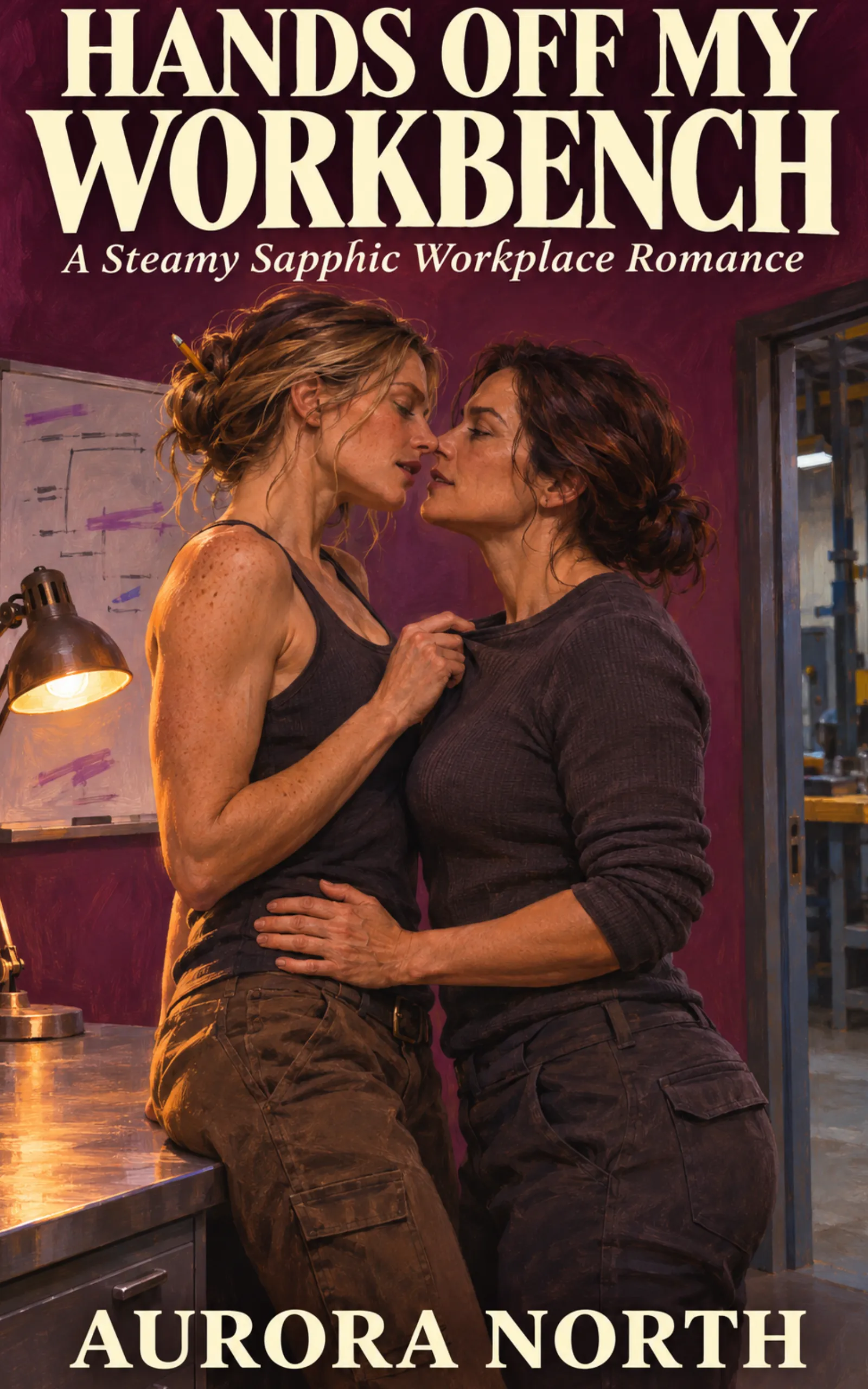
Hands Off My Workbench
A Sapphic Grumpy/Sunshine Workplace Romance
by Aurora North
Available at all major retailers
Pairing: FF (Sapphic)
Heat: 🌶️🌶️🌶️🌶️🌶️ Inferno
Tropes: Grumpy/Sunshine, Forced Proximity, Rivals to Lovers, Workplace Romance, Shared Workshop, Coworkers to Lovers, Office Sex, Competence Kink, Opposites Attract, Forties Heroines, Restorer × Prop Maker, Blue Collar Heroines, Rules to Break, Only One Bed, Snowed In, Light Bondage, Strap-On, Switch Dynamic, Dirty Talk, Instruction Kink, Grovel, Found Family, Dual POV, Standalone
She builds things to last. She builds things to fool you. Neither of them is faking this.
Marie Collins has rules for her new shared workshop. Stay on your side of the tape. Don’t touch her tools. Customer pieces are sacred.
Kelly Shaw breaks most of them before lunch.
Marie restores furniture built to survive a century. Kelly builds theater props that only have to fool row M for six weeks. Marie thinks Kelly’s work is clever, fast and a little bit fake. Kelly thinks Marie is gorgeous, brilliant and terrified of anything that isn’t already a hundred years old.
Then the Halloran Stage Company offers them a commission neither can land alone: a real 1940s hotel desk to restore, and a set of trick cabinets to build around it. Late nights turn into diner booths. Diner booths turn into a kiss against a truck in the snow. And the one rule they actually write down on the whiteboard, No touching in the shop, lasts exactly four days.
The sex is easy. Being taken seriously is not. Because Marie can’t stop ranking the work, Kelly can’t stop laughing when it hurts, and opening night is coming whether they’ve fixed it or not.
Hands Off My Workbench is a high-heat, standalone sapphic grumpy/sunshine workplace romance with two forty-ish heroines who know exactly what they want in bed, dual POV, no cheating and an HEA guaranteed. Explicit content. 18+.
You’ll love this book if you enjoy:
✅ A rule-making furniture restorer and the loud, laughing prop maker on the other side of the tape
✅ A whiteboard of rules that keeps getting longer, in two handwritings, black and purple
✅ Competence kink both ways: one hand-cuts dovetails, one engineers a cabinet that opens on cue in the dark
✅ “Slower.” A locked office, a steel desk and a rule that lasts four days
✅ A hand-stitched leather harness, a bowling-lane dining table, a snowed-in B&B and a silk scarf on a bedpost
✅ Forty-something heroines, a grovel done properly and a public apology in front of the whole board
✅ Found family: a sister who loves her already, a stage manager who says huh, and a neighbor who brings soup
✅ No cheating, 🌶️🌶️🌶️🌶️🌶️ heat and an HEA guaranteed
⚠️ Content Warning: This novel contains extremely explicit sexual content (graphic FF scenes throughout, including solo play, fingering, oral, face-sitting, scissoring, a strap-on, light bondage with a scarf, sex in an office, in a shower, on a dining table and on a love seat, and dirty talk), strong language and alcohol. Also includes a public humiliation at a work event, a painful mid-book separation, a past breakup and references to a parent’s emotional distance. No cheating between the leads. Intended for readers 18+.
📖 Read Chapter One Free
Not sure yet? Read all of Chapter One right here.
Chapter One: Marie
The tape had to be straight.
Not straight-ish. Not straight for a warehouse. Straight, the way a board is straight when you sight down the edge and see nothing at all.
Marie Collins knelt on the concrete of Unit 4 with a chalk line looped over one wrist and a roll of blue painter’s tape in her fist. Forty-two feet from the front wall to the office door. She had measured both ends off the brick, split the difference, and snapped the line twice, because the first snap had a belly in it where the floor dropped toward the drain. Now the tape went down on the chalk a foot at a time, pressed flat with the side of her thumb, checked against the four-foot level every third foot.
North of the line was hers. Clamp racks bolted to the brick. The finishing booth, its extraction fan installed Saturday by a man who called her “hon” eleven times and did good work anyway. Three customer pieces under moving blankets, each tagged in her block capitals with a name, a date, and a scope. A Hepplewhite side chair with a cracked splat. A cedar chest with a split lid. A walnut dining table and eight chairs for the Pellegrinis, glue-up scheduled for tomorrow.
South of the line was empty. It would not stay empty. That was the point of the tape.
She had nineteen feet down when the loading door went up.
It went up the way roll-up doors do, all at once and complaining, and February came in under it at knee height. Grit skated across the floor. Somewhere outside a truck idled with its radio on. Then a dolly came over the threshold, and on the dolly, strapped upright with two ratchet straps and what looked like a bungee cord off a child’s sled, was a seven-foot gargoyle.
It was grey and pitted, leaning forward, wings half-furled, one clawed hand raised as if it had been interrupted mid-sentence. Its tongue was out. It had very good teeth.
The woman pushing it backed through the door, swung it around the steel post without looking, and stopped with the dolly’s front lip three inches from Marie’s tape.
“Morning,” she said. “Is that crooked?”
Marie looked up. “It’s a gargoyle. It’s supposed to be crooked.”
“I meant the tape.”
“So did I.”
The woman laughed. It was a big laugh, unembarrassed, using the whole chest, and it went up into the steel trusses and came back down. “Okay. Good. We’re going to be fine.” She tipped the dolly back, stepped around it, and held out a hand. “Kelly Shaw. Shaw Fabrication. We did six minutes on the phone.”
“Marie Collins.”
“I know. Your name’s on forty emails from Dennis.” Dennis was the landlord. Dennis wrote emails the way other men cleared their throats. “He calls you ‘the furniture lady.’ He calls me ‘the theater gal.’ I think he thinks we’re a sitcom.”
Marie stood. Kelly’s hand was cold from the dolly handle, dry, calloused at the base of the fingers. A real grip. Marie let go first.
She was taller than she’d sounded. Five-eight, rangy, an easy way of standing that put her weight on one hip and made it look like the building was the one leaning. Dark blond hair wound up off her neck and stabbed through with a carpenter’s pencil. Carhartts gone soft at the knees. A grey thermal under a flannel under a canvas jacket. Green eyes, quick, already done with Marie and moving on to the clamp racks, the booth, the blankets, then back. And a wide mouth that did not stop working even when she wasn’t talking. It tucked up at one corner. Pressed flat. Decided things.
Marie noted all of it the way she noted a piece when it came in the door. Condition. Construction. Signs of use.
“That’s a lot of layers,” she said.
“It’s February in Syracuse. That’s a lot of February.” Kelly patted the gargoyle on its stone shoulder, which made a hollow, papery sound. “This is Gerald.”
“Of course it is.”
“He did eight weeks of Hunchback in Rochester and the theater wouldn’t store him after strike. So now he’s emotionally mine.” She looked down at the tape. Then along it, all the way to where the blue stopped at nineteen feet and the roll sat on the concrete next to the level. “Huh.”
“What.”
“Nothing. You’re using a level.”
“I’m using a level.”
“On tape.”
“On a line,” Marie said. “The tape is just where the line lives.”
The corner of Kelly’s mouth went up and stayed there. “That’s going on a mug.”
Kelly moved in the way weather moved in.
She had a rented box truck backed to the dock and no help, and she did not seem to need any. Bins came off first. Clear plastic, stacked four high on a hand truck, and every one of them labeled on two sides with a label maker. EPOXY — 2-PART — KEEP UPRIGHT. FOAM OFFCUTS 2″–4″. LED STRIPS / DRIVERS / DO NOT BEND. BLOOD (STAGE) (OBVIOUSLY).
Marie went back to her tape and did not watch.
She watched a little.
A speaker clipped to Kelly’s belt played something with horns. Kelly sang along to roughly half the words and made up the rest. She talked to the bins. She talked to the hand truck, which had a sticky wheel and was told so. She talked to Gerald, who was parked by the paint wall with his tongue out and was apparently going to supervise. A pallet jack came off the truck carrying a CNC router shrouded in a moving blanket and shrink-wrap, and Kelly walked it across the floor backward, steering it with one hand, and swung it into the south corner within an inch of where a router ought to go.
Within an inch. Not on it. Marie could see the inch from here.
At twenty-six feet, a bin rolled over the tape.
Not far. A wheel and a half. It sat there on the blue line with SAWDUST — FINE — FOR TEXTURE facing Marie like an argument.
“That’s over the line.”
Kelly glanced back. “It’s in transit.”
“Transit is still location.”
“Transit is neutral. Like Switzerland.”
“Switzerland,” Marie said, “has extremely clear borders.”
Kelly laughed and rolled the bin back with her boot, but she didn’t stop moving to do it, and three trips later there was a coil of extension cord resting over the line, and two trips after that a sheet of foam board leaning on Marie’s side of the post. Marie moved them back. Kelly said, “Sorry, sorry,” and meant it, and did it again.
It wasn’t carelessness. Marie had seen carelessness. Carelessness had no pattern, and this had a pattern: Kelly was fast and the line was new, and the tape simply hadn’t become a fact yet to anyone but the woman who’d laid it.
That was worse, somehow. Carelessness you could disapprove of with a clear conscience.
At thirty-one feet she sat back on her heels to rest her knees, and that was when she saw Kelly lift the crate.
It was a wooden crate, slatted, heavy enough that it came off the truck bed with a grunt. Kelly had shed the canvas jacket somewhere along the way, then the flannel, and the thermal sleeves were shoved up past the elbow. Her forearms were long and corded and pale with a faint gold dusting of hair, and when she took the weight, everything in them went tight at once. Tendon. Muscle. The thick vein along the inside of her wrist. She lifted with her legs, back flat, hips under, and carried the crate across the floor like it had personally offended her.
Good form, Marie thought. That was all. Good lifting form, which mattered in a shared space for insurance reasons.
Kelly set the crate down, crouched, and read the stenciled label on its end.
And went still.
Not paused. Still. Her whole body stopped, and the singing stopped, and her hand rested flat on the slats while her eyes moved across the stencil, and her lips moved very slightly, and for four full seconds the loudest thing in Unit 4 was the horn section coming out of the speaker on her belt. Then she nodded once to herself, pried off the lid with a flat bar, and looked inside with an expression Marie had seen before. On her own face. In a mirror. Over a piece of quartersawn oak she’d waited six weeks for.
Then Kelly stood up and was loud again, and Marie realized she had been holding the roll of tape against her sternum like something she was afraid to drop.
She put it down. Snapped off a length. Pressed it flat.
Thirty-two feet.
“You want me to hold the end of that?”
Kelly was standing over her with a coffee in a dented steel tumbler, looking down at the level.
“No.”
“I’m not offering to help. I’m offering to hold. Holding’s different.” She was already crouching on the south side of the line, one knee on the concrete, tumbler set down out of range. “The level’s rocking on your end. You’ve got grit under it.”
Marie looked. There was grit under it.
She brushed it away with the edge of her hand. Kelly steadied the far end of the level with two fingers, and the long aluminum edge settled flat on the concrete, right along the chalk.
“You’re a hair off,” Kelly said.
Marie looked. Along the level’s edge, the last foot of tape had wandered a hair north of the line.
She lifted the tape and laid it again, and while she did it, Kelly’s fingers stayed on the level, eight inches from Marie’s own. Close up, Kelly smelled like oranges and something sharp and chemical underneath. Two-part epoxy, probably. Citrus hand cleaner over it. Her knuckles had a thin line of dried grey paint in the creases. There was a small burn scar on the back of her thumb, old and shiny.
The tape sat dead on the chalk, edge to edge with the level, not a hair of blue past the line.
“There,” Kelly said, softer. “That’s straight.”
“I know it’s straight.”
“I know you know.” Kelly’s eyes came up. They were very green under the skylight, and they were laughing, but not at her. Or not only at her. “I just like saying it out loud when something’s right. Makes it count more.”
Marie didn’t have anything to say to that, so she said nothing, and Kelly picked up her tumbler and went back to the truck.
Marie finished the last ten feet alone. It took longer than it should have.
The fight started at ten past one, over the beanstalk.
“So tomorrow,” Kelly said, coming across the floor with a tablet under her arm and a granola bar in her teeth, “I need the bay.”
The bay was the reason Marie had taken this unit. Twenty feet by twenty-four in the middle of the floor, under four big wired-glass skylights, the ceiling fifteen feet clear. The concrete there had been ground and sealed by some previous tenant who had cared, and it was the only part of the building that was flat. Truly flat. She had checked it with a straightedge and a feeler gauge on her first walkthrough while Dennis stood beside her saying, “It’s a floor, hon.”
The bay belonged to neither side of the tape. The tape stopped at it, picked up again on the far side. Shared, said the lease. Shared, said Addendum B.
“I need it tomorrow,” Marie said.
Kelly took the granola bar out of her mouth. “For?”
“The Pellegrini table. It’s a glue-up. Walnut, seven feet, two leaves. Three of the top boards have let go along the joints and I’ve already cleaned them out. Glue goes on at eight. It has to sit in clamps on a dead-flat surface for a full day or the top will cup.”
“Tomorrow tomorrow?”
“I told you.”
“When?”
“On the phone.”
Kelly’s eyebrows went up. “On the phone, you said you’d have ‘a table at some point.’ I wrote it down. I remember thinking, that’s the most ominous thing anyone’s said about furniture.”
Marie had said that. She remembered saying it.
“I’ve got a beanstalk,” Kelly said.
“Of course you do.”
“Nine feet. Eight sections. It’s for the Children’s Theater Co-op, opens in three weeks, and the director wants to see it standing before I paint it, which is fair, because it’s a beanstalk and she’s paying for vertical.” Kelly flipped the tablet around. On the screen, a drawing: a twisting green column with leaves the size of manhole covers, broken into numbered sections with dimension lines down the side in neat, small print. “The bay’s the only place in this building I can stand it up. Fifteen feet of clearance. Everywhere else, Jack’s going to bonk his head on a truss.”
“Your beanstalk can be vertical Wednesday.”
“Her flight to Chicago is Wednesday morning.”
“Then she can see it on her phone.”
“She’s a director, Marie. They don’t believe anything on a phone. They need to stand next to it and squint.” Kelly tucked the tablet back under her arm. “And for the record, I put in for it.”
“You put in for it.”
“Addendum B, section four, paragraph C.” Kelly didn’t look at anything. She didn’t consult the tablet. She said it straight out, the way some people said the Lord’s Prayer. “‘Use of the shared assembly area shall be reserved by written notice from one tenant to the other, delivered no less than forty-eight hours in advance. Absent written notice, use shall be first come, first served. No tenant shall reserve the shared assembly area for more than three consecutive business days without the written consent of the other.'” She took a bite of granola bar. “I emailed you Saturday. Nine-fourteen p.m. Subject line ‘Beanstalk.’ Which, I’ll grant you, sounds like spam.”
Marie took out her phone.
Saturday at nine-fourteen she had been on her back under the finishing booth with a flashlight in her teeth, swearing at an extraction duct the man who called her hon had seated a quarter turn off. She scrolled. Dennis. Dennis. Dennis. A hardware supplier. And there, between a forwarded parking notice and a promotion for wood glue she already owned:
Beanstalk. Hi Marie! Per Addendum B 4(c) I’d like to reserve the assembly bay Tuesday 2/4, 7 a.m. to 5 p.m., for test assembly of a 9′ standing piece. Let me know if that conflicts with anything on your end and we’ll sort it. — Kelly.
Polite. Specific. Timestamped.
Marie had read Addendum B. She had read it once, on her kitchen counter, with a glass of wine, and initialed it at the bottom of each page, and filed it. She could not have told anyone what paragraph C said. She could not have told anyone there was a paragraph C.
She read everything. That was the whole point of her. She read the fine print on glue labels. She read customer contracts aloud to customers, slowly, so nobody could say later they hadn’t understood the clause about original hardware. Joanne used to say Marie could make a grocery list feel like a deposition.
And the theater gal with the singing speaker and the bin labeled BLOOD (STAGE) (OBVIOUSLY) had memorized the addendum.
“I didn’t see it,” Marie said.
“I figured. You didn’t write back.” Kelly’s voice had no edge in it, which was its own kind of edge. “So, technically, I have the bay.”
“Technically.”
“I’m just saying where we stand.”
“The table has to be glued on a flat surface.” Marie heard her own voice go exact, every consonant filed square. It did that. She could not stop it doing that. “That bay is the only flat surface in the building. The rest of this floor drops three-eighths of an inch toward the drain.”
Kelly’s chewing slowed. “Three-eighths.”
“Over eleven feet.”
“You measured the slope of the floor.”
“I measured everything.”
Kelly looked at her for a long moment. Something moved behind her face that didn’t look like annoyance. It looked like interest. Like the face she’d made reading the crate.
“Except the addendum,” Kelly said.
It wasn’t cruel. That was the problem. If it had been cruel, Marie could have done something with it. It was just accurate, and it went in like a splinter goes in, small and clean and all the way.
“I’ll be in the office,” Marie said.
The office was at the back of the unit, a box of drywall built into the brick by some tenant in the nineties. It had a steel desk, two rolling chairs that didn’t match, a mini fridge, a window onto the alley, and a love seat in mustard corduroy that the previous tenant had left behind, presumably because nobody could lift it without being ashamed. The door had a real lock. Marie had tested it.
On the wall across from the desk was a whiteboard, four feet by three, ghosted with someone else’s old arithmetic.
She wiped it clean with the side of her fist. Found a black marker in the desk drawer. Tested it on her palm.
Then she wrote, in block capitals, the way she wrote tags:
UNIT 4 — RULES
1. STAY ON YOUR SIDE OF THE TAPE.
2. ASSEMBLY BAY BY THE CALENDAR.
She stopped. There was no calendar. She wrote it anyway. There would be a calendar. She would make one tonight, a sensible one, and it would be on this wall by morning.
3. DON’T TOUCH MY TOOLS.
4. CUSTOMER PIECES ARE SACRED.
She capped the marker and stood back and read it. It was clear. It was short. It was, she was aware, the written equivalent of putting her hands on her hips.
She was still reading it when the door opened behind her.
“Hey, where’s the—” Kelly stopped in the doorway with a large chrome machine in her arms, the cord trailing over her shoulder. “Oh. Oh, no. We have a constitution.”
“We have rules.”
“Hang on.” Kelly set the machine on the corner of the desk with exaggerated care, as though it were a sleeping animal. It had a steam wand, two pressure gauges, and an eagle on top. “This is my espresso machine. It is Italian. It is older than both our businesses combined. I’m putting it in the break nook, and you’ll pretend you don’t drink out of it, and I’ll pretend I don’t notice.”
“I don’t drink espresso.”
“Everybody drinks espresso when it’s free and there’s a deadline.” Kelly turned to the whiteboard. Her eyes went down it once. Twice. Her mouth started at one corner and spread, and then she was laughing, not big this time but low and helpless, bracing a hand on the back of a rolling chair. “Stay on your side of the tape. Marie. Did you write this in the same font as your customer tags?”
“It’s not a font. It’s handwriting.”
“It’s a font. It’s the font of a woman who’s been disappointed by a lot of contractors.” Kelly wiped her eye with a knuckle. “Okay, no, I’m sorry, this is good. These are good rules. One, sure. Two, love it, we’ll get to two. Three, I would never. You’ve got a Lie-Nielsen block plane out there that I’m scared to breathe on. Four.” She went quiet. “Four’s right. Four’s actually right.”
“They’re all right.”
“They’re all reasonable. That’s different.” Kelly picked up the black marker from the tray. Then put it down and dug in her own back pocket and came out with a purple one. “Can I add one?”
“No.”
“I’m going to add one.”
“It’s not a democracy.”
“It’s literally a shared lease. It’s the only democracy I’m currently part of.” She uncapped the marker with her teeth and leaned in, and Marie stepped back to give her room, and the office was small enough that stepping back put her shoulder against the doorframe and left her nowhere to go.
Kelly wrote fast. Her handwriting was nothing like Marie’s. It slanted forward like it was late for something.
5. Marie smiles once a week (enforced).
She capped the marker. Stepped back. Considered it with her head tilted.
“No,” Marie said.
“Too late. It’s in purple.”
“Who enforces it?”
“Gerald.”
“Gerald is foam.”
“Gerald is carved foam with a hard-coat finish and a steel armature, thank you, he’s very structurally sound.” Kelly turned around. In the narrow space between the desk and the board, she was closer than she’d been on the floor with the level between them, close enough that Marie could see a fleck of green paint on her jaw, just under the ear. “Fine. Then me. I’m very persistent.”
“I’ve noticed.”
“Have you?” Kelly’s eyes did something. A quick drop and return, too fast to be anything. “Good. Saves time.”
She picked up the espresso machine, hitched it on her hip, and went out. The door swung half shut behind her.
Marie looked at Rule 5 for a long time. She picked up the eraser.
She put it down.
It was in purple. Erasing it would mean she’d read it. That was all.
She spent the afternoon on the Hepplewhite chair, which was what she did when something was bothering her. The cracked splat had come in held together with brown packing tape and somebody’s optimism, and getting the old hide glue out of the crack with a warm knife and a dental pick took the kind of attention that left no room for anything else.
Almost no room.
Around three, she realized the unit had gone quiet. The speaker was off. No horns, no hand truck, no conversations with inanimate objects. She looked up.
Kelly was at a folding table in the south half, sitting on an upturned bucket, a laptop open in front of her and a pencil crosswise in her teeth. She wasn’t moving. One hand was on the trackpad and the other was flat on the table and her whole body had gone still the way it had over the crate, leaned in, shoulders forward, an absolute and private attention. The afternoon light through the skylight lay across the back of her neck, where the hair had come loose from the pencil and curled.
She stayed like that for forty minutes. Marie knew because she checked the clock twice, both times for reasons she did not examine.
At five-forty, Kelly said, “Hey, Collins. Got a sec?”
Marie wiped her knife. “Collins?”
“You called me Shaw in your head all day. I could tell.” Kelly was standing in the office doorway. “Come look. Bring your skepticism. I want it fully loaded.”
On the office wall, next to the whiteboard, Kelly had taped up four sheets of tabloid paper in a grid. A month. February, every weekday blocked from seven to seven in half-hour rows, printed small and clean. Down the side, a legend. BLUE = Collins Restoration. ORANGE = Shaw Fabrication. GREY = shared/open. RED = customer property in active process (see Rule 4).
Tomorrow, Tuesday, was orange from seven until one.
From one o’clock Tuesday through five o’clock Friday, it was blue.
“Okay,” Kelly said. “So. I had the director come down to seven a.m. I bribed her with the promise of my espresso, and I’m going to have to deliver on that, which is a real cost to me personally. The beanstalk goes up in sections, bolted, it takes ninety minutes. She squints at it for an hour. I take pictures for the painters. It comes down by twelve-thirty, the bay’s swept by one, and it’s yours. Glue at one-fifteen instead of eight. That gives you the rest of Tuesday, all of Wednesday and Thursday in clamps, Friday to clean up.” She tapped the blue block. “Three point five business days. I checked the addendum—that’s over the consecutive limit, so I’m consenting in writing.” She tapped a sticky note at the bottom. On it, in purple: I consent. — K. Shaw.
Marie looked at the calendar.
She looked for the flaw. She was very good at finding the flaw. It was most of her job.
“A glue-up needs to sit undisturbed,” she said. “Not just untouched. Undisturbed. Vibration. Somebody dragging a pallet jack past it.”
“Swap rule’s at the bottom.” Kelly pointed. “Any block can be traded with twenty-four hours’ written notice. Text counts, email counts, sticky note on the coffee machine counts. Disputes go to whoever booked first. Exception for red. Anything in red doesn’t move and doesn’t get walked past with anything heavier than a coffee.” She tapped the red stripe she’d already drawn across Tuesday afternoon through Thursday. PELLEGRINI GLUE-UP. QUIET ZONE. NO JACKS. “Rule four. I built it in.”
“You don’t know how long a walnut glue-up takes to cure.”
“Titebond Three, sixty-minute clamp time, twenty-four-hour full cure, but you want forty-eight on a top that size because of the humidity in here in winter. I looked it up.” Kelly paused. “Also I saw the bottle on your bench.”
Marie opened her mouth. Closed it.
She checked it again. The hours. The swap rule. The exception. She tried to imagine a scenario in which the calendar failed, and all of them involved one of them breaking it, and the calendar couldn’t be blamed for that.
It was reasonable. Worse. It was airtight.
“Fine,” Marie said.
“Fine?”
“It’s fine. It’s a good system.”
Kelly’s face opened. There was no other word for it. It just opened up, all of it at once, mouth and eyes and something in the set of her shoulders, as if fine from Marie Collins was a standing ovation. She reached past Marie to straighten the bottom corner of the calendar where the tape had lifted, and her arm came past Marie’s shoulder, and for a second Marie was standing inside the smell of oranges and epoxy and warm skin, and the back of her own neck went hot.
“See?” Kelly said, close and quiet and pleased with herself. “I can follow rules. I just make better ones.”
Then she stepped back, grabbed her jacket off the love seat, and was gone. The loading door went up, the truck coughed awake, and the door came down, and Unit 4 was very quiet.
Gerald stood by the paint wall with his tongue out.
Marie stayed in the office doorway. She looked at the calendar, blue and orange and one red stripe, neat as anything she’d ever made herself. She looked at the whiteboard. Her four rules, square and black. Kelly’s one, purple and leaning forward like it was going somewhere.
She became aware, slowly and then all at once, of the shape of her own mouth.
She was smiling.
She had no idea how long she’d been doing it. It had happened without consultation, the way a crack opens along the grain. It was not a small smile. It was the kind that went up into the cheeks and stayed there.
Rule 5: satisfied. On a Monday. Before six.
She was furious about it.
Want to keep reading? The full novel is available now at all major retailers, and direct from our store.
🔥 Want an EXCLUSIVE Bonus Chapter?
Office Hours — A scene TOO HOT for the bookstore
The day they sign the lease again. A door that locks, a steel desk that has heard all of it before, a harness in a tote bag, and a list in block capitals. Marie finally wrote down exactly what she wants.
More from Aurora North
Browse all Aurora North books.

Wingwoman Down
She asked her best friend for dating lessons. Every lesson proved the men were never the point.
Hands Off My Workbench
She builds things to last. She builds things to fool you. Neither of them is faking this.

The Away Game
She's never stayed anywhere longer than a season. The mechanic isn't going anywhere.

The Woman in the Main House
She owns the house. She doesn't own me. That's exactly the problem.

The Night Shift Agreement
Nothing at the plant. Nobody knows. Off the clock, ask for what you want.

Straight Sets
In tennis, love means nothing. Alison Hale is about to find out it means everything.
Never Miss a Release
Get new release alerts, exclusive bonus content, and reader-only giveaways.