

Sugar Daddy Down Low
A Steamy MM Sugar Daddy Age Gap Romance
by Jace Wilder
Available at all major retailers
Pairing: MM
Heat: 🌶️🌶️🌶️🌶️🌶️ Inferno
Tropes: Sugar Daddy, Age Gap, Daddy Kink, Praise Kink, Closeted Hero, Secret Relationship, Hurt/Comfort, Coming Out, Touch Starved
The rules were simple. Cash. Discretion. Hotel rooms only.
Marcus Hale has spent forty-five years being exactly what everyone expects: corner office, firm handshake, an ex-wife who never suspected a thing. What happens behind hotel doors twice a week is nobody’s business — especially not the business of the tattooed bartender who calls him daddy like he means it.
Leo Reyes isn’t naive. Rich older men don’t fall for the help — they rent them. And the arrangement is perfect: Marcus’s money clears his mom’s medical bills, and Marcus’s hands clear his head of everything else. Feelings weren’t in the contract.
But contracts don’t cover the way Marcus draws him a bath after a brutal shift. Or the way Leo stopped taking other clients without being asked. Or the night a colleague spots Marcus checking into a hotel with a man half his age.
Now Marcus has to decide what he’s actually paying for — silence, or the only real thing he’s ever had.
You’ll love this if you enjoy:
✔️ A filthy-mouthed daddy in a three-piece suit
✔️ A bratty bartender who breaks every rule
✔️ Age gap (45/26) with real caretaking
✔️ Praise kink administered like vows
✔️ Hotel rooms with excellent soundproofing
✔️ A coming-out arc that earns every tear
✔️ A guaranteed, hard-won HEA
Content Warning: This book contains explicit sexual content between consenting adults, a sugar arrangement between an executive and a bartender, closeted identity and period-typical internalized homophobia, references to a parent’s chronic illness (MS), and brief discussion of a religious upbringing. Intended for readers 18+.
📖 Read Chapter One Free
Not sure yet? Read the full first chapter right here.
Chapter One: Last Call
The Copper Rail was seventeen blocks from Marcus Hale’s office, which was exactly the point.
Seventeen blocks put it past the financial district’s gravitational pull, past the steakhouses where Calloway executives closed deals over dry-aged ribeye, past any bar where a colleague might materialize with a handshake and a question about the quarterlies. Seventeen blocks was a different city. Brick instead of glass. Neon instead of brass. A chalkboard out front that read WHISKEY FIXES NOTHING BUT IT’S DELICIOUS in handwriting that had clearly been done by someone who found their own joke funny.
Marcus stood outside it in a charcoal suit that cost more than the bar’s monthly liquor order and told himself he’d picked it at random.
He was very good at telling himself things.
Inside, the place was half-full and warm, all amber light and scarred wood, a jukebox in the corner playing something with a slide guitar. Marcus took a stool at the far end of the bar, the seat with a wall behind it and a sightline to the door — a habit so old he no longer noticed it — and set his phone face-down on the wood like he was holstering a weapon.
The board meeting had lasted four hours. Richard Calloway had spent the last forty minutes of it dismantling the Meridian acquisition in front of eleven people, and Marcus had sat there with his hands folded and absorbed it, because that was the job. You absorbed it. You kept your face smooth and your voice level and you said understood, Richard and we’ll revise the model and you did not, under any circumstances, let anyone in that room see anything real.
He’d been not letting people see anything real for forty-five years. He was, by any objective measure, exceptional at it.
“You look like you lost a fight with a spreadsheet.”
Marcus glanced up.
The bartender had appeared in front of him the way bartenders do, materializing out of the middle distance with a rag over one shoulder and both forearms braced on the rail. Young — mid-twenties, maybe. Dark hair pushed back like he’d been shoving his hands through it all night. A sleeve of tattoos climbing the left forearm, black ink over brown skin: a snake, a matchbook, something floral that disappeared under a rolled cuff. A face built for trouble — sharp jaw, crooked grin, eyes dark and quick and currently cataloguing Marcus with frank, unhurried interest.
Marcus’s mouth went dry, which was ridiculous, so he ignored it.
“Several spreadsheets,” he said. “It was an ambush.”
“Brutal.” The bartender’s grin widened a notch. “What are we drinking about it?”
“Whiskey. Neat. Whatever you’d recommend.”
“Dangerous thing to say to me.” He turned to the back bar, and Marcus watched him move — economical, loose-hipped, the kind of ease Marcus had never once possessed in his entire rigid life — and pull down a bottle without hesitating. “Four Roses single barrel. It’s what I give people who say ‘whatever you’d recommend’ and are wearing a watch like that.”
“You price your recommendations by the watch?”
“I price everything by the watch.” He poured with a flick of the wrist, slid the glass across. “It’s the most honest thing in the room. People lie. Shoes lie. Watches never lie.”
“And what does mine say?”
The bartender leaned on the rail again, closer this time, and looked at Marcus’s wrist with theatrical consideration. Then he looked up, and his eyes did a slow, deliberate trip from the wrist to Marcus’s shoulders to his face, and Marcus felt it like a hand dragged up his spine.
“It says you make real money and nobody’s spending it on anything fun,” he said. “It says meetings that should’ve been emails. It says—” he squinted, “—divorced, but polite about it.”
Marcus’s laugh came out before he could screen it — a short, genuine thing that surprised them both.
“That’s a good trick.”
“It’s not a trick, it’s a skill. Twelve hundred hours behind this bar. I could do your taxes off that watch.” He stuck out a hand. “Leo.”
“Marcus.” The handshake was brief. Leo’s hand was warm and rough-palmed and Marcus released it at exactly the socially correct moment, because Marcus released everything at exactly the socially correct moment.
“Well, Marcus.” Leo rapped a knuckle on the bar. “Drink your whiskey. Yell if the spreadsheets come back.”
He moved off down the bar, and Marcus did not watch him go.
He watched the mirror behind the bottles, which showed him the same thing, which didn’t count.
The whiskey was good. The second whiskey was better. Marcus drank them slowly and answered four emails and deleted a fifth unsent, and around him the bar filled and emptied in tidal shifts — a bachelorette party that Leo handled like a lion tamer, a pair of regulars he greeted by name and drink, a guy at the taps who told a long joke Marcus couldn’t hear the end of, only Leo’s laugh, which carried.
He had a good laugh. Loud, unguarded, thrown out into the room like he had an infinite supply of it and no reason to ration.
Marcus tried to remember the last time he’d laughed like that and got as far as never before he made himself stop.
Around eleven, the tide went out. The bachelorettes decamped to somewhere with a DJ, the regulars settled up, and Leo drifted back down the rail wiping a glass, unhurried, and planted himself in front of Marcus like he was resuming a conversation neither of them had ended.
“So what do you do, Marcus-with-the-watch? When you’re not getting ambushed.”
“Corporate development. Acquisitions, mostly.”
“You buy companies.”
“I evaluate companies. The board buys them, and then blames me for the price.”
“That’s the most depressing job description I’ve ever heard, and a guy once told me he inspects parking garages.” Leo set the glass down, picked up another. “Do you like it?”
The question was so simple that it got past him. Marcus opened his mouth to deploy the standard answer — it’s challenging, I enjoy the strategic side — and found, to his mild alarm, that he didn’t want to.
“I’m good at it,” he said instead.
Leo’s rag stopped moving. He looked at Marcus for a second too long, and something in his expression shifted — the performance dimming a little, something more careful coming up underneath it.
“That wasn’t the question,” he said.
“No,” Marcus agreed. “It wasn’t.”
The jukebox changed songs. Somewhere behind Marcus, chairs scraped as a table stood to leave, and neither of them looked away, and the moment stretched exactly one beat past what strangers were entitled to.
Then Leo grinned, easy again, and flicked the rag at the bar between them like he was resetting a chessboard.
“Okay, Marcus. New policy. In this bar, you’re allowed to be bad at your job and good at drinking whiskey. We’ll build from there.”
“Generous terms.”
“I’m a generous guy.” He tipped his chin at the empty glass. “One more? On me. You look like a man who never lets anything be on anybody.”
Marcus should have said no. It was eleven-forty on a Tuesday, and he had a seven a.m. call with the Singapore office, and he was three whiskeys deep in a bar he had no defensible reason to be in, watching a bartender’s forearms with an attention he’d spent thirty years learning to strangle in the crib.
“One more,” he said.
Leo poured it with that same clean flick of the wrist, and this time he poured one for himself, two fingers, and touched his glass to Marcus’s where it sat on the wood.
“To ambushes,” he said. “May they always end seventeen blocks away.”
Marcus went still.
“How did you—”
“Your office is on your building badge.” Leo tapped his own chest, where a lanyard would hang. “Clipped to your bag. Calloway Tower, right? That’s what — sixteen, seventeen blocks?” He knocked back a sip, entirely pleased with himself. “Nobody walks seventeen blocks past forty bars to get to this one unless the point is the seventeen blocks.”
He said it lightly. He said everything lightly, Marcus was learning; it was the delivery system, sugar around something sharp. But his eyes weren’t light. His eyes were steady on Marcus’s face with a directness that felt less like flirtation and more like recognition — like he’d seen this exact man on this exact stool a hundred times before and knew precisely what the seventeen blocks were for.
Marcus’s heart was beating somewhere it didn’t belong.
“Maybe I like the walk,” he said.
“Sure,” Leo said, gentle as a closing door. “Maybe you like the walk.”
He drifted off to close out the couple at the end of the rail, and Marcus sat with his fourth whiskey and his hammering pulse and the distinct, vertiginous sensation of having been read — quickly, casually, in full — by a twenty-something bartender with a snake on his arm.
It should have terrified him. It did terrify him.
It also felt, God help him, like being handed a glass of water after a very long time in the desert.
He settled up at midnight. The tab was forty-one dollars; Marcus put down two hundred and stood, shrugging into his coat, arranging his face into the polite blank of a man concluding an unremarkable evening.
Leo picked up the bills, counted them with one glance, and raised an eyebrow.
“This is a hundred and sixty percent tip.”
“Your recommendations were sound.”
“My recommendations were bourbon.” Leo held his gaze, and there it was again — that steadiness underneath the grin, the sense of being seen straight through the suit. Then he folded the bills into his apron and knocked twice on the bar, a little punctuation. “Tuesdays through Saturdays,” he said. “I’m here most nights, Marcus-with-the-watch. In case the spreadsheets ambush you again.”
“I’ll keep it in mind.”
“No you won’t,” Leo said cheerfully. “You’ll think about it twice tomorrow and talk yourself out of it, and then Thursday around nine you’ll lose the argument. I’ll have the Four Roses ready.”
Marcus left before his face could do anything unauthorized.
The seventeen blocks back were cold and he barely felt them.
His condo was on the thirty-first floor and it was, by design, immaculate. Gray sofa no one sat on. Marble island no one cooked at. On the bookshelf, in a silver frame, Diane smiled next to him at someone’s wedding, eight years ago — kept there the way you keep a fire extinguisher, in case of inspection. The cleaning service came Mondays and Thursdays and their only real job was erasing the evidence that no one lived here at all.
Marcus hung the suit in its designated place. Brushed his teeth. Lay down in the exact center of a king-size bed, in a silence so complete he could hear the building’s bones settle.
He thought about the Singapore call.
He thought about the Meridian model.
He thought about a rag flicking across scarred wood, and a rolled cuff, and black ink moving over a brown forearm as a wrist snapped through a pour. He thought about that wasn’t the question and the way it had gone through his ribs like a stiletto. He thought about being read in one glance and smiled at anyway — smiled at more, if anything, after — and lay there in the dark with his pulse ticking like a countdown, twenty years of discipline holding the line, right up until it didn’t.
By morning, he told himself, the account would be zeroed out. By morning he would be Marcus Hale again — smooth-faced, level-voiced, nothing real showing.
Except that somewhere in the back of his mind, in a low voice with a grin in it, Thursday around nine said: I’ll have the Four Roses ready.
He lost the argument on Wednesday.
He’d like to have claimed it went the distance — that he held out until Thursday like a man with a functioning will — but Wednesday’s calendar collapsed a dinner, and at eight-forty he found himself in the back of a car giving the driver a corner two blocks from the Copper Rail, because apparently his discretion extended even to rideshare records now, which was either prudence or a symptom.
Leo saw him come in and didn’t gloat, which was somehow worse. He just reached back for the Four Roses, set a glass on the rail at the last stool — Marcus’s stool, already, after one night — and poured as Marcus sat down.
“Spreadsheets?” Leo asked.
“Lawyers,” Marcus said.
“God. Do you need a double?”
“I need a lobotomy, but I’ll start with the double.”
Leo laughed — the whole loud unrationed thing, head tipped back — and something in Marcus’s chest, some load-bearing beam that had been holding weight for decades, creaked audibly.
He stayed two hours. On Friday, Marcus came back again and told himself it was because the kitchen made a decent burger.
He didn’t order the burger.
“Three nights in one week,” Leo said at last call, sliding the check across — a check Marcus had insisted on, over protest. His voice was doing the light thing again, sugar over something sharp, and his eyes were doing the steady thing, and the combination was becoming a specific problem for which Marcus had no line item. “Careful, Marcus-with-the-watch. People are going to think you like it here.”
Marcus signed the slip. Tipped a hundred and twenty percent. Stood, buttoned his jacket, and met the bartender’s dark, quick, entirely too-knowing eyes for one steady second.
“Maybe I like the walk,” he said.
Leo’s grin went crooked and slow, like a fuse catching.
“Sure,” he said softly. “Maybe you like the walk.”
Marcus walked home. All seventeen blocks, and then some — he overshot his own building by two streets and had to double back, because his feet had kept going while the rest of him was replaying a fuse of a grin, and by the time he got upstairs he’d already lost Saturday’s argument too, and Tuesday’s, and he knew it, and the strangest part — the part he examined in the dark like contraband, hand pressed flat over his own hammering heart —
The strangest part was that it didn’t feel like losing.
Want to keep reading? The full novel is available now.
🔥 Want More Marcus & Leo?
There’s a free, exclusive bonus chapter — “Quarterly Review” — one year in, one legal pad, and a performance review daddy will never forget.
More from Jace Wilder
Steamy MM romance with heart, heat, and heroes who fall hard. Meet Jace Wilder →

Deposit Required
He paid for the hours. He never planned to pay with his heart.
No Straight Answers After Midnight
He called a stranger at midnight. The stranger already knew his name.

Best Friend’s Dad Bod
He calls it a dad bod. I call it exactly what I want.

His Ex-Husband’s Brother
Nine years of restraint. One dark kitchen. No going back.

The Straight Man’s Plus-One
The boyfriend was fake. The first kiss was not.

Eight Seconds, No Regrets
He only needs eight seconds on the bull. The man who saves him wants him alive for everything that comes after.

Five-Star Anonymous
One storm. One hotel suite. One night without surnames — then he walks into my hotel with a critic's badge.

Bi the Time We Check Out
The rules end at checkout. Their feelings don't.

Three Keys to the Honeymoon Suite
Late Checkout
Their marriage was never broken. Their family simply wasn't finished.

First Time for the Straight Roommate
He asked his roommate to teach him how to be better in bed. He wasn't ready for how good the lesson would feel.

Two Divorces and a Dare
Thirty days to experiment. Twenty years of wanting.
Now Hiring: Our Boyfriend
Two husbands. Forty-two questions. One best friend with all the right answers.

Black Tie Damage
Damage Control
Hollywood thinks Julian Cross has no fear. Gabe Navarro knows exactly where he hides it.
Bi Now, Ask Questions Later
Under Renovation
The contractor is six-foot-six. The denial is somehow bigger.
My Boss Says Good Boy
He can manage a billion-dollar acquisition. He cannot manage two quiet words from his boss.

The Boyfriend Clause
I told one lie to save my career. Now I have to pay a man to make it true.

Road Trip Ruined
Two thousand miles. Five motels. Ten years of unfinished business.

Heatwave Neighbors
The grid failed. The wall between us didn't survive either.

Sugar Daddy Down Low
The rules were simple. Cash. Discretion. No feelings.
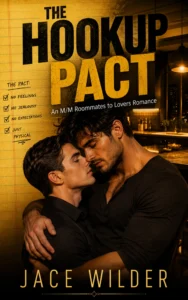
Hookup Pact
Fifteen filthy items. One best friend. What could go wrong — besides falling in love around experiment two?
Never Miss a Release
Get new release alerts, exclusive bonus content, and reader-only giveaways.