
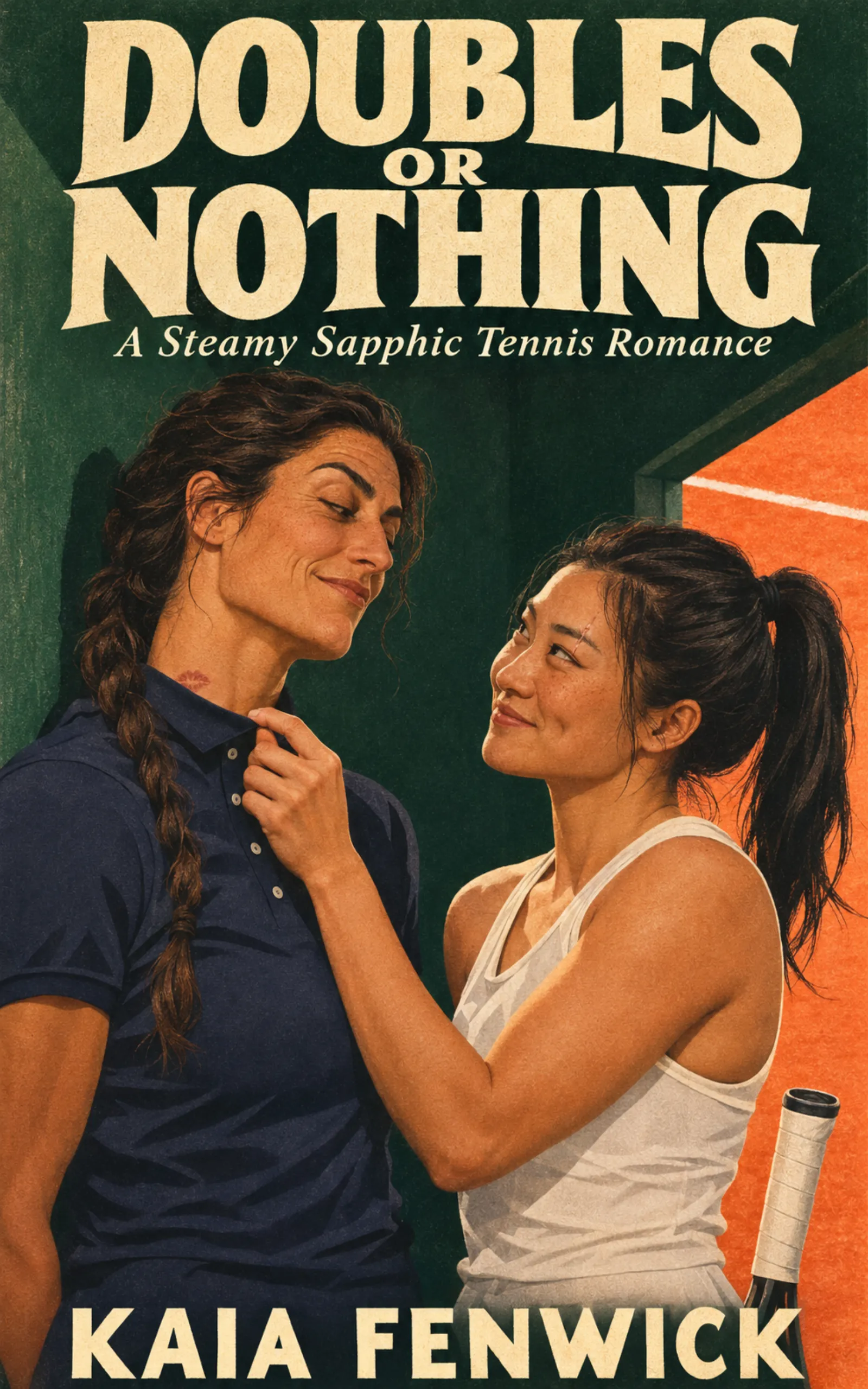
Doubles or Nothing
A Steamy Sapphic Age-Gap Tennis Romance
by Kaia Fenwick
Shop the ebook · Shop the audiobook
Available at all major retailers
Pairing: FF (Sapphic)
Heat: 🌶️🌶️🌶️🌶️🌶️ Inferno
Tropes: Age Gap, Partners to Lovers, Forced Proximity, One Bed, Secret Relationship, Veteran/Rookie, Older Heroine, Praise Kink, Instruction Kink, Light Bondage, Strap-On, Dirty Talk, Switch Dynamic, Competence Kink, Tennis Romance, Sports Romance, Found Family, Grand Gesture, Standalone, HEA
She said doubles was for losers. Then she met the woman who’d make her beg for a second set.
Naomi Chen has made a career out of almost. Almost through qualifying. Almost into the big draws. Almost able to afford another month on tour.
So when her coach tells her the only way to save her season is doubles, she’d rather eat her racquet. Especially when the partner he’s lined up is Alba Martín: thirty-seven, Spain’s best doubles player, and sitting in the third row the day Naomi told a press room that doubles is what you play when singles stops paying.
Alba needs a lefty with a vicious return. She does not need a cocky twenty-six-year-old who watches her own shots and treats the net like a crime scene. She agrees to one spring. Shared costs. Shared hotel rooms. One rule: she doesn’t sleep with her partners.
Then Naomi starts moving with her. Then the wins start coming. Then two twin beds get pushed together across a hotel carpet, and Alba’s voice on the practice court (move with me, good, again) becomes the voice Naomi hears in the dark.
But Naomi keeps a ledger of every kindness she can never repay, and Alba has never once in her life asked for what she wants. And the better they play together, the faster Naomi’s singles career takes off, until a life-changing offer arrives with one condition: drop doubles.
Naomi has to decide whether the woman who taught her to come forward is a stepping stone… or the whole point.
Doubles or Nothing is a high-heat sapphic age-gap tennis romance with sun-soaked clay courts in Valencia, a British family who adopts the tall Spanish one on sight, a yellow rope, a red box of tea, four thousand photographs of doors, a lot of hotel rooms, a championship point in Hong Kong, and a guaranteed HEA. Standalone.
You’ll love this book if you enjoy:
✅ A press-conference insult that comes back to bite her in front of the woman she insulted
✅ An eleven-year age gap: a cocky 26-year-old and a 37-year-old who has been doing this since before she could volley
✅ A “never sleep with my partner” rule that doesn’t survive the spring
✅ Twin beds pushed together, then one bed, then hers
✅ Coach voice in bed: “Look at me. Good. Again.”
✅ A yellow training rope that ties them together on court, and later, somewhere else
✅ A remote toy, a sponsor dinner, and a chocolate mousse she won’t ever forget
✅ Meeting the parents in Stockport, a single bed, and “your mother will hear”
✅ A ledger of every debt, and the day it gets crossed out with a ruler
✅ A great-aunt with four thermoses of soup who interrogates the whole tour
✅ A grand gesture by post, a hotel-lobby reunion, and a championship point played out loud
✅ 🌶️🌶️🌶️🌶️🌶️ heat, HEA guaranteed
⚠️ Content Warning: This novel contains explicit sexual content (graphic FF scenes including oral sex, fingering, scissoring, face-sitting, a strap-on, light bondage with a training rope, a remote-controlled toy worn in public, phone sex, praise and dirty talk), an eleven-year age gap between adult leads, financial anxiety and a compulsive habit of tracking debts, a sports injury, a painful breakup, family sacrifice and guilt, public mockery on social media, and strong language. Intended for readers 18+.
📖 Read Chapter One Free
Not sure yet? Read all of Chapter One right here.
Chapter One: Let It Bounce
NAOMI
The ball came back again.
Naomi had hit it hard enough to end the point three times over, and every time the seventeen-year-old from Tampa with braces and a forehand like a slammed car door got there, bent her knees, and sent it back.
Six-all in the final-set tiebreak. Last round of qualifying. A hundred and eleven people in the stands, at least forty of whom were somebody’s relatives.
The ball landed short. Not very short. A metre inside the service line, sitting up, fat and yellow in the Florida glare, and every coach Naomi had ever had was screaming in her head at once: Go. Go in behind it.
She hit the approach. Good approach. Deep, low, skidding off the hard court into the girl’s backhand.
And then she watched it.
Half a second. Less. Long enough to admire how good it was. Long enough to plant her feet a step behind where she should have been, which was the exact length of time it took the girl to flick a backhand pass down the line that kissed the paint and kept going.
“Out,” Naomi said to no one, because it wasn’t.
Seven–six. Match point against.
She pressed the strings of her racquet against her forehead. Hot. Bonita Springs in March was a sauna someone had built a strip mall around.
Serve wide. Serve wide and stay back and play the long point. You’re better at the long point.
She served wide. The lefty slice, the one that broke off the court and dragged right-handers into the side fence. The girl got a frame on it. The ball floated back over the net, slow, high, a gift.
Naomi let it bounce.
She would think about that later, at three in the morning over the Atlantic. A ball floating at her like a balloon at a child’s party, and she’d let it bounce, because the net was where she went when she was frightened and the baseline was where she lived.
She crushed the forehand. The girl, who had nothing left, who was seventeen and cramping and visibly praying, threw her racquet at it and the ball ballooned off the frame and dropped onto Naomi’s side like a dead bird. Untouchable. Two inches from the net cord.
Naomi was nine feet behind it.
The girl from Tampa burst into tears. Naomi shook her hand at the net and said, “Well played,” and meant it, which was the worst part.
The stairwell behind the player lounge smelled of bleach and someone else’s Red Bull. She sat on the third step down with her bag between her knees and opened the note on her phone.
It was called LEDGER, because that sounded like something a grown woman would keep, and not something a fourteen-year-old had started after finding her father’s spreadsheet on the family computer and reading every line of it with her heart going like a fist on a door.
Lessons. Flights. Restrings. A line in the spring she was twelve that just said remortgage — tennis in Dad’s neat sans serif, as if it were a utility bill.
She didn’t think about that spreadsheet very often. She just kept the note.
Flight Manchester–Miami: £418. Car share Miami–Bonita: $40. Hotel 5 nts (split w/ Sofia): $310. Stringing x4: $96. Qualifying prize money (R3 loss): $512.
She did the arithmetic again, though she’d already done it on the walk from the court.
Seven weeks. If she shared every room, ate supermarket dinners and didn’t break a racquet in temper, seven more weeks before the account hit zero and she had to go home to Manchester and tell her mum, with the kettle on, that she was twenty-six and still almost.
Almost was her whole career. Almost through qualifying. Almost into the big draws. Almost beat a top-fifty player in Rome, three sets, with cramp. She had a highlight reel made entirely of brilliant points in matches she’d lost.
Her phone buzzed. The family group chat, which Jamie had renamed THE CHEN DYNASTY in a moment of hubris and nobody had ever changed back.
Jamie: lost?
Jamie: sorry. that was brutal. the stream said you “let it bounce” what does that mean
Mum: Jamie.
Jamie: I’m being SUPPORTIVE
Dad: Very proud of the fight, love. Ring when you can. x
Mum: Eat something with a vegetable in it.
She typed I’m fine and deleted it, because it was a lie and her mother had an ear for them even through a screen. Typed Knackered. Will ring tomorrow x, sent it, and put her head between her knees.
She didn’t cry. She had a rule about crying in stairwells — too much like a film. She just sat there and let the heat come up through the concrete, and thought, unhelpfully, about Melbourne.
Six weeks ago. Australian Open qualifying, final round, another loss she could still feel in her wrist. A small interview room, a sweaty T-shirt, four journalists looking at her with sympathy she hadn’t asked for. Third question: would she consider doubles to supplement her season? And Naomi, who had slept four hours and could still taste blood where she’d bitten her cheek on the last point, leaned into the microphone and said, “Doubles is what you play when singles stops paying.”
Somebody in the third row made a sound — a short breath through the nose, like a laugh with the edges filed off. Naomi hadn’t looked up to see who. The clip went round tennis Twitter for three days. Somebody made it into a T-shirt. Marcus texted her one word, Naomi, which was worse than a paragraph. She’d meant it as a joke. Mostly.
The phone buzzed again in her hand. Not the group chat this time.
MARCUS BELL.
She looked at it for two rings. Answered on the third.
“Before you say anything,” she said, “I know.”
“Do you.” Marcus had a voice like a filing cabinet being closed — Yorkshire, flat, impatient. He’d been her coach on and off for six years, in the gaps when she could afford him. “Go on, then. What do you know?”
“I let it bounce.”
“You let it bounce.” She heard him breathe out through his nose. “You had that kid dead. Twice.”
“It was a good approach.”
“It was a beautiful approach. You watched it like it was on telly.” In the background, a kettle — he was in Sheffield and had stayed up to watch the stream. That landed somewhere under her ribs and stayed. “Where are you?”
“Stairwell.”
“Christ. Right. Are you crying?”
“No.”
“Good. You can’t listen while you’re crying.” Another pause. “How many weeks?”
He knew about the ledger. So did Sofia, who’d seen it in Antalya and said Jesus Christ, Naomi, you log your tampons? She logged toiletries. Which was different.
“Seven,” Naomi said.
“Seven.” He didn’t say I told you so, which was decent of him, since he had, repeatedly, since Christmas. “So here’s what you’re going to do with seven weeks. You’re going to Valencia.”
“I’m not going to Valencia.”
“You’re going to Valencia,” Marcus said, in the same tone, as if she hadn’t spoken, “to the Ferrer academy, where I have spent a not insignificant amount of goodwill getting you a trial with a doubles coach called Inés Vidal.”
Naomi took the phone away from her ear and looked at it. Put it back.
“No.”
“Naomi.”
“I’m a singles player.”
“You’re a singles player ranked hundred and forty-one with seven weeks of money and no net game.” His voice didn’t get louder. It got quieter, which was much worse. “You need to learn to come forward like it’s a decision and not an emergency. And you need prize money from somewhere that isn’t the last round of qualifying, because you’ve lost there nine times in fourteen months and I’m running out of ways to make that sound like a strategy.”
“Doubles prize money’s split two ways.”
“Half of something is more than all of nothing. Even you can do that sum.”
She pressed the back of her head against the wall. “I said—”
“I know what you said. It’s on a T-shirt.” She heard him pour the kettle. “Inés thought it was funny. She’s got a proper doubles player looking for a lefty with a return, and you, God help us, are a lefty with a return. Best I’ve seen outside the top fifty. Wasted on you. You hit it, and then you stand there and wait for applause.”
“I don’t wait for applause.”
“You wait for something. Doubles will knock it out of you in a week. There’ll be another ball coming at your partner’s head, and if you’re standing there admiring your follow-through, she’ll know about it.”
Naomi looked at the opposite wall. Someone had written ROSA WAS HERE in Sharpie, and underneath, in different handwriting, ROSA LOST IN Q1.
“Who’s the doubles player?”
“Someone who knows what she’s doing.”
“That’s not a name.”
“It’s a description. You’ll get the name when you get there.” He sipped something. “Be nice.”
“I’m always nice.”
“You told a press room full of people that—”
“Marcus.”
“There’s a flight to Madrid tomorrow night. Connection to Valencia. I’ve emailed you. Inés will meet you Thursday morning, court four, nine o’clock.” His voice went, briefly, almost gentle. “You were brilliant today for two hours and fifty-one minutes, Naomi. I just need the other nine minutes.”
He rang off before she could say anything kind back.
She opened the ledger and added a new line.
Flight MIA–MAD–VLC: £612.
Seven weeks became six and a half.
Valencia hit her like an opened oven door.
Not the temperature — March, the taxi driver told her cheerfully, was fresquito, chilly, which was a lie by Manchester standards. It was the light. Pale gold and enormous, a sky so blue it looked lacquered. They passed through flat green country that smelled sweet and faintly bitter, and when she asked, the driver waved a hand at the rows of dark glossy trees.
“Naranjos,” he said. “Oranges. Everything is oranges.”
The academy was a long low compound behind a white wall south of the city, the sea a flat glitter beyond the trees. Twenty-odd courts, mostly red clay, laid out under an avenue of orange trees, so the whole place smelled of blossom and wet brick dust and the sprinklers that hissed across the clay like something breathing.
Naomi stood in the gravel car park with her racquet bag on her shoulder and felt, for one disorienting second, that she’d come somewhere nice.
She didn’t trust the feeling. Nice places cost money.
“Chen?”
A woman was coming down the path between the courts. Mid-forties, wiry, tanned to the colour of a saddle, grey streaked through a short black crop, jaw working steadily on something.
“Inés Vidal,” the woman said, and stuck out a hand. Her grip was dry and hard. She chewed, assessed Naomi from trainers to ponytail, and chewed some more. “You look tired.”
“I flew overnight.”
“Everybody flies overnight. You look tired here.” Inés tapped her own temple, then popped a fresh square of nicotine gum into her cheek. “I quit smoking eleven years ago. This, I have not quit. Leave the suitcase in the office. Your partner is already here.”
“My—” Naomi hadn’t even hit a ball. “It’s a trial. I thought.”
“Of course it is a trial. Everything is a trial. My marriage was a trial. Come.”
Naomi followed Inés down the avenue of courts, past Spanish juniors grinding forehands at each other with the joyless intensity of fifteen-year-olds. Clay dust puffed up round her trainers. A sprinkler came on behind her, and she jumped.
“Marcus says you have a good return,” Inés said, without looking back.
“Marcus says a lot of things.”
“Marcus says very few things. That is why I listen when he does.” Inés stopped at the gate of court four and turned round. She looked at Naomi with her head tilted, still chewing, with an expression Naomi couldn’t read and didn’t like. “Also I saw your press conference.”
Naomi’s face went hot. “Right.”
“It was very funny.” Inés did not smile. “I would not say it again here. This is a doubles academy. We have a lot of rackets and some of us have very good aim.” She pushed the gate open with one hip. “Go and introduce yourself. Try not to talk too much.”
Naomi stepped onto the clay.
The court was empty except for a ball basket, a scatter of yellow balls, and one woman.
She was standing at the service line with her back to the gate, feeding balls one-handed to nobody. Just hitting them — an easy, idle flick of a forehand volley, the ball dropping into the far corner, then another, then another, each one landing within a racquet’s width of the last, as if she were practising her handwriting. In her other hand she was holding a peach.
She was tall. That was the first thing. Tall in the way some players are, all length — long legs in black shorts, a long back, long arms, the kind of reach that made the court look a size too small for her. Her shoulders were broad and strong under a faded grey vest, the deltoids rounding into the arms with the easy definition of someone who’d spent twenty years doing exactly this. Dark hair hung down her back in a single thick braid, almost to her waist. There was a spray of freckles over the top of her right shoulder, scattered like someone had flicked a wet paintbrush, and a line where her tan stopped and something paler began, just under the strap of the vest.
She took a bite of the peach. Fed another ball. Corner.
Naomi noticed all of it with the bright, useless clarity of the badly jet-lagged, and was annoyed at herself for noticing.
“Hiya,” she said. “Sorry. I’m—”
The woman turned round.
She was older than Naomi had expected from the back. Late thirties, maybe. Brown eyes, a strong nose, a wide mouth that was currently shiny with peach juice. Faint lines fanned from the corners of her eyes, the kind you get from twenty years of squinting into sun, and she hadn’t done a single thing to hide them. A small gold hoop in one ear. A face that was — Naomi went looking for the word and came back with handsome, then striking, then gave up — a face she knew.
She knew it from side courts at three Slams, where she’d walked past on the way to her own losses and seen this woman stalking the net like a cat along a fence.
Alba Martín.
Former world number six in doubles. Three tour titles. A US Open semifinal with Eva Soler, the Spanish partnership everybody called the best-organised team on tour. Alba Martín, who read the server’s toss like a postcard addressed to her, and poached so early opponents said they felt robbed.
The proper doubles player.
Marcus, Naomi thought, with deep and genuine hatred.
Alba looked at her. Took her in — trainers, bag, ponytail, face — with a slow, unhurried thoroughness that made Naomi feel abruptly like a used car. Then something moved across that wide mouth that wasn’t quite a smile.
“Ah,” Alba said. Her voice was lower than Naomi expected, warm, with a Spanish rhythm under the English that rolled the edges off the words. “The one who thinks doubles is for people singles stopped paying.”
There it was. Third row. That short breath through the nose, a laugh with the edges filed off.
Naomi’s face went from hot to scalding. She considered, briefly, walking straight back to the airport.
Six and a half weeks.
“You were there,” she said.
“I was there.” Alba took another bite of the peach, unhurried, and a drop of juice ran down the side of her wrist. She caught it with her tongue. Naomi looked very hard at the ball basket. “Third row. I had just lost a match. Super tiebreak, eleven–nine, in front of my mother. So I went to listen to the British girl, because Eva said you had a nice forehand and I wanted to see if you also had a nice personality.” She chewed. Swallowed. “You have a nice forehand.”
“That’s—” Naomi stopped. Started again. “It was a joke.”
“Was it? It was very well delivered for a joke.”
“I’d lost. I was knackered. Someone asked a stupid question and I gave a stupid answer.”
“That was not a stupid question.” Alba bounced a ball on the strings of her racquet, idle, without looking at it. Up, down. Up, down. “You gave a stupid answer to a good question. It is different.”
“Fine. A stupid answer to a good question. I apologise to the entire sport of doubles.” Naomi heard herself and winced, because it hadn’t come out how she meant — it had come out the way things always came out of her when she was embarrassed, dry and flat and slightly too sharp, like admin. “That — sorry. That wasn’t—”
“No, no. Keep going. It is interesting.” Alba tilted her head. Up, down, went the ball. “Do you also want to apologise to my coach? She is very sensitive.”
From the gate behind Naomi, Inés said, “I am extremely sensitive,” and chewed.
Naomi closed her eyes for one second.
When she opened them, Alba was still looking at her. Not unkindly, quite. Not kindly either. The way Naomi herself looked at an opponent in the warm-up — measuring the backswing, watching the feet, trying to work out where the weakness was so she could put the ball there for three hours.
“Marcus didn’t tell me it was you,” Naomi said.
“No. He told me he would not.” Alba shrugged, and it did something to the line of her shoulders that Naomi decided not to think about. “He said if he told you, you would not come. I said, if she will not come because of me, then she is not serious and I do not want her. He said, she is serious, she is just stupid about it. I liked that. So.” She tossed the peach stone into the ball basket, wiped her hand on her shorts, and walked towards the net. “Here you are. Serious and stupid. Let us see.”
“What—” Naomi said. “Now?”
“You came to play tennis or to make conversation?” Alba stopped at the net and leaned her forearms on the tape, the way Naomi had seen doubles players do a thousand times between points and had always thought looked smug. On Alba it looked like ownership. “Because I have conversations with my sister. She is much better at it than you.”
Naomi dropped her bag on the bench and pulled out her good racquet, strung in Florida for thirty-two dollars she’d logged.
“I flew sixteen hours,” she said.
“And I have been standing here since eight-thirty eating fruit.” Alba straightened up from the net. “We are both suffering. Go to the deuce side, please. I will serve to you. Real serves, not practice. Inés will tell me if I am being unkind.”
“You are being unkind,” Inés said from the gate.
“Good. Then it is working.”
Naomi walked to the baseline. The clay was soft under her hard-court shoes, and the sun came down through the orange trees in long gold bars that shifted when the breeze moved the leaves. She set her feet. Bounced on her toes.
Across the net, Alba bounced a ball. Once. Twice. Didn’t look at Naomi at all. Then she tossed — a high, lazy toss, the ball hanging there in the bright air for longer than seemed possible — and uncoiled into it like a whip cracking.
The serve was a kick. Heavy, spinning, jumping up off the clay towards Naomi’s backhand shoulder, the most uncomfortable place in the world for a two-handed lefty to meet a ball. A serve built by someone who’d spent half her life working out exactly where returners didn’t want it.
Naomi didn’t think. She never thought on the return. It came from somewhere older than thinking — a thousand afternoons at the club in Stockport with her dad feeding baskets. She took one step in. Took it early, on the rise, before the kick could finish climbing. Two hands, short swing, all hips. Hit it so hard and so flat and so close to Alba’s feet that the ball was past her before Alba had finished landing from the serve.
It skidded off the line in the far corner and kicked up a little puff of red dust, like a gunshot in a western.
Silence on court four.
Somewhere behind her, Inés stopped chewing.
Naomi stood with her racquet still across her shoulder in the follow-through and watched the ball roll into the back fence. It was a beautiful return. Probably the best return she’d hit in a month. She felt the old familiar warmth of it go through her like a shot of something — there, see, that’s what I can do — and only then, too late, half a second too late, did she realise she was still standing exactly where she’d hit it from. Rooted. Watching.
If there’d been another ball coming, she’d have been dead.
Across the net, Alba had turned to watch the ball too. Now she turned back. Looked down the court at Naomi with an expression that had changed — the measuring look was still there, but there was something else under it now. Something sharper. Interested.
“Again,” Alba said.
Body serve. Jammed. Naomi turned her hips out of the way and smacked it straight back down the middle, at Alba’s feet, low and hard.
This time Alba moved. Faster than anyone that tall had a right to move — two quick steps in and a half-volley off her shoelaces, soft hands, the ball dying over the net and dropping onto Naomi’s side like a feather onto a pillow. A shot so delicate it looked like a magic trick.
Naomi, who was still standing on the baseline admiring her return, watched it bounce twice.
“Ay,” said Inés from the gate, and resumed chewing.
Alba walked up to the net and leaned on it again, forearms on the tape. She was a little out of breath. Not much. A flush across her collarbones, high colour on her cheekbones, a strand of dark hair come loose from the braid and stuck to her neck.
“So,” she said.
“So,” said Naomi.
“Your return is very good.”
“I know.”
“Yes. You know.” Alba’s mouth did the thing again — almost a smile, and then, decisively, not. “You know so much that after you hit it you stand there and look at it like it is a painting in a museum. And while you are looking at your painting, the ball comes back and I put it at your feet and you are still in the museum.”
“That’s not—”
“It is. I watched you in Melbourne, before the press conference. You hit a good ball and then you stand there, and it comes back, and you are surprised. Every time, surprised.” Alba bounced a ball on her strings. “In singles, sometimes, you get away with it. In doubles, there is always somebody at the net waiting for you to stand still. In doubles, standing still is how you die.”
Naomi opened her mouth.
Closed it.
The breeze moved the orange trees. Sun and shadow slid across the clay between them, and for a second Alba’s face was all gold light — the strong nose, the laugh lines, a faint shine of sweat at her temple, the mouth that had just licked peach juice off her own wrist — and Naomi felt something in her stomach turn over, slow and unwelcome, like an engine trying to start in the cold.
Absolutely not, she told it.
“So that’s a no, then,” she said out loud. “Great. I’ll get my suitcase.”
“I did not say no.”
“You said I stand there like I’m in a museum.”
“You do stand there like you are in a museum.” Alba straightened up off the net. She was taller than Naomi by a couple of inches, and she used every one of them, looking down the length of that strong nose with her brown eyes very steady. “That is a habit. Habits, I can fix. What I cannot fix is somebody who is slow, or somebody who is scared of the ball, or somebody who does not care. Those people, I send home.”
“And I’m not those people.”
“You are not slow. You are not scared of the ball.” Alba considered her. “The third one, I do not know yet.”
“I care.”
“You care about singles.”
“I care about winning.” It came out harder than she meant. Truer than she meant. Naomi heard it land in the warm air between them and couldn’t take it back. “I care about not going home in six and a half weeks to tell my mum I couldn’t make it work. If doubles stops that happening, then I’ll care about doubles. I’ll care about it so much you’ll be sick of me.”
For a long moment, Alba didn’t say anything at all.
She looked at Naomi — really looked — and something in her face shifted. Not softened. Sharpened. Focused, like a lens.
Then she picked up a ball from the clay and turned it over in her long fingers.
“I need a partner,” Alba said. “Not a project. I am thirty-seven years old, and my last partner left me for a girl who is number eight in the world at singles and plays doubles when she is bored. I do not have time to teach someone who will leave when her singles is going well. I do not have time to be anybody’s consolation prize.”
“I’m not asking you to be.”
“No. You are asking me to save your season.” Alba tossed the ball up and caught it without looking. “Which is fine. I am asking you to save mine. That is a fair trade. That is what partners do. But it is a trade, not a favour, and I am not interested in somebody who is going to stand in the museum.”
She walked back to the service line. Turned round. Bounced the ball once on the clay, red dust puffing round it.
“So,” Alba said. “Show me your return again. And this time, when you hit it, you come forward. Two steps. Like it is the beginning of something and not the end.” She tossed the ball up into the gold air and caught it again, and her eyes came to rest on Naomi’s — steady, brown, faintly amused, entirely uncompromising. “If it is as good as your mouth, we will talk.”
Want to keep reading? The full novel is available now.
🔥 Want an EXCLUSIVE Bonus Chapter?
Specific Yes — A scene TOO HOT for the bookstore
The night after the proposal. The long table in El Carmen, seven empty chairs, a garnet ring, and the yellow rope out of the racquet bag one more time. Naomi’s point of view. This time she makes Alba ask.
More from Kaia Fenwick
Browse all Kaia Fenwick books.

The Captain and the Chaos
The captain handles everything. She can't handle Frankie DeLuca.
Doubles or Nothing
She said doubles was for losers. Then she met the woman who'd make her beg for a second set.

She Calls the Play
She's never let anyone run her offense. The six-foot-five center across the hall isn't asking.
The Partner Clause
Twelve clauses. One season. Clause Nine says no.

The Trade We Made
She traded me once. Now we're on the same line. And the coach has one rule.
Never Miss a Release
Get new release alerts, exclusive bonus content, and reader-only giveaways.