

She Calls the Play
A Steamy Sapphic Rivals-to-Lovers Basketball Romance
by Kaia Fenwick
Shop the ebook · Shop the audiobook
Available at all major retailers
Pairing: FF (Sapphic)
Heat: 🌶️🌶️🌶️🌶️🌶️ Inferno
Tropes: Rivals to Lovers, Teammates to Lovers, Neighbors to Lovers, Secret Relationship, Size Difference, Forced Proximity, Competence Kink, Praise Kink, Switch Dynamic, Dirty Talk, Strap-On, Mutual Pining, Basketball Romance, Sports Romance, Found Family, Grovel, Only Soft For You, Standalone, HEA
She’s never let anyone run her offense. The six-foot-five center across the hall isn’t asking.
Kennedy Ross runs every possession. Every screen, every cut, every second of the shot clock is hers. It’s made her the smartest point guard in the league. It also got Chicago bounced in the first round on a possession she held eighteen seconds too long, and now she’s in a contract year with something to prove.
Then the Alloy sign Daria Vuković: six-foot-five, Serbian, ten years of European ball behind her, and absolutely no interest in being told where to stand.
Daria slips screens Kennedy didn’t call. She sees lanes Kennedy missed. She annotates Kennedy’s annotations and slides them under the door, because of course the club put her in the condo across the hall.
Kennedy has one rule: never a teammate again. Daria breaks it against the padded wall of an empty gym at six in the morning.
Now they have terms. Keep it secret. Keep it off the court. End it when the season ends. And one clause Daria added in her own handwriting: In bed, I call the plays.
The point guard has never let anyone else run the offense. But Daria doesn’t want her to give up control. She wants her to hand it over.
And with a championship on the line, a European club offering Daria a way out, and Kennedy’s ex waiting on the other side of the Finals, they’re about to find out if they can trust each other with the last shot.
She Calls the Play is a high-heat sapphic rivals-to-lovers basketball romance with a Detroit point guard who has to learn to let go, a Serbian center who has to learn to say it out loud, notes under the door, an ugly amber lamp, a long bed, a green velvet couch, six typed clauses that break one by one, a strap-on that doesn’t fit the smaller woman (she wears it anyway), a playoff run, and a guaranteed HEA. Standalone.
You’ll love this book if you enjoy:
✅ Rival teammates who argue in red and black ink and slide it under each other’s doors
✅ A six-foot-five center who lifts her point guard off the floor like she weighs nothing
✅ A never-a-teammate rule broken against a padded wall at 6 a.m.
✅ Six typed clauses, one struck out and rewritten: In bed, I call the plays
✅ “You don’t call this one.”
✅ A control freak who has to ask out loud, and finally does
✅ A Serbian word whispered in the dark she won’t translate until after the season
✅ Secret dates, a stormy Chicago river, and one photo under a bridge that changes everything
✅ Big loud families, a glitter sign, and a team that becomes found family
✅ Real game detail, a Finals run, and a last possession nobody holds
✅ 🌶️🌶️🌶️🌶️🌶️ heat, HEA guaranteed
⚠️ Content Warning: This novel contains explicit sexual content (graphic FF scenes including oral sex, fingering, scissoring, face-sitting, edging, a strap-on, power exchange, praise and degradation in dirty talk, and sex in semi-public places), sports injuries including cuts and a split lip, a parent’s hip surgery, a partner going behind the other’s back on a contract negotiation, emotional withholding and lying by omission between the leads, an ex on the opposing team, public outing via a viral photo, and strong language. Intended for readers 18+.
📖 Read Chapter One Free
Not sure yet? Read all of Chapter One right here.
Chapter One: Eighteen Seconds
KENNEDY
Eighteen seconds.
Kennedy Ross had watched them so many times she could feel them in her teeth.
The film room at the Alloy practice facility was kept at sixty-four degrees because Coach Dana Ortiz believed warm rooms made people forgiving. The screen took up the whole front wall. The chairs were the cheap stackable kind that left grooves in the backs of your thighs. Kennedy sat in the third row, center, the way she always did, legs crossed at the ankle, hands flat on her knees.
On the screen, last season was still happening.
Game Three, first round, Seattle. Down two. Eighteen seconds on the game clock, eighteen on the shot clock, so nobody had to do math. Kennedy brought the ball up the right side in white, braids tied back, face doing absolutely nothing. She remembered thinking about her feet. She remembered thinking the crowd sounded like a jet engine with an opinion.
Tasha Okafor jogged up to set the high screen. Six-four, honest, good hands. She set it the way they’d drilled it a thousand times. Square. Wide. Solid.
Kennedy rejected it.
On film it was obvious. In real life it had felt like genius. She’d seen Seattle’s big man sitting back in a deep drop and the guard cheating over the top, and she’d thought, I can beat them both to the left elbow, and she’d crossed back away from the screen, and for one dribble it had worked.
Then the help came. Two Seattle defenders, long arms, one of them already in the air before Kennedy had decided to rise. She pulled up anyway. Fifteen feet, contested, shoulders squared because she had always been taught to square her shoulders. The ball hit the back iron hard enough that she’d heard it over twenty thousand people.
Seattle rebounded. Season over.
Ortiz hit the remote.
The frame froze two seconds before the shot. Kennedy in the air. Two green jerseys swallowing her. And down at the bottom of the screen, alone at the dotted line, Tasha Okafor rolling toward the rim with both hands up and her mouth open, calling for it.
Nobody within eight feet of her.
Ortiz set the remote on the table between them and didn’t say anything. She was forty-five, compact, gray creeping in at the temples of her black hair, and she had played point guard in this league for eleven seasons before Kennedy was out of middle school. She knew exactly how long to let a silence sit.
Kennedy lasted four seconds.
“I saw her.”
“Then why is she still open?”
Kennedy kept her hands on her knees. “Because the big could have recovered. Seattle’s center was the best rim protector in the league last year. If I throw that pocket pass and she gets a hand on it—”
“She was at the free-throw line with her back turned.” Ortiz didn’t raise her voice. She never did. “You know where she was. You know where everybody was. You always know where everybody is, Kennedy. That’s your gift. It’s why I’d take you over half the guards in this league with my eyes closed.”
“But.”
“But you saw the open woman and you decided you’d rather do it yourself.” Ortiz tapped the frozen screen with a pen. “That’s not a read. That’s a preference.”
Kennedy looked at Tasha’s open hands. Tasha who’d signed with Phoenix in February and had sent Kennedy a very nice text about it. No hard feelings, KR. Just wanted to touch the ball in the fourth quarter.
No hard feelings. Kennedy had read it eleven times.
“I’ve hit that shot,” she said.
“You’ve hit that shot,” Ortiz agreed. “Thirty-eight percent of the time, contested, late clock, for your career. I pulled it. You want to know what Tasha shot on uncontested rolls last year?”
Kennedy did not want to know.
“Seventy-one.” Ortiz let it land. “I’m not telling you anything you can’t calculate faster than me. I’m telling you because six seasons the first option worked. Six seasons you could see the floor and beat the floor at the same time. The league caught up. They load up on you because they know you’ll try to solve it alone. So we stop letting them.”
“How?”
“You give it up early.” Ortiz said it like a scripture she’d been saving. “Before the help comes. Before you’re sure. You give it up early, you get it back better.”
Kennedy’s jaw ached. She realized she was clenching and stopped.
“Okay,” she said.
Ortiz looked at her for a long moment, the way you’d look at a bridge after someone told you it was fine.
“Camille wants us upstairs at ten,” she said, and clicked off the screen.
Camille Price’s office had a glass wall that overlooked both practice courts, which Kennedy suspected was the entire point of Camille Price’s office.
The general manager was thirty-nine and had never once, in Kennedy’s presence, raised her voice, lowered her guard, or worn a blazer with a wrinkle in it. Today’s was dove gray. She had coffee in a ceramic mug with no logo on it and a single sheet of paper face-down on her desk, and Kennedy spent the first thirty seconds trying to read it through the back.
“Kennedy. Thanks for coming in early.”
“It’s ten o’clock.”
“Early for April.” Camille smiled with exactly the right amount of teeth. “I’ll be direct, since you prefer it. Sandra called me last week about an extension.”
Sandra Ellis, Kennedy’s agent, had called Camille against Kennedy’s explicit wishes, which was what Kennedy paid her for.
“And?”
“And I told her what I’ll tell you. We value you. Seven seasons, the assist record, the way you show up in this building. Nobody here wants you in another uniform.” Camille turned her mug a quarter turn. “But we’re not discussing years and money until we see something different on the floor. Different basketball. That’s all.”
That’s all. Like it was a grocery item.
“Define different,” Kennedy said.
Ortiz, leaning against the window with her arms crossed, answered instead. “The offense runs through the elbow this year. Not exclusively through you. We get the ball to the free-throw line, let someone catch it there and decide. Finish, dump it off, kick it out, reset. Five options instead of one.”
“Who’s catching it at the elbow? Tasha’s gone.”
Camille turned the sheet of paper over and slid it across the desk.
A headshot, a contract summary, a stat line from a league in France that Kennedy had heard of but never watched. A woman with dark hair pulled back hard, a jaw like a statement, a nose that had been broken once and set by someone in a hurry. She wasn’t smiling. She looked like she’d been asked to and had declined.
DARIA VUKOVIĆ. CENTER. 6’5″. 31. BELGRADE, SERBIA.
“Signed Thursday,” Camille said. “Two years. Ten seasons in Europe—Belgrade, Valencia, Istanbul, Lyon. She’s been the decision-maker in every offense she’s played in. Best passing big we could find on either continent.”
“She’s thirty-one and she’s never played in this league.”
“She’s thirty-one and she’s played against better centers than this league has,” Ortiz said mildly. “She’s already in the city. Flew in last night. She’ll be at film this afternoon.”
Kennedy looked at the woman on the paper and heard, very clearly, the thing nobody in the room was saying out loud.
You’re the problem. We bought a fix.
Her hands wanted to move. She pressed them flat on her thighs instead, the way she did in pressers when somebody asked about the eighteen seconds, and felt the familiar cold settle over her, the one that made reporters write words like composed and unflappable and ice in her veins.
It wasn’t ice. It was a lid.
“Partnership,” Camille added. “That’s how we’re framing it publicly. The point guard and the center. People like a pairing.”
Kennedy had been part of a pairing once.
Three years ago. Reese Calloway, starting wing, the best laugh in the locker room and the worst idea Kennedy had ever acted on. Fourteen months of hiding it from the team, then not hiding it, then the whole roster quietly picking sides when it went sour, then Reese traded to New York for a second-round pick and a bench shooter. Reese’s last words to her had been delivered in the parking garage, car door open, voice perfectly calm. Being with you is beautifully organized and incredibly lonely, Ken. Then she’d driven to O’Hare and never looked back, and the Union had made the Finals twice since.
Kennedy had made a rule that night, sitting in her car with the engine off. One rule, simple enough that even she couldn’t negotiate with it.
Never a teammate again.
It had nothing to do with this meeting. She didn’t know why she was thinking about it.
“Questions?” Camille asked.
“Three.” Kennedy held up a finger. “Does she know the system?” Second finger. “Does she know she’s coming off my screens, not the other way around?” Third. “What’s her free-throw percentage, because if she’s going to catch at the elbow she’s going to get fouled.”
Ortiz and Camille exchanged a look Kennedy did not care for.
“She knows the system on paper,” Ortiz said. “She’ll learn the rest from you. Sixty-eight from the line. And Kennedy—” Ortiz pushed off the window. “Nobody’s coming off anybody’s screens. You’re going to run it together. She reads. You read. Somebody gets open, somebody gets the ball. That’s the whole idea.”
“Of course,” Kennedy said.
She said it very evenly. Ortiz, who had been watching her for seven years, didn’t look reassured at all.
The building cleared out after lunch. Kennedy didn’t.
She went back down to the film room, dropped the temperature another degree out of spite, pulled up the Seattle clip, and watched it four more times. Then she pulled up every possession of Daria Vuković that the video staff had loaded into the system—sixty-two clips, French commentary, grainy arena feeds—and started taking notes.
The woman was good. Kennedy could admit that in a dark room with nobody watching.
She didn’t set screens; she arrived. She moved quietly for her size, no wasted steps, and then she was just there, wide and immovable, and guards bounced off her like they’d run into a load-bearing wall. Half the time she slipped out of the screen before contact, slid into the gap, caught on the move. She passed out of traffic with either hand. She didn’t look at the ball enough, Kennedy wrote. She looked at people.
Slips early, Kennedy wrote. Leaves before the guard uses it. Fix.
She had looped back to the Seattle clip for the fifth time when the door opened behind her.
“—and this is film,” said Marcus from equipment, in his tour voice. “Coach likes it cold.”
“I can feel that,” said a low, accented voice. “Is she hiding bodies in here?”
Kennedy didn’t turn around. She knew who it was the way you know a thunderstorm before it gets to you—a change in the pressure. She kept her eyes on the screen as footsteps came down the aisle, unhurried, and then a shadow fell across the second row and kept going, and kept going, and Kennedy finally looked.
Daria Vuković was a lot of woman.
That was Kennedy’s first thought, and she was mortified by it immediately. Six-five didn’t do it justice. The photo hadn’t prepared her for the breadth of her—the shoulders, the long arms, the solid stance of somebody who’d spent a decade getting hit by people and not moving. She wore a gray hooded sweatshirt that said nothing on it and black joggers and the specific creased, gritty exhaustion of a transatlantic flight. Her dark hair was coming out of a low knot. A roller bag stood beside her like an obedient dog.
Her eyes were hazel. Tired. Very awake.
“Kennedy Ross,” she said. Not a question.
“Daria.” Kennedy stood, and still had to tilt her head back. “Welcome to Chicago.”
“Thank you. It is very flat.” Daria glanced at the frozen screen. “This is the famous one?”
“Famous is a strong word.”
“Marcus sent it to me in Lyon. Before I signed.” Daria tipped her head toward the equipment manager, who had suddenly discovered something fascinating about the doorframe. “He said, this is why we need you.“
Marcus made a strangled noise and disappeared.
“Great,” Kennedy said. “Love that for me.”
Daria didn’t smile, but something at the corner of her mouth considered it. “May I?”
She held out her hand for the remote. Kennedy gave it to her before she’d decided to.
Daria backed the clip up to the start and let it run. Once, at full speed. She didn’t pause or rewind. She stood in the aisle with her weight on one hip and watched Kennedy reject the screen, watched the double team close, watched the ball clang off the back of the rim. Her face did nothing at all.
When it ended, she set the remote down on the table between the rows.
“The roller was open,” she said.
“I looked,” Kennedy said. Her voice came out sharper than she meant it to. “I’m not blind. I had her the whole way.”
“You looked at her.” Daria turned those hazel eyes on her, level and unimpressed. “You didn’t see her.”
It went in clean and stuck, a splinter under a fingernail.
“There’s a difference?”
“Of course.” Daria said it simply, like a fact about weather. “Looking is checking she is where you left her. Seeing is believing she can do something with it. You checked. Then you decided it would be better if it was you.”
Kennedy opened her mouth and nothing came out.
Ortiz had said it with a pen and a statistic. This woman had said it in the time it took to watch eighteen seconds, jet-lagged, in a hoodie, without ever having met her. Kennedy wanted to be furious, and she was, but under the fury was something far more irritating, which was that she was paying attention.
To the voice—low, unhurried, every consonant set down carefully like it might break.
To the hands.
Daria had rested them on the back of a chair while she talked, and they were enormous. Long fingers, broad palms, knuckles that had been jammed more than once, a strip of old athletic tape still clinging to one ring finger. Hands that could palm a ball without trying. Hands that could probably span Kennedy’s entire—
She looked back at the screen so fast her neck clicked.
“We’ll find out,” Kennedy said, “whether you see better than I do.”
“Yes.” Daria picked up the handle of her roller bag. “We will. Tomorrow, nine o’clock?”
“Practice is at ten.”
“I know.” Daria paused at the end of the row. “I meant for me. I like an empty gym first. Nobody yelling yet.”
She walked out. She ducked slightly through the doorway, a small, automatic dip that she’d clearly been doing her whole life, and Kennedy stood alone in the sixty-three-degree room and realized she had goosebumps on her arms that had nothing to do with the air conditioning.
She sat down. She did not watch the clip again.
She looked at her own notebook instead, at the words she’d written an hour ago—Slips early. Leaves before the guard uses it. Fix.—and underlined Fix twice, hard enough to tear the page.
Her building was on the river at the south edge of the Loop, an old printing warehouse turned glass-and-brick condos, with an elevator that smelled like cedar and a doorman named Luis who knew everyone’s dog by name. Kennedy had bought 14B four years ago with her second contract. She’d chosen it for the east windows, the kitchen with real counter space, and the fact that the unit across the hall had been vacant for two years, which meant silence.
The elevator opened on fourteen, and the silence was over.
The hallway was full of moving blankets. Two movers in back braces were wrestling a mattress through the door of 14C—a mattress that was clearly custom, clearly long, clearly made for somebody who’d spent a lifetime with her feet hanging off the ends of hotel beds. A dolly stacked with boxes. A single, battered hard-shell suitcase, olive green, covered in faded stickers from airports Kennedy couldn’t pronounce.
And a lamp.
It sat on the hallway carpet by itself like a refugee. It was the ugliest lamp Kennedy had ever seen. Squat, heavy, a base of lumpy amber glass that looked like it had been blown by someone who’d been angry at glass. A pleated mustard shade, slightly crooked. A brass pull-chain with a tiny glass bead on the end.
Kennedy stared at it.
“It was my grandmother’s,” said the voice behind her.
Kennedy turned. Daria Vuković was standing in the open door of 14C with a box cutter in one hand and a set of keys in the other. She’d taken the hoodie off. Underneath was a plain black tank top, and Kennedy got the full, unobstructed argument of her shoulders and arms—long muscle, a faint tan line from some other country’s sun, a thin white scar running along the inside of one forearm.
“Of course it was,” Kennedy said faintly.
“You don’t like it.”
“I didn’t say anything.”
“Your face said several things.” Daria bent—a long way—and picked up the lamp in one hand as if it weighed nothing, tucked it against her hip, and regarded Kennedy over it. “Ross.”
Nobody called her Ross. Reporters called her Kennedy. Her family called her Kenny, which she’d survived. Ortiz called her KR when she was pleased and Kennedy when she wasn’t. Nobody had ever just taken her last name and set it down like that, like they were claiming the short end of a rope.
“You live here,” Kennedy said.
“The club leased it. Fourteen C.” Daria glanced at 14B behind her. “And you are fourteen B.”
“You’re my neighbor.”
“I’m your center.” Daria shifted the lamp. Her tone was perfectly mild. “Neighbor is incidental.”
One of the movers said, “Ma’am, where do you want the bed frame?” and Daria said, “Bedroom, the wall on the left, please, thank you,” without looking away from Kennedy, and the wall on the left, Kennedy realized with a slow, sinking horror, was the wall that backed onto her kitchen.
She had opinions about that wall. She’d had it soundproofed once and the contractor had warned her it was the oldest one in the building, original brick and plaster, thinner than it looked.
“Camille didn’t mention this,” Kennedy said.
“Camille thought it would be good for chemistry.” Daria said chemistry like it was a word in quotation marks, something she’d been handed by a translator and didn’t entirely trust. “I think she was making a joke. It is hard to tell with her.”
“It’s impossible to tell with her.”
“Ah.” That almost-smile again. “Then we agree on something. Good. That is one.”
Behind her, through the open door, Kennedy could see the inside of 14C. Boxes stacked at random. A floor lamp lying on its side. The movers had put the couch—a tired rental thing, beige—directly under the vent, and the kitchen boxes were in the bedroom, and somebody had labeled a box MISC in black marker, which in Kennedy’s professional opinion was a cry for help.
Her mouth was moving before she’d authorized it.
“The freight elevator’s only reserved until six. If they run long, Luis will charge you a hundred and fifty for the overtime. And that couch is under the vent, it’ll blow cold on you all summer. And your kitchen boxes are in the bedroom.” She was already reaching for her phone. “I can text Luis, he owes me, and if you tell me what goes where I can—”
“Ross.”
Kennedy stopped.
Daria hadn’t moved. The lamp was still on her hip. Her voice hadn’t changed at all, and that was somehow the problem.
“I have moved eleven times,” she said. “In five countries. I know where my kitchen boxes are.”
“Right.” Kennedy’s face went hot. “Obviously.”
“But thank you,” Daria added, after a pause just long enough to make the thanks feel like a correction. “About the vent. That is useful.”
Kennedy put her phone away and wanted to put herself away with it.
She stepped back to let the movers through with a bed frame that could have housed a family of four. Kennedy stood holding her keys and her gym bag and her entire carefully built life and watched a woman she had known for six hours carry an ugly lamp into the apartment across the hall.
At the threshold, Daria stopped and looked back.
“Nine o’clock,” she said. “Empty gym. If you want.”
“I don’t.”
“Okay.”
She said it so easily, without pushing, without needing the last word, that Kennedy felt it as an insult. The door swung shut. A lock turned.
Kennedy let herself into 14B and stood in her own kitchen for a long, silent moment.
Then she did what she always did. She washed her hands. She took out the recipe binder—tabbed, laminated, color-coded by protein—and turned to the chicken thighs with lemon and olives, and set the kitchen scale on the counter, and weighed the olives. Eighty grams. Not seventy-nine. She chopped garlic into identical slivers. She put on music, low, old Anita Baker, the volume at nine, which was the number it lived at, and she cooked, and it helped the way it always helped, which was to say it gave her hands somewhere to be.
She ate at the counter. She wiped the counter. She labeled the leftovers—CHX LEMON 4/24—and put them on the second shelf, left side, where leftovers went.
She was rinsing the cutting board at ten-forty when she heard it.
A laugh.
Not through the hall door—through the wall. The kitchen wall, the one in front of her, the one with her good knives on a magnetic strip and the framed print of the Rookery’s staircase she’d bought on her first architecture walk. Muffled by a century of plaster and still unmistakable.
Daria Vuković, in bed, laughing on the phone.
The words came through in pieces, low and quick and completely incomprehensible—a language full of soft sh and ch sounds, a rolling r that went on a beat too long. Then a pause, someone on the other end saying something. Then the laugh again. Deeper this time, unguarded, warm in a way that had not been anywhere near her face in the film room. A laugh with her whole chest in it.
Kennedy turned off the faucet.
She stood there with the cutting board dripping in her hands and listened, and the laugh rolled through the wall into her kitchen like it had every right to be there. She thought about the long custom mattress pushed against the other side of this plaster. About the black tank top. About those big, scarred, patient hands, resting on the back of a chair.
She had no idea what was funny.
She wanted to know what was funny.
She wanted to know so badly that she caught herself leaning toward the wall, actually leaning, her ear three inches from the Rookery print, and she jerked back so fast she nearly dropped the board.
Kennedy Ross stood in the middle of her perfectly organized kitchen with her heart going like it was the fourth quarter, and understood, with total clarity, that this was a problem.
The first one.
Want to keep reading? The full novel is available now.
🔥 Want an EXCLUSIVE Bonus Chapter?
Make It, Take It — A scene TOO HOT for the bookstore
Six in the morning. An empty gym. A padded blue wall, a game of one-on-one stopped at ten–nine, and the version where the custodian’s cart never comes. Daria’s point of view. Nobody calls the foul.
More from Kaia Fenwick
Browse all Kaia Fenwick books.

The Captain and the Chaos
The captain handles everything. She can't handle Frankie DeLuca.
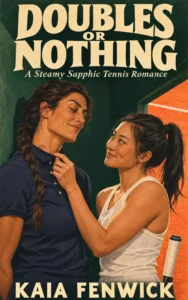
Doubles or Nothing
She said doubles was for losers. Then she met the woman who'd make her beg for a second set.

She Calls the Play
She's never let anyone run her offense. The six-foot-five center across the hall isn't asking.

The Partner Clause
Twelve clauses. One season. Clause Nine says no.

The Trade We Made
She traded me once. Now we're on the same line. And the coach has one rule.
Never Miss a Release
Get new release alerts, exclusive bonus content, and reader-only giveaways.