
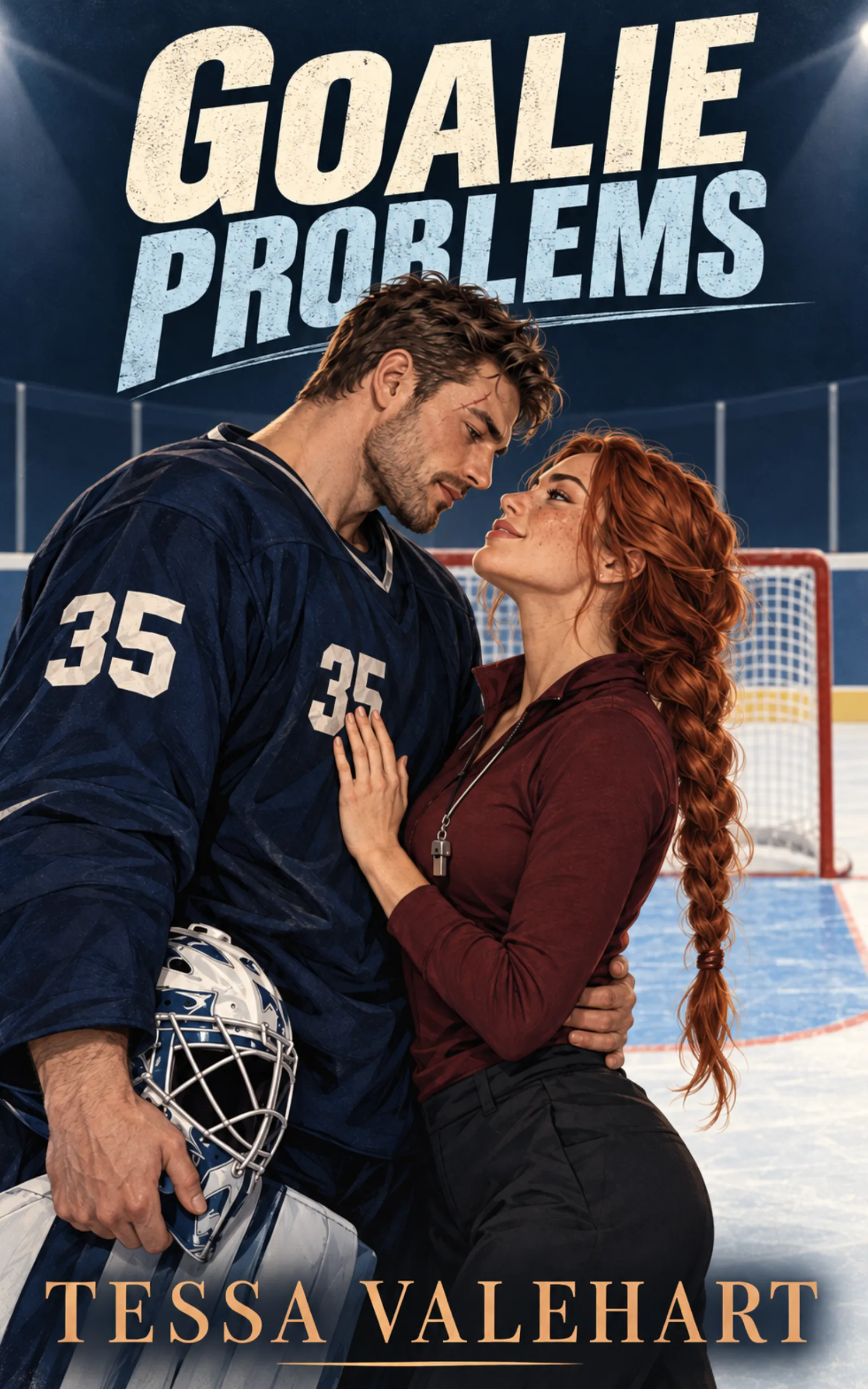
Goalie Problems
A High-Heat Hockey Romance
by Tessa Valehart
Shop the ebook · Shop the audiobook
Available at all major retailers
Pairing: MF
Heat: 🌶️🌶️🌶️🌶️🌶️ Inferno
Series: Standalone
Tropes: Coach × Goalie, Forbidden Workplace Romance, Professional Boundaries, Grumpy Hero, Competence Kink, Praise Kink (Both Ways), Injured Athlete, Comeback Story, He Falls First, Control and Surrender, Switch, Light Bondage, Safe Word, Size Difference, Touch Starved, Dog Dad
She stood in his crease. He told her to prove it.
Alexei Volkov gets beaten by the same goal forty-two times, and I’m the only person in the building who thinks that’s good news.
The Northbridge Wolves hired me for eight weeks to fix their starting goalie. He’s thirty-three, six foot four, the most expensive goaltender in the league, and he hasn’t listened to a coach in over a year. I run a goalie school out of a rented rink at six in the morning. He took one look at my lanyard and asked how many pages my report would be.
So I walked onto his ice in cross-trainers and stood in his crease.
“Prove it,” he said.
I did. I found the half-second everyone else called attitude. I asked him what he felt, and I wrote down the answer without underlining it. And somewhere between the video room and the day they took me off his program, the most difficult man in professional hockey started looking at me the way he looks at a shooter coming down the wing.
Patiently. As if he already knows what I’m going to do.
Now I’ve got a key to his house, a job offer that puts another coach’s name on my work, and a goalie who says “good” in a voice that ought to be illegal.
He wants me close. I want my name on what I do.
I’m not sure this building will let me have both.
Goalie Problems is a high-heat MF hockey romance with a guarded veteran goalie and the coach who reads him better than anyone, a forbidden workplace attraction, praise that goes in both directions, a skate lace, a safeword that gets used and honored, an eighty-pound dog who is afraid of the doorbell, a lot of on-page spice, no cheating, and a guaranteed HEA. Dual first-person POV. Standalone.
You’ll love this book if you enjoy:
✅ A grumpy veteran goalie who turns out to be the funniest man in the building
✅ A heroine who can do his coach’s job better than his coach, and knows it
✅ “Prove it.” Two words in a crease, and eight weeks of consequences
✅ “Again.” and “Good.” One syllable each, used in both directions
✅ A man who makes sixty identical dumplings and refuses to discuss it
✅ He learns to follow instructions; she learns to ask for the number
✅ A grand gesture made of nine microphones, one true sentence, and no adjectives
✅ An eighty-pound dog named Misha who changes sides
✅ Competence kink, praise kink, a desk, a locked video room, no cheating, 🌶️🌶️🌶️🌶️🌶️ heat, HEA guaranteed
⚠️ Content Warning: This novel contains explicit sexual content (graphic MF scenes, including oral sex, praise, edging and orgasm denial, light restraint with a skate lace and a necktie, sex in a workplace, and a hand over the mouth; all on-page sex is consensual, and a safeword is used and honored), a chronic sports injury concealed from medical staff, a past career-ending injury and surgery, a workplace power imbalance and professional retaliation, a woman’s work credited to a male colleague, media intrusion into a relationship, a brief third-act separation, alcohol, and strong language. No sexual violence, no dub-con, no cheating. Intended for readers 18+.
📖 Read Chapter One Free
Not sure yet? Read all of Chapter One right here.
Chapter One: Wren
Alexei Volkov gets beaten by the same goal forty-one times, and I seem to be the only person in this building who thinks that’s good news.
I thumb the remote. On the wall screen, six feet four inches of the most expensive goaltender in the league slides right to left across his crease, drops, seals the ice, and eats the first shot whole. It’s gorgeous. It’s textbook, if the textbook had been written by somebody with a grudge.
Then the rebound kicks out to the far side, and he has to get back.
He does get back. That’s the part everyone watches: the desperate sprawl, the glove thrown at the puck like he’s swatting a wasp, the red light blooming behind him. The broadcast cuts to his face. The commentator says something about confidence.
I don’t care about his face. I back the clip up eleven frames.
There. Left leg.
The skate should bite and drive the instant his weight comes across. A goalie at his level doesn’t think about that push any more than you think about blinking. But his leg just waits. Not long. A hitch you’d miss at full speed, and I’ve watched it at quarter speed for four hours with my nose a foot from the wall. Then the leg fires, and he’s late, and everything after that is a very large man trying to out-athlete arithmetic.
Half a second. Maybe less.
I write the timestamp on my legal pad under the forty above it and flex my fingers. My hands have been cold since October of the year I turned nine, and this room isn’t helping. No windows. One couch the color of oatmeal, one desk, one screen, a door with a thumb lock, and the permanent smell of carpet glue and somebody else’s coffee.
Next clip. January. Right to left, down, save, rebound.
Wait.
Fire.
“Forty-two,” I tell the empty room.
“Should I be worried that you’re keeping score?”
I don’t jump. I do click my pen about six times. Dana Price is in the doorway in a charcoal suit that costs more than my car, holding two paper cups and looking at the frozen image of her starting goalie doing the splits.
“I gave you the login so you could get a feel for him,” she says. “That was at noon.”
“I got a feel.”
“And?”
It’s right there in my mouth. He’s not guessing wrong, he’s arriving late, and I think he knows it. But I’ve had this login for four hours and this woman’s attention for ninety seconds, and I know what happens to the person who announces the answer before anyone’s asked the question.
“He’s not random,” I say. “Whatever’s going wrong, it goes wrong the same way.”
Dana hands me a coffee. It’s hot enough to hurt and I wrap both hands around it like it’s a religious object.
“The general view upstairs is that it’s between his ears.”
“The general view of goalies is always that it’s between their ears. Mostly from people who’ve never stood in front of anything harder than a spreadsheet.”
One corner of her mouth moves. She sits on the arm of the couch, which is how I know this is the actual meeting.
“Eight weeks,” she says. “Through the end of the regular season. You’d be a consultant to hockey operations, working with our goaltending group. Grant Mercer’s put together a plan for Alexei. It’s a good plan. Alexei won’t run it.” She tips her cup at the screen. “He’s stopped hearing Grant. Frankly he’s stopped hearing everyone. I want fresh eyes. Somebody he hasn’t already decided to hate.”
Fresh eyes. I turn that over. Fresh eyes on a plan that’s already written isn’t a coaching job. It’s a delivery job. I’m the spoonful of sugar.
“If I see something that changes the plan,” I say carefully, “whose plan is it? Who signs the change?”
Dana smiles. It’s a terrific smile. Warm, patient, all the way to the eyes.
“We’re very collaborative here,” she says. “Everybody pulls in the same direction.”
I asked for a name and got an adjective.
I should ask again. I know I should, the same way I know when a shooter’s about to go high glove, by the drop of a shoulder a full second before the puck leaves the blade. I should say, that isn’t an answer, Dana, and wait.
Here’s what I think about instead.
Crease Theory Goaltending is two women and a rented sheet at Fairmount Community Rink from six to seven-fifteen in the morning, because that’s the hour nobody else will pay for. It’s eleven kids, three beer-league dads with worse habits than the kids, and a logo my partner Liv drew on her tablet during a rain delay. It’s a business account I check with one eye closed. It’s good work. It’s the best work I’ve ever done, and no one above the bantam level has ever seen it.
The Northbridge Wolves on my client list changes every conversation I’ll have for the next five years. Leases. Insurance. Parents. The sentence people say after my name.
“The rate we had in mind is—”
“Yes.”
Dana blinks. “I hadn’t said it.”
“I’m sure it’s fine.”
It might be fine. It might be insulting. I have no idea, and I’ve just told a woman who negotiates eight-figure contracts for a living that I don’t need to know. Liv is going to hold me down and shave my head.
“Well.” Dana stands, and she’s too professional to look pleased, but she isn’t unhappy. “I’ll have the paperwork to you tonight. One piece of advice, since you’ll hear it from someone eventually. Grant has been here eleven years. He’s well liked and he’s good. Don’t make this about his methods.”
“I’m here to make it about Volkov’s.”
“Ideally those are the same thing.” She stops at the door. “He’s over at the Annex. He stays after everyone’s gone, don’t ask me why. Go introduce yourself.”
“Now?”
“You said yes before I gave you a number, Wren. I assumed you were in a hurry.” Her heels are already going down the hall. “And he bites.”
The Annex is the practice rink, across a parking lot that the wind has personally taken against. By the time I’m through the staff door my braid has frozen into a rope I could tow a truck with.
Inside it’s the smell I’d know blind. Cold rubber, wet laundry, the faint electrical tang of the compressors. The room is empty. Thirty stalls of dark wood, name plates in brushed steel, a wolf’s head woven into the carpet that everyone has clearly been trained to walk around.
One stall is occupied.
He’s on the bench under the plate that says VOLKOV 35, and he is half taken apart. Skates on. Pads still strapped, big white slabs that make his legs look like architecture. But the jersey and chest protector are in a heap beside him and his undershirt’s shoved off and hanging from the back of his neck like a towel, and above the waist of his pants there is just him.
I’ve spent four hours looking at this man through a lens. The lens was doing me a kindness.
He’s lean the way goalies are lean, long muscle laid on a long frame, nothing built for show. Sweat has gone tacky on his shoulders. There’s a tattoo low on his ribs, two small black digits, and it takes me a second to read them because they’re wrong. Thirty. Not thirty-five.
I file that.
His hands are the size of dinner plates and he’s using them to wind white tape around the knob of a stick with a level of care I’ve only seen in bomb disposal footage. He doesn’t look up.
“Media is Tuesdays.”
His voice is lower than it sounds in scrums. The accent is there the way a watermark is there. You’d have to hold him up to the light.
“I’m not media.”
“Then you are lost.” Wind, wind, smooth with the thumb. “Offices are in the other building. Follow the smell of carpet.”
“I just came from there. It’s worse than you’d think.”
That gets me nothing. He tears the tape with his teeth. It’s a small, efficient, slightly savage motion, and something in my stomach takes a note it has no business taking.
“Wren Cassidy.” I stop a careful six feet from his stall, outside the wolf. “I’m a goaltending coach. Dana Price brought me in to work with you through the end of the season.”
Now he looks. Not at my face. At the lanyard, where the temporary pass says CONSULTANT in capitals over a photo of me that was taken before I’d found the coffee.
“Consultant,” he reads.
“That’s what the plastic says.”
“They’ve sent a consultant.” He sets the stick across his knees. “This is new. Usually it is only Grant, and a man from analytics who cannot skate. How many pages?”
“Sorry?”
“The report.” He says it pleasantly, in the tone you’d use to ask about parking. “At the end of your eight weeks, or six, or however long they’ve given you. The one that says Volkov is thirty-three, Volkov does not take coaching, Volkov’s numbers will not come back, and so in June the club is regretfully correct to pay him to go away. I only want to know how thick it is. I like to be prepared for what I am going to be hit with.”
So that’s what he thinks I am. Not help. Paperwork. The woman who measures the coffin.
The thing is, I can’t even promise him he’s wrong about what Dana wants. I asked who signs the plan and got a smile.
“I don’t write reports,” I say. “I coach goalies.”
“Where?”
“Fairmount Community Rink. Six a.m.”
He takes in the sneakers. The frozen braid. The whistle I’ve worn every day for four years and never once blown, because if you need a whistle you’ve already lost the room.
“Children.”
“Some of them. A couple are forty-five. They listen worse than the children, and, I’m told, better than you.”
His eyebrow lifts. The left one, with the scar through it, a pale notch that splits it almost in half.
“Tell me something, Coach.” He puts a spin on the word that should come with a wet floor sign. “Have you ever faced a shot at this level? One. In your life.”
There it is. I knew it was coming. I’ve had some version of it from every man I’ve ever tried to teach anything, and I still feel it land, right in the old bruise.
I let it land. Then I let it go by.
“I’ve faced enough,” I say, “to know contempt isn’t a training method.”
The room goes quiet enough that I can hear the compressors cycle.
And Alexei Volkov looks at me. Properly, this time. All the way up.
Nobody mentioned his eyes. Fourteen months of footage and four hundred articles about his attitude, and no one thought to say they’re grey. Not blue-grey, not anything poetic. Flat winter grey, like lake ice, and so completely still that I understand all at once what it must be to skate in on him with the puck on your stick. He doesn’t glare. He reads. He goes over me the way I went over his tape, patiently, backing up to check his work, and I feel every inch of the pass. My mouth. My hands, wrapped around a cup that’s gone cold. The way I’ve set my feet shoulder-width without deciding to, because some part of me got squared to the shooter before the rest of me knew there was a shot.
His gaze stops on my stance. Stays there.
Heat goes up my neck. It’s a ridiculous, unhelpful, teenage thing to feel, and it settles low in my belly anyway and makes itself at home.
I am here to fix his recovery push. I am not here to notice that his hair looks like he cuts it himself, in the dark, angrily, and that it does not matter even a little.
“I watched all of your goals against today,” I say, and my voice comes out steadier than I’ve earned. “Fourteen months of them. And I don’t think the problem is what they’ve been telling you it is. I think there’s a pattern in—”
He stands up.
On skates he’s six foot seven, and for one second the whole length of him is right there, the ribs with their wrong number, the flat plane of his stomach, a bead of sweat making its way down toward his waistband with no sense of urgency at all. Then the chest protector goes on over his head. Jersey. Thirty-five. He picks up the mask and the stick he’s just taped.
And he walks out. Past me, close enough that I get cold air and clean sweat and tape adhesive, down the rubber matting toward the tunnel, while I’m still standing there with the back half of a sentence in my mouth.
The door to the ice swings shut behind him.
“—the recovery,” I finish, to a wolf on a carpet.
I give it ten seconds. That’s about how long it takes to work out that I have two options.
I can go back across the parking lot and send a polite email asking for a convenient time.
Or.
The tunnel spits me out at the bench. The Annex sheet is empty and enormous, the overheads at half power, the ice scarred white from practice. Volkov is at the far blue line with a bucket, collecting loose pucks with the blade of his stick, flicking them in one after another without looking. He doesn’t miss.
At the near end, his net sits in a square of fresh snow.
He’s already done it. Every goalie has a version, and his is all over the paint: the short choppy cuts side to side, post to post, roughing up the surface until it grips the way he likes. Nobody touches that. Not the trainers, not the Zamboni driver if he values his job, and never, ever a skater. You do not step into a goalie’s crease. It’s the nearest thing this sport has to a religion, and it isn’t written down anywhere, because nobody’s ever needed it explained.
I open the bench gate and walk out onto the ice in cross-trainers.
There’s a trick to it. Flat feet, short steps, weight low, like you’re carrying something that might spill. I learned it at eleven, chasing a water bottle. It gets me to the top of the blue paint without dying.
Then I step in.
The snow he made crunches under my soles. I walk to the dead center of it, right where his skates go, turn around, and stand there with my cold coffee.
The pucks stop.
He’s seen me. I can tell by the quality of the silence, and then by the sound of him coming, long unhurried strides, edges hissing, the hollow knock of his stick on the ice every third push. He doesn’t speed up. That’s almost worse. He pulls up at the lip of the crease in a hockey stop that throws a fine cold spray over my shoes, and then he’s just there, mask shoved up on top of his head, looming.
His mouth opens.
Nothing comes out of it.
I’d like the record to show that I’ve rendered the most difficult man in professional hockey speechless with my feet, and that it’s the most satisfying thing that has happened to me in a calendar year.
“Get out,” he says finally. Quiet.
“No.”
“That is my—”
“I know what it is. I lived in one for fifteen years. I know exactly how rude this is.” I have to tip my head back to hold his eyes. This close they aren’t flat at all. “You walked out while I was talking. I figured we were being rude.”
A muscle goes in his jaw. A drop of sweat tracks down his temple and he doesn’t wipe it. He’s breathing a little hard from the skate and I can see it move the logo on his chest, in and out, and I am suddenly, stupidly aware that I’m standing in the one place on earth this man has never let anyone stand, and that he could pick me up and set me outside it like a traffic cone.
He doesn’t.
“You’re in my crease,” he says slowly, like he’s testing the sentence for a trap, “in running shoes.”
“They’re cross-trainers.”
His eyes drop to my mouth. Just for a moment. Just long enough for my pulse to do something a cardiologist would want to hear about.
“Twenty minutes,” I say. “Tomorrow, six a.m., right here. You, me, a bucket of pucks. No report. No meeting. If I waste them, you never have to look at me again. I’ll tell Dana myself that it didn’t take.”
“And if you don’t waste them?”
“Then I guess you’re stuck looking at me.”
The corner of his mouth moves. It isn’t a smile. It’s what a smile leaves behind when it has thought better of the whole idea. He looks down at my feet in his snow, then back up, taking his time about the trip.
“Prove it,” says Alexei Volkov.
He pulls the mask down. Then he pushes off backward, and he doesn’t go through the paint to do it. He goes around. Wide. Like I’m a post.
I make it to the corridor before my knees remember they belong to me.
“You must be Dana’s fresh eyes.”
He’s coming out of the coaches’ room with his hand already extended, a big square man in a team quarter-zip, silver brush cut, a championship ring like a doorknob. His handshake is warm and exactly firm enough. His smile says he’s been expecting me, and that he was here first.
“Grant Mercer. Welcome to the Works. Well, the poor man’s Works.” He nods at the wet prints my shoes are leaving on the rubber. “Been out on my ice already, I see.”
My ice.
“Just saying hello to Volkov.”
“And how was Lex?”
I’d bet my rent Alexei Volkov has never once answered to Lex.
“Brief.”
Mercer laughs. It’s a good laugh. I can see why he’s well liked. “That’s him on a good day. Listen, I think it’s terrific Dana’s brought you in. I mean that. Another voice, a little video support, can’t hurt.” He drops his own voice, colleague to colleague. “I’ll save you some time, though. He’s going to tell you he knows where he ought to be. They all know where they ought to be. With Lex the issue’s always been commitment. He hesitates. He goes deep in his net and waits for it to come to him. Everything I’ve built for him is about getting him out at the top of his paint, challenging, driving through the push. He just has to buy in.”
Driving through the push.
Forty-two timestamps go off in my head like a string of firecrackers.
“That’s really helpful context,” I say. “Thank you.” It’s my voice, and it’s so pleasant I could slap it.
“Here’s what we’ll do. Before anybody puts him through anything new, we sit down. You, me, Dana. My office, nine tomorrow. I’ll walk you through the attitude situation, where the landmines are, how I like things run past me first. Saves you stepping on one.”
“I’d actually asked him for a little time on the ice in the morning. Six.”
“Six is mine.” Still smiling. “I’ve got the kid in. Barrett. You’ll like him, he listens. Nine o’clock, Wren. Bring your notes. Happy to look them over.”
He claps my shoulder, once, and goes on down the hall, whistling.
I stand under a framed photo of a younger Volkov holding a trophy over his head. He isn’t smiling in that one either.
I’ve been in this building five hours. I have a contract I didn’t read, a boss who won’t give me a noun, a goalie coach who’s just offered to grade my homework, and a goalie who told me to prove it and then skated around me like I was nailed down. In about twelve hours he’s going to show up to an empty sheet of ice, or to Finn Barrett and Grant Mercer, and decide that I’m exactly what he thought I was.
The easy thing is to go to the nine o’clock. Smile. Bring my notes.
I get out my phone. My thumbs are so cold the screen takes three tries.
I don’t need another meeting about his attitude, I type to Dana. I need his ice.
I hit send before I can make it polite.
Want to keep reading? The full novel is available now.
🔥 Want an EXCLUSIVE Bonus Chapter?
Session Plan — A scene TOO HOT for the bookstore
Three months after the epilogue, on the first road trip of the new season, Wren has a hotel room with her own name on the booking, a full-length mirror, and a plan written out in pencil with the times on it. Item three took her six months to put in a sentence. Alexei has until curfew.
More from Tessa Valehart
Browse all Tessa Valehart books.

Damage Control
Six weeks. Twelve appearances. Every touch agreed in advance.
Return to Contact
Cleared to play. Not cleared to touch her.

The Driver Veto
He can't have her removed. Then she puts her voice in his ear.

Goalie Problems
She stood in his crease. He told her to prove it.
Never Miss a Release
Get new release alerts, exclusive bonus content, and reader-only giveaways.