
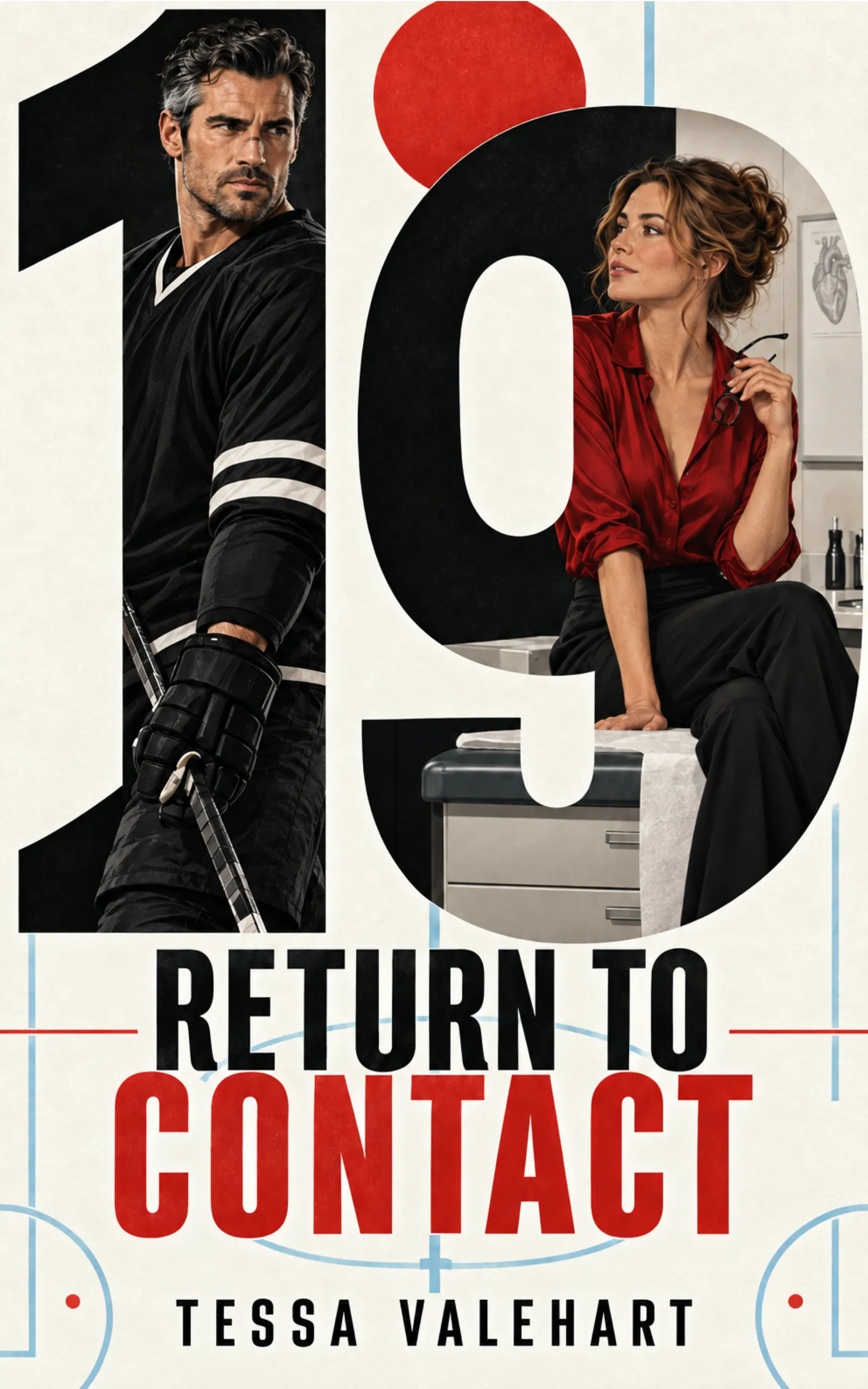
Return to Contact
A Forbidden Doctor Hockey Romance
by Tessa Valehart
Shop the ebook · Shop the audiobook · Shop the paperback
Available at all major retailers
Pairing: MF
Heat: 🌶️🌶️🌶️🌶️🌶️ Inferno
Series: Standalone
Tropes: Surgeon × Hockey Captain, Forbidden Romance, Professional Boundaries, Injured Athlete, Comeback Story, Competence Kink, Praise Kink (Both Ways), He Falls First, Mutual Pining, The One Who Got Away (Almost), Phone Sex Before First Touch, Scar Worship, Silver Fox Hero, Dirty Talk, Control and Surrender, Edging, Hurt/Comfort, No Cheating, No Love Triangle
Cleared to play. Not cleared to touch her.
Grant Callahan walked out of my exam room last June and said he’d ask me out when he was worth asking.
He didn’t call. Not in July, not all season.
Eight months later the Harbor City Breakers’ captain is standing in my office doorway, thirty-eight, contract up in April, volunteering for my return-to-performance study. I rebuilt his shoulder with my own two hands. Now he’s participant fourteen, shirtless on my blue tape, telling me his left side feels “the same” while my cameras say otherwise.
I don’t date participants. So I filed the form.
Fourteen days until the recusal goes live. No touching until the ink is dry.
He keeps his hands on a railing and tells me exactly what he’d do to me if I said yes. He calls me from two time zones away. He buys two kitchen stools for a house that’s never had a chair. And when it’s finally allowed, the man who’s spent twenty years playing hurt lets me see him hold still.
We made one rule: his body is his to report. If he says it’s a two, it’s a two. I never check.
Then he gets his first game back, and a contract he can feel slipping, and he types a three into the log where a six should be.
I gave up the right to know. Now I have to decide whether I can take his word again.
Return to Contact is a high-heat MF hockey romance with an orthopedic surgeon who doesn’t soften anything and the veteran captain she put back together, a forbidden research-ethics attraction, a fourteen-day countdown, a pain log with timestamps, a red Dutch oven that finally gets used, a lot of explicit on-page spice, no cheating, and a guaranteed HEA. Dual first-person POV. Standalone.
You’ll love this book if you enjoy:
✅ A surgeon who sees through every “fine” and a captain who finally stops saying it
✅ “Give me a number.” Zero to ten, in the lab, in the fight, and in bed
✅ A fourteen-day recusal, a no-touching rule, and a phone call on day nine
✅ He counts her spine with his mouth. Twenty-four. He had twenty-three
✅ A hero whose recovery is written into every sex scene, until the night he can pick her up with both arms
✅ A grovel in three parts, none of them starting with “but”
✅ A career ending that’s honest instead of miraculous, and a mentor handing his faceoffs to the kid
✅ Competence kink, praise kink, dirty talk, a hotel room where she hands him every decision, no cheating, 🌶️🌶️🌶️🌶️🌶️ heat, HEA guaranteed
⚠️ Content Warning: This novel contains explicit sexual content (graphic MF scenes, including oral sex, phone sex, solo masturbation, dirty talk, edging and orgasm denial, and light restraint with wrists held; all on-page sex is consensual and negotiated), a sports injury and surgical recovery, an athlete concealing pain from his medical team, a research-ethics conflict of interest, a private photo going viral and a woman’s name and workplace posted online, a past instance of a mentor taking credit for her work, career uncertainty and the prospect of retirement, a brief third-act separation, alcohol, and strong language. No sexual violence, no dub-con, no cheating. Intended for readers 18+.
📖 Read Chapter One Free
Not sure yet? Read all of Chapter One right here.
Chapter One: Elise
“—so if there’s no room, I’d rather hear it from you than from an intake form.”
Grant Callahan is standing in my office doorway as though eight months is something that happens to other people.
I have a pen between my teeth, reading glasses shoved up into my hair, and a spreadsheet open with fourteen rows on it. Thirteen are filled. I take the pen out of my mouth. That is the full extent of my preparation.
“Callahan.”
“Dr. Ward.”
Grey quarter-zip with the Breakers crest over the heart, dark jeans, a manila folder held flat against his thigh. Six-foot-three of him in a door frame built for grad students. There’s more silver at his temples than there was in June, and the nose still bends in two places, and he’s standing square, left shoulder level with the right. I hate that it’s the first thing I check.
The second thing I check is whether he looks sorry. He doesn’t. He looks courteous.
“Your agent emailed my coordinator on Monday,” I say. “Tess Morgan sent a referral on Tuesday. I assumed that was the application.”
“That was the paperwork.” The folder lifts an inch. “This is me asking.”
I let the verb sit there. He doesn’t blink at it, which means either he’s forgotten or he remembers every syllable, and I have never been able to tell with this man, and I once had both hands inside his shoulder for two hours and forty minutes.
June. Exam room four. His last visit before I signed him over to an independent rehab team and closed the surgical chart. He’d looked at the clock over the door and said, In ten minutes I’m not your patient. I’d said that in ten minutes he would still be twelve weeks out from a reconstruction, which was accurate, and which I have replayed more often than I’d confess under anesthesia. He smiled as if I’d caught him clean with his head down.
Then I’ll ask when I’m worth asking, Doc.
He walked out. July came. Then the rest of the calendar.
I didn’t wait by a phone. I want that on the record. I operated, I published, I ran the harbor loop at six every morning and bought tickets to three shows I never attended. I also watched every Breakers game he wasn’t playing in, which is an odd habit for a woman with no interest in hockey, and I kept the volume low, as though the television might report me.
“Sit down,” I say. “You’re blocking my light.”
He sits. The chair is too small for him; every chair is. He lays the folder on my desk and I can see he’s flagged pages with those tiny colored tabs. A thirty-eight-year-old hockey captain with a system for sticky notes.
“You read the protocol.”
“Twice. Second time with a dictionary.”
“Then you know what it isn’t.” I pull my glasses down, mostly to have glass between us. “It isn’t clearance. Dr. Bell and Tess clear you. I don’t examine you, I don’t treat you, and I don’t write anything Miles Rourke can wave at a microphone. I measure whether you can do a thing the fortieth time the way you did it the first, tired, when something surprises you. Fourteen athletes, eleven weeks. A few of them will get answers they hate.”
“That’s why I’m here.”
“You’re here because your contract is up in April and your team is four points out of a playoff spot.”
“I can be here for two reasons.”
“The second one is the one that concerns me.”
One corner of his mouth moves. It isn’t quite a smile. Grant doesn’t hand those out; he lets you earn the edge of one and then leaves you wondering about the rest. His voice hasn’t changed either. Low and level, the voice of a man who has never needed volume to shut a locker room up.
“Everybody in that building tells me I look great,” he says. “Coaches. Trainers. The kid who sharpens my skates. I’ve looked great for six weeks, and not one of them will say a thing past that, because they need me back and they’re scared of what happens if they look too close.” He turns one of his colored tabs with a fingertip. “You held my MRI up to a lightbox and told me exactly what was torn and exactly what it would cost me. Didn’t soften a word. I’d like that again.”
“That was a diagnosis. This is research.”
“It’s still you not lying to me.”
That shouldn’t land anywhere. It lands low in my stomach and stays.
“You played two shifts with the head of your humerus sitting in front of the socket,” I say. “You told the trainer on the bench you were fine. I’ve watched the footage. You took a faceoff.”
“Won it.”
“That is not the defense you think it is.”
“No.” He doesn’t look away. “It’s the reason I filled out your form. I’m good at finishing things, Doc. I’m told that isn’t the same as being ready, and I can’t tell the difference from the inside. I want an honest answer. Whatever it turns out to be.”
I almost believe him.
That’s the dangerous part, the almost. He means it right now, folded into my undersized chair with his annotated protocol. I’d put money on it. What I wouldn’t bet on is whether he’ll still mean it in week six with a general manager breathing down his collar, and I’m not going to find out by staring at his mouth.
I slide the consent packet across the desk. “Page six. Read that one a third time.”
He reads the whole thing instead. Nobody does that. I pretend to work on row fourteen and watch his left arm in my peripheral vision as it reaches across the blotter for a pen. Smooth. No hitch, no guarding.
“Section six,” he says. “If my numbers are bad, who sees them?”
“You do. Your treating team, with your written consent. The study gets them with your name stripped off. The club gets nothing from me, ever.”
“And from me?”
“What you tell your GM is your business. What you tell us has to be accurate. It’s the only thing I’m going to ask you for.”
His eyes come up at ask. Just for a second.
Then he signs, and initials every page, and caps my pen before he hands it back.
“Fourteen,” I say, and type his name into the last row.
Devon has the flu.
I learn this from a text containing four apologies and a thermometer emoji while I’m walking Grant down to the bay, which leaves me with a calibrated camera array, a booked ninety-minute slot, and nobody to place sensors on participant fourteen.
“My tech’s out,” I tell him. “I can move you to Thursday, or I can do the setup myself.”
“Your call.”
“They’re stickers, Callahan. It’s not a procedure.”
“Then I’m in your hands.”
I let that one go by without touching it.
The bay is my favorite room in the building. Thirty feet of ceiling, a strip of synthetic ice down one side, force plates set flush in the floor, twelve infrared cameras staring down like a jury. It smells of rubber and new electronics. I wheel the cart over and snap on gloves out of habit, then strip them off again, because the adhesive won’t seat properly through nitrile and I know it.
“Shirt off, please. Stand on the tape.”
He reaches back with his right hand and drags the quarter-zip and the T-shirt under it over his head in one pull. Right hand. A leftover from the sling. He drops them on the bench and stands on my X of blue tape with his arms loose at his sides, and I get very busy with an alcohol wipe.
It isn’t as if I haven’t seen it. I’ve seen further into this man than anyone alive. But I saw him draped and prepped and painted orange with antiseptic, a square of joint under surgical lights. I never saw him upright and breathing. He’s built like the job: heavy through the chest and back, dark hair across his sternum narrowing to a line that disappears into his waistband, a bruise going yellow over the right ribs, forearms corded from two decades of leaning on a stick. Not a gym body. A working one.
And on the front of the left shoulder, four inches long, pale pink and flat: my handwriting.
It healed beautifully. I’m vain about my closures, and that is the only reason I look at it for as long as I do.
“Cold,” I warn him, and swipe between his shoulder blades.
His back jumps. “Jesus.”
“Big tough captain.”
“Big tough captain’s been standing in rinks since he was four. Doesn’t mean he likes it.”
I start behind him, where it’s easier. The first sensor goes at the base of his neck. To place the next two I have to find the bony ridge of each shoulder blade with my fingertips, which means pressing into muscle that shifts under my hand like something awake and paying attention. His skin is hot. He smells of cedar soap with the cold mineral bite of the rink underneath, and it is ridiculous how much information that is. I press the right one flat. Then the left. I feel him breathe in and not let all of it back out.
“Arm out. Other one.”
Upper arm, both sides. Forearm, both sides. I’m quick and neat and I don’t speak, and neither does he, and silence in a room that size has a hum to it.
Then I have to come around the front.
He’s looking at the far wall, at nothing, jaw set. I’m five-six in flat shoes; my eyes are level with his collarbone. I peel the backing off a sensor and find the notch at the top of his sternum with two fingers, and his pulse is right there under them, going harder than a man standing still has any reason for.
Mine isn’t setting records for calm either.
“Last one.” It comes out lower than I intended.
The last one sits on the point of the left shoulder, on the bone at the very top. One inch from the end of my incision. I know what’s under my fingertips with a precision that ought to be clinical: three anchors, a labrum I stitched back down, a capsule I tightened by hand. I know the color of it. I know how the joint sat when I was finished, snug and exactly where I wanted it.
I didn’t know the skin over it would break into gooseflesh when I touched it. I watch it run down his arm, every hair lifting.
“Cold?” I ask.
“No.”
My thumb smooths the adhesive flat. Once would do it. I do it twice. I’m close enough that his breath stirs the hair that’s slipped out of my clip, and neither of us is breathing the way people breathe, and if I look up I am going to learn something I can’t put in a spreadsheet.
I step back and pick up the tablet.
“Twelve of twelve tracking,” I tell the screen. “Let’s see what you’ve got.”
What he’s got is, frankly, obscene.
Loaded reaches at three heights against a cable that tries to yank him off line. Rotational pulls. A set where the resistance drops out without warning and he has to catch himself. Then twenty shots off the synthetic ice into a net, forehand and backhand, the puck hitting twine with a sound like a slap. He does all of it without wasted motion and without theater, with the bored economy of someone who has been the best-prepared person in every room for twenty years. He doesn’t grunt. He barely sweats. On the last shot he lets the follow-through carry and looks over at me. Not smug. Checking.
I’m supposed to be watching the traces build on the tablet. I watch the tablet for most of it. For the remainder I watch the long muscles of his back gather and release under my sensors, a faint shine starting at the dip of his spine, and I remind myself that I am a board-certified surgeon with a funding vote in eleven weeks and a strict personal policy against wondering what a participant’s skin tastes like.
The policy is about four minutes old.
“How did that feel?”
“Fine.”
“Left compared to right?”
“Same both sides.”
I turn the tablet around.
Two traces, overlaid. His right side is a clean arc, shoulder blade gliding, arm following. On the left, the shoulder blade climbs toward his ear a fraction early and his ribcage rotates to finish the work the joint was supposed to do. It’s small. A coach wouldn’t catch it from the bench. It is also in every left-side rep he just gave me, eight for eight, as regular as a signature.
He studies it for a long moment. A muscle moves in his cheek.
“I finished every one.”
“You did.”
“Hit every target.”
“Also true.”
“So what am I looking at?”
“A difference you told me wasn’t there.” I keep my voice even; he is not a man you corner. “I’m not saying what it means. I’m not the right person to, and it isn’t my place anymore. Tess knows your progression. She’ll know if this is old news or new. I’m sending her the capture this afternoon.”
“You’re telling on me.”
“I’m copying your rehab lead on your own data, which you authorized forty minutes ago. Page six. You initialed it.”
That not-quite-smile again, there and gone. He rolls the left shoulder, slowly, and I watch him feel for the thing on the screen and fail to find it. That bothers him more than any number could.
“I did it, Doc. Every rep you asked for.”
“Rested. Ten in the morning. Nobody hitting you.” I take the tablet back. “Once is not the question.”
I let him peel off his own sensors.
I tell him it’s because the adhesive pulls and people prefer to control the sting, which has been true of exactly none of the other thirteen. He doesn’t call me on it. He drops them one at a time into the tray I hold out, twelve small grey discs, then pulls his shirt on right-handed, and the scar goes away under cotton.
Before it does, I see what the last sensor left behind: a faint red ring on the point of his shoulder, exactly the width of my thumb. I look at that ring longer than I have looked at some X-rays.
“You’re staring, Doc.”
“I’m checking for a skin reaction.”
“And?”
“You’ll live.”
I walk him to the door of the bay because it would be strange not to.
“Thursday,” I say. “Group session. Six of you, repeated tasks under fatigue. Bring water and a second shirt. By minute twenty you’ll have opinions about me.”
“I already have opinions about you.”
“They’ll get worse.”
“I doubt that.”
He stops with one hand on the door frame, and I think: here it comes. Eight months. He’ll say he meant to call. He’ll say the season got away from him, or the rehab did, or he’ll claim nothing happened in June worth mentioning, and I have a cool, pleasant answer loaded for each of those. I’ve had them loaded since roughly Labor Day.
He looks at my hair, where my glasses have ended up again. Then at my face.
“You look well, Doc.”
“I look the same.”
“That’s what I said.”
And that’s all. No apology, no explanation, not even the decency to be awkward about it. He just stands in my doorway with his shirt on, polite as a handshake, while my fingertips are still warm from his skin and I’m furious about that in a calm, well-organized way I intend to examine later. Alone. Possibly never.
“Was there something else?”
He glances back into the bay, at the dark screen where his two shoulders didn’t match.
“Does the team have to know about a result that didn’t stop me finishing?”
Want to keep reading? The full novel is available now.
🔥 Want an EXCLUSIVE Bonus Chapter?
Road Game — A scene TOO HOT for the bookstore
October, two time zones west, the first road trip of Grant’s new contract. At twenty to midnight his phone lights up. Then somebody knocks on room 1412, and the woman in the camel coat has fourteen minutes on the clock, a rule about touching, and nothing on under his sweater.
More from Tessa Valehart
Browse all Tessa Valehart books.

Damage Control
Six weeks. Twelve appearances. Every touch agreed in advance.
Return to Contact
Cleared to play. Not cleared to touch her.

The Driver Veto
He can't have her removed. Then she puts her voice in his ear.

Goalie Problems
She stood in his crease. He told her to prove it.
Never Miss a Release
Get new release alerts, exclusive bonus content, and reader-only giveaways.