
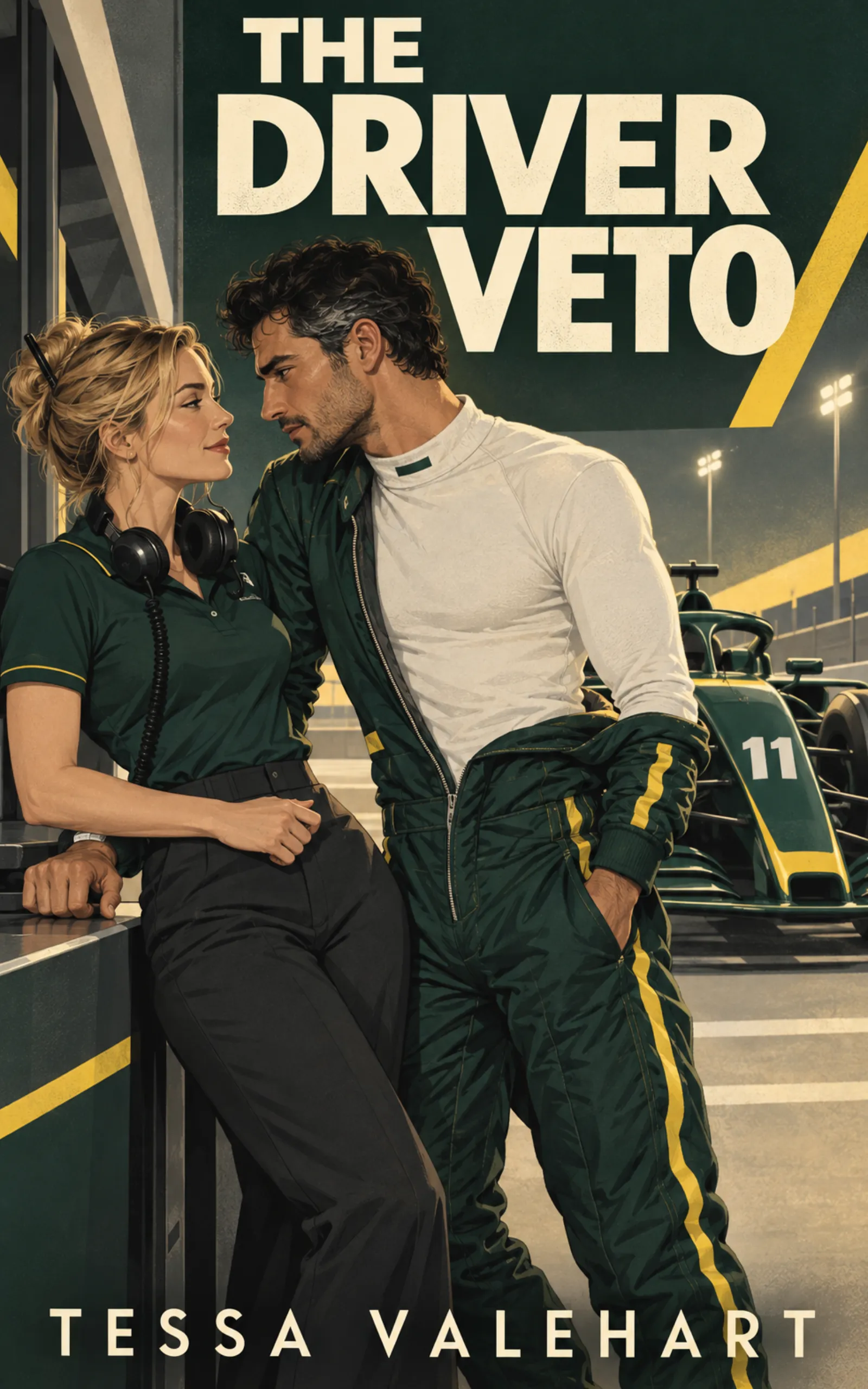
The Driver Veto
A High-Heat Grand Prix Racing Romance
by Tessa Valehart
Shop the ebook · Shop the audiobook · Shop the paperback
Available at all major retailers
Pairing: MF
Heat: 🌶️🌶️🌶️🌶️🌶️ Inferno
Series: Standalone
Tropes: Rivals to Lovers, Forbidden Workplace Romance, Grumpy Champion × Competent Heroine, Race Engineer × Driver, The Only One He Listens To, Voice Kink, Control Swap (Both Ways), Praise Kink, Competence Kink, He Falls First, Light Bondage, Edging, Contract Clause, Whistleblower Heroine, Past Crash, Lake Como Getaway, No Cheating, No Love Triangle
The only person he can’t fire is the only woman he can’t forget.
Mara Voss knows what happens to engineers who tell Nico Rinaldi no.
They disappear from his garage.
So when the three-time world champion’s team offers her the job nobody else can keep, she takes it on one condition, in writing: he can’t have her removed before the season ends.
He calls it an insult. She calls it job security.
Then she puts her voice in his ear at two hundred miles an hour, and the most difficult man in the paddock does something he’s never done for anyone. He listens.
The car is hiding something the team doesn’t want found. Mara can prove it. Nico can feel it. And somewhere between the late nights and the data, the arguments turn into something neither of them can file under professional.
He takes orders from her on the track. He gives them everywhere else.
Until the night she uses that radio voice on him.
Wanting each other could cost them the season. Trusting each other could cost them everything. And when the team demands silence, the one woman Nico can’t fire becomes the one person he can’t lose.
The Driver Veto is a high-heat MF Grand Prix racing romance with a brilliant race engineer, a champion who has never once done what he was told, a contract clause that cuts both ways, a blue six-euro scarf, a kitchen table on Lake Como, a lot of on-page spice, no cheating, and a guaranteed HEA. Dual first-person POV. Standalone.
You’ll love this book if you enjoy:
✅ A grumpy three-time champion who has sacked three engineers in two seasons
✅ A heroine who puts a clause in her contract so he can’t sack her
✅ “I saw it.” Three words over the radio that change everything
✅ “Copy.” The word he refuses to say, until he says it to nobody else
✅ He takes orders from her on the track and gives them everywhere else, until she turns the radio voice on him
✅ A man who writes his feedback in pencil, in block capitals, with no adjectives
✅ Forty-one steps, green shutters, and a lake house kitchen table
✅ A whistleblower plot where she wins by writing everything down
✅ Competence kink, praise kink, edging, a locked driver’s room, no cheating, 🌶️🌶️🌶️🌶️🌶️ heat, HEA guaranteed
⚠️ Content Warning: This novel contains explicit sexual content (graphic MF scenes, including oral sex, solo scenes, phone sex, light restraint with a scarf, edging and orgasm control, power exchange in both directions, sex in workplace rooms, and a hand over the mouth; all on-page sex is consensual and a stop word is honored), a past racing crash with serious injury, on-track danger from a concealed car fault, workplace retaliation and a whistleblowing investigation, a woman’s work credited to a male colleague in her past, a leaked private relationship and media intrusion, a brief third-act separation, alcohol, and strong language. No sexual violence, no dub-con, no cheating. Intended for readers 18+.
📖 Read Chapter One Free
Not sure yet? Read all of Chapter One right here.
Chapter One: Mara
“Get him off my radio.”
The voice comes out of Celia Arden’s wall screen without any heat in it at all. I was told to expect shouting. This is a man doing a hundred and eighty through a fast right-hander and speaking the way you’d ask a waiter to take a plate away.
“Nico, we just need you to hold the—”
“Off. Put on someone who can count.”
On the timing overlay, car eleven’s second sector goes purple. He sacks a man and sets the fastest middle sector of anyone that afternoon, and he does both inside the same four seconds.
Celia pauses it. The frozen frame is an onboard: dark green halo, silver gloves at ten and two, a Styrian hillside smeared sideways.
“Austria,” she says. “Eleven days ago.”
“I watched it live.”
“Everyone watched it live. It’s had nine million views.” She sets the remote down square to the edge of her desk. Celia does everything square to the edge of something. “Pete Lindqvist cleared his locker on the Monday. He was the third in two seasons. Hannah Kovač lasted fourteen races, the one after her lasted nine, and Pete managed six and a half.”
“And a half.”
“He was replaced mid-stint. Legal tell me that counts.”
Rain ticks against the window of the Aster motorhome. Below us the Silverstone paddock is doing its Thursday impression of a car park in a hurry: flight cases, golf buggies, a man carrying a front wing like a newborn. I’ve worked for this team for ten months and I’ve never been up here. Vehicle dynamics lives at the factory, forty minutes away, in a room with no windows and very good coffee.
“You know why I rang you last night,” Celia says.
“I know what you offered me last night. I’d like to hear why.”
That gets me a small, recalibrating look. She’s forty-five, grey trouser suit, hair cut to be ignored. She has the stillness of a woman who has sat through a great many men explaining her own budget to her.
“Race engineer, car eleven. Effective this morning. You’d run his weekend, his setup, his radio.” She folds her hands. “Your models are the only thing in the building that has correlated with the track since March. Your reports are the only ones I read without a pencil. And in ten months I haven’t once heard you raise your voice in a meeting. I asked around. Nobody has.”
“It’s inefficient.”
“Quite. He eats loud men. I’d like to try something else.” A beat. “It’s the making of a career, Mara. Thirty-two, race engineer to a three-time world champion. There are people downstairs who’d give a kidney.”
“There are people downstairs who say they’d give a kidney. In my department they say it the way people say they’d love to climb Everest.”
“You don’t want it?”
“I want it badly enough that I’ve been awake since four.” I take the folded sheet out of my jacket and put it on her desk, square to the edge, because I can do that too. “Which is why I’d like to talk about what it actually is. You’re offering me his results without any authority over the things that produce them. If the car’s slow, it’s my setup. If he’s angry, it’s my radio. If he decides on lap thirty that I can’t count, I’m clearing a locker on Monday and you’re playing someone else a clip of me.” I nod at the screen. “That isn’t a promotion. That’s the blame with a headset attached.”
Celia doesn’t argue. I like her slightly more for it.
“Three conditions,” I say. “They’re on the page. My solicitor looked at the wording at seven this morning, so it’s tidier than it would be if I’d done it alone.”
She unfolds it. I watch her eyes go down the first paragraph and stop.
“Section seven point three,” she reads. “‘For the duration of the season, the lead driver shall have no right, directly or indirectly, to request or initiate the removal or reassignment of the race engineer.’” She looks up. “You want a clause that says he can’t have you sacked.”
“I want a clause that says he can’t have me removed. You still can. Gross misconduct, restructuring, management suspension, the contract running out. It’s all carved out underneath. I’m not asking to be unsackable. I’m asking that the one person in the building with a documented habit doesn’t get to indulge it.”
“He’ll take it as an insult.”
“He can take it however he likes. What he can’t do is take it to you.”
Her mouth does something that isn’t a smile and is related to one. “And the second?”
“Event-level traces for car eleven. Current season, read access, every run. Not the summary pack.”
“Those sit with the technical office.”
“Then the technical office can add my login. I can’t engineer a car from a document that’s been averaged until it’s polite.”
“Victor won’t love it.”
“Victor doesn’t have to talk to the man who drives it.” I keep going before she can settle on that. “Third. On a race weekend, nothing goes onto car eleven’s setup sheet without my signature. Not a click of wing. If it’s my name on the result, it’s my name on the sheet.”
Celia reads all three again. She takes long enough that I hear a wheel gun fire twice somewhere under the floor.
I don’t fill the silence. Two years ago a man called Stephen Rourke asked me to keep something informal, just between us, while he handled it. He’s a technical director now on the strength of my Tuesday afternoon, and the only record of what I said to him is what I remember saying.
“If I say no to seven point three?”
“Then I go back to the factory and you ring whoever’s fourth on your list.”
“There isn’t a fourth.” She says it quite simply, uncaps a pen, and initials each condition in the margin before she signs at the bottom. “HR will bind it into the contract by lunch. I’ll send him a copy myself.” She slides the page back across. “He’s going to hate you before he’s met you.”
“That’s all right,” I say. “He’d have got there anyway. This way it’s on file.”
The garage smells of brake cleaner and warm carbon and somebody’s bacon roll.
Car eleven sits on its stands with the floor off and the engine cover up, stripped the way they always are on a Thursday, dark green bodywork racked along the wall like a row of shed skins. Six people are doing six jobs around it. Nobody stops. Several of them look, though, quick sideways looks, the kind you give a supply teacher while you work out how long she’ll last.
“You’re Voss.”
The woman who says it is on a creeper under the rear of the car with a torch between her teeth, which she removes to speak. Small, late thirties, a black plait tucked down the back of her team shirt, reading glasses pushed up into her hair.
“Mara. You’re Leena Shah. I read your reliability reports twice.”
“Nobody reads them once.” She rolls out and sits up, forearms on her knees. “You’re the one whose sims match the track. I assumed you were a rumour.” Her eyes go over me: no headset, lanyard still stiff. “Did she do the speech? Making of a career?”
“Kidneys were mentioned.”
“And did you get anything in writing?”
“Three things.”
One eyebrow goes up. It’s the most approval I’ve had all day. “Then you’re already doing better than Pete.” She wipes her palms down her thighs and gets to her feet without offering one to shake. “Don’t take this personally. I’ve got two kids and a mortgage in Bicester, and I’ve learnt three engineers’ birthdays in two years. I’m going to give it a few races before I learn yours.”
“March,” I say. “No rush.”
That earns a short breath through the nose. She’s already turning back to the car when a voice behind me says, “Ah. There she is. One of mine.”
Victor Hale takes my hand in both of his. Fifty, tall, a silver crew cut and a watch that costs more than my car, and a way of standing in a garage as though he’d personally drawn everything in it. Which, to be fair, he mostly has. I’ve sat at the back of his design reviews since September. He has never before used my first name.
“Mara. I told Celia we ought to promote from the technical office. Somebody who understands the car, for once, rather than somebody who claims to understand him.” He lets go and lays his palm flat on the bare edge of the chassis, where the floor will bolt on. “You’ll have seen the numbers on the new floor.”
“I ran half of them.”
“Then you know. Best piece of work this team’s put on a car in five years. He’ll tell you it’s undriveable. He told Pete, he told the one before Pete.” A warm, weary smile. “He’s thirty-six and the car’s moved on without him. It happens to all of them eventually. We’re all very glad Nico has someone new to shout at.”
“I’ll let you know when he gets round to it.”
“Oh, he will.” He pats the carbon twice, fondly, the way you’d pat a horse. “I saw an access request come through, by the way. Event-level traces. All of it?”
“All of car eleven.”
“You’ll drown. That’s what the summary pack is for. We do the swimming so the race engineers don’t have to.”
“I’m a strong swimmer.”
“I’m sure.” The smile doesn’t move at all. “My door’s open, Mara. Before you take anything to Celia, bring it to me. It saves everybody time.”
He goes, collecting a junior aerodynamicist on the way like a coat. Leena, back under the car, says nothing. Her torch beam stays on the same rear mounting point for a long time.
“Mara? Hi. Tom.”
Tom Okafor is twenty-nine and six foot three and holding two coffees, one of which he hands over as if it’s a peace treaty. He’s the performance engineer on eleven, which from this morning makes him mine. He also worked the last six and a half races beside Pete Lindqvist, and he has the careful good cheer of someone who has decided not to get attached.
“I’ll show you the wall,” he says.
The pit wall is forty feet away across the pit lane, a steel gantry under a canopy with the rain blowing through sideways. Six stools, six banks of screens. In the box behind us the crew are laying out guns for stop practice. Tom walks me to the third seat from the left.
There’s a strip of white tape on the headset hook with LINDQVIST on it in marker pen. Tom looks at it, then at me, then peels it off with his thumbnail and puts it in his pocket.
“He left his Haribo as well.” He opens the drawer under the desk to show me half a bag of cola bottles. “Do you want them gone?”
“Leave them. I’ll need something to throw.”
His laugh surprises him. He steps back to give me the seat.
It’s only a stool. A wet stool with a view of an empty grandstand. I sit on it anyway and lift the headset off the hook.
It’s heavier than I expected. Thick green ear cups, a boom mic with a foam sock gone grey from other people’s breath, a curly cable running down to a panel with a row of buttons. The one that matters is the size of a ten-pence piece and worn pale in the middle.
“That’s him,” Tom says. “Press and hold. Driver channel only. Nobody talks over you unless Celia or Victor opens the intercom.”
I rest my thumb on it without pressing.
“One thing.” Tom shifts his weight. “You’ll get told he doesn’t listen. It’s the opposite. He hears everything. Your breathing. Whether you hesitate. Whether you look at another screen halfway through a sentence. Pete used to say ‘um’ before a number.” He grimaces. “Don’t say ‘um.’”
“I don’t say ‘um.’”
“No,” he says, looking at me properly for the first time. “I don’t suppose you do.”
I hook the headset round my neck. The band is cold, and it settles against my collarbones like a hand.
The corridor behind the garages is a metre and a half wide and lit like a fridge.
I’m halfway down it with a signed contract in a plastic wallet, hunting for the engineering office, when the door at the far end bangs open and Nico Rinaldi walks through it straight from the pit box.
I’ve seen him before. Everybody alive has seen him: on podiums, in watch adverts, on the side of a bus in Milan. I’ve seen him across the factory atrium twice, at a distance, in the middle of a clump of people who rearranged themselves as he moved.
I have not seen him at four paces in a corridor with nowhere to stand.
He’s shorter than the bus suggests. Five ten, perhaps. It doesn’t help. He’s built the way they all are and none of the rest of us are, narrow and dense, everything unnecessary trimmed off. His race suit is peeled down and the arms are knotted low on his hips. Above it the white fireproof top is stuck to him, grey with sweat down the breastbone and spotted with rain across the shoulders, so I can see precisely what forty practice stops strapped into a car on a muggy afternoon do to a man’s chest. There’s a ridge under the wet fabric at his left collarbone that runs down out of sight. His forearms are bare where he’s shoved the sleeves up, and they are, I’m sorry to report, the kind of forearms that make a woman think about being held down by them.
Which is an insane thing to think about a man I spent last night building a legal fence against.
Dark curls flattened by the balaclava, silver coming in at the temples. A red line across his forehead where the helmet sat. He has his phone in one hand and he’s reading as he walks, and he doesn’t look up until he’s close enough for me to see that it’s a PDF.
He stops. So do I.
“Voss,” he says.
In person the voice is lower than the radio makes it. The accent is all in the vowels.
“Rinaldi.”
“You are the one with the lawyer.”
“Solicitor. She’s very good, thank you for asking.”
His eyes are brown, nearly black, and extremely awake. They go to the plastic wallet, to the headset round my neck, to the stylus I’ve apparently pushed through my hair at some point this morning, and back to my face. It takes about a second. I have the distinct feeling I’ve just been read the way he’d read a corner on an out-lap: braking point, apex, where it’ll bite.
“Celia sent me a present.” He turns the phone to show me my own paragraph. “Seven point three. I have had a contract with this team for five years. I have never been in somebody else’s.”
“You’re not in it. You’re excluded by it. There’s a difference.”
“‘Directly or indirectly.’” He says the words slowly, tasting them. “Indirectly. So I cannot ask. And I also cannot say to Celia over a coffee, this one, she is not working, what a pity. I cannot make a face.”
“You can make whatever face you like. She just can’t act on it.”
“You thought of the face.”
“I thought of everything. It’s four lines and I had all night.”
Something moves at the corner of his mouth and is put down again, fast. He locks the phone and slides it into the folded waist of the suit, against his hip, which is not somewhere I needed my attention directed.
“You expect me to be unreasonable.”
“I expect you to be consistent with your employment history.”
He laughs. One breath, no pleasure in it. Then he takes a step towards me.
It isn’t a lunge. He doesn’t crowd me against the wall or put an arm up beside my head. He simply closes half the distance between us and stops, the way he presumably puts a car down the inside of somebody and leaves them to decide what to do about it.
I decide to do nothing. I don’t step back. My feet stay exactly where they are on the grey rubber floor, and I tip my chin up the necessary few inches.
He smells like heat. Hot brakes, scorched rubber, clean sweat, and under it something green and expensive that has mostly burnt off. I note it the way I’d note an anomaly on a trace: a small spike, time-stamped, almost certainly going to cause me trouble later.
“Do you know what your clause tells my garage?” Quieter now. His right hand has come up between us and it’s moving, flat, palm down, tilting, as if he’s showing me a car’s attitude through a bend. I don’t think he knows he’s doing it. “It tells them my new engineer is frightened of me before she has said good morning.”
“It tells them your new engineer can read. Kovač, fourteen races. The one after her, nine. Lindqvist, six and a half.” I keep it level and pleasant, the way I’d read him a gap. “The intervals are shortening. I’m not frightened of you. I’m looking at a trend, and I don’t negotiate with trends. I contract around them.”
The hand stops.
“They were slow,” he says.
“Maybe. I haven’t seen their data. I’ve only seen what happened to them.”
“They told me the car was fine.” His jaw works. There’s a muscle in the side of his neck, thick as rope from fifteen years of five-G corners, and it stands out when he swallows. “Every week. The car is fine, Nico. It is in the window, Nico. While it is trying to put me in a wall.”
“Then we’ll get on. I don’t tell people things are fine. I’ve been told it’s one of my least attractive qualities.”
“Who told you this?”
“Men, mostly.”
That one lands. I watch it land. His gaze drops to my mouth for a fraction of a second. It isn’t a leer. It’s closer to a reflex, as if he wants to see where the sentence came from. When it comes back up there’s a different quality of attention in it. He has stopped looking at me like an obstacle and started looking at me like a problem, and from everything I know about this man, he has never in his life left a problem alone.
My pulse does something I would flag in anyone else’s telemetry.
“There is a pen in your hair,” he says.
“Stylus.”
“You are going to stab me with it?”
“I can’t. Seven point three doesn’t cover gross misconduct. I’d lose my protection.”
This time the laugh almost makes it out. He kills it in his chest, but I see his ribs move under the wet cotton, and I think, very clearly and entirely against my will: oh, fuck. Temper I’d planned for. Arrogance, being frozen out, being talked over. I have contingencies for all of it, tabbed. I hadn’t planned for him to be quick.
He leans in the last few inches. Not touching. Close enough that the warmth coming off his skin reaches my face, close enough to count the drops of rain still caught in his eyelashes. I hold myself so still that my calves ache. Lower down, something that has no business having an opinion about my new job tightens, slow and warm, and I let it, because I can’t stop it, and I despise it a little.
“I will tell you what happens now.” It’s nearly gentle. “You sit on the wall with your paper. I drive. You say something in my ear that I have heard forty times from forty people, and I do what I was going to do anyway. And after three races, four, you are tired. Not sacked. Tired. Nobody is sacked by me. They are only tired.” A slow breath, and I feel it on my mouth. “You will want to leave before I want you gone, ingegnere.”
I don’t speak Italian. I don’t need to. He says it the way other men say sweetheart, to see if I’ll flinch, and it goes down my spine like a thumb.
So I smile at him. Small, polite, the one I keep for people who have quoted me the wrong number with total confidence.
“Then you’ve got nothing to worry about, Champion.”
Want to keep reading? The full novel is available now.
🔥 Want an EXCLUSIVE Bonus Chapter?
Sim Session — A scene TOO HOT for the bookstore
December. The factory is shut for Christmas and the notice on the door says no work. Nico has a pass that still opens the simulator building, a wet Silverstone on the screen, and one request: that Mara run him one lap. She straps him in herself. Six belts. Then she puts the headset on.
More from Tessa Valehart
Browse all Tessa Valehart books.

Damage Control
Six weeks. Twelve appearances. Every touch agreed in advance.
Return to Contact
Cleared to play. Not cleared to touch her.

The Driver Veto
He can't have her removed. Then she puts her voice in his ear.

Goalie Problems
She stood in his crease. He told her to prove it.
Never Miss a Release
Get new release alerts, exclusive bonus content, and reader-only giveaways.