

She’s Not My Daughter’s Friend Anymore
A Sapphic Age-Gap Romance
by Blair Lennox
Available at all major retailers
Pairing: FF (Sapphic)
Heat: 🌶️🌶️🌶️🌶️🌶️ Inferno
Tropes: Age Gap (17 Years), Daughter’s Best Friend, First Time with a Woman, Sapphic Awakening, Late Bloomer, Older Heroine, Contractor × Designer, Coworkers to Lovers, Historic Renovation, Small Town, Forbidden Romance, Forced Proximity, Slow Burn, Mutual Pining, Competence Kink, Praise Kink, Instruction Kink, Control/Surrender, Light Bondage, Switch Dynamic, Coming Out, Found Family, Two-Signature HEA
Eight years ago she looked for two seconds. Now the girl in the green dress has her name on the contract.
Darla Keene has never once looked at a woman. That’s her story, and she’s sticking to it.
She’s forty-seven, six years divorced, and the best restoration contractor on the Michigan lakeshore. Her crew has spent the whole winter inside Rutherford House, an 1894 Queen Anne on the bluff, saving it one rotted sill at a time. It opens as an inn the last Saturday in June. She has no designer and eighteen weeks.
Then her daughter’s engagement dinner gets one extra guest.
Maddie Ross is thirty, home from Chicago with a broken engagement, a copper-pink bob, and a signed contract as the new lead designer on Rutherford House. She’s also Tess Keene’s best friend. And she remembers a backyard eight years ago, a green dress, and the two seconds Darla looked at her before turning to the grill for the rest of the summer.
See you Monday, Darla. You can look this time.
Two signatures on every finish. A butler’s pantry the money man wants gutted. A pair of oak pocket doors nailed shut since 1955. A town that notices exactly which truck is parked on Main Street all night. And a woman who has spent six years being told she’s too much, working beside a woman who has never once asked anybody for anything.
The building was always going to stand. Learning to say it out loud, with the lights on, is the hard part.
She’s Not My Daughter’s Friend Anymore is a scorching ~76,000-word sapphic age-gap romance with dual POV, a first-woman-at-forty-seven awakening, a contractor and a designer fighting for the same house, a small town that shows up, and an HEA guaranteed.
You’ll love this book if you enjoy:
✅ A 47-year-old divorced contractor and her daughter’s 30-year-old best friend, two signatures on every room
✅ A first woman at forty-seven, and the slow, stunned discovery that she’s a natural
✅ A historic inn restoration: hidden pocket doors, a 130-year-old butler’s pantry, original wallpaper and a carpenter’s 1894 signature
✅ Praise, instruction, “hands on the mantel,” a belt, a corded wand and a strap-on, with control handed over on purpose
✅ Lights on, front door, no alley: a heroine who refuses to be anybody’s secret
✅ A daughter who figures it out first and leaves a bagel with a sticky note that says For Mads
✅ A real business fight they win together, and a whole town that shows up at two in the morning
✅ No cheating, 🌶️🌶️🌶️🌶️🌶️ heat and an HEA guaranteed
⚠️ Content Warning: This novel contains extremely explicit sexual content (graphic FF scenes throughout, including oral, fingering, a vibrator, a strap-on, light restraint with a belt, orgasm control and edging, power exchange, solo masturbation, and sex in a parked truck with risk of being seen), strong language, and alcohol. Also includes a significant age gap (17 years), a heroine who looked after the other heroine’s daughter when they were both kids (all romantic interest begins in adulthood), divorce, small-town gossip and homophobic remarks, coming out later in life, and workplace and financial conflict. No cheating. Intended for readers 18+.
📖 Read Chapter One Free
Not sure yet? Read all of Chapter One right here.
Chapter One
DARLA
The short ribs had eleven minutes left when my daughter told me she’d invited one more.
“One more what?”
“Person, Mom.” Tess stole a carrot coin off my cutting board and crunched it. “Don’t make the face.”
“There’s no face. I’m counting plates.”
“It’s the face you make when a client changes the tile after it’s grouted.”
I pulled a fifth plate down. I’d built the cabinet it came out of, along with the twenty-three others in the room, inset doors and tight reveals, back when Keene Build was me and one pickup and I worked on my own house on Sundays. The kitchen is the only thing I ever made purely to please myself. Soapstone counters. A range big enough to feed a framing crew. A walnut island I planed by hand over one long winter because I wanted to know that I could.
Tonight it was feeding four. Five, apparently.
“Who is it?”
“A surprise.”
“I’m forty-seven. The only surprises I get anymore come from my knees.”
She laughed, and the ring threw light. Jonah Reyes had put it on her nine days ago, out on the breakwater in a February wind that nearly took them both into Lake Michigan. He was in my living room now with her father, the two of them being courteous about college basketball. Paul and I have been divorced six years and we still share holidays, birthdays, and evidently engagement dinners without anybody bleeding. People in Pell Harbor find that remarkable. It isn’t. It’s easy to stay friendly with a man you were only ever friendly with.
The doorbell went.
“Mine!” Tess was gone, socks skidding on the hall floor.
I lifted the lid off the Dutch oven. Steam rolled up, wine and thyme and beef fat. I heard the front door, then my daughter shrieking the way she hadn’t since middle school, then a second woman’s laugh under it. Lower. A little rough at the edges, like it had been used hard and enjoyed. I didn’t know that laugh.
Boot heels came down my hallway. Not Tess’s. Tess was in socks.
“Mom. Look who I found.”
I looked.
She’d stopped in the doorway with one shoulder against the casing, like she’d been leaning on doorframes in this house her whole life. Which she more or less had. But the hair was new. A blunt bob the color of a copper pipe somebody had dipped in pink, tucked behind one ear. A rust silk shirt, open two buttons past where I’d have stopped, tucked into high gray trousers that fit her waist like they’d been cut on her. Sleeves pushed to the elbow. Down her left forearm ran a tattoo in fine black line, ferns and some tall belled flower, wrist to elbow, delicate as a drafting pen.
A grown woman. Thirty, if I did the arithmetic, and I did it twice. Hips, shoulders, a mouth with opinions in it. She held a bottle of wine by the neck and she was looking straight at me with brown eyes I knew and an expression I absolutely did not.
“Hi, Darla.”
Not Mrs. Keene. She had never once used my first name.
Something dropped through me, breastbone to belly and lower. Fast and hot, a plumb bob on a cut line. I’ve carried sheets of three-quarter ply up a ladder alone. I could not, right then, have told you where my knees were.
“Maddie Ross,” I said. It came out like I was reading it off a permit.
“That’s the one.” She pushed off the casing. “Are you going to hug me or just hold that lid at me?”
I was still holding the lid. I set it down on the soapstone, wrong side up, dripping, which I never do, and then she was across the kitchen and her arms were around my neck.
It was a short hug. An ordinary one. I want that on the record. Her cheek brushed my jaw. She smelled like orange peel and woodsmoke, and she was warm through the silk, and her breasts pressed soft against mine for maybe two full seconds. My hands landed on her back and had no idea what they were for. I have hugged this person at Christmas, at graduations, at the funeral for Paul’s mother. My hands had always known what to do.
She let go first. Stepped back just far enough to look me over, boots to ponytail, taking her time about it.
“You look exactly the same,” she said. “It’s honestly rude.”
“You don’t.”
“No.” One corner of her mouth went up. “I worked on it.”
“Mads has been back two weeks,” Tess said, bouncing on her toes, “and I made her swear not to come by until tonight. She’s over the bookstore. The apartment with the weird round window.”
“Two weeks,” I said.
“I’ve been busy.” Maddie handed me the wine. Her fingers didn’t touch mine. I noticed that they didn’t, which was its own problem. “It smells incredible in here. Is that the short ribs?”
“It’s the short ribs.”
“Thank God. I’ve been thinking about them since Tess said dinner.” She bent over the pot, eyes closing, and breathed in, and the silk fell away from her collarbone, and I examined the label on the wine as if it were a load calculation.
When I looked up she’d moved to the island. She had laid her palm flat on the walnut and was running it down the length of the top, slowly, the way you check a surface for what your eyes will miss.
“This is new,” she said.
“Seven years.”
“It was laminate. Yellow. There was a burn mark shaped like Ohio.” Her fingers found the edge and followed it around the corner. “You did this by hand. There’s no machine chatter. And you eased the edge instead of routing it.” She crouched until her eyes were level with the top and sighted down it like a rifle. “Darla. It’s dead flat.”
“It’s supposed to be.”
“It’s supposed to be, and it never is.” She stood. Her hand stayed where it was, fingers spread on the walnut, and I had the clear and unwelcome thought that nobody had ever touched that island the way it deserved. “Oil finish?”
“Tung. Six coats.”
“Of course six.” She smiled at the countertop, not at me. “People pay me a great deal of money to fake this, you know. To make a thing look like one person cared about it for a whole winter.”
I hadn’t told her it was a winter.
“How did you—”
“Walnut that dark was air-dried, and you’d have let it move between passes. That’s months.” One shoulder lifted, silk sliding. “I can read a piece of work. It’s sort of the whole job.”
In twenty-two years I’d had clients drag a hand over something I built and say nice. I’d had Paul tell me it looked expensive. Nobody had ever crouched down and sighted the top.
“Thank you,” I said, and it came out rougher than a countertop warranted.
“Don’t thank me. I’m stealing that edge.”
Tess dragged her off toward the living room to meet Jonah. I heard Paul say, “Well, I’ll be damned, Madeline Ross,” and her say, “Hi, Paul, you got glasses,” and everybody laugh.
I stood at my own stove with a hot face that had nothing to do with the oven.
Eight years. That’s how long since I’d laid eyes on her. There had been Christmas cards. Photographs on Tess’s phone that I glanced at and handed back. A grand-opening notice for a design studio in Chicago that I had stuck on the refrigerator and taken down a week later for reasons I never looked at closely.
I picked up the spoon and tasted the braise. It needed nothing.
Whatever was wrong with me was low blood sugar. Or the wine I hadn’t had yet. I turned the lid right side up, wiped the puddle off my counter, and plated five.
I put her across from me. That was a mistake. I should have put her next to me, where I’d only have had to deal with her elbow.
Across the table I got all of it. The way she ate, for one, which was with her entire attention. She took the first bite of short rib and made a sound in the back of her throat, quiet and completely unselfconscious, and Jonah said “Right?” and Paul said “She hasn’t lost a step,” and I drank half a glass of water.
“So, Chicago,” Paul said. He’s a pharmacist. He asks questions the way he fills prescriptions, carefully and in order. “Tess says you had your own firm out there.”
“Half of one.” Maddie tore a piece of bread. “I sold my half in the fall.”
It was smooth. It had been said before, to other people, and sanded each time. But there was a splinter left in it, and I heard it catch.
“And the fiancée?” Tess asked, because my daughter works in an emergency room and believes in getting the bleeding out in the open.
“Was the other half.” Maddie dragged the bread through sauce. “Turns out when you leave the woman, she keeps the letterhead. I got my samples library, my good lamp, and my self-respect. Honestly I came out ahead.”
“I never liked her,” Tess said.
“You met her once.”
“She called my earrings ‘fun.'”
“Oh, that’s a hanging offense where Camille comes from.” Maddie licked sauce off her thumb, quick, a flick of tongue. I looked at my plate. “Anyway. I’m thirty, I’m single, and I’m living over a bookstore with a window shaped like a porthole. I’ve decided it’s romantic.”
The woman. She. She said it like weather. I’d known since she was nineteen, when she’d come home at Thanksgiving with a girlfriend and an expression that dared anyone to comment. No one had. I’d made up the pull-out couch for two and thought nothing of it at all.
I was thinking something of it now. I couldn’t have said what. Just that the word woman out of her mouth had gone down my spine like a thumbnail.
“She did your spelling words at this exact table,” Paul told Tess, aiming his fork at Maddie. “Every Thursday. You’d cry.”
“I did not cry.”
“You cried over ‘necessary,'” Maddie said. “One collar, two sleeves. I got you there eventually.”
“I’m a nurse. I chart ‘medically necessary’ forty times a shift, thank you.”
“You’re welcome.”
Everybody laughed. I laughed too, half a second late. I remembered those Thursdays. A lanky kid in a marching-band hoodie who drove a Corolla with a dented door and always rinsed her own glass. I had liked that girl enormously, and paid her twelve dollars an hour, and I could not find her anywhere in the woman sitting across from me. The two wouldn’t lie flat on top of each other. Different drawings entirely. Different scale.
She’d quit sitting for us the fall she left for college. It was years after that, once she was grown and gone to Chicago, that Tess started saying my best friend about her. I’d taken it for the kind of thing girls say. It had outlasted two of Tess’s boyfriends and one of Maddie’s apartments, and it had outlasted my opinion of it.
That should have been a comfort. It felt more like losing my last excuse.
Somebody ought to say a decent thing. That’s usually my job. I reached for the old drawing.
“Well,” I said. “Chicago’s loss. It’s good to have you home, kiddo.”
“Try again.”
She said it pleasantly. The same tone you’d use to ask for the salt. She didn’t even put her bread down.
The table went quiet. Paul discovered something fascinating in his polenta. Jonah, who is a sweet boy and had known this family for only two years, looked from her to me like a man watching a truck back toward a mailbox. Tess had her lips pressed together and her eyes very bright.
I’ve run job sites for twenty-two years. I have been yelled at by electricians, sued by a dentist, and once had a homeowner throw a sample board at my head. Nobody tells me to try again.
My face was hot. So was the rest of me, and that was the part I couldn’t account for. Being corrected at my own table by a woman in a silk shirt should have made me angry. It had gone somewhere else entirely. Somewhere south.
“It’s good to have you home,” I said. “Maddie.”
“There she is.” She smiled, a real one, slow and wide, and I felt it like a hand on the back of my neck. “Thank you. It’s good to be here.”
“Okay!” Tess slapped both palms on the table. “Announcements. I have two.”
“You already announced,” Paul said. “That’s what the ring was.”
“Different announcements, Dad. One. Maddie is redoing the condo, top to bottom, and Jonah is forbidden from choosing a couch.”
“I chose one couch,” Jonah said.
“It reclined, babe. It had cupholders.”
“They were heated cupholders.”
“I’m going to give you a beautiful home,” Maddie told him, “and you’re going to hate it for six weeks and then tell everyone it was your idea.”
“That’s fair.”
“Two.” Tess turned her whole body toward Maddie. “Tell her. Tell her, tell her.”
Maddie wiped her fingers on her napkin, one at a time. Then she looked at me, and it was a different look than before. Level. A professional across a conference table.
“Lakeshore Hospitality signed me on Friday,” she said. “I’m the lead interior designer on Rutherford House.”
I put my fork down.
Rutherford House is the largest contract my company has ever held. An 1894 Queen Anne on the bluff north of town, nine thousand square feet of rotted sills and knob-and-tube wiring and the best quarter-sawn oak I’ve ever put my hands on. Lakeshore was turning it into an inn. My crew had spent the whole winter inside it doing the ugly work. Foundation. Steel. Plumbing, electric, heat. The house was sound now for the first time in fifty years, and it was also a shell with no finishes, no designer, and an opening date nailed to the last Saturday in June.
The designer had walked in January. Bryce. He’d lasted through three budget cuts and quit on the fourth. Grant Whitcomb, who managed the money, had told me he was “exploring options.”
“Nobody called me,” I said.
“Grant said he’d call you Monday.”
“Grant says a lot of things.”
“So I gathered. I read his whole email chain with Bryce. All fourteen months.” She picked up her wine. “It was like watching a man lose an argument with a spreadsheet.”
Paul snorted. I didn’t.
“You’ve done historic work,” I said. “At that scale.”
“Mom,” Tess said.
“It’s a fair question.”
“It is a fair question.” Maddie didn’t blink. “Eleven projects. Three on the National Register. A 1907 bank in Evanston that’s a hotel now, sixty-two rooms, and I kept every inch of the original teller cage.”
She woke her phone and slid it across the table. The photograph was small. I took my reading glasses out of my shirt pocket, because I had no choice, and put them on. Brass grillwork, stripped and relacquered, glowing behind a marble front desk. Every rosette intact. It was beautiful work. Worse, it was correct.
“Those are new,” Maddie said.
“The glasses are temporary.”
“That’s not how eyes work.” She took her phone back. Her gaze stayed on my face a beat longer than the phone required. “Leave them on. They suit you.”
I took them off.
“Would you like the full list,” she said, “or should I have my references phone you directly?”
“The list is fine.”
“I’ll bring it Monday. Ask me another one.”
It wasn’t an invitation. It was, though. Underneath. She sat there with her chin up and color high on her cheekbones, daring me, and I understood that she had walked into my house tonight braced for exactly this. For me to check her math.
“Who do you report to?” I asked.
“Ownership. Same as you. My contract’s with Lakeshore, not with Keene Build.” She let that settle. “You’re not my boss, Darla. We sign off together or nothing gets installed. Every finish. Every fixture. Every room.”
Nine guest rooms. Parlor, dining room, the stair hall, the butler’s pantry. Paint, paper, tile, hardware, light. Two signatures on every surface in that house, hers and mine, side by side. Every working day from Monday until the end of June.
Eighteen weeks. I’d done the count before I picked my fork back up.
“Then I guess I’ll see you at seven-thirty,” I said.
“I guess you will.”
“Isn’t it great?” Tess beamed at both of us. “My two favorite people. Working together.”
“Hey,” said Jonah.
“My three favorite people, one of whom has terrible taste in couches.”
They kept talking. Wedding dates, September, the lawn at Rutherford if the inn opened on time. Paul asked about deposits. I answered when I was spoken to and I ate my dinner and I did not look across the table more than was normal.
I don’t know what’s normal. I counted nine times. Each one, she was already looking back.
Tess had a seven a.m. shift, so they left by ten. Paul left with them, carrying the leftover polenta I’d packed for him, because he’ll eat cereal for dinner otherwise.
Maddie stayed.
“She cooked,” she told Tess at the door. “I’ll dry. Go, you look dead on your feet.”
Tess hugged me hard. Over her shoulder I saw her glance from Maddie to me and back, quick, the way she reads a monitor. Then she was down the porch steps with Jonah’s coat around her, and the house was quiet, and there was a woman in my kitchen rolling her sleeves higher.
I ran the water hot. The Dutch oven doesn’t go in the dishwasher. Neither do the knives, or my grandmother’s platter. I shoved my own sleeves up past the elbow and got my hands in the suds, because my hands needed a job.
She took the towel off the oven bar and came to stand on my left.
Close. Not touching. Maybe four inches between her hip and mine, and I knew it was four because I measure things for a living and I could not make myself stop. Heat came off her. Orange peel and smoke again. Her tattooed arm rested on the edge of my counter, and up close the linework was even finer than I’d thought. Fern fronds. Foxglove. A little moth near the inside of her elbow, where the skin looked very soft.
I scrubbed the platter and handed it over. She dried it without looking at it.
She was looking at my forearms.
She wasn’t sneaking it. She watched the water run off my wrists, watched the muscle shift when I lifted the Dutch oven and turned it under the tap. Thoroughly. The way I’d look at a joint somebody else had cut, to see if it was as good as it appeared.
“You’re staring at my arms,” I said.
“I am.”
“Any reason?”
“They’re good arms.” She set the platter on the island. “I’m assuming that’s deliberate.”
“It’s drywall.”
“Then God bless drywall.”
I laughed. It got out before I could stop it, one short bark, and she grinned like she’d won a hand of cards.
“You shouldn’t say things like that to me,” I said.
“Why not?”
I had a list. It was a long list, and a sensible one, and I’d been assembling it since she’d leaned in my doorway. She’d watched my daughter after school. I was seventeen years older than she was. She was Tess’s friend, and half the town had known her in braces, and I was a divorced contractor who had never in her life looked at a woman and felt her stomach drop.
Until about three hours ago.
“Because I’m old enough to—”
“To what?” She waited. Dried a knife, slowly, edge away from her palm like she’d been taught right. “Go ahead. Finish it.”
I didn’t.
“Mm.” She slid the knife into the block. “That’s what I figured.”
I gave her the last one. Our fingers were both on the handle for a second. Hers were warm and dry and mine were dripping, and neither of us moved until I did.
“Why’d you really come back?” I asked. “You could have gone anywhere.”
She was quiet. When she answered, the shine was gone from her voice. This was what was underneath it.
“I spent six years being told I was a lot,” she said. “Too loud in meetings. Too much color in the renderings. Too much, generally. I got very polished, and I got very small, and one morning I looked at a conference room I’d designed in eleven shades of greige and I couldn’t remember what I actually liked.” She folded the towel in half. “I liked it here. So I came to find out if I still do.”
“And?”
“Jury’s out. The short ribs were a strong opening argument.”
She hung the towel on the oven bar and squared it so the edges met. Then she turned, and she stepped in.
She didn’t touch me. I’ll say that too. She put one hand flat on the counter beside my hip and leaned until her mouth was a few inches from my ear, and I stood there with both hands underwater, held still by nothing at all.
“Seven-thirty,” she said. Low. I felt each word on the side of my neck. “I’ll bring coffee. You still take it black?”
“Yes.”
“Thought so.”
She straightened. Picked her coat up off the stool and shrugged into it, flipped her bright hair out of the collar. At the kitchen doorway she stopped, one hand on the casing, same as when she’d come in.
“See you Monday, Darla.” She looked at me over her shoulder, all the way down and all the way back up. “You can look this time.”
Her boots went down the hall. The front door opened, and shut.
I didn’t move.
The water had gone lukewarm around my wrists. My pulse was going in my throat, and my nipples were tight against the inside of my bra, and between my legs I was slick. Unmistakably, embarrassingly wet, standing at my own sink over a woman who had not laid one finger on me.
This time.
I knew which time she meant. That was the worst of it. There was no confusion to hide in.
Tess’s sixteenth birthday. July, the backyard, forty people and a rented tent. Maddie had been twenty-two, home three weeks with a design degree and a job offer in Chicago, and she had come through my gate in a green dress. A wrap dress, emerald, tied at the waist, cut low. She’d walked up to the cooler where I was standing and said, “Can I get one of those?” and I had handed her a beer, and I had looked.
One second. Maybe two. At her throat, and the shadow where the dress crossed, and the brand-new fact of her.
Then I’d turned around and looked at the grill. I’d looked at the grill for the rest of the party. I’d looked at everything but her for the rest of that summer, until she packed her car in August and drove away, and I told myself I’d simply been busy.
I had been married. I had been thirty-nine. I had decided it was nothing, and I’d nailed that decision shut and painted over it.
She’d seen. She had caught me in that one second and carried it around for eight years. And tonight she’d walked back into my kitchen, a grown woman with her name on my contract, to let me know.
I pulled the drain. Dried my hands on the towel she’d squared, and stood there holding it.
Eighteen weeks.
Want to keep reading? The full novel is available now at all major retailers and direct from our store.
🔥 Want an EXCLUSIVE Bonus Chapter?
The Green Dress — A scene TOO HOT for the bookstore
Their wedding night, in the backyard on Larch Street: string lights, a rented tent, and a cooler by the back steps. Maddie has been saving green for eight years. It ties on the left. This time Darla doesn’t look away, and she doesn’t stop at looking.
More from Blair Lennox
Browse all Blair Lennox books.

She’s Not My Daughter’s Friend Anymore
Eight years ago she looked for two seconds. Now the girl in the green dress has her name on the contract.

Internal Affairs
The investigator assigned to take her badge had her wrists tied to a headboard twelve hours ago.

Mother of the Groom
She came to return a brooch. She stayed for the woman who should have been her mother-in-law.

Her Mother’s Type
She took the job to fix her ex's mother's courtyard. She didn't plan on wanting the woman who owned it.
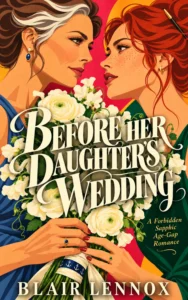
Before Her Daughter’s Wedding
Ten days at her best friend's wedding. One door between their rooms. Twenty-two buttons she sewed knowing she'd be the one to undo them.

The Guest Room Rule
Six weeks in her best friend's mother's guest room. Five rules chalked inside a chair. Every one of them is about to break.
Never Miss a Release
Get new release alerts, exclusive bonus content, and reader-only giveaways.