

Her Mother’s Type
A Sapphic Age-Gap Ex’s Mother Romance
by Blair Lennox
Free with Kindle Unlimited
Pairing: FF (Sapphic)
Heat: 🌶️🌶️🌶️🌶️🌶️ Inferno
Tropes: Ex’s Mother, Age Gap (23 Years), Forbidden Romance, Hands Off Until the Invoice Clears, Secret Relationship, Older Heroine, Divorced Heroine, Late-Blooming Bisexual Heroine, First Time with a Woman, Instruction Kink, Praise Kink, Orgasm Denial, Control/Surrender, Switch Dynamic, Body Worship, Lowcountry Small Town, Grovel, Two Homes HEA
She took the job to fix her ex’s mother’s courtyard. She didn’t plan on wanting the woman who owned it.
Rowan Ellis doesn’t keep clients’ keys.
Thirty, a landscape designer with a truck that won’t shift into third and a business one bad quarter from folding, she almost turns down the job at 12 Gale Street. It’s her ex-girlfriend June’s childhood home. The walled courtyard is a wreck. And the client who hired her with a four-line email signed C. Ashby is June’s mother.
Celia Ashby is fifty-three, eighteen months divorced, barefoot, newly silver, and finished pretending not to look at things. For two years she poured Rowan’s coffee at Sunday dinner and never once really saw her. Now she stands in the doorway watching Rowan cut the jasmine off her wall, and tells her: don’t design it for the family that used to live here. Design it for the woman who does.
Twelve days. Sixteen thousand four hundred dollars. And one rule: Rowan doesn’t touch anyone who’s paying her. So they say everything out loud beside the fountain and nothing with their hands, until the last invoice clears and the key goes back on the counter.
Then come the new rules, typed into a phone on the seawall. Two weeks private, not secret. No money. No lies. And June stays out of bed.
But Celia is selling the house June wants to raise her kids in, and she’s very, very good at true things built to be misunderstood. The hardest rule was never the touching. It was saying it out loud.
Her Mother’s Type is a scorching ~70,000-word sapphic age-gap romance with dual POV, an ex’s newly divorced mother, a late-blooming bisexual heroine, a younger woman who has spent her life being easy to have around, and an HEA guaranteed.
You’ll love this book if you enjoy:
✅ A 30-year-old landscape designer and her ex’s 53-year-old newly divorced mother
✅ Twelve days of wanting and a strict no-touching rule until the invoice is paid
✅ A walled garden, a fountain that keeps secrets, and a nail brush used as foreplay
✅ A cool former finance director who finally says what she wants, and makes her lover ask for it
✅ “Yes, Ms. Ashby,” praise, instruction, a strap-on chosen by spreadsheet, and a porch on a tidal creek
✅ A secret kept from the daughter, a front-step discovery, and a grovel delivered as typed terms
✅ Two homes, two keys, and no more waiting in the dark
✅ No cheating, 🌶️🌶️🌶️🌶️🌶️ heat and an HEA guaranteed
⚠️ Content Warning: This novel contains extremely explicit sexual content (graphic FF scenes throughout, including mutual masturbation without touching, oral, fingering, tribbing, a strap-on, wrist-holding and power exchange, biting, and risk-of-discovery scenes with family in the next room), strong language, and alcohol. Also includes a significant age gap, a relationship with an ex-girlfriend’s mother, divorce, a parent’s emotional neglect in backstory, a secret kept from a family member and its fallout, and family conflict. No cheating. Intended for readers 18+.
📖 Read Chapter One Free
Not sure yet? Read all of Chapter One right here.
Chapter One
ROWAN
The last time I stood at this gate, I had a bottle of wine in one hand and June Prescott’s fingers laced through the other.
That was three years ago, give or take a breakup. This morning I had a clipboard, a hundred-foot tape, and a truck at the curb that wouldn’t shift into third, and I was here because of four polite lines that had come through my website on a Tuesday night.
12 Gale Street. A walled courtyard, badly neglected. I would like it made into something. Are you available to look at it? — C. Ashby
I didn’t know a C. Ashby. I knew the address the way you know an old scar.
I’d nearly said no. I had a rule about exes, and a second, vaguer rule about their mothers. Then I looked at what was in my business account and what was on my calendar for June, the month and not the woman, and neither one could afford my rules.
June the woman and I were fine. Better than fine. We’d pulled off the thing everybody claims lesbians do and almost nobody does well, which was stay friends and mean it. She was engaged to an ER nurse named Hannah who was better for her than I had ever been, and I was glad about it, and it cost me nothing to be glad. I hadn’t told her I was coming here. I figured if her mother wanted her to know, her mother would say so.
The side gate was wrought iron, older than anybody living, and the latch stuck. It had always stuck. You had to lift it and put your hip into the bars in one motion, a trick June taught me the first night she brought me home, laughing, telling me the house didn’t let just anyone in. My hip remembered before the rest of me caught up. The hinge gave its two-note complaint, and I was standing in the Prescotts’ courtyard at eight in the morning in late May, with the heat already settling over Wren Harbor like a damp palm on the back of the neck.
It was worse than I remembered, and I remembered it as the one part of the house nobody bothered with.
Thirty feet by forty, near enough. Brick walls on three sides and the back of the house on the fourth. Good walls. Old Lowcountry brick the color of a week-old bruise, lime mortar, ten feet high, and not a window on the block that could see over them. Somebody in 1890 had built a room with no ceiling. Somebody around 1995 had paved it in concrete squares, and the fig in the corner had been levering those squares up one root at a time ever since.
I walked it the way I walk every job. Slow, edges first, mouth shut.
The east wall was gone. Not fallen. Swallowed. Star jasmine had been let run for a decade at least, and it had built a second wall on top of the first, three feet thick, the stems as big around as my wrist where they left the ground. It was in full bloom. The smell was sweet enough to have weight, and under the sweet was the green rot of everything dying in the dark beneath it. I worked my arm in through the leaves to the elbow, found brick, and felt the mortar go to powder under my fingertips.
First problem. I wrote it down.
The fig was the second, and cutting it wasn’t the answer, because it was magnificent. Sixty years old if it was a day, low and wide and muscled, leaves like open hands. You don’t take out a tree like that. You apologize to it and build around it.
And dead center, the fountain. A round basin of that same old brick, capped in limestone, knee-high, with an iron spout rising out of the middle like something that used to matter. Six inches of black leaf sludge in the bottom and one small, offended tree frog. I crouched and laid my hand flat on the cap. Cool, even in this heat. No give. Whatever had killed it was in the pump or the line, not the bones.
I liked it. I didn’t write that down.
“You still know the trick with the latch.”
I stood up too fast.
She was on the back steps, in the open French door of what they used to call the garden room, which was where the family had always put whatever it didn’t want to look at. And for one full second I didn’t know her.
I knew Mrs. Prescott. Mrs. Prescott had honey-colored hair that never moved and a dish towel over one shoulder and shoes on, always, low heels you could hear coming down the hall. Mrs. Prescott asked how your work was going and then, before you’d gotten to the verb, asked June if she’d remembered to call her grandmother. For two years she had been kind to me the way a very good hotel is kind to you.
The woman on the steps was barefoot.
That’s what I saw first, and I couldn’t tell you why it went through me the way it did. Bare feet on warm brick, narrow and pale, nails unpainted. Loose linen trousers the color of oatmeal. A white linen shirt with the sleeves turned back twice and the top two buttons left alone, so the notch of her collarbone showed, and a shadow below it. A thin gold watch. Reading glasses on a chain, resting against her chest. And her hair was silver. Not graying, not going. Silver, all of it, cut blunt at the jaw and bright as a new nail in the sun.
She let me look. Then she came down the steps and across the wrecked pavers without once checking where she put her feet, the way you cross a room you’ve walked in the dark.
“It’s the hair,” she said.
“It’s different.”
“I stopped paying a man named Trevor two hundred dollars every six weeks to lie on my behalf.” The voice I knew. Low and level, and dry enough to strike a match on. “My last appointment fell on the day the decree came through. I canceled it from the courthouse parking lot. I recommend both.”
“The divorce and the hair?”
“The parking lot, mainly. It was an extremely satisfying parking lot.”
She stopped an arm’s length away and tipped her face up. I had three inches on her. I’d never noticed that, not in two years of Sunday dinners. Her eyes were gray. I had eaten at this woman’s table a hundred times and couldn’t have told you that until right then.
“Hello, Rowan.”
“Mrs. Pres—”
“Don’t.”
“Sorry. Reflex.”
“You kept it up for a solid month the first time, as I recall. I had to threaten you with Miss Ellis.” One corner of her mouth moved. “It’s Celia. It was Celia then, too.”
“Celia.”
It sat oddly on my tongue, like a word in a language I’d only ever read.
I’d wiped my palm down my thigh, ready for the handshake. It didn’t come. She kept her hands loosely together in front of her, one thumb turning the gold watch a quarter inch around her wrist and back, and after a moment I put mine in my pocket and felt like someone who’d gone in for a hug at a funeral.
“So,” she said. “How bad is it?”
“You want the polite version?”
“I’ve had thirty years of the polite version. Give me the invoice.”
I almost smiled. “The paving’s a loss. All of it comes up. Your drainage runs toward the house, which is backwards. The beds are dead clay. And the jasmine’s pulled maybe a third of the mortar out of your east wall.”
“Show me.”
I took her to it. I held the vines apart with my forearm so she could see in, and she slid the glasses onto her nose and bent to look, close enough that I could smell her under all that jasmine. Soap. Something green and bitter, like crushed tomato leaf. I scraped a pinch of mortar loose and held it out on my palm, and she studied it there without taking it.
“That’s sand,” she said.
“That’s what’s holding up your wall.”
“Twenty-eight years I’ve lived with this wall.” She straightened. “I never once looked behind the pretty part.”
“Most people don’t. It’s why I’ve got a job.”
“And the tree?”
“The fig stays.”
“Does it.”
“I’m not taking that tree out. If you want it gone, you want somebody else.”
Her eyebrows lifted. Not offended. Interested, as if I’d finally said something worth the drive over.
“I don’t want it gone,” she said. “I wanted to see whether you’d tell me or ask me.”
“Did I pass?”
“I’ll let you know.” Her gaze went past my shoulder to the fountain, rested there, came back. “And that?”
“I’d want a proper look inside it before I said anything.”
“That’s a careful sentence.”
“It’s a careful fountain.”
That got the other corner of her mouth. It did something to her whole face, took ten years of hostess off it, and I looked down at my clipboard because looking at her had suddenly started to require a decision.
“I’ll need to measure before I can give you a number,” I said. “Who’s the estimate made out to?”
I’d already written the address. Under it, on pure muscle memory, my pen had put down P-R-E-S.
“Ashby.”
The pen stopped.
She still had the glasses on, and she was reading my clipboard upside down, looking at those four letters. “A-S-H-B-Y. I took my name back. It was mine for twenty-one years before I lent it out, and I’d like it returned in good condition.” She let the glasses drop to the end of their chain. “Celia Ashby. Write it down, please. I’d like to see it on something.”
I struck through the four letters, one clean line, and wrote it underneath in block capitals. Then I turned the clipboard around and held it out so she could read it right way up.
She looked at it for a good deal longer than two words take.
“Thank you,” she said, and it wasn’t a hostess’s thank-you. It was quieter than that, and it wasn’t really for me.
Measuring took an hour and ten. By the end of it my shirt was stuck to my spine, I had the whole courtyard on graph paper, and she’d sent me a look through the kitchen window that I chose to read as come in before you fall down.
The kitchen hadn’t changed. That was the dizzying part. Same soapstone, same six-burner range, same open shelf to the left of it with the mugs lined up handles-out. Same long table by the window with the same eight chairs, and I knew without looking which one was June’s.
My body knew this room. It wanted to get the milk out for somebody.
“Sit,” Celia said. “Not that one, it wobbles. I’ve been meaning to do something about it since 2016.”
I took a different stool at the island and spread my drawing out. She had her back to me, at the shelf, and I watched her hand travel down the row of mugs and stop on the heavy brown one with the thumb dent in the glaze. The ugly one. The one I’d drunk out of every Sunday for two years because nobody else would.
She poured. She opened the sugar, put in one spoon, and stirred it while the steam was still coming off hard.
Then she set it on the island and turned the handle toward me with a single fingertip.
“I didn’t say how I—”
“One sugar. No milk. Stirred in while it’s still too hot to drink, which I always thought showed a touching faith in the future.” She poured her own and didn’t look up. “Have I got it wrong?”
“No.”
“Good.”
I drank some. It took the roof of my mouth off, and it was exactly right, and I sat there with a ridiculous warmth spreading under my ribs that had nothing to do with coffee. Then again, she’d known how everybody took everything. That had been the job.
“June tells me you went out on your own,” she said.
“Five years in March.”
“While you were with her, then.”
“Second year of it. Yeah.”
She nodded slowly, both hands around her cup. “I don’t believe I ever asked you one real question about it. I asked whether you were keeping busy. I’ve been thinking about that.”
I had no idea what to do with that. Nobody in this house had ever handed me an apology I hadn’t had to dig for. “You were hosting.”
“I was always hosting. It’s a marvelous way to never be in a room.” She set the cup down. “Walk me through it.”
So I did. I pushed my sleeves to the elbow, turned the drawing to face her, and took her around it with the pencil. Jasmine off the wall and cut back to a frame I could train. Wall repointed in lime, not cement, because cement would kill that brick in ten years. Concrete out, drainage turned around, bluestone laid dry on sand so the fig could keep breathing. Deep beds along the north and west walls. A bench, there, where the evening light landed. Low-voltage lighting, because a walled garden is wasted on anybody who only sees it in the daytime.
“Twelve days, start to finish. I work Saturdays,” I said. “Sixteen thousand four hundred, fixed, materials in. Half up front, half the day I finish. If you change your mind about something in the middle, we write it down and price it before I pick up a tool.”
“You’ve been burned.”
“I’ve been paid in compliments. Turns out the bank doesn’t take them.”
“No. They never have.” She said it like someone who’d checked. “And if you find something terrible behind that jasmine?”
“Then I show you, I tell you what it costs, and you decide. I don’t eat it and I don’t spring it on you.”
“That’s a better contract than my marriage had.”
I looked up to see if I was allowed to laugh.
She wasn’t looking at the drawing.
She was looking at my arms. The left one, mostly, turned up on the soapstone where I’d been holding the paper flat. The rowan branch runs from the inside of my wrist almost to the elbow, fine black line, leaves and a cluster of berries, and under it the tendons were standing out because I’d been gripping the pencil like a chisel. She was following it. Wrist to elbow, unhurried, then across to the other forearm, and down to my hands, to the white seam of the scar across my left thumb.
I’ve been looked at by women. I know what it is when it’s happening.
I told myself I didn’t know what this was.
What I couldn’t explain away was that she didn’t startle. When she felt me watching her, she didn’t snatch her eyes off me and find something fascinating in her coffee, the way anyone would. She finished. Then she lifted her gaze to mine, gray and level and not one bit sorry, and said, “That’s new.”
“Two years.”
After June. Neither of us said it.
“It’s a rowan branch,” I said. “It’s a little on the nose.”
“I’ve come around to things being on the nose.” She touched her own name at the top of my estimate, lightly, one finger. “I’ve just been through the paperwork.”
Client, I thought. I underlined her name on the page, hard, to remind myself what it was doing up there.
My phone buzzed on the island between us. Face-up, because I’m an idiot.
MOM HIRED YOU. Full circle!!
And then, before I could get a hand on it:
Don’t let her do anything crazy to my house.
I turned it over. Too late. Celia had her glasses halfway to her face, and she let them fall back without a word.
“She’s thrilled,” I said.
“She is. June likes it very much when things come back around to where she left them.” There was no edge on it. There was something more complicated than an edge, with love all the way through it and a tiredness under the love. “She’ll want to have you to dinner. You should know I didn’t hire you as a favor to her, or to you. I looked at eleven portfolios. Yours was the only one where the gardens looked as though somebody lived in them.”
“Okay.”
“I wanted that said before any money changed hands.”
She opened a drawer. Left of the sink, second down. I’d have gone to the same one blind. She came back with a checkbook and an old iron key, and she wrote the check standing up, in a quick slanted hand, tore it off, laid it on the soapstone, and pushed it across with that same single fingertip.
Celia Ashby, printed in the top corner. New checks. Nobody orders checks anymore.
“I know,” she said, reading my face. “I wanted to see it printed. Indulge me.”
“Eight thousand two hundred dollars’ worth, apparently.”
“I’m told I’ve earned an indulgence.”
She held the key over my open palm and dropped it from an inch up. It landed cold and heavier than it looked. Her fingers never came near mine, and I felt the place they hadn’t touched like a draft under a door.
I pulled a length of green twine out of my back pocket. I always have some. I tie up everything with it. I threaded the key, knotted the loop, and clipped it to the carabiner on my belt, where it knocked against my hip.
“This comes back to you the day I finish,” I said. “I don’t keep clients’ keys.”
“A policy.”
“A good one.”
“I’m sure it is.” She picked up her coffee and regarded me over the rim, and I had the distinct sensation of being filed somewhere, carefully, under a heading I couldn’t read. “Twelve days, then, Rowan.”
I started on the jasmine that same morning, because I’m no good at standing around in a job without drawing blood from it.
Loppers first, then the pruning saw for anything thicker than my thumb. Star jasmine bleeds white when you cut it, a milky sap that gets on your gloves and your arms and dries to glue, and inside ten minutes I was striped with it. The flowers came down on me by the hundred. In my hair, down my collar, stuck to the sweat on my throat. I cut and hauled and cut, and the pile on the tarp behind me grew, and a ragged window opened in the green until, for the first time in maybe fifteen years, sunlight landed on a square foot of that east wall.
The brick under there was beautiful. Darker than the rest, damp, soft at the edges. I pulled my glove off with my teeth and put my bare hand on it.
That was when I felt her.
Not heard. Felt, between the shoulder blades, the way you feel weather turning.
She was in the garden-room doorway. Leaning on the frame with her arms loosely crossed and her bare feet crossed at the ankle, the coffee gone, the glasses hanging. Not on her way anywhere. Not holding a watering can or a phone or any of the hundred props a person picks up when they want to stare and be forgiven for it. She was simply watching me work, openly, with the calm attention of somebody who had decided she was finished pretending not to look at things.
I had sap to the elbow and jasmine in my hair and my shirt plastered to me front and back.
I went back to the saw. For a stroke or two my hands forgot what they were doing.
Ten minutes. Fifteen. She didn’t move, and it should have been unnerving, a client hovering. It wasn’t hovering. Hovering wants something from you. This asked for nothing at all and took its time, and I worked inside it the way you work in sun, aware of it on every inch of skin.
“You’re not taking it all,” she said eventually.
“No.”
“I’d assumed you would. It’s done so much damage.”
“It’s not malicious. It’s just never been told no.” I set the blade against a stem as thick as a broom handle and leaned in. “It wants to be here. It needs somebody to tell it where.”
“And you intend to be that.”
“For twelve days.”
“Hm,” said Celia, and I felt that one syllable travel down my spine and sit.
When I couldn’t stand it anymore I dragged my wrist across my forehead and turned around.
“I need to ask you something for the design.”
“Ask.”
“What’s it for?”
Her head tipped.
“The courtyard. I can make it pretty for anybody. I’d rather make it right.” I gestured with the saw at the whole wrecked rectangle. “I keep seeing a long table. This house always had a full table. Ten, twelve people out here, lights strung up, June’s—” I stopped. Started over. “Kids down the line, maybe. Somewhere for a grill. I can give the family a place to—”
“No.”
She didn’t raise her voice. She didn’t need to. It crossed the courtyard like a hand laid flat on a table.
She straightened off the doorframe. For a moment she looked up at the house rising behind her, three stories of it, all those rooms. Then at the fig, and the dead fountain, and last at me, standing in a heap of her cut jasmine with white sap drying on my arms.
“Don’t design it for the family that used to live here,” Celia Ashby said. “Design it for the woman who does.”
She went inside and left the door open.
I stood there with the saw hanging from my hand and her key knocking against my hip, and it came to me that in two years of sitting at her table, I had never once actually met her.
Want to keep reading? The full novel is available now, free with Kindle Unlimited.
🔥 Want an EXCLUSIVE Bonus Chapter?
Amended Terms — A scene TOO HOT for Amazon
One year to the day since the courtyard. The jasmine is blooming on the porch at Heron Creek, Celia has typed up terms for year two, and clause seven says Rowan isn’t allowed to help. Green twine, a new toy chosen by spreadsheet, and the word not yet. Then Rowan adds a clause of her own.
More from Blair Lennox
Browse all Blair Lennox books.

Her Mother’s Type
She took the job to fix her ex's mother's courtyard. She didn't plan on wanting the woman who owned it.
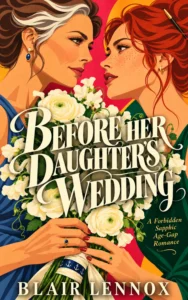
Before Her Daughter’s Wedding
Ten days at her best friend's wedding. One door between their rooms. Twenty-two buttons she sewed knowing she'd be the one to undo them.

The Guest Room Rule
Six weeks in her best friend's mother's guest room. Five rules chalked inside a chair. Every one of them is about to break.

My Ex-Husband’s Sister Wants Me
Port Sorrel After Dark
The divorce ended her marriage. It did nothing about his sister.

The Pastor’s Wife Is Leaving
She spent nine years watching the bar across the street. Now she lives above it.

My Ex’s Mother After Dark
Her daughter broke my heart. Her mother wants to show me what being chosen feels like.
Never Miss a Release
Get new release alerts, exclusive bonus content, and reader-only giveaways.