

The Pastor’s Wife Is Leaving
Sapphic Small-Town Romance
by Blair Lennox
See available purchase options
Pairing: FF (Sapphic)
Heat: 🌶️🌶️🌶️🌶️🌶️ Inferno
Tropes: Bi Awakening, Later-in-Life First Time, Landlord/Tenant, Small Town, Secret Relationship, Mutual Pining, Rules Arrangement, Praise Kink, Switch Dynamic, Found Family
Length: ~102,000 words
She spent nine years watching the bar across the street. Now she lives above it.
The night Bethany Wren leaves the parsonage with a suitcase and a grocery bag of shoes, the woman across the street unlocks her bar door. Twenty minutes later, Bethany has a whiskey she doesn’t know how to drink, a key to the apartment upstairs, and a lease that says her name without Mrs. in front of it.
Monica Cross has run the Bellwether for nine years. She has fourteen years sober, forty years behind her, and exactly one bad habit: noticing the woman in the church window.
Now that woman is barefoot on her stairs, asking her questions Monica has been imagining answers to for the better part of a decade.
They make an agreement. Written on stationery. Two nights a week. No one else. Nothing downstairs. Bethany has spent twenty-three years being a good wife, a good mother, a good example. She would like to find out what she is when she’s allowed to want something.
The problem is she’s good at wanting Monica. Very good. And Monica — who knows better than to need anyone’s permission — is starting to need the one thing Bethany didn’t put in the terms.
A street with two doors. A town that sees everything. And a woman who is done being kept in the dark.
You’ll love this book if you enjoy:
✅ A heroine over forty choosing herself — and a woman — for the first time
✅ Butch bar owner × newly separated pastor’s wife
✅ Nine years of mutual pining across a single street
✅ A written arrangement that gets gloriously out of hand
✅ Praise kink, a switch dynamic, and “use your words” as a love language
✅ Private heat that has to become public courage
✅ Found family at the pub table
✅ 🌶️🌶️🌶️🌶️🌶️ Inferno heat — graphic, explicit, emotional
✅ HEA guaranteed
⚠️ Content Warning: This novel contains explicit sexual content (graphic FF scenes, including a strap-on), strong language, religious and community judgment, an emotionally diminished marriage, separation and divorce, a character in long-term sobriety, a relationship kept secret, and a brief breakup. Bethany is openly separated before any romantic or sexual contact with Monica. Intended for readers 18+.
📖 Read Chapter One Free
Not sure yet? Start the first chapter right here.
Chapter One
Bethany
The suitcase had one bad wheel. I had known about it since the retreat in Asheville, three years ago, and I had never once mentioned it because mentioning it would have meant asking for something.
Now it caught on every crack in the sidewalk between the parsonage and the curb, making a sound like a small animal being dragged, and I thought: I am forty-four years old, and I am leaving my husband with luggage I didn’t pick out.
I had a grocery bag in my other hand. In it were a pair of flat shoes, my mother’s Bible, and a bottle of face wash I had forgotten to put in the suitcase. Twenty-three years, packed in twenty minutes. I could have taken longer. Graham had offered to sleep at the rectory for the night, give me space, let me “think about this in the morning.” He had said it kindly. That was the worst part. He was always kind about the things he didn’t believe I meant.
I had put the shoes in the bag and kept packing.
It was 11:42 on a Wednesday in October. The church sign, which I had updated myself that afternoon, glowed across the lawn: Come As You Are. I had stood on a step stool in a cardigan and slid the letters into their tracks, and now I was standing under them with a broken suitcase and no idea where to go, and I could not stop laughing.
It wasn’t a good laugh. It was the kind that meant if I stopped, something else would start.
The street was empty. The town had been asleep since nine-thirty, except for one building directly across from the parsonage: the Bellwether, its front windows lit amber, a chalkboard sign still propped beside the door. I had looked at those windows every night for nine years. From the kitchen. From the bedroom. From the upstairs landing while Graham took calls with the elders in his study and I stood in the dark in my good bra with nothing to do with it.
I had never been inside.
Behind the window, a woman was wiping down a table. She moved slowly, methodically, the way people move when they’re closing up and thinking about something else. Short dark curls, a few streaks of gray at the temples. A green shirt with the sleeves pushed to her elbows. I knew the shape of her before I knew her name. I had watched her carry beer kegs up from the cellar, watched her lean in the doorway on summer evenings with her arms crossed, watched her tip her head back and laugh at something I couldn’t hear from across the street.
Monica Cross. She had come by the church office once to drop off a check for the flood relief drive. I had taken it from her hand and thanked her and then stood in the supply closet for six minutes pretending to count paper towels.
That was eight years ago.
I crossed the street.
The door was locked. Of course it was locked. It was nearly midnight and I was standing on a sidewalk in my church cardigan holding a grocery bag with shoes in it.
I lifted my hand to knock and then lowered it. Then lifted it again. The suitcase tipped sideways on its bad wheel.
She saw me before I knocked. She was behind the bar now, stacking glasses, and she looked up and went still for a moment. Not long. Just long enough that I noticed.
Then she set down the glass, walked to the door, and opened it.
“Bethany.”
She said my name as if she’d been expecting me. As if it was a word she’d been carrying around for a while and was glad to put down.
“I’m sorry. I know you’re closed.”
“Come in.”
“I just need—”
“Come in first. Need things second.”
She took the suitcase handle from my hand. Her fingers brushed mine and I felt it all the way up my arm, which was absurd, which was inconvenient, which was the last thing I needed right now. She lifted the suitcase clear off the ground with one hand and carried it inside like it was a bag of flour.
The bar was warm. That was the first thing. I hadn’t realized I was cold until I wasn’t. It smelled like old wood and lemon oil and the faint ghost of a hundred thousand pints. The stools were upholstered in cracked burgundy leather. There was a dartboard at the far end, a jukebox that wasn’t playing, and a row of photographs behind the bar—teams, parties, faces, all of them laughing.
It looked like a place where people were allowed to take up space.
“Sit.” She pointed at a stool near the end of the bar, then went around behind it. “Water?”
“Whiskey,” I said.
She paused. Looked at me. Her eyes were brown, warm and very direct.
“You drink whiskey?”
“No.”
“Okay.” She got a glass. “We’re going to start with water, and then we’ll negotiate.”
I sat on the stool. My cardigan had a button missing—the third one down, the one I kept meaning to sew back on—and I pulled it together with my hand, which was what I always did. Hold things together. Make it look fine.
She set a glass of water in front of me. Then a second glass, shorter, with about a finger of something amber.
“That’s a sipping amount. Not a throwing-back amount. I say that because you look like you might throw something.”
I laughed. The bad laugh again. “I left him.”
She didn’t move. Didn’t widen her eyes or put a hand to her chest or say Oh, honey in the voice women used when they were relieved it wasn’t them. She just stood there with both hands flat on the bar and let me say it.
“I told him tonight. I said I wanted a separation. He said we should pray about it. I said I’d been praying about it for eleven years.”
“What did he say to that?”
“He said he didn’t realize I’d been so unhappy.” I picked up the whiskey. Put it down. Picked it up again. “Which is true. He didn’t. I made very sure of that.”
The words were coming out in the wrong order, or maybe the right order for the first time, and I couldn’t tell because I had never said any of them before. Not to anyone. Not even to my sister, who had been married three times and would have thrown a party.
“You don’t have to explain it to me,” Monica said.
“I know.”
“You don’t have to explain it to anybody.”
“I don’t know that one yet.”
She nodded, slowly, like that was fair. Then she leaned back against the counter behind her and crossed her arms. The sleeves of her shirt were pushed up, and there was a small tattoo on the inside of her left forearm—something I couldn’t make out in the light. Her hands were broad, with short nails and a nick on one knuckle.
I looked at her hands for a second too long.
I took a sip of the whiskey. It burned all the way down, and I coughed, and she smiled—not at me, not unkindly, just smiled, the corner of her mouth pulling up on one side.
“There it is.”
“What?”
“Your first whiskey face. Everybody has one.”
“Is mine terrible?”
“Yours is excellent. Very honest.”
Honest. The word sat in the space between us like something she’d handed me.
“I don’t know where to go,” I said. Quietly. That was the part I hadn’t wanted to say, the part that made me feel small. I had a credit card in my own name—I had made sure of that years ago, one private act of self-preservation I had never told Graham about—and I had a little money. But the nearest hotel was forty minutes down the highway, and my car was in the parsonage garage, and I couldn’t go back across the street. Not tonight. If I went back across the street, he would make tea and be gentle and reasonable and I would fold.
I was so good at folding.
“I’ve got an apartment upstairs,” Monica said. “It’s empty. Been empty since June.”
I looked up. “I can’t—”
“You can. It’s not charity. I’ll charge you rent. Fair rent. You can stay a week or a year.” She uncrossed her arms and reached for something under the bar, a ring of keys on a brass clip. “It’s not fancy. The radiator makes a noise. The window sticks in summer. But it’s clean and it has a bed and the door locks.”
The door locks. I almost cried at that. I hadn’t had a door that was just mine to lock in twenty-three years.
“Can I see it?”
She was already picking up my suitcase.
The stairs were narrow and steep, tucked behind a door at the back of the bar. She went first, suitcase in one hand, the other on the railing. I followed, watching the way her shoulders moved under the green shirt, the way she took the steps like they were nothing, the way the light from above caught the gray in her hair.
I was forty-four years old, freshly separated, slightly warm from half a finger of whiskey, and watching a woman carry my suitcase like I was watching a match burn.
I told myself it was gratitude.
The apartment was small. A bedroom, a living room with a kitchenette, a bathroom with a claw-foot tub. The walls were painted a soft yellow. There was a couch with a knitted blanket on it, a bookshelf with actual books, and a window in the living room that looked out onto the street.
Onto the church.
I stood at that window and looked at the parsonage, at the lit rectangle of Graham’s study, and felt the strangest thing: not grief, not guilt, but distance. Forty feet of asphalt, and it might as well have been another country.
“I know,” Monica said behind me. “The view’s a bit pointed. But there’s a blind.”
I turned around. “It’s fine.”
“You keep saying that word.”
“I’ve had a lot of practice.”
She set the suitcase beside the bedroom door. The room beyond had a double bed with white sheets and a blue quilt folded at the foot. A lamp on each side. Curtains that were actually curtains, not the thin institutional panels I’d hung in the parsonage because the decorating budget went to the sanctuary.
“I’ll need a name for the lease,” she said. “In the morning. We don’t need to do paperwork at midnight.”
“Bethany Wren.”
“I know your name.”
“Not Mrs. Wren. Not ‘the pastor’s wife.’ Just—”
“Bethany.” She said it again. The same way she’d said it at the door. “I know.”
I looked at her. She was standing in the middle of the small room, keys dangling from one finger, and she was looking at me with an expression I didn’t have a name for. Patient. Careful. Something under both of those things that I wasn’t ready to look at directly.
She handed me the key. A plain silver key on a ring with nothing else on it.
“This one opens the street door at the side. So you don’t have to come through the bar. This one’s the apartment.” She separated them on the ring so I could see. “I’m in the back, same floor, other door. If you need anything, knock.”
“Thank you.”
“You’re welcome.”
“I mean it.”
“I know you do.” She paused in the doorway. “There’s tea in the cabinet. Peppermint. And a clean towel in the bathroom. And Bethany?”
“Yes?”
“You’re not a guest. You’re a tenant. That means you don’t have to be grateful every time you walk down the stairs. You just have to pay rent and not set fire to anything.”
I smiled. It was small, and my face felt strange doing it, like a muscle I hadn’t used in a long time.
“I can do that.”
“I figured.” She went out. The door clicked shut. I heard her footsteps going down the hallway, then a different door opening and closing, and then nothing.
Silence. My own silence.
I stood in the middle of the room with the key in my hand for a long time.
I didn’t unpack. I took off my cardigan and hung it on the back of a chair. I took off my shoes. I took off the small pearl earrings Graham had given me for our tenth anniversary and set them on the nightstand beside the lamp.
Then I sat on the edge of the bed and looked at my phone.
One text from Graham: Please let me know you’re safe.
I typed: I’m safe. I’ll call you tomorrow.
I did not tell him where I was. That felt like the first real thing I’d done all night. Not the leaving—the leaving had been a door swinging shut. This was choosing not to open it again.
I put the phone facedown.
The bed was comfortable. The sheets smelled like laundry soap, plain and unscented, and the quilt was heavy enough to feel like something. I lay down on top of it in my clothes—blouse, skirt, the good bra I had put on that morning for reasons I couldn’t now explain—and listened to the radiator tick.
My hand rested on my stomach. I could feel my own breathing. I could feel the unfamiliar quiet of a room where nobody needed anything from me.
And then, because I was apparently determined to make this night as complicated as possible, I thought about her hands.
Not in a vague way. Not in the careful, passing way I had let myself think about her for years—a thought glanced at sideways, like a bright light. I thought about the nick on her knuckle. The width of her palm. The way she had lifted my suitcase. The way her fingers had brushed mine when she took the handle, and again when she gave me the key, and neither time had she hurried.
My stomach tightened. Low. Below where my hand was.
I had been attracted to people before. I wasn’t dead. I had been married to a man I once loved and occasionally still liked, and I had a body that had opinions about things. But I had spent so long redirecting those opinions—into baking, into committees, into the particular exhaustion of being useful—that feeling one directly was like hearing my own name shouted in an empty room.
Her hands.
I pressed my thighs together. My breath caught, and the catch itself startled me. I was warm. Not whiskey-warm. Warm in a way that had nothing to do with the radiator or the quilt or the room.
I thought about her voice. Come in first. Need things second. How she had stood there and let me be a mess without trying to fix it. How she had looked at me—not past me, not through me to the situation, but at me. As if I was someone worth looking at.
My hand moved. Just an inch, from my stomach to the waistband of my skirt, and then stopped. I lay there with my palm flat against myself and my heart beating too fast, and I thought: You just left your husband. It has been two hours.
And then I thought: It has been eleven years.
I didn’t do anything. Not that night. I unbuttoned the top button of my skirt so I could breathe, rolled onto my side, and pulled the quilt over me. But I lay awake for a long time, aware of every inch of my skin, aware of the woman on the other side of the wall, aware of the silver key on the nightstand and the pearls beside it.
The radiator ticked. A car went by on the street below. Somewhere in the back of the building, a floorboard creaked, and I held my breath for no reason at all.
I had left the parsonage because I was tired of being numb.
I was not numb.
Want to keep reading? The full novel is available now.
🔥 Want an EXCLUSIVE Bonus Chapter?
The Last Night in the Rear Apartment — After the Christmas fundraiser, Bethany packs up Monica’s apartment. At the bottom of the closet she finds a harness Monica never offered to use. Tonight she asks. An exclusive scene between Chapter Twenty-Two and the epilogue — too hot for the retailers.
More from Blair Lennox
Browse all Blair Lennox books.

Her Mother’s Type
She took the job to fix her ex's mother's courtyard. She didn't plan on wanting the woman who owned it.
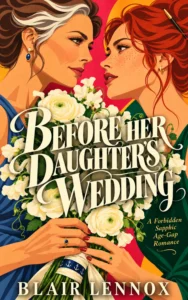
Before Her Daughter’s Wedding
Ten days at her best friend's wedding. One door between their rooms. Twenty-two buttons she sewed knowing she'd be the one to undo them.

The Guest Room Rule
Six weeks in her best friend's mother's guest room. Five rules chalked inside a chair. Every one of them is about to break.

My Ex-Husband’s Sister Wants Me
Port Sorrel After Dark
The divorce ended her marriage. It did nothing about his sister.
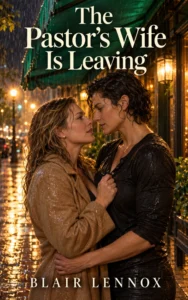
The Pastor’s Wife Is Leaving
She spent nine years watching the bar across the street. Now she lives above it.

My Ex’s Mother After Dark
Her daughter broke my heart. Her mother wants to show me what being chosen feels like.
Never Miss a Release
Get new release alerts, exclusive bonus content, and reader-only giveaways.