

My Ex’s Mother After Dark
Sapphic Age-Gap Romance
by Blair Lennox
See available purchase options
Pairing: FF (Sapphic)
Heat: 🌶️🌶️🌶️🌶️🌶️ Inferno
Tropes: Ex’s Mother, Age Gap (20 years), Secret Affair, Ice Queen, Praise Kink, Photographer/Client, Hotel Romance, Body Worship, Switch Dynamic
Her daughter broke my heart. Her mother wants to show me what being chosen feels like.
The woman I photographed running a charity gala six years ago is standing in the hotel corridor. Silver-blonde hair, sleeves pushed up, divorce ring gone. Helena Cross owns the Cross Estate now. She needs a photographer for the relaunch. She asked for me.
I am twenty-nine. She is forty-nine. I used to date her daughter.
Nothing about this should be a job I take.
But the fee clears my arrears. The work is mine to make. And the woman who once made me feel like a badly-dressed adolescent now looks at me like she’s trying to remember where she put her composure.
It starts in the pantry. It becomes a set of rules: no staff, no guests, no one finds out. Helena has spent thirty years holding a room together, and she would very much like, for a few hours after dark, to stop.
I’m very good at telling her what to do.
I’m less good at pretending I don’t want her in the morning.
The campaign needs a face. The gala needs a miracle. And her daughter is coming home.
You’ll love this book if you enjoy:
✅ Ice queen heroine who melts for the right woman
✅ Twenty-year age gap (49 / 29)
✅ Ex’s mother, with all the mess that implies
✅ Secret affair in a luxury lakeside hotel
✅ Praise kink that runs in both directions
✅ A younger woman who takes charge — and an older woman who learns to ask
✅ Competence kink, body worship, and “look at me” as a love language
✅ 🌶️🌶️🌶️🌶️🌶️ Inferno heat — graphic, explicit, emotional
✅ HEA guaranteed
⚠️ Content Warning: This novel contains explicit sexual content (graphic FF scenes, including a strap-on), strong language, a twenty-year age gap between consenting adults, a secret relationship with an ex-partner’s parent, family conflict, references to an unhappy past marriage, and workplace power dynamics addressed explicitly on the page. Intended for readers 18+.
📖 Read Chapter One Free
Not sure yet? Start the first chapter right here.
Chapter One
Jamie
The first thing I noticed was the ring was gone.
Not her face. Not the fact that she was standing in the corridor of a hotel I had driven four hours to reach, wearing a white shirt with the sleeves pushed up, looking directly at me as if she had been waiting for exactly this moment. The ring. A thin band of pale skin on the fourth finger of her left hand, where a diamond the size of my first camera had once lived.
I had photographed that ring. I had cropped around it in post, once, because it threw light like a weapon.
“Jamie.”
She said my name the way she said everything: as though she’d already considered it, decided it was worth saying, and was now giving it to you as a small, precise gift.
I should have been prepared. I had looked at the contract. I had seen the name of the estate. I had told myself that Cross was a common enough name, that the hospitality world was large, that there was no reason to assume.
I had assumed. Of course I had assumed. I had driven four hours with my stomach tight and the windows down and a playlist I couldn’t remember a single song from, because some part of me had known.
“Mrs. Cross.”
Her mouth moved. Not quite a smile. The corner of it tilted, as if she’d caught something she’d been expecting.
“Helena,” she said. “Please. I think we’re past Mrs. Cross.”
Were we? I had last seen her six years ago, at a garden party where I’d been holding a glass of prosecco I couldn’t afford to spill, standing beside her daughter, trying to look like someone who belonged in a garden with a name. Morgan had introduced me as “Jamie, she’s a photographer,” the way you’d introduce someone as “Jamie, she’s between things.” Helena had looked at me for one second longer than was polite and said, “What do you shoot?”
I had said, “People, mostly.”
She had said, “The difficult kind, I hope.”
I had thought about that exchange for approximately six years.
“Helena,” I said now, and felt the syllables do something low and inconvenient in my chest.
She stepped forward and offered her hand. I took it. Her palm was cool, her grip firm, her fingers longer than I remembered—no, that was ridiculous, I hadn’t been cataloguing her fingers at a garden party. I had been twenty-three and in love with her daughter. I had been an idiot, but a faithful one.
She held the handshake a beat past what was necessary. Not long enough to mean anything. Long enough for me to notice.
“You’ve driven a long way. There’s coffee in the sitting room. Real coffee, not the pods they insist on putting in the guest rooms. I’ve lost that particular argument twice.”
“I’m fine, thank you. I’d love to see the space.”
“Of course you would.” She turned, and I followed, because that was apparently what my body did when Helena Cross walked away from me. “You always did go straight to work.”
I didn’t know how to answer that. I wasn’t sure how she’d know it.
The corridor opened into a room that made me stop.
High ceilings, pale walls, a fireplace large enough to stand inside. Tall windows on the east side, and through them a lake so still it looked like a photograph I hadn’t taken yet. The light was absurd. Late-afternoon October light, low and gold, coming in at an angle that turned the dust in the air into something expensive. I could have shot the room exactly as it stood and charged twice my day rate for the privilege.
“Oh,” I said, which was not a professional response.
“That’s the face I was hoping for.”
I looked at her. She was watching me, not the room. Something about that made my skin feel too tight.
“The light,” I said.
“I know. The architect in 1890 had either extraordinary instincts or extraordinary luck. I choose to believe instincts.” She crossed to a table near the window, where a leather folder waited beside a glass of water. “This is the brief. The relaunch is in eight weeks. Sixty rooms, a restaurant, the spa, the grounds, and a campaign that needs to convince people that this is no longer the hotel their parents stayed at on anniversaries they were trying to save.”
I laughed before I could stop myself.
She looked pleased.
“I want it to feel alive,” she said. “Not staged. Not aspirational in that hollow way hotels do now, where you can practically smell the stock photography. I want people in these rooms who look like they’re actually feeling something.”
“That’s what I do.”
“I know,” she said again, and this time she let it sit.
I opened the folder. The brief was thorough—dates, deliverables, usage rights, a proposed shot list that someone had clearly spent time on. It was also, I noticed, in her handwriting in the margins. Small, sharp notes. No champagne in the bathtub. We are not that hotel. Hands, not just faces. The library should look like someone reads in it.
“You wrote this.”
“I have opinions.”
“Good ones.”
“You’ll find that debatable by week three.”
I turned a page. The rate was the one we’d agreed on through her assistant—Sera, who had been brisk and funny on the phone and had said she’s particular in a tone that suggested particular was a weather system. I had taken the job because the money was good. I had taken it because my studio lease was up in January and my biggest client had folded in September and I was twenty-nine years old and very tired of pretending that artistic integrity paid for health insurance.
I had not taken it because of Helena Cross.
I was going to keep telling myself that.
She gave me the tour herself.
That should have been the first warning. Owners didn’t give the tour. Owners shook your hand, told you they were delighted, and vanished into a meeting. Someone with a lanyard showed you where the outlets were.
Helena walked me through every room we would be shooting. The restaurant, with its reclaimed-wood bar and the chef who called her Helena without flinching. The spa, still smelling of paint, where she ran a hand along a tiled wall and frowned at a grout line I couldn’t see. The library, which was not a room so much as a long, warm corridor of books, low lamps, and leather chairs that looked as if they had absorbed a century of secrets.
“This one’s my favorite,” she said, and her voice was different. Quieter. Less finished.
“I can see why.”
“I used to come in here when the children were small. After they were asleep. I’d tell Richard I was checking the books, and he’d assume I meant the accounts.” A pause. “I was not checking the accounts.”
I looked at her profile. The light from a lamp caught the silver at her temples, and I realized that what I’d remembered as blonde was now something more complicated—ash and silver and a few stubborn streaks of the old gold, worn up in a twist that was coming slightly undone. She was forty-nine. Morgan had mentioned it once, years ago, in the dismissive way daughters mention their mothers’ ages, as if it explained everything that was embarrassing about them.
It explained nothing. It explained the lines at the corners of her eyes, maybe, and the patience in her hands. It did not explain why standing next to her in a room full of books made me feel like I’d been caught doing something.
“You still read in here?”
“Sometimes.” She turned to me. “More, lately.”
I didn’t ask about Richard. I didn’t ask about the ring. I was a professional, and professionals did not ask clients about the pale band on their finger, even when they had once spent a year dating that client’s daughter and had a working knowledge of the family’s particular silences.
“The divorce was finalized in March,” she said.
I blinked.
“You were being very disciplined about not asking. I thought I’d save you the effort.”
“I wasn’t—”
“Jamie.” One eyebrow. “You looked at my hand before you looked at my face.”
Heat went up my neck. I could feel it. I had freckles, which meant I could never hide a blush, which was one of the many design flaws I had been meaning to take up with whoever was responsible.
“I’m a photographer. I notice things.”
“So am I,” she said, then corrected herself. “Not a photographer. But I notice things.”
She looked at me for a moment longer. Then she moved toward the door, and the moment passed, and I stood in the library pretending that my pulse had not just relocated to my throat.
Sera found us in the east hallway.
She was shorter than I’d expected, with a sharp bob, a tablet, and the expression of a woman who had already solved three problems and was bracing for a fourth. “Jamie. Hi. Welcome. I’ve put you in 214—the light’s good and it’s far enough from the kitchen that you won’t wake up smelling croissants, unless that’s something you want.”
“I wouldn’t object.”
“Nobody ever does. It’s a flaw in our complaint system.” She glanced at Helena. “The board call is in twenty minutes. I’ve pushed it once.”
“Then they can wait another ten.”
Sera looked at her. Then at me. Then back at her.
“I’ll tell them,” she said, in a tone that contained an entire conversation I was not part of.
When she was gone, Helena exhaled. “I should let you settle in. Dinner is at seven in the restaurant. You’re our guest tonight.”
“That’s not necessary.”
“I know. I didn’t say it was necessary. I said you’re our guest.”
There was no arguing with that voice. There was no arguing with it in a way that would not sound like you were being difficult on purpose, and I was trying very hard to be the kind of person who was not difficult on purpose around her.
“Thank you,” I said.
She nodded, then paused. Her hand was on the doorframe, and I saw the pale band again, and the tendons in her wrist, and the way the cuff of her shirt had fallen open enough to show a small, faded scar on the inside of her forearm. I wanted to ask about the scar. I wanted to ask about a lot of things.
“I’m glad you took the job,” she said.
“So am I.”
“Your work has changed.”
I went still. “You’ve seen my work?”
“Of course I’ve seen your work. I hired you.”
“I mean—recently? Or—”
“The series you did in Lisbon. The women in the laundromat. The one with the older woman looking straight into the lens.” She held my eyes. “That photograph is why you’re here.”
I didn’t have a response ready. That was not a photograph people usually mentioned. It was not the one that got reposted. It was the one I had almost cut from the series because it felt too bare, too much like I’d asked someone to take off something that wasn’t clothing.
“She was seventy-two,” I said. “She’d just left her husband. After forty-six years.”
“I know. I read the caption.”
A silence. Not uncomfortable. Something worse than uncomfortable.
“Dinner at seven,” she said, and left.
I stood in the hallway for a moment, then went to find room 214.
The room was beautiful. I was irritated by how beautiful it was.
A king bed with white linen. A window overlooking the lake. A bathroom with a tub I could have curled up in and forgotten my name. On the desk, a small card with my name written on it in the same handwriting as the brief: Welcome back to the difficult people. — H.
I sat on the edge of the bed and stared at that card for longer than I would ever admit to anyone.
Then I called my best friend.
“You’re there,” Priya said, before I’d spoken. “How’s the money palace?”
“It’s her.”
A pause. “Her who?”
“Morgan’s mother.”
A longer pause. Then: “Oh, fuck.”
“Yeah.”
“The terrifying one? The one who made you feel like you’d been dressed by a charity shop in a power outage?”
“She was never unkind to me.”
“She didn’t have to be unkind. She just stood there and your self-esteem left the room.”
I looked at the card. “She’s different now.”
“Different how?”
“Divorced.”
“Ah.” I could hear Priya setting something down. “And?”
“And nothing. I’m here to work.”
“Jamie.”
“I’m here to work. The fee covers my studio through June. The campaign goes in my portfolio. That’s the whole story.”
“Okay.” She let the word stretch. “Is Morgan there?”
“No. I don’t think so. Nobody’s mentioned her.”
“Does she know you’re there?”
“I don’t know.”
“Are you going to tell her?”
“Why would I tell her? We broke up five years ago.”
“Because her mother hired you for a two-month job at the family hotel, and you just called me to tell me she’s divorced.”
I closed my eyes. “I mentioned the divorce because it’s relevant context.”
“Relevant to what, Jamie?”
I hung up on her. She texted immediately: Wear something good to dinner.
I looked down at myself. Black jeans, a gray T-shirt, the leather jacket I’d bought secondhand in Porto. I looked like myself. I had spent six years becoming someone who looked like herself, and I was not going to undo that because Helena Cross had written me a note.
I showered. I put on the black shirt instead of the gray one. I told myself there was no significance to this.
I was early. The restaurant wasn’t open yet. I walked back toward the library because I wanted to see what the light did at dusk, because I was a professional, because apparently I was going to spend the next eight weeks lying to myself in progressively more elaborate ways.
The hallway outside the library was narrow, with a turn at the end that made it impossible to see who was coming. I rounded it at the same moment she did.
We didn’t collide. We stopped just short of it, close enough that I caught the scent of her—something clean and dark, not floral, something that belonged on warm skin rather than on a blotter in a department store. Close enough that her hand came up and landed on my forearm, steadying me, or herself, or nothing at all.
“Oh.” She looked up at me. She was shorter than I remembered, or I was taller than I’d felt at twenty-three. “Sorry. I was thinking about something else.”
Her hand stayed.
I could feel each of her fingers through the thin cotton of my shirt. The pressure was light, barely there, and it was the most present thing in the world. Her thumb was on the inside of my elbow. I could feel my pulse in that exact spot, as if my body had decided to be helpful and provide a demonstration.
“No problem,” I said, in a voice that was not quite mine.
She looked at me. Not at my face, exactly—at my whole face, as though she was reading it. Her eyes were pale blue, or gray, or something that changed depending on what the light was doing, and right now the light was doing something unkind to my composure.
“You’ve changed too,” she said quietly.
“Have I?”
“You used to look at the floor when you spoke to me.”
“You used to be scarier.”
She laughed. A real laugh, short and surprised, and her hand tightened on my arm for half a second before she let go.
“I doubt that,” she said.
Then she moved past me, and I felt the air change where she’d been, and I stood in the narrow hallway with my forearm still warm and the ridiculous, undeniable awareness that something had started.
I was here to work.
I was absolutely, completely, without question here to work.
I followed her to dinner.
Want to keep reading? The full novel is available now.
🔥 Want an EXCLUSIVE Bonus Chapter?
Rochester, Unrated — The night Helena admitted she’d been touching herself thinking about Jamie. Jamie left a few hours out of her account of room 614. Here they are. An exclusive, extra-steamy scene set during Chapter Thirteen — too hot for the retailers.
More from Blair Lennox
Browse all Blair Lennox books.

Her Mother’s Type
She took the job to fix her ex's mother's courtyard. She didn't plan on wanting the woman who owned it.
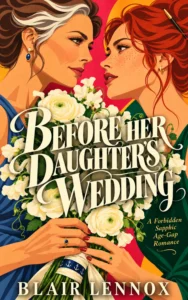
Before Her Daughter’s Wedding
Ten days at her best friend's wedding. One door between their rooms. Twenty-two buttons she sewed knowing she'd be the one to undo them.
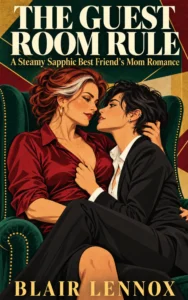
The Guest Room Rule
Six weeks in her best friend's mother's guest room. Five rules chalked inside a chair. Every one of them is about to break.

My Ex-Husband’s Sister Wants Me
Port Sorrel After Dark
The divorce ended her marriage. It did nothing about his sister.
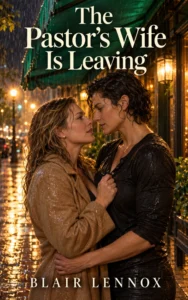
The Pastor’s Wife Is Leaving
She spent nine years watching the bar across the street. Now she lives above it.

My Ex’s Mother After Dark
Her daughter broke my heart. Her mother wants to show me what being chosen feels like.
Never Miss a Release
Get new release alerts, exclusive bonus content, and reader-only giveaways.