
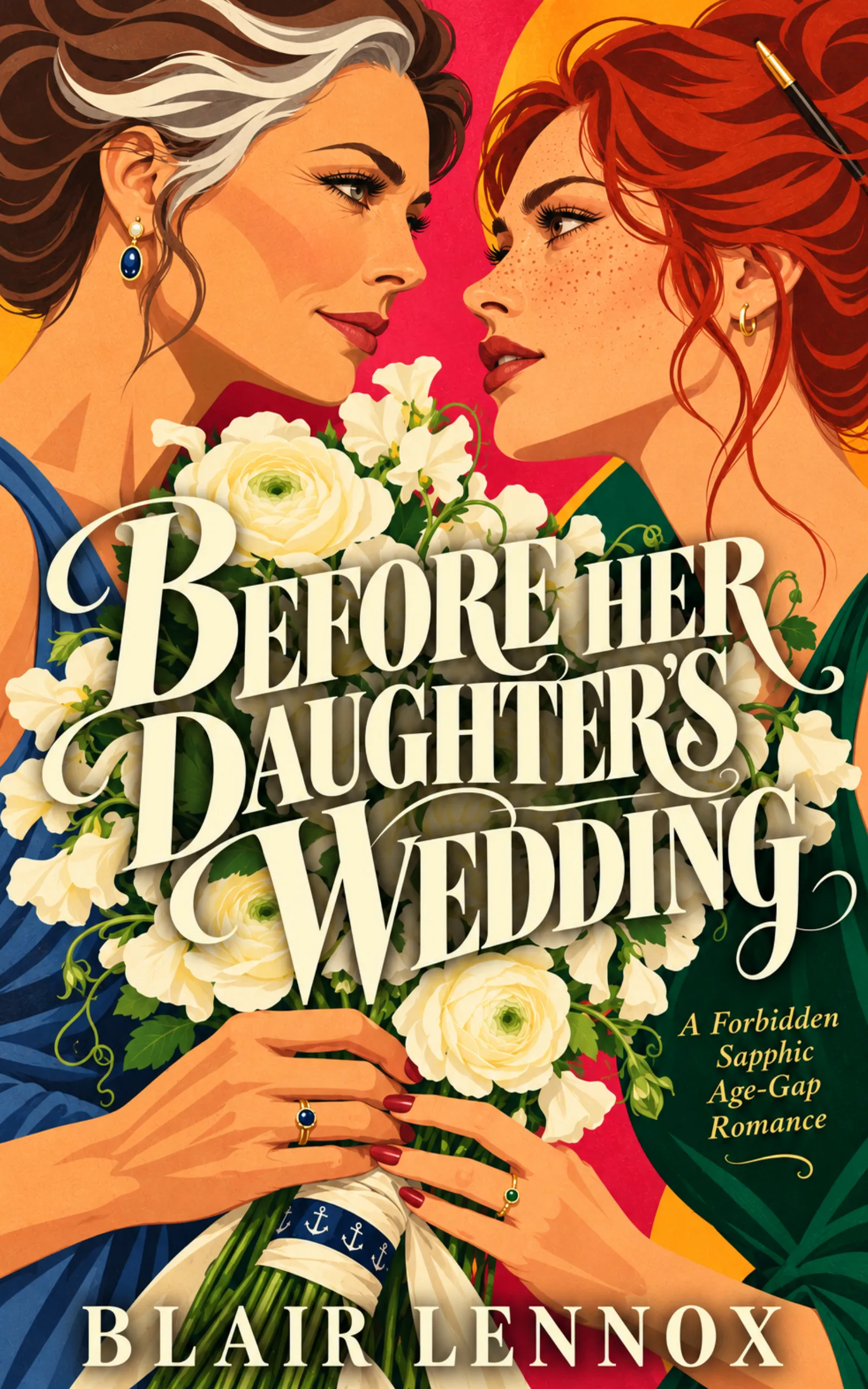
Before Her Daughter’s Wedding
A Sapphic Age-Gap Wedding Romance
by Blair Lennox
Free with Kindle Unlimited
Pairing: FF (Sapphic)
Heat: 🌶️🌶️🌶️🌶️🌶️ Inferno
Tropes: Best Friend’s Mom, Age Gap (22 Years), Destination Wedding, Maid of Honor, Forbidden Romance, Secret Relationship, Connecting Rooms, Rules on a Napkin, Forced Proximity, Older Heroine, Widowed Heroine, First Time with a Woman, Bisexual Heroine, Grief Recovery, Voyeurism, Instruction Kink, Praise Kink, Orgasm Denial, Switch Dynamic, Grovel, Two Homes HEA
Ten days at her best friend’s wedding. One door between their rooms. Twenty-two buttons she sewed knowing she’d be the one to undo them.
Willa Grant is the friend who fixes things.
A twenty-eight-year-old tailor who quit bridal alterations after one too many favors, she arrives at the Lantern House for her best friend’s ten-day seaside wedding with her car keys in her teeth and a stranger’s split bridesmaid dress already over her arm.
Maren Bell is fifty, three years widowed, a hand therapist who handles everything and everyone, and the mother of the bride. Willa finds her barefoot on a bench in the service courtyard, drinking the wedding champagne out of a fishing mug. Maren takes the dress out of her hands and tells her to sit down.
Elise has put her two favorite people in the tower rooms. Nine and Ten. Divided in 1954 by a cream-painted connecting door with a brass bolt on each side.
So they make rules, on a cocktail napkin with a ship’s wheel in the corner. Nothing before the wedding. Pins only. Elise first. When the last sparkler goes out, either of us can walk. And rule three, written on a breakwater at dawn: the door may be open. Nobody crosses.
The door opens on the fourth night.
But a wedding only lasts ten days, and home is a house with a dead man’s coat on the hook, a daughter writing her mother’s dating profile, and one small lie told at a birthday dinner to keep everybody comfortable. The hardest rule was never the door. It was telling the truth full size.
Before Her Daughter’s Wedding is a scorching ~74,000-word sapphic age-gap romance with dual POV, a best friend’s widowed mother, a slow-burn doorway, a dark moment with real consequences, and an HEA guaranteed.
You’ll love this book if you enjoy:
✅ A 28-year-old tailor and her best friend’s 50-year-old widowed mother, one connecting door apart
✅ Ten days at a seaside inn, five rules on a napkin, and a threshold nobody’s allowed to cross
✅ Doorway nights full of watching, instructions, praise, and a first “good girl” neither of them saw coming
✅ A slate-blue silk dress with twenty-two covered buttons that only one woman can undo
✅ A first-time-with-a-woman wedding night, a clawfoot bath, a cutting table and a yellow tape measure
✅ Grief handled with tenderness: a husband’s tie sewn into the bridal bouquet
✅ A secret kept from the bride, a lie that makes it small, and an apology done full size
✅ No cheating, 🌶️🌶️🌶️🌶️🌶️ heat and an HEA guaranteed
⚠️ Content Warning: This novel contains extremely explicit sexual content (graphic FF scenes throughout, including mutual masturbation across a doorway, overheard sex, phone sex in a public restroom, a vibrator, orgasm denial and edging, oral, fingering, a strap-on, light restraint with a tape measure, and risk-of-discovery scenes with family on the other side of a wall), strong language, and alcohol. Also includes grief and the death of a spouse (before the book begins), a significant age gap, a relationship with a best friend’s mother, a secret kept from the bride and its fallout, and family conflict. No cheating. Intended for readers 18+.
📖 Read Chapter One Free
Not sure yet? Read all of Chapter One right here.
Chapter One
WILLA
I had been inside the Lantern House for ninety seconds when a woman I’d never met handed me a dress.
“You’re the seamstress.” Not a question. She had a coral cardigan, the Marsh family jaw, and the confidence of someone who had never once been told no by a stranger. “Elise said you’d be in today. My daughter split this climbing out of the car, can you believe it, and I told her, don’t panic, there’s a professional coming.”
Dusty-rose chiffon over a polyester lining. The side seam had let go from the underarm to the waist. Not torn. The thread had simply quit, the way cheap thread does when a factory sets the stitch long to save eleven seconds a garment. I could see the whole repair before she’d finished her sentence. Ten minutes. A needle, decent thread, an iron.
I still had my duffel on my shoulder. My car keys were in my teeth.
“Sure,” I said, around the keys.
“You’re an angel. No rush. Tonight’s fine.” She patted my arm and sailed off toward a terrace where glasses were clinking and somebody was laughing over the sound of the sea.
So there I stood in the front hall of a dead sea captain’s house, under a brass ship’s lantern the size of a toddler, with a stranger’s bridesmaid dress over my arm, on the first day of the first vacation I’d taken in two years.
I took the keys out of my mouth. “Sure,” I said again, to nobody, to hear how it sounded.
It sounded exactly like me.
“Willa.“
Elise Bell came down the main staircase at a speed the staircase had not been built for, clipboard clamped under one arm, and hit me hard enough that the duffel swung around and clocked us both.
“You’re here. You’re here, you’re early, I love you.” She smelled like sunscreen and the same grapefruit shampoo she’d been buying since we were twenty-three and splitting a two-bedroom with one working radiator. She pulled back, gripped my shoulders, and looked me over the way she looks at a patient chart. “You cut your own bangs.”
“I trimmed.”
“With pinking shears.”
“Fabric shears. I’m not an animal.”
She laughed, and for a second she was just my best friend: sunburned across the nose, twenty-eight, getting married in nine days to a man who had cried during a practice run of the vows. Then her eyes dropped to my arm.
“Why do you have Owen’s cousin’s dress?”
“Her mother gave it to me.”
“Gave it to you.”
“With a mission statement.”
“Oh my God.” Elise shut her eyes. “I told Owen’s aunt you were a tailor as a fun fact. Like, this is Willa, she’s my maid of honor, she once made a prom dress out of a shower curtain on a dare. I did not say bring her your mending.”
“It’s ten minutes.”
“It’s your vacation.”
“It’s a side seam, El. I’ve done them in moving cars.”
She gave me the look. I’d been getting the look for five years, ever since the night I stayed up until four re-hemming a jumpsuit for a girl in our building who never did learn my name. The look said: I see what you’re doing, and I’m too tired to fight you about it today.
Today she really was too tired. Up close I could read it. The clipboard had colored tabs. The tabs had sub-tabs. She had a pencil behind each ear and didn’t seem to know about the second one.
“How bad?” I asked.
“It’s great. Everything’s great. The inn’s great, the florist is great, Owen’s great, his family is—” she flapped a hand at the terrace “—plentiful. Ben got in last night and has said nine words. Aunt Caroline brought a binder. Her own binder, Wills. A rival binder.” She breathed. “Mom’s handling it. Mom’s handling everything. I don’t actually know where she is right now, but wherever it is, it’s handled.”
“And how’s she doing? Actually.”
“Fine.” Elise said it the way you’d say Tuesday. “She’s always fine. Three years of fine. I asked her in June if she was dreading any of this, and she asked me if I’d confirmed the shuttle.” A crease came and went between her eyebrows. “It’s a little like being raised by a very loving lighthouse.”
“And you?”
“I’m great.” Too fast. She heard it, too; her grip shifted on the clipboard. “I keep finding things Dad would’ve had opinions about. The band. The parking. There’s a sign on the harbor road that’s been misspelled since before I was born, and yesterday I stood in front of it for ten minutes like an idiot, because he’d have pulled the car over.” She shook it off the way a dog shakes off water. “I’m not doing this in a hallway. I just need you to be my person this week, Wills. That’s the whole ask. Don’t fix anything. Just be where I can see you.”
“I’m your person.”
“I know.” She squeezed my arm, hard. “That’s how I can say everything’s great with a straight face.”
That was the job, then. Not the hems. Stand where Elise could see me. I could do that. I’d been doing it for five years, and it was the one piece of work I’d never once resented.
I’d met Maren Bell five times. The first was a receiving line, which shouldn’t count; nobody is a person in a receiving line. After that, two Thanksgivings, a birthday brunch, and a moving day. I had her filed under nice. Good cardigans. Better stuffing. The kind of mother who asked what you did for a living and then actually listened to the answer, which, in my experience of mothers, made her a unicorn. But pleasant. Smooth all the way around, like a stone somebody had been carrying in a pocket.
“You’re on the top floor, by the way.” Elise flipped a tab without looking. “Tower rooms. Nine and ten. You and Mom.”
“You put me next to your mother.”
“I put my two favorite people as far from the Marsh cousins as this building physically allows. There’s a turret. You get a turret.” She kissed my cheek, fast and hard. “I put you next to the only other person here who isn’t going to ask me for anything. Dinner’s at seven. It’s casual. Put that dress down.”
Someone called her name from outside in a tone that had a question mark and a catering invoice in it. She went. Halfway across the hall she turned and walked backward, pointing at me with the clipboard.
“Down, Willa.”
“It’s down. It’s so down.”
She disappeared into the light.
I looked at the dress. I looked at the stairs, at the top of which was a turret and a bed and nine days of not being anybody’s emergency.
Then I went to find an iron.
The front desk sent me to housekeeping. Housekeeping was a teenager with a vape pen, who sent me out back: through the kitchen, across the yard, linen room’s on the left, the door sticks.
The service courtyard was the part of the building that told the truth. Flagstones worn into dips. Crates of lemons. A cracked pot of rosemary gone to wood. A line of chef’s whites drying stiff in the salt air, and a kitchen fan breathing garlic over everything. One bench, shoved against the brick in the last warm triangle of sun.
On the bench, a woman with her shoes off.
I didn’t know her at first. That’s the thing I’d turn over later, lying awake. For three full seconds she was just a woman, and I looked at her the way I look at women.
Tan pumps toppled on their sides. Bare feet flat on the warm stone, toes spread, the feet of somebody who’d been standing since dawn and had finally told everyone to go to hell. Linen trousers rolled once at the ankle. A white shirt with the sleeves shoved past the elbow and one more button open than its owner probably knew about. Her head was tipped back against the brick, eyes closed, throat long and bare, and she had a mug resting on her breastbone, rising and falling.
I size people. I can’t help it; it’s like reading billboards. Shoulders a touch broader than that shirt had been cut for. A soft, real waist. A hip that ready-to-wear had been failing for thirty years. Chestnut hair to the collarbone, going silver at the temples in two clean streaks she hadn’t bothered to hide. A pair of reading glasses hung crooked on a beaded chain.
Then she opened her eyes, and they were grey, and she was Elise’s mother.
“If you’re looking for the mother of the bride,” she said, not moving a muscle, “she’s in a meeting.”
Her voice was low. Lower than I remembered. But then I’d only ever heard it say more stuffing?
“Is it a long meeting?”
“It’s scheduled for one mug.” She raised it two inches off her chest. The mug said WORLD’S OKAYEST FISHERMAN. “This is the second.”
“Is that coffee?”
“This is the vintage brut I bought twelve cases of. I’m doing quality control.” She took a considering sip. “It’s fine. It isn’t forty-one dollars a bottle fine. I’ve decided not to know that until October.”
The laugh got out of me before I could dress it up. I had never heard Maren Bell be funny. Standing there, I realized I had never heard her be anything. Pleasant isn’t a personality. It’s a way of leaving the room without getting up.
Her eyes went to my arm. “That isn’t yours.”
“How do you know?”
“It’s pink, it’s polyester, and you’re holding it like it owes you money.”
“It’s a bridesmaid’s. Owen’s cousin. Her mother asked me to—”
“Asked.”
“Handed.”
“Mm. Coral cardigan?”
“Coral cardigan.”
She sat up. It took a moment; she did it like a woman reassembling herself from parts. Then she held out her hand, palm up, and waited. And I gave her the dress. I don’t know why. Nobody takes work out of my hands. I’ve had women twice her size try.
Her fingers crossed the inside of my wrist as she took it. Warm. Dry. Unhurried. Short bare nails, and a plain gold band on the right hand, not the left. I noticed that, and then I noticed myself noticing.
“You’re a guest,” she said. “She can find a tailor in town. There’s one on Water Street, beside the chandlery. I looked it up in April, because I’m a person who looks things up in April.” She folded the dress in thirds and set it at the far end of the bench, well outside my reach, the way you’d slide a wineglass away from a toddler.
“It’s ten minutes.”
“Is it? Or is it ten minutes today, and tomorrow it’s the other five dresses, and by next Saturday there’s a line outside your door and a groomsman at the end of it holding his trousers.”
I opened my mouth. Nothing came out. She had just described the last three weddings I’d attended as a guest, in order.
“Elise told me you quit,” she said.
“I quit brides.”
“And that is?”
“A bridesmaid.” I heard it as it left me. “It’s a loophole.”
The corner of her mouth moved. Not the smile from Thanksgiving. Something smaller, with an edge on it. “You like a loophole.”
“I like a clean exit. I’m just bad at taking one.”
“Evidently. You said yes to that with your hands full, didn’t you.”
“Keys in my teeth, actually.”
That got her. A short breath through the nose, not quite a laugh. And then she looked at me. Properly. From the pencil stabbed through my hair, down the wrinkled shirt and the travel-creased trousers, to my boots, and back up, in no hurry at all. It wasn’t a polite look. It wasn’t a mother’s look. I’d had four hours in a car and my mascara was somewhere near my jaw, and my whole spine straightened anyway.
“Sit down, Willa,” she said. “I’ll find you a mug.”
She walked barefoot through the kitchen door like she held the deed, and came back with a mug that said CAPTAIN and a bottle she fished out from behind the rosemary. She poured. She sat. A foot of bench between us, the sun on our shins.
“To arriving,” she said. “You’ve done it. That’s the entire job today.”
We clinked. The champagne was warm and a little flat and it was the best thing I’d tasted in a month. I watched her throat work when she swallowed. Then I made myself look at the lemons.
“Since you’re here,” she said, “and since you’re a professional, and I’m one and three-quarter mugs in. Would you like to see something funny?”
She hooked a white garment box out from under the bench with her heel. Courier label. Tissue paper. She lifted the lid like a waiter with a cloche.
Blue.
Not a blue. The blue. The blue of a swimming pool on a motel sign. Mouthwash blue. A blue you could see from space.
“Oh,” I said. “Oh, no.”
“I ordered slate.”
“That’s not slate.”
“The website called it Slate Mist. I have the confirmation email. I’ve read it several times today, as a form of prayer.” She stood, shook the thing out, and held it up against herself by the shoulders.
It was meant to be a sheath. Boat neck, three-quarter sleeve, respectable. On her it hung like a sail on a windless day. The shoulder seams stood two inches off her body on either side. The waist seam sat at her hips.
“I ordered a ten,” she said.
“That’s a sixteen.”
“The label says ten.”
“The label’s lying. Labels lie to me for a living.”
She looked down at herself, at the acreage of it, and she started to laugh. Not the short breath this time. A real one, alto, from the stomach, bending her at the waist, and it took me with it. Two women howling in a service yard while a line cook stared at us through the screen door.
“Mother of the bride,” she got out, wiping her eye with the heel of her hand, “will be played tonight by a tarp.”
“A festive tarp.”
“A tarp with sleeves.”
And then it ran out. I watched it go. The laugh kept on in her shoulders a second longer than it stayed in her face, and then she was just standing there holding a bad dress, looking at it.
“I ordered it in March.” Her voice had gone light, and careful. “I measured twice. I thought, there. That’s one thing done. One thing I don’t have to carry around all summer.”
A gull said something rude on the roof. The fan hummed.
“Tom would’ve told me to wear it,” she said. “He’d have said it’s a wedding, not a tribunal. Then he’d have stood next to me all night and dared the room to say one word.” She folded the dress. Sleeves in, sides over. Her hands were very exact. “Well. There’s an outlet mall ninety minutes south. I’ll find something beige and appropriate.”
Beige.
It hit me square in the chest, like an insult. To her, I mean. I’d reached into the box before I decided to, and I had a fistful of skirt.
Poly satin, stiff with sizing to fake a weight it didn’t have. An invisible zipper already rippling. Bust darts aimed an inch too high for any woman who has ever lived.
“It wouldn’t have been right,” I said. “Even in your size. Even in the right blue. This bodice is drafted for somebody with no ribcage, and this”—I rubbed the cloth between my fingers; it squeaked—”doesn’t breathe. You’d have sweated through it by the toasts.”
Her eyebrows went up. “Is that a professional opinion?”
“It’s a free one.”
“In my experience,” she said mildly, “those are the ones that cost you the most.”
She held my eye a beat longer than mild needed.
“Mom?” Elise, from somewhere inside, pitched high. “Mom, the florist’s on the phone and Aunt Caroline wants to know if the boathouse has a projector—”
I watched it happen. It took about four seconds. Maren’s spine lengthened. Her feet found the pumps without her looking down. The glasses were straightened, the hair tucked behind one ear, the extra button done up by a thumb that knew where it was after all. And the woman from the receiving line reassembled herself right in front of me, smooth all the way around, pleasant as a closed door.
“There she is,” she murmured.
I wasn’t sure which of them she meant.
She lidded the box and tucked it under one arm. Then she picked up the pink dress, too. “I’ll see this gets home. With an address.” She nodded at my mug. “Finish that. Then go upstairs and do nothing whatsoever. If anyone hands you anything else, tell them the mother of the bride said no.”
“Does that work?”
“I’ve no idea. I’ve never tried it.”
The screen door clapped behind her.
I stayed on that bench until the sun left it, drinking flat champagne out of a mug that called me CAPTAIN, with the inside of my wrist still lit up where her fingers had been.
I never did find the iron.
Room Nine was the seaward half of the tower. Slanted ceiling, iron bedstead, a window seat, and beyond the glass the whole Atlantic going from pewter to black.
And a door.
Not the hall door. Not the bathroom. A third one, in the wall beside the wardrobe, painted the same cream as the plaster so many times that the panels had gone soft at the edges. It had a brass bolt at chest height. Thrown. A laminated card on the dresser explained, in a jaunty font, that Nine and Ten had been the captain’s private suite until 1954, when the family discreetly divided it.
I’d laid my palm flat on that door before I’d unpacked a sock. I couldn’t tell you why. The paint was cool. I took my hand back.
By half past ten I was lying on top of the covers in the dark with my phone face-down on my stomach. There was an email on it from Lyric Repertory that I’d been not answering for six days, the way you don’t open a bill. Resident cutter. A real title, a real shop, a whole season of real work. All they wanted from me was a number, and I had never in my life named one that didn’t come with an apology stitched into the lining.
At 10:52 it buzzed against my ribs. Elise.
you alive up there
Barely. There’s a turret. I’ve decided I’m a consumptive heiress.
lol. did you see mom at dinner
I’d seen. I’d been at the far end of a table for thirty, wedged between two Marsh cousins and a bread basket, and I’d heard it over all of them.
She laughed, I typed.
like ACTUALLY laughed. at something ben said. i haven’t heard that in forever and then i felt weird that i noticed. forget it. love you. sleep
I wrote She’s got a great laugh, looked at it sitting there in the box, and deleted it one letter at a time. Love you. Sleep, I sent instead, and turned the phone back over, and listened to the sea.
Then I listened to her.
I didn’t mean to. Old buildings give you no choice. Footsteps on the tower stairs, slower than she’d walked all day, the tread of someone who finally isn’t being watched. A key. The door of Ten opening and closing.
One shoe. The other. Water running, and stopping. A drawer. The small bright click of that beaded chain set down on wood.
And humming. Low and absent-minded, a few bars of nothing I knew, but dead on pitch, with a grain in it like good wool. She could sing. Really sing; that was a trained voice idling. It broke off mid-phrase, as if she’d caught herself at it.
Then her footsteps came toward me.
I stopped breathing like a kid playing hide-and-seek. On the other side of that soft cream door there was a slide of metal and a neat, final clack.
Her bolt. Going home.
It wasn’t a statement. It was manners. It was what a decent woman does when there’s a near stranger on the far side of a door. A moment later the bed in Ten creaked, and a line of gold under the door, one I hadn’t even noticed, went out.
My own bolt had been thrown when I walked in. I hadn’t touched it. It occurred to me, lying there, that for about five hours that evening the only thing holding that door shut had been on my side of it.
Two inches of pine. Maybe two and a quarter. I have spent my whole working life knowing exactly how thick things are.
I lay there, and my head did what my head does. It measured her.
Thirty-eight. Thirty-one. Forty-one. Give or take a half inch, and I’d put money on the half inch. A high waist. Those shoulders. A long back. That ridiculous dress had been cut to cover her like a dust sheet over a good chair, and all I could see was what belonged there instead. Blue with grey in it, the true thing, the color the water had been outside my window at six o’clock. Silk with some weight to it, cut on the cross so it would move when she moved. A neckline that showed off her collarbones instead of apologizing for them.
Buttons, maybe. Small covered ones, a long row straight down the spine. The kind a woman can’t do up alone.
Somebody would have to stand behind her. Somebody would have to start at the small of her back and work upward, one loop at a time, knuckles riding the groove of her spine, her hair swept forward over one shoulder to keep it clear. Twenty of them. More. I’d cut the loops tight on purpose, so each one took a second. So she’d have to hold still for me and breathe shallow, and I’d feel every breath through the silk.
And at the end of the night, somebody would have to undo them.
That’s where my body, which had been politely dead from the neck down for most of a year, chose to check in.
It wasn’t a flutter. It was heat, slow and low and specific, and then a hard, unmistakable pulse between my legs, as if somebody had pressed a thumb there. I was wet. In a turret. Over bare feet on a flagstone and a voice telling me to sit down.
Sit down, Willa. Three words. I’d done it before I’d thought about it, and I had not done what I was told since the ninth grade.
I clamped my thighs together and turned my face into the pillow.
No. Absolutely the fuck not. That was Elise’s mother on the other side of that door. Elise, who was asleep two floors below me with a pencil probably still behind her ear, who had put her two favorite people in a tower together precisely because we were the two she never had to worry about.
I kept my hands where they were. Flat on the quilt. Like a good girl.
But I’m a tailor, and I can’t lie to myself about a fitting. I had not wanted to make anything for another human being in eighteen months. I had quit so I would stop being a pair of hands that people passed things to.
I could fix that dress. That wasn’t the problem.
The problem was that I wanted to.
Want to keep reading? The full novel is available now, free with Kindle Unlimited.
🔥 Want an EXCLUSIVE Bonus Chapter?
Fitting Room Three — A scene TOO HOT for the bookstore
February, after hours, in the costume shop at the Lyric. Willa has the keys till ten, a three-way mirror, a cutting table with her name on it, and a red silk dress for Maren’s spring solo. She’s measured a hundred and nine people since January. Tonight Maren takes the tape.
More from Blair Lennox
Browse all Blair Lennox books.

Her Mother’s Type
She took the job to fix her ex's mother's courtyard. She didn't plan on wanting the woman who owned it.

Before Her Daughter’s Wedding
Ten days at her best friend's wedding. One door between their rooms. Twenty-two buttons she sewed knowing she'd be the one to undo them.

The Guest Room Rule
Six weeks in her best friend's mother's guest room. Five rules chalked inside a chair. Every one of them is about to break.

My Ex-Husband’s Sister Wants Me
Port Sorrel After Dark
The divorce ended her marriage. It did nothing about his sister.

The Pastor’s Wife Is Leaving
She spent nine years watching the bar across the street. Now she lives above it.

My Ex’s Mother After Dark
Her daughter broke my heart. Her mother wants to show me what being chosen feels like.
Never Miss a Release
Get new release alerts, exclusive bonus content, and reader-only giveaways.