
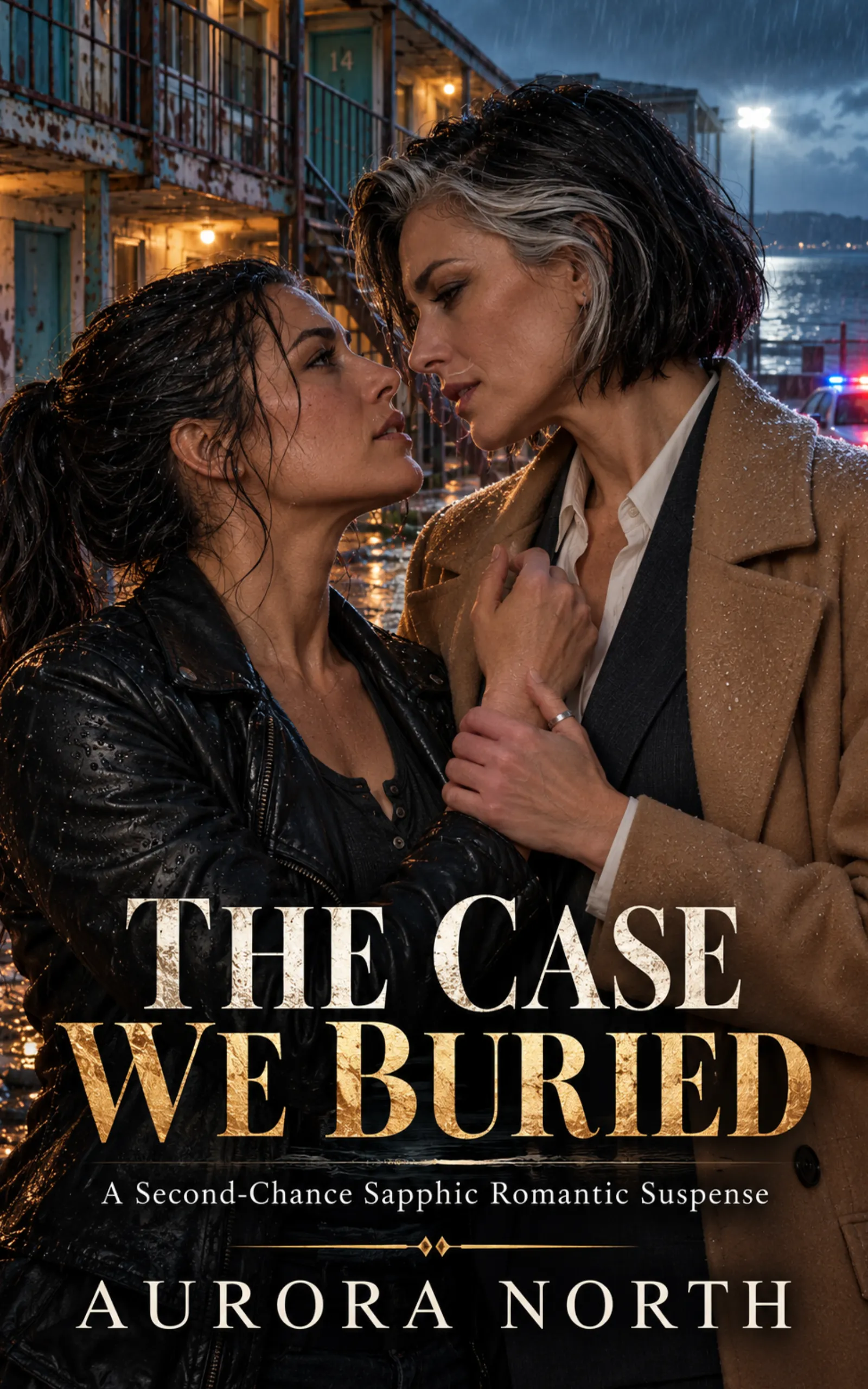
The Case We Buried
Sapphic Second-Chance Romantic Suspense
by Aurora North
Free with Kindle Unlimited
Pairing: FF (Sapphic)
Heat: 🌶️🌶️🌶️🌶️🌶️ Inferno
Tropes: Second Chance, Former Lovers, Age Gap (42/48), Cold Case, Secret Relationship, Forbidden Workplace, Small Town, Enemies to Lovers Again, Hurt/Comfort, Praise Kink
She was forty feet away the night Iris vanished. Twelve years later, the wall comes down.
Twelve years ago, Detective Alex Navarro and State Investigator Helena Ward were secretly in love, until the night their confidential source vanished and took the relationship with her.
Now a demolition crew has opened a wall in a condemned lakeside motel, and Iris Keene never left town at all. She was in the basement. Two floors below the room where Alex stood looking for her.
Assigned to the cold-case review together, Alex and Helena last exactly one drink before they’re tearing each other’s clothes off in the lake house they once planned to buy together. Alex bought it alone. Helena never forgave her for it, or for the way she ended things.
But each of them is hiding what she did the night Iris disappeared. And somebody else has known Alex’s secret for twelve years.
Someone who’s willing to kill again to keep the case buried.
You will love this book if you enjoy:
✅ Second-chance sapphic romance with twelve years of history
✅ A 42-year-old cold-case detective and a 48-year-old state investigator
✅ A murder mystery that actually plays fair, with a killer who knows their secrets
✅ Former lovers who fall back into bed by chapter four
✅ Older heroines whose bodies are hot without apology
✅ Open-door, graphic heat (🌶️🌶️🌶️🌶️🌶️): counters, headboards, strap-ons, filthy talk, praise
✅ Two flawed women telling the truth and paying for it
✅ A lake town, a stray cat named Pickle, and an HEA guaranteed
⚠️ Content Warning: This novel contains explicit sexual content (graphic FF scenes), strong language, and alcohol use. It also includes the murder of a young woman (historical, off-page), the discovery of human remains, gun violence, the death of a witness, police misconduct, prescription-drug crime, grief, and a past family overdose. Intended for readers 18+.
📖 Read Chapter One Free
Not sure yet? Read the full first chapter right here.
Chapter One
ALEX
The Lakeview Motor Lodge was dying the way most things in Harrow Point died, slowly, in public, and about ten years after anyone stopped caring.
Alex Navarro parked her truck behind the demolition company’s flatbed at 6:41 on a Saturday morning and sat for a second with the engine running and the heater blowing lukewarm air onto her knuckles. April on Lake Ontario wasn’t spring. It was winter with a better publicist. The sky over the water was the color of a bruise two days old, and a wind came off the lake hard enough to rattle the chain-link the city had put up around the motel the summer it was condemned.
Half the building was already gone. The north wing, the one that used to face the highway with its sun-faded doors in alternating turquoise and orange, was a heap of cinderblock and rebar and pink insulation that looked obscene in the gray light, like something that had been skinned. The south wing still stood, two stories of exterior walkway and rusted railing, the office at its end with the big plate window long since boarded. The sign was still up on its pole by the road. LAKEVIEW MOTOR LODGE. COLOR TV. WEEKLY RATES. Someone had shot out the O in LODGE years ago, and nobody had ever fixed it.
She knew that sign. She had known it at night, lit up and buzzing, with half its neon dead.
Alex turned off the truck.
Dez Okafor was already at the tape with two coffees, which meant he’d been here long enough to make a coffee run, which meant whatever was in that basement was bad enough that patrol had called the cold-case unit before the medical examiner’s investigator finished his drive in from Oswego. Dez was six-four and built like he’d been designed to stop doors, and he was wearing a Bills beanie with a pom-pom on it, and he held out the coffee the way he did everything, gently, like he was afraid of breaking the cup.
“Morning, sunshine.”
“Is it?”
“Not even a little.” He nodded toward the south wing. “City’s paying weekend overtime to get this lot cleared by May. Excavator operator was taking down the interior wall behind the boiler room to get at the support columns. Hit a void. Block wall around it, maybe four feet by six, built into the corner. He thought it was an old fuel tank enclosure until the bucket came out with a boot on it.”
Alex didn’t drink the coffee. She held it.
“Just a boot?”
“Boot. Some fabric. Zipper.” Dez’s voice dropped the way it did when he was about to say something he didn’t want to have said. “And what’s left inside the boot, Al.”
“Who’s down there?”
“Foreman, one patrol officer who’s been very brave about not throwing up, and Ferris from the ME’s office, who got here eight minutes ago and told everybody to stop touching things in a tone I’d describe as spiritual.” He studied her. “You okay?”
“I’m great.”
“You look like somebody just told you your truck’s been repossessed.”
“My truck’s paid off.” She ducked the tape. “Let’s go look.”
The foreman was a heavyset Swede named Bo Lindqvist with a gray beard and a hard hat with a Harley sticker on it, and he met them at the edge of what used to be the motel’s laundry room, now open to the sky on one side where the building had been sheared away. He kept wiping his palms on his canvas jacket.
“Twenty-six years,” he said, before anyone asked. “Twenty-six years taking buildings down. Raccoons. Snakes, once, in Fulton, a whole nest. A guy’s whole collection of porno tapes in a drop ceiling in Watertown, which, I’ll tell you, that was its own experience.” He swallowed. “Never this.”
“You did the right thing stopping,” Alex said. “Nobody’s going to blame you for any of it.”
“I just want to know if it’s—” He gestured vaguely. “If it’s like an old thing. A historical thing. Like a Native burial or a—”
“It’s a cinderblock wall in a motel basement,” Dez said kindly. “It’s not historical, Bo.”
The stairs down were concrete, cracked, slick with the wet that came through every foundation on this side of the lake. The basement smelled the way basements smell when they have been sealed for a decade and then suddenly torn open: mildew and cold stone and old fuel oil and something under it, faint and sweetish, that Alex’s brain categorized and filed before she let herself think the word.
The excavator had come through the east wall at an angle, and its bucket was still resting where the operator had set it down and run, steel teeth on rubble. Beyond it, behind the dead hulk of the old boiler, the corner of the basement had been closed off with a second wall of block. Neat work. Mortared. Painted the same tired cream as the rest of the room, so that for twelve years it would have looked like nothing at all, just the place where the room ended.
The bucket had bitten a ragged hole in it about three feet up.
Tom Ferris from the ME’s office was on his knees in a Tyvek suit with a flashlight, and he didn’t look up when they came in. “Don’t come closer than the boiler. I mean it. I’ve already got the scene photographed to hell and back, but the anthropologist’s coming from Syracuse and if anybody so much as breathes on that debris pile she’s going to crucify me in a peer-reviewed journal.”
“Wasn’t going to,” Alex said.
“You were going to,” Ferris said. “You’ve got the face.”
She stopped at the boiler.
From here she could see into the hole. Ferris’s flashlight moved across it slowly, and the beam caught what it caught. Fabric, dark and stiff and gone the brownish color everything goes. The edge of a quilted coat. Rubber sole of a second boot, still laced. Something pale and curved and too smooth to be stone.
And a zipper. A long brass zipper running down the coat front, tarnished nearly black. At the top of it, where the pull tab should have been, somebody had threaded a bent paperclip and twisted it closed.
Alex had seen that paperclip before. She had watched it be put there. A girl with chipped black nail polish had done it in the front seat of Alex’s old Impala, swearing under her breath because the original tab had snapped off in February when the coat caught on a dock cleat. Don’t laugh at me, Navarro. I’m resourceful. Put that in your little file.
The basement tilted. Only for a second.
“Detective?” Ferris had looked up. “You see something?”
“No.” It came out normal. That was the worst part. Twenty years on the job and her voice had learned how to lie without consulting her. “Nothing you won’t see better in an hour.”
“We won’t know anything about who this is for a while. Remains in this condition, I’m not going to guess sex or age from where I’m sitting, and I’m sure as hell not going to guess a name.”
“Nobody’s asking you to.”
“Somebody always asks me to.” He went back to the flashlight. “That’s the whole job. Somebody always asks.”
Dez had gone quiet beside her. She could feel him not looking at her, which was how Dez looked at people.
“You know this place,” he said finally.
“Everybody in this city knows this place. Every cop who ever worked nights has pulled somebody out of one of these rooms.”
“That’s not what I mean.”
“I know what you mean.” She turned toward the stairs. “I need air. Get me the building file. Everything code enforcement has on this place, permits, inspections, contractor filings, anything that says who built that wall and when. Call Lieutenant Kessler. Tell him we’re going to want it treated as a homicide scene until somebody gives us a reason not to.”
“Al—”
“Building file, Dez.”
He let her go.
She didn’t go to the air. She went up.
The exterior stairs on the south wing were steel, and they’d rusted through in places so that the treads flexed under her boots and sang a little. The second-floor walkway ran the length of the wing, a long concrete shelf with a railing that wouldn’t have held a child’s weight anymore. The doors were all open or gone. The city had cleared the place out when it was condemned, chased out the last weekly renters, the ones who’d been there so long the motel was the only address on their parole paperwork, and the scrappers had come through after that and taken everything that could be sold. Copper. Light fixtures. The air conditioners out of the wall sleeves, so that each room had a square hole beneath its window where the cold came straight in.
Room 14 was the third door from the end.
Turquoise once. Mostly primer now. The brass numbers were gone, but they’d left their ghost on the paint, a darker 1 and a darker 4 where the sun had never reached.
Alex stood in the doorway and didn’t go in.
It was so much smaller than she remembered. Memory had built this room into something enormous, a cathedral of failure she’d been walking through in her sleep for twelve years. It was a box. Fourteen feet by twelve. Water-stained ceiling tiles, half of them on the floor. The bed frame was still there, a cheap metal rectangle without its mattress. A wall-mounted lamp hung by its wires. The carpet had been pulled up and the concrete under it was the same bruise color as the sky.
At 10:45 p.m. on a Tuesday twelve years ago, she had stood exactly here.
The door had been unlocked. The TV had been on with the sound off, a Sabres replay from back in March on the cable sports channel, the old score frozen in the corner of the screen. The bed was made, but there was a dent on top of the cover where someone had been sitting. On the nightstand: a pink plastic lighter, a pack of Newports with three left, a can of Diet Pepsi going warm and flat with a lipstick mark on the rim. A duffel bag zipped on the luggage rack.
No Iris.
She remembered saying the name into the room. Not loud. Iris? Iris, it’s me. She remembered checking the bathroom, checking behind the shower curtain like an idiot, like a person in a movie. She remembered standing on this walkway and calling Iris’s phone and getting voicemail on the first ring, which meant it was off, which meant nothing, which meant Iris had gotten scared and run, the way people like Iris always got scared and ran. She remembered how relieved she had been to have a reason. How fast she’d built it.
She panicked. She bolted. She’ll call in the morning.
She had walked back down those steel stairs at 10:52. She knew because she’d checked her watch at the bottom and thought, If I go now I can still get some sleep.
And forty feet beneath her boots, behind a boiler, in the dark—
Alex turned away from the door so fast she caught her shoulder on the frame. She went down the stairs with the steel singing under her, past the patrol officer at the tape who said, “Detective?” and past Bo Lindqvist’s truck and behind the big green demolition dumpster at the edge of the lot, where nobody could see, and she braced one hand on its cold, dented side and threw up everything she’d eaten since yesterday.
It wasn’t much. She hadn’t eaten much since yesterday.
When it was done she stayed bent over, breathing, spitting, the wind off the lake drying the sweat on her neck into a chill. Her eyes were running. She told herself it was the heaving. She told herself a lot of things.
You did not get to fall apart. Not here. That was the rule. You did not get to make the dead woman’s night about your feelings. You stood up and you did the work and you fell apart later, in the truck, in the shower, in the kitchen at two in the morning with the lights off and the radio on low. That was how you lasted twenty years. That was how you lasted.
She heard Dez’s boots on the gravel before she saw him.
He came around the dumpster and stopped and looked at her and didn’t say anything for a second. Then he held out a bottle of water.
“Coffee,” Alex said. “Went down wrong.”
“You didn’t drink the coffee.” He kept holding out the water. “You’ve been carrying it around like a little friend this whole time.”
She took the water. Rinsed. Spat. Drank.
Dez leaned against the dumpster next to her, careful not to stand in anything, and stared at the lake, giving her his profile to look at instead of his face. It was a decent profile. His wife, Monique, said it was the only reason she’d married him.
“I’m not asking,” he said.
“Good.”
“I’m just saying. I’ve been your partner four years. I’ve watched you work a baby in a suitcase in Fair Haven and you ate a chicken parm sub right after. You told me it was important to keep your blood sugar up.”
“It is important.”
“Al.”
“It’s a body in a wall, Dez. It’s a bad morning. Can I have a bad morning?”
He let a long breath out through his nose. Then he nodded, once, like he was signing for a package he hadn’t ordered.
“Kessler’s on his way,” he said. “Building file’s coming over from code enforcement. Woman over there named Pam who I think is in love with me came in on her day off and pulled it in four minutes flat. Want the headline?”
“Give me the headline.”
“That corner of the basement was enclosed by permit. Licensed contractor. Inspected and signed off.” He pulled his phone out and squinted at the screen. “Work order says, quote, ‘East utility recess, enclosure for pest remediation per abatement plan, block and finish.’ Contractor’s some outfit called Northshore Environmental Services. Permit was pulled about a month earlier. Work completed and signed—” He scrolled. “April nineteenth, 2017. Twelve years ago.”
April nineteenth.
The pink lighter. The Diet Pepsi with the lipstick on the rim. The TV on mute. April eighteenth, a Tuesday, 10:45 p.m.
“The morning after,” Alex said, before she could stop it.
Dez looked over at her slowly.
“The morning after what?”
The wind off the lake picked up a sheet of torn plastic from the rubble and slapped it against the chain-link, and it stayed there, flapping and snapping like something trying to get out. Alex watched it. She made herself breathe through her nose. In, out. Logistics. When it was bad, you went to logistics.
“Twelve years ago,” she said, “a woman named Iris Keene stayed in a room on the second floor of this motel. Room fourteen. She was a dispatcher at a freight company and she was a confidential source for the medication-diversion task force. She was last seen here on the night of April eighteenth. The next morning she was reported missing. A couple days later somebody saw her get on the Kingston ferry, and the case went from missing to ran, and that’s where it stayed.” She paused. “Until about six-fifteen this morning.”
Dez had stopped leaning on the dumpster.
“You worked that task force.”
“I was the city’s guy on it. One of them.”
“You reported her missing.”
“Yes.”
“So when Kessler asks who knows the most about the case that’s about to be in every paper in central New York—”
“It’s me,” Alex said. “Yeah. It’s me.”
“And when you say a couple days later somebody saw her get on the ferry.” He tilted his head. “Who said it was her?”
She knew the answer to that one too. She knew the exact words. She’d read them in a state police report so many times in the first month that they’d burned into the backs of her eyelids, block capitals, stamped with that awful certainty. CONFIRMED SIGHTING. She knew whose initials were at the bottom.
“The state,” she said. “State investigator. It was a joint operation.”
“Huh.” Dez folded his arms. “So the state’s going to want in.”
“The state’s going to want in.”
Her phone buzzed in her jacket. Lieutenant Ray Kessler. She answered it standing behind a dumpster, with the taste of bile still in her mouth, and she sounded like a professional, because she was one.
“Navarro.”
“I’m two minutes out.” Kessler had a voice like a gravel driveway and a habit of starting every conversation in the middle. “Okafor give you the permit thing?”
“He did.”
“Okay. So listen. I already had the chief on the phone and the chief already had Albany on the phone, because God forbid anything in this city happen on a weekend without three people above me knowing about it first. Your missing girl—”
“Nobody knows it’s her, Lieutenant. Ferris won’t even guess the sex.”
“Fine. Your hypothetical missing girl was a source on a joint operation, which means half her file’s sitting in a state police building in Syracuse, which means the state’s not letting us touch this alone. They’re standing up a joint historical review. They want somebody from their side who worked the original task force. You’re ours.”
“I figured.”
“They’re sending someone today. Should already be on the road. I’ll have a captain from the state over the whole thing, somebody with no connection to the old case, so nobody can say it’s the same people grading their own homework. That’s the deal.”
Alex closed her eyes.
There had been eleven state investigators attached to that task force at one time or another. Most of them would be retired by now. Two were dead. One had gone to the FBI and one had gone to prison, for something unrelated involving his ex-wife’s boat. Some of them had moved on, moved up, moved away.
Some of them had not.
“Who,” she said. “Who are they sending?”
“Didn’t say. Somebody senior. Somebody who knows where the bodies are buried, apparently.” He snorted. “Sorry. Poor choice of words. One minute out. Don’t let anybody leave.”
He hung up.
Alex stood with the phone against her ear for a second after the line went dead, listening to nothing.
Somebody senior.
She thought about a hand. That was the stupid, unbidden thing her brain served up, out of everything: not a face, a hand. Long fingers, square nails always cut short, a narrow silver ring on the right thumb that Alex had bought at a craft fair in Clayton for eighteen dollars because the woman selling it said it was supposed to bring clarity. That hand on the back of her neck in a dark car, holding her still. That hand spread on her stomach in the morning, the thumb moving in slow circles under her navel, lazy and proprietary, while a low voice said against her shoulder, We have time. Stay. We have time.
They hadn’t had time. It turned out that was the one thing they hadn’t had.
She put the phone away.
“Al,” Dez said. “You’ve got a look again.”
“Different look?”
“Worse look.” He considered it. “Kind of a look like a woman who’s about to see her ex at a wedding.”
“That’s a very specific look.”
“I’ve got three sisters. I’ve seen it at a lot of weddings.”
She laughed. It hurt, a little, in the raw place in her throat. “Go meet Kessler. I’ll be right behind you.”
He went. She stayed behind the dumpster one more minute, rinsed her mouth again, and wiped her face with the heel of her hand and then, for good measure, with the inside of her jacket collar. She retied her hair. Dark, thick, a long tail she’d been threatening to cut for a decade. She’d let it grow because someone used to like to pull it.
That was over. That had been over for eleven years.
She came out from behind the dumpster into the wind.
Kessler’s Charger was pulling into the lot, and the ME’s van was finally coming down the highway behind it, slow, the way the ME’s van always came, like a hearse that had all the time in the world. Patrol was moving the tape back another twenty feet. Bo Lindqvist was on the phone, gesturing, probably explaining to his wife or his boss or his priest that he’d found a dead woman in a wall. Above them the motel stood with its doors open to the cold, room after empty room, the sign on its pole by the road missing its O.
And behind Kessler’s car, turning in off the highway with the deliberate, unhurried, maddening precision of someone who had never once in her life been late for anything, came a gray state-issue Ford Explorer.
It parked at the edge of the lot. Alongside the chain-link. Perfectly square to the fence.
Of course it did.
Alex stopped walking.
The driver’s door opened. A boot first, black leather, low heel, polished. Then a long leg in charcoal wool trousers. Then the rest of her, unfolding out of the car the way she’d always unfolded out of everything, like a sentence that knew exactly where its period was. Tall. Taller than Alex remembered, or else Alex was smaller now, folded down by eleven years. A camel overcoat, tailored close, belted. A leather folio under one arm. Her hair was shorter than it used to be, chin-length and blunt, and it was still dark, but at the temples it had gone silver, two clean wings of it swept back from her face, and she had not dyed it.
She had not dyed it. Alex didn’t know why that, out of everything, was the thing that knocked the air out of her.
Helena Ward shut the car door and turned, and the wind off the lake caught the edge of her coat and pushed it back, and she didn’t reach to hold it. She looked across the lot. Past Kessler getting out of his Charger with his hand already raised in greeting. Past the ME’s van. Past the patrol officer and the foreman and the tape. Straight across sixty feet of wet gravel and wreckage and twelve years, to where Alex was standing with bile in her throat and her hair half wet and her hands, she realized, curled into fists at her sides.
Helena’s face didn’t change. Not one muscle. She’d always been able to do that.
But she looked. She held it. One second. Two. Three.
Like she had known exactly where Alex would be standing.
Like eleven years hadn’t happened at all.
Want to keep reading? The full novel is available now, free with Kindle Unlimited.
🔥 Want an EXCLUSIVE Bonus Chapter?
Housewarming — A scene TOO HOT for Amazon
Their first night in the brick house on Fourth Street. No curtains, no bed frame, one clawfoot tub, and a pair of handcuffs Alex has been carrying for twenty years. Helena’s side of the night Alex finally hands her the key. It runs hotter than anything in the book, and it’s only available here.
More from Aurora North
Browse all Aurora North books.

Wingwoman Down
She asked her best friend for dating lessons. Every lesson proved the men were never the point.
Hands Off My Workbench
She builds things to last. She builds things to fool you. Neither of them is faking this.

The Away Game
She's never stayed anywhere longer than a season. The mechanic isn't going anywhere.

The Woman in the Main House
She owns the house. She doesn't own me. That's exactly the problem.
The Night Shift Agreement
Nothing at the plant. Nobody knows. Off the clock, ask for what you want.

Straight Sets
In tennis, love means nothing. Alison Hale is about to find out it means everything.
Never Miss a Release
Get new release alerts, exclusive bonus content, and reader-only giveaways.