
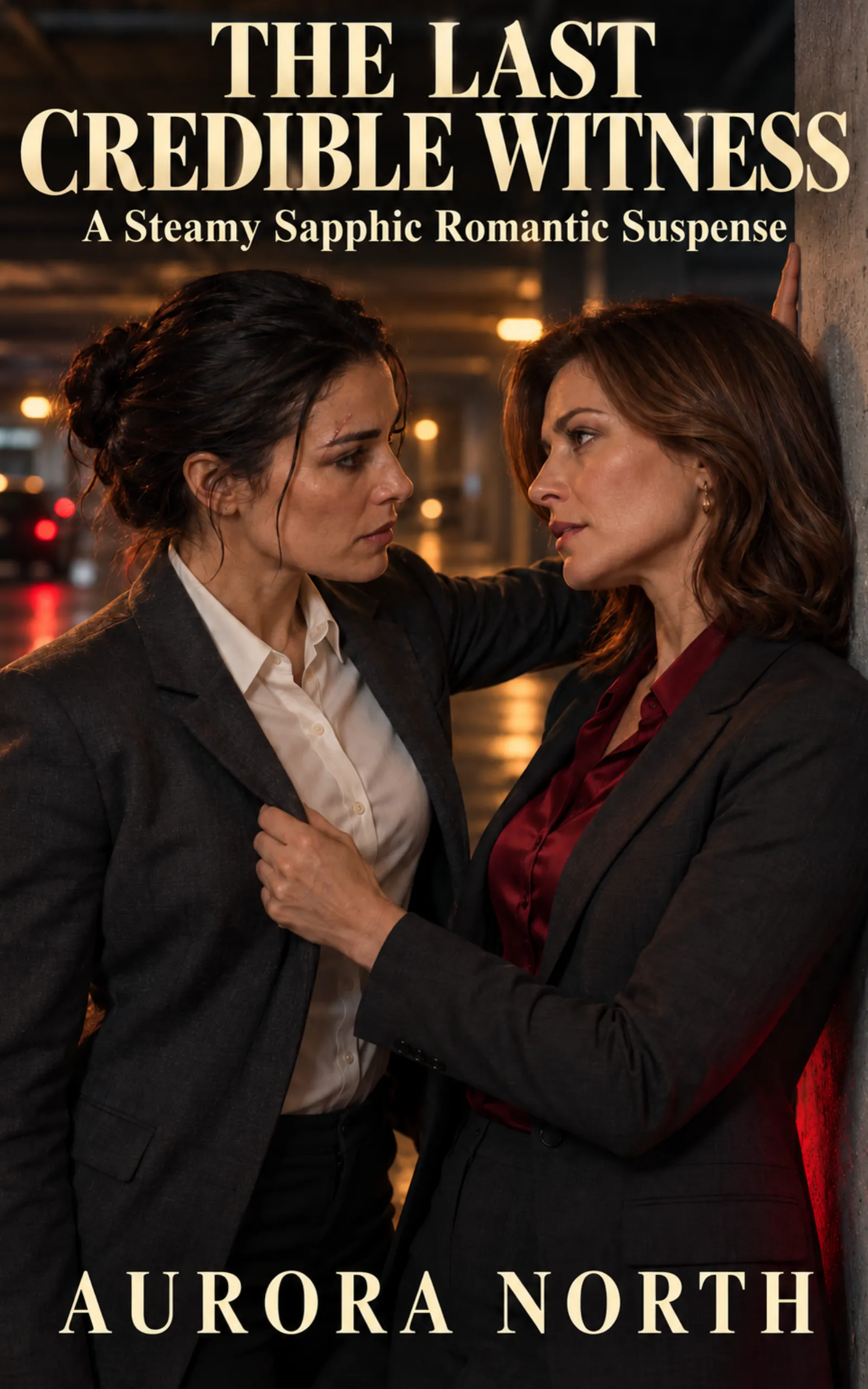
The Last Credible Witness
A Sapphic Enemies-to-Lovers Romantic Suspense
by Aurora North
Shop the ebook · Shop the audiobook
Available at all major retailers
Pairing: FF (Sapphic)
Heat: 🌶️🌶️🌶️🌶️🌶️ Inferno
Tropes: Enemies to Lovers, Detective × Defense Attorney, Forbidden Romance, Secret Relationship, Professional Boundaries, Cop Romance, Lawyer Romance, Wrongful Conviction, Mentor Betrayal, Competence Kink, Light Bondage, Safe Word, Hurt/Comfort, Scar Worship, Older Heroines, Romantic Suspense
Eight years ago she tore my testimony apart. Now she’s my witness, and the one woman I can’t touch.
Eight years ago, homicide detective Rachel Dean sat on a witness stand for two days while defense attorney Laura Bennett took her case apart one patient question at a time. Rachel won anyway. Daniel Ortiz went to prison. And in a courthouse corridor afterward, Laura told her: You’re going to have to live with this.
Rachel said: I already do.
Now a court interpreter is dead on the floor of her office, strangled after a meeting with someone she trusted. Her last text says call Laura Bennett, tell her it’s about Ortiz. Laura’s investigator has vanished. His car turns up by the river with a seat full of his blood. And someone breaks into Laura’s office in the middle of the night to steal one box: the Ortiz trial file.
Laura is a witness. Rachel is the lead detective. They can’t be alone in a room together, and they keep ending up in one. A parking garage. A filing cabinet at one in the morning. Laura’s front door, in a wine-red silk robe with nothing under it.
So they make rules. No case talk in bed. Nobody knows. Nothing traded. And if either of them wants out, she says it to the other one’s face.
Then the trail leads to the man who taught Rachel everything she knows about police work, and someone starts taking pictures through Laura’s office window. The rules were never going to hold.
The Last Credible Witness is a high-heat, standalone sapphic enemies-to-lovers romantic suspense with dual POV, a killer to catch, a wrongful conviction to undo and an HEA guaranteed. Explicit content. 18+.
You’ll love this book if you enjoy:
✅ A detective and the defense attorney who lost to her, eight years after the verdict
✅ Forbidden, secret, and completely against every rule either of them has ever kept
✅ A buttoned-up cop who labels her pantry and a lawyer who narrates everything in bed
✅ Desk sex, a filing cabinet, a skylit iron bed, and cuffs with a safe word of Objection
✅ A murdered interpreter, a missing investigator, and a mentor with something to hide
✅ A woman who has never once asked for what she wants, finally learning to say it out loud
✅ Cheerios, a hair tie, and the word Okay meaning more every time it’s said
✅ No cheating, 🌶️🌶️🌶️🌶️🌶️ heat and an HEA guaranteed
⚠️ Content Warning: This novel contains extremely explicit sexual content (graphic FF scenes throughout, including oral, fingering, masturbation, desk sex, handcuffs and light bondage with a safe word, a strap-on, edging, and consensual hand-on-throat), strong language, and alcohol. Also includes on-page aftermath of a murder by strangulation, the abduction and captivity of a secondary character, blackmail using an intimate photograph taken without consent, threats against a police officer, a wrongful conviction, workplace discipline, injury during an arrest, vomiting and grief. No cheating between the leads. Intended for readers 18+.
📖 Read Chapter One Free
Not sure yet? Read all of Chapter One right here.
Chapter One: Rachel
The bakery had been closed for three years, and the building still smelled like bread.
Rachel Dean noticed it on the stairs — yeast and burnt sugar soaked so deep into the plaster that no amount of empty could get it out — and she knew it was the wrong smell for what was waiting at the top. A body after a night in a closed room had its own smell. Up here the bread was still winning. Barely.
“Watch the fourth step,” the patrol officer said behind her. “It’s soft.”
“Thanks.” She stepped over it. Ten past six on a Tuesday in late October, the sky over Canal Street the color of dishwater, and her coffee was already gone because she’d drunk it in the car like it owed her money. Her hair was pinned. Her sleeves were rolled. Her stomach was doing the thing it did at the start, the quiet clench that meant pay attention, this is the part you can’t get back.
The door at the top said RUIZ TRANSLATION & INTERPRETING in gold vinyl letters, the R peeling at one corner. No pry marks on the frame. No splintering at the strike plate. The deadbolt was thrown open, not broken. Somebody had been let in, or somebody had a key.
“Who made entry?”
“Me and Kowalski. Welfare check, five fifty-two. Daughter called it in. Door was unlocked, lights on.” The officer was young, very pale, holding it together with his jaw. “We didn’t touch anything except her pulse. Wrist. There wasn’t one.”
“Okay.” Rachel pulled on gloves. “You did fine. Go stand at the bottom of the stairs and don’t let anyone up who isn’t me, my partner, or the ME.”
He went gratefully.
The office was one long room under a pressed-tin ceiling, two windows onto Canal, a radiator ticking like it was keeping time. Filing cabinets along one wall, the old-fashioned steel kind. A desk under the windows with a green-shaded lamp still burning. A kettle on a hot plate, unplugged. A little round table with two chairs and a box of tissues on it — the place clients sat when the words they needed translating were the worst words of their lives.
Elena Ruiz was on the floor between the desk and the table.
She lay on her side, one arm folded under her, the other reaching toward nothing. Late forties. Dark hair with a streak of gray she hadn’t bothered to hide, cut blunt at the jaw. Navy cardigan, black slacks, low heels, one of them off. Reading glasses on a beaded chain, the lenses cracked. There was blood at her hairline, dried to rust, a small tacky halo on the floorboards under her temple. Not much. Head wounds bled like hell when the heart was still pumping. This one hadn’t bled for long.
Rachel crouched, careful of where she put her feet, and looked at the throat.
The bruising was there. Mottled, purple-black, the shape of thumbs. Petechiae speckling the whites of the half-open eyes like pepper.
Hit her first. Then finished it with his hands.
She didn’t let herself think his yet. She let herself think it anyway.
“Morning.” Priya Shah came through the door with two coffees in a cardboard carrier and set them on the landing outside without crossing the threshold, which was why Rachel loved her. Five-four, black hair in a braid down her back, a camel-hair scarf her wife had knitted wound twice around her throat. She took in the room in one pass and her mouth tightened. “Oh. Oh, that’s Elena.”
Rachel looked up. “You knew her?”
“Everybody knew her. She did the Hernandez arraignment for us last spring. She corrected the judge’s Spanish. On the record.” Priya pulled on gloves. “She was funny. Dry. You’d have liked her.”
Rachel had met her. She knew that the way you knew a song you’d heard once in a grocery store — the face was familiar, the context gone. Courthouse hallways. A woman with a legal pad and a pencil behind her ear. She turned it over and couldn’t get it to land.
“Purse is on the chair,” Priya said. “Wallet’s in it. Cash. Two cards. Phone?”
“Not that I’ve seen.”
“Laptop?”
Rachel stood and went to the desk. The lamp. A cup of pencils, every one sharpened to the same lethal point. A legal pad, blank. A laptop charger plugged into the power strip, its cord running across the blotter and ending in nothing — the magnetic tip lying there like a severed finger.
“Gone,” she said. “He unplugged it and took it and left four hundred dollars of phone charger and her wallet.”
“So not a robbery.”
“So not a robbery.”
Priya was at the little table. “Two chairs pulled out. She had somebody sitting with her.” She leaned closer to the hot plate without touching it. “Kettle’s been used. One mug in the drying rack, rinsed. One in the sink, not.”
Rachel came and looked. The mug in the sink had a skin of cold tea in the bottom and a faint coral print of lipstick on the rim. Elena’s. The one in the rack was clean, upside down on a dish towel, a drop of water still clinging to the handle where it had pooled overnight.
“He washed his cup,” Rachel said.
“After he killed her.”
“Or before. While she was still alive and thought this was a meeting.” She pressed her thumb to the scar through her left eyebrow, an old habit, the ridge of it a comfort under the pad of her finger. “Either way he’s careful. And he had time.”
“Careful people still miss things.”
“That’s the hope.”
They worked the room the slow way, the only way Rachel knew how to work anything — inch by inch, no theories, just inventory. The filing cabinets were locked and looked untouched. The windows were latched. The trash can held a yogurt cup and a crumpled parking receipt from the courthouse garage, yesterday, 4:47 p.m. Elena had been at work and then she had come back here to meet someone and then she had died on her own floor with her shoe off.
The appointment book was under the desk.
It had slid there or been kicked there — a fat spiral planner with a black leather cover gone soft as skin at the corners, half under the radiator, where a man in a hurry, a man who’d already found the thing he came for, might not look.
Rachel got down on her stomach and photographed it in place before she touched it. Then she drew it out with two fingers by the spine.
Elena’s handwriting was small and upright and very neat, the handwriting of a woman who’d spent her life making sure nobody could ever say they’d misunderstood her. Arraignments. Depositions. Fam. Court — Morales — 9:30. Dr. Kim — med interp — bring glossary. Each entry in blue ink, a few in pencil, a handful crossed through with one clean line.
“T.W.,” Rachel read aloud. “Eleven days ago. ‘T.W., 6 p.m.’ Then eight days ago. Then four.” She turned the page. “No place listed. Just initials.”
Priya came and read over her shoulder. “Client?”
“She writes out her clients. ‘Morales.’ ‘Dr. Kim.’ These are the only initials on the page.” Rachel turned to yesterday. Monday. The courthouse in the morning, a deposition at two. And then, at the bottom of the day, in pencil, pressed hard enough to dent the paper:
M.H. — originals, 8pm.
“Originals,” Priya said. “Original what?”
“Documents. Recordings. Statements.” Rachel stared at the two letters. Something moved in her, small and cold, and she didn’t look at it. “Whatever it was, she wanted them badly enough to meet a man after dark in an empty building.”
“You don’t know it was a man.”
Rachel looked at the bruises on Elena Ruiz’s throat, the span of them.
“No,” she said. “I don’t.”
She kept turning, backward this time, through the last two weeks, and that was how she found it — not in an entry but in the margin, beside a Thursday, written sideways up the edge of the page in the same small hand. Five words. Underlined twice, the second line harder than the first, gouged deep enough to tear.
I’d know that walk anywhere.
Rachel read it. Then read it again.
It itched. That was the only word for it. Like a name on the tip of your tongue, like a face across a room you couldn’t place. She knew those words. She knew them from somewhere that mattered.
“What’s that?” Priya said.
“I don’t know.” True. Not true. She photographed the page and bagged the book. “Something she heard. Or something she wanted to remember.”
“You’ve got a look.”
“I don’t have a look.”
“You have the look you get when you’ve lost your keys and you know they’re in your hand.”
“Go find me the daughter,” Rachel said, and Priya, who’d known her six years and had never once been fooled by her, went.
Isabel Ruiz was twenty-five and wearing navy scrubs under a parka two sizes too big, and she was sitting on the bumper of the second patrol car with her hands clamped between her knees so hard her knuckles had gone white.
She looked like her mother. Rachel saw it from twenty feet off, the jaw and the dark straight brows, and she felt it go into her the way it always did with family, the bruise you had to carry around all day and couldn’t press on.
“Ms. Ruiz. I’m Detective Dean. I’m very sorry.”
Isabel looked up. Her eyes were dry and furious. “Is she — they wouldn’t let me up. Is she in there? Is she still just lying there?”
“She’s being taken care of. The medical examiner’s people are with her now. I won’t let anyone be careless with her.” Rachel crouched so they were level. “I need to ask you some questions. You can stop whenever you want.”
“I’m a nursing student.” Isabel said it like an accusation. “I’ve been on nights at Mercy. Clinicals. They make us lock our phones up.” Her breath hitched and she forced it level. “I got out at five-thirty and I had this.”
She held out her phone.
The text was from MAMÁ, sent at 7:52 p.m. the night before.
If I don’t call you by ten, call Laura Bennett. Tell her it’s about Ortiz. Te quiero, mija. Don’t worry. I’m being careful.
Rachel read it once.
The street noise went away. The radio chatter, the idling engines, the gulls working the river two blocks over — all of it went flat and distant, like someone had closed a door on it. What was left was her own pulse in her ears and one word on a cracked phone screen.
Ortiz.
Eight years. Eight years and she could still see the courtroom. Daniel Ortiz at the defense table in a borrowed suit, very still, his hands folded. The jury filing out. The foreman’s voice. And afterward, in the corridor with the bad fluorescent lights, a woman in a charcoal suit stopping in front of her, reading glasses in one hand, saying very quietly, You’re going to have to live with this.
And Rachel saying, I already do.
She handed the phone back. Her hand was steady. She’d made sure of that.
“Do you know what your mother meant? About Ortiz?”
“No. Some old case. She’d been — weird. The last couple weeks. Up late. Pulling boxes out of the closet at home. I asked and she said it was work and she’d tell me when she could.” Isabel’s voice cracked straight down the middle. “She said she was being careful.“
“Did she mention anyone she was meeting? Initials T.W. or M.H.?”
Isabel shook her head.
“Did she ever talk about a Tom? A man named Tom?”
That came out of Rachel before she’d decided to say it. Something in the back of her brain, connecting dots she didn’t have yet. Isabel just looked at her blankly. “I don’t know. She knew a million people. Lawyers. Cops. Judges.” Her mouth twisted. “She used to say interpreters are furniture. Everyone talks in front of the furniture.”
“Did you call Laura Bennett?”
“At five-thirty-five. She answered on the second ring. She told me don’t go up there alone, call 911 and ask for a welfare check, and she’d come.” Isabel looked past Rachel’s shoulder toward the end of the block, and something in her face eased a fraction. “She came.”
Rachel didn’t turn around right away.
She took the rest of it — the address, the phone, the father in Rochester who hadn’t been in the picture since Isabel was nine, the aunt who’d come and sit with her. She gave Isabel her card and told her someone from victim services would call by noon and that they’d be careful with her mother. She meant every word of it, and she said it in the voice she’d learned for this, low and level, the voice that said I am a wall you can lean on.
Then she stood up and turned around, and there she was.
Laura Bennett was standing at the tape.
She stood exactly at it, the yellow line two inches from her coat, the way someone who knew precisely where a line was and had decided precisely how close she would come to it would stand. Camel coat belted at the waist. Under it, the cuffs of what were very clearly pajama pants — dove-gray, soft, absurd — over leather ankle boots she’d shoved on without socks. Chestnut hair loose to her shoulders and still kinked from the pillow. No makeup. Reading glasses folded in one hand.
She looked like she’d rolled out of bed and into a war, and she looked completely, infuriatingly composed.
Eight years. They’d passed in hallways. They’d been in the same elevator once, for nine floors, in total silence. Rachel had sat in the back of a courtroom once on an unrelated case and watched Laura gut a state trooper on cross so cleanly he’d thanked her when she was done. She had never once been closer to her than ten feet.
She walked over. Laura watched her come the whole way.
“Counselor.”
“Detective Dean.” Laura’s voice was low and a little rough with early morning. “It’s been a while.”
“You can’t be here.”
“I’m on a public sidewalk, on the far side of your tape, and I haven’t touched anything. I’m fairly sure I can be here.” The hazel eyes moved past Rachel’s shoulder to the second-floor windows, to the lamp still burning in one of them, and something went across her face very fast and was gone. “Is it Elena?”
Rachel didn’t answer.
“Isabel called me,” Laura said. “I told her to call it in. I told her not to go up. I’d like to know if I was right to.”
“You were right to.”
Laura’s throat moved. She didn’t look away from the window. “How?”
“I can’t tell you that.”
“Of course you can’t.” She said it without heat. She looked back at Rachel and the heat came in anyway, banked and steady. “Then let’s be efficient. You want to know why a dead woman told her daughter to call me. I’d like to know too.”
“Start with what you know.”
“I know Elena Ruiz. I’ve known her eleven years. She’s interpreted for my clients more times than I can count. She has a better ear than any lawyer in that courthouse, mine included, and a worse temper.” Present tense. Laura heard herself do it and didn’t correct it. “I saw her last two weeks ago. She came by my office. We had coffee. That’s what I personally know.”
“What did you talk about?”
“Personally?” Laura tilted her head. “Her daughter’s clinicals. My terrible taste in espresso machines.”
“Ms. Bennett.”
“Detective.” Light, cool, precise. A blade laid flat on a table. “I’m going to give you a formal statement, today, on the record, with whoever you assign to take it. I’ll give you everything I have that’s mine to give. What I’m not going to do is stand on a sidewalk in my pajamas and start speculating to a homicide detective, because I’ve spent twenty years watching what happens to people who do that.”
“I’m not trying to trap you.”
“I didn’t say you were.” A pause, almost gentle. “I said I’ve watched what happens.”
Rachel’s jaw tightened. The wind came off the river and lifted a strand of Laura’s hair across her mouth, and Laura hooked it away with one finger, and Rachel watched her do it and hated that she watched.
It was a good mouth. It had always been a good mouth. That was the problem. For two days, eight years ago, she had sat on a witness stand and watched that mouth take her testimony apart, piece by piece, question by patient question — And you didn’t think to ask, Detective? You didn’t think it relevant? — and some low, traitor part of her had noticed the shape of it the whole time. The full lower lip. The way it went very slightly crooked when Laura was about to land something.
It was doing that now.
“T.W.,” Rachel said. “M.H. Do those mean anything to you?”
Laura’s face didn’t change. Laura’s face, Rachel thought, could hold perfectly still through a bomb. But her fingers tightened on the folded glasses.
“I’m not going to guess at initials for you.”
“I didn’t ask you to guess.”
“You asked if they meant anything. Lots of things mean something. I’m not going to hand you a name off two letters and have it end up in an affidavit.” Laura’s eyes held hers. “Ask me again when you’ve got more than two letters.”
“Does the name Ortiz mean anything to you?”
That landed.
It didn’t show on Laura’s face. It showed in the half-second before she answered, the way her breath stopped and then started again, deliberate, like she was choosing to keep doing it.
“You know it does,” she said quietly.
“She texted her daughter at seven fifty-two last night. ‘Call Laura Bennett. Tell her it’s about Ortiz.'” Rachel watched her. “So tell me. What’s it about?”
“I don’t know.”
“You don’t know, or you won’t say?”
“I don’t know, Rachel.” It cracked out of her — the first time in eight years she’d used Rachel’s first name, and it went through Rachel like a hand on the back of her neck. Laura heard it too. She closed her eyes for exactly one second and opened them again, and the composure was back, but it had cost something to put it there. “I don’t know. I wish to God I did. She asked me about the Ortiz case two weeks ago and I thought — it was an anniversary thing. Elena worked that trial. She sat beside Daniel’s mother every single day.”
“I remember.”
“Do you?” Laura looked at her. “She interpreted every word. The opening. The medical examiner. You. Two days of you. She sat there and turned it into Spanish for a woman watching her son go to prison.” A beat. “She used to say you never looked at her. Not once. Not at Elena, not at Mrs. Ortiz. You looked at the jury and you looked at me.”
Rachel felt that somewhere under her sternum. “I was testifying.”
“I know what you were doing.”
“I was telling the truth.”
“I know you believed that.”
They stared at each other across a strip of yellow plastic, the wind going through it, the radiator of some idling patrol car ticking in the cold.
You’re going to have to live with this.
I already do.
“I think you should go home, Ms. Bennett,” Rachel said.
“I think you should stop calling me Ms. Bennett like you’re reading it off a docket. You know my name. You just used it.” Laura lifted her chin. “And I’m not going home. I’m going to wait for Isabel’s aunt so that girl doesn’t sit alone on the back of a police car, and then I’m going to go to my office and shower and put on a suit, and at whatever time your partner calls me, I’ll be there.”
“Detective Shah.”
“Priya Shah.” Laura nodded once, and something like approval moved across her face. “Good. She’s fair. Don’t let me take your statement — isn’t that the rule? You can’t interview me.”
Rachel hadn’t thought that far yet. She thought it now, fast: Laura Bennett, the attorney who’d lost People v. Ortiz, named in a murder victim’s last text; Rachel Dean, the detective who’d won it.
“It’s not a rule,” she said. “It’s sense.”
“Look at you.” The mouth went crooked. “Being sensible.”
“Somebody has to be.”
“You’ve been sensible for eight years. How’s that working?”
Rachel stepped closer. She didn’t decide to. Her body did it, the way it did on a street when someone mouthed off and she wanted them to feel exactly how much bigger the moment had just gotten. She was taller by two inches and broader by more than that and she stopped close enough to see the faint pillow crease still printed on Laura’s left cheek, the gold flecks in the hazel, the pulse in her throat above the collar of the coat.
Laura didn’t step back. Laura didn’t even blink. She tipped her head up, the smallest degree, and held it there.
Up close she smelled like sleep and some soap with bergamot in it.
“Something you want to say to me, Detective?” Laura murmured.
A lot of things. None of them about the case.
“Don’t leave town,” Rachel said.
Laura laughed. It was low and startled and genuinely amused, and it was the worst thing that had happened to Rachel all morning, because she liked it.
“I’m not a suspect, and you know I’m not, and that is the most cop thing anyone has ever said to me.” Laura unfolded her glasses and slid them on, and over the top of them her eyes were bright and dry and grieving and entirely, dangerously focused. “I’ll see you at the station.”
“You won’t see me. You’ll see Priya.”
“Then I’ll see you through the glass.” She turned to go toward Isabel, and stopped, and looked back over her shoulder. “Rachel.”
Twice now. Twice in ten minutes.
“What.”
“She was a good woman. She was careful and she was good and she kept her word. Whoever did this to her —” Laura’s voice did not break. It thinned to a wire and held. “Find him. I don’t care what else it costs. Find him.”
She walked away. She went to the patrol car and sat down on the cold bumper next to Isabel Ruiz in her dove-gray pajama pants without a word, and put an arm around the girl’s shoulders, and Isabel folded into her like her strings had been cut.
Rachel stood at the tape and watched them and made herself breathe.
I’d know that walk anywhere.
It was still itching. Worse now.
Priya came down the stairs at seven forty with her phone in her hand and her face set in the expression she wore when she’d found something she didn’t like.
“ME’s investigator puts it between seven and ten last night. Probably closer to eight. Blunt force to the left temple, then manual strangulation, which you knew.” She held up the phone. “Two things. First, I ran T.W. against her client invoices and her court calendar. Got nothing. So I ran it against everybody she’s billed in the last year.”
“And?”
“Wallace Investigations. Thomas Wallace. Private investigator, licensed, office on Water Street. She invoiced him four times this year for translation of witness statements.” Priya paused. “And here’s the thing. Tom Wallace’s wife called Dunford PD at noon yesterday. Filed a missing person. He didn’t come home two nights ago. Phone off. Hasn’t been to work.”
Rachel looked up sharply. “Whose investigator is he?”
“You already know whose,” Priya said, and looked past her, down the block, to where Laura Bennett sat on the bumper of a patrol car with her arm around a grieving girl.
“Second thing?”
“Traffic camera at Canal and Mill. Pointed the wrong way, mostly, but it gets a slice of the curb.” Priya turned the phone around. “Eight-oh-four p.m.”
The image was grainy, gray-green, lit by a single sodium streetlight. A silver sedan parked at the curb half a block down from the old bakery, nose toward the camera, engine off. A Honda Accord. Ten years old, maybe more. The plate was a smear. But the passenger-side mirror caught the streetlight, and the mirror was wrong — the glass cracked in a starburst, the whole housing wrapped around and around in something that threw back the light in a dull silver band.
“Duct tape,” Priya said. “Someone taped that mirror together.”
“Whose car is it?”
“Thomas Wallace drives a silver 2014 Honda Accord.” Priya’s voice was flat. “According to his wife, he’s been meaning to fix the mirror since August.”
Rachel looked at the car on the screen, parked in the dark outside a dead woman’s door twelve minutes after her last text. Then she looked down the block at Laura Bennett, who had stood at the tape in her pajamas and refused, with perfect precision, to guess at two initials.
Ask me again when you’ve got more than two letters.
She had more than two letters now.
“Okay,” Rachel said.
Want to keep reading? The full novel is available now.
🔥 Want an EXCLUSIVE Bonus Chapter?
Objection, Overruled — A scene TOO HOT for the bookstore
Closing day. The keys to the gray house on the hill, an empty living room, a bay window with no curtains, and a brand-new pair of cuffs. For seven months Laura has held the key. Tonight Rachel asks for the wheel.
More from Aurora North
Browse all Aurora North books.

The Last Credible Witness
Eight years ago she tore my testimony apart. Now she's my witness, and the one woman I can't touch.

What the River Kept
She took a stranger home from a bar. Four hours later, the stranger was standing over a body.
The Cabin We Both Booked
Two reservations. One cabin. Six weeks. Seven rules.

The Second Apartment
She finally has a life that's all hers. The woman across the hall wants to be in it out loud.

Last Call for the Ice Queen
She runs the hotel like a Swiss watch. The new consultant just took it off her wrist.
The Woman Experiment
Three dates. One honest night. No way to keep it theoretical.
Never Miss a Release
Get new release alerts, exclusive bonus content, and reader-only giveaways.