

The Straight Girl Tax
Sapphic Best-Friends-to-Lovers Romance
by Blair Lennox
Free with Kindle Unlimited
Pairing: FF (Sapphic)
Heat: 🌶️🌶️🌶️🌶️🌶️ Inferno
Tropes: Best Friends to Lovers, Fake Dating, Bisexual Awakening, One Bed, Forced Proximity, Opposites Attract, Competence Kink, Financial Dirty Talk, Praise Kink
Ten years of pining, compounded daily.
Aster Bly has three rules for managing her best friend’s finances: never trust Fia Carrow with a corporate card, never approve a launch budget after midnight, and never calculate what ten years of loving a straight woman has cost.
Aster calls it the straight girl tax—the unpaid surcharge for rescuing Fia’s swimwear company, screening her terrible boyfriends, remembering her deadlines, and pretending none of it feels like marriage without benefits.
Then Fia introduces Aster to a powerful investor as “my partner.”
One expensive misunderstanding later, they’re attending a luxury founders-and-couples retreat where winning the investment could save Carrow Coast from a predatory takeover. Aster agrees to play girlfriend under a contract containing seventeen rules, three exit clauses, and absolutely no unscheduled kissing.
Fia breaks the kissing rule on the first night.
Now the woman who’s always called herself straight wants private lessons, public practice, and increasingly creative explanations for why Aster keeps waking up in her bed. But when the investment deal threatens everything they’ve built, Fia must decide whether Aster is another resource she can spend—or the partner she’ll finally choose.
You’ll love this book if you enjoy:
✅ Ten years of lesbian pining for a presumed-straight best friend
✅ Fake dating for an investor retreat with one bed and zero boundaries
✅ Bisexual awakening that hits like a structural audit
✅ Financial dirty talk, competence kink, and a seventeen-clause contract
✅ “You already act like my wife” energy
✅ Slow burn that DETONATES (🌶️🌶️🌶️🌶️🌶️ — graphic, explicit, emotional)
✅ Swimwear fittings, moonlit swimming, toys, mirrors, and alternating control
✅ A breakup that wrecks you and a reunion that rebuilds you
✅ HEA guaranteed
⚠️ Content Warning: This novel contains explicit sexual content (graphic FF scenes including oral, fingering, toys, mirror play, and alternating control), strong language, themes of emotional labor and codependency, bisexual awakening, a predatory investor subplot, and a breakup before HEA. Intended for readers 18+.
📖 Read Chapter One Free
Not sure yet? Read the full first chapter right here.
Chapter One: Past Due
The swimwear company I’d kept alive for a decade was thirteen days from missing payroll, and I was finding out from a bounced supplier invoice instead of from its founder.
I set down my coffee—black, no sugar, the kind of cup that said I’ve already been awake for three hours and none of them were pleasant—and pulled up Carrow Coast’s cash position for the fourth time that morning. The numbers hadn’t improved since 6 a.m. They’d actually gotten worse, because a $14,200 fabric deposit had auto-drafted overnight from an approval Fia must have clicked sometime between her second glass of wine and her third Instagram story.
Thirteen days. Maybe fifteen if I could sweet-talk Meridian Textiles into a net-forty extension, which I could, because their accounts receivable manager liked my voice and didn’t know I was leveraging that. Seventeen if the delayed wholesale payment from Coastal Provisions landed, which it wouldn’t, because I’d called their AP department twice and gotten the verbal equivalent of a shrug in business casual.
I opened a fresh spreadsheet. Named it Bridge to Nowhere v6. Started building scenarios.
This was the part nobody warned you about when you became a fractional CFO for your best friend’s company. Not the spreadsheets—I loved spreadsheets the way other people loved golden retrievers, with sincere and uncomplicated devotion. Not even the emergencies, which arrived on a schedule so predictable I could have built a forecasting model around them.
No, the part nobody warned you about was the unpaid overtime your heart put in.
I called it the straight girl tax. The invisible surcharge for being essential to a woman who would never want me the way I wanted her.
The door to my glass-walled office swung open without a knock, because Fia Carrow had never met a boundary that applied to her personally.
“I need your hands,” she said.
A normal sentence. A completely professional request that my nervous system received like a declaration of war.
She stood in the doorway wearing high-waisted linen trousers, a cropped cardigan with the buttons undone, and—over everything—an unfinished Carrow Coast support top in deep bronze, pulled on like a second skin over her clothes.
I noticed.
“I’m in the middle of something,” I said.
“You’re always in the middle of something. You are the middle of something. You’re the load-bearing wall of this entire operation and I need you to bear my load for—” She paused. Blinked. “That came out wrong.”
“Noted.”
I saved Bridge to Nowhere v6 and stood up. She’d already turned around, sweeping her hair over one shoulder to expose the back of the sample.
“Arms up,” I said.
I stepped behind her and placed both hands on her ribcage, thumbs following the underwire channel from the center gore outward. My knuckles grazed the outer curve of her breast through the fabric, and I kept my attention on the thread count the way a surgeon keeps attention on the incision.
“The sample runs warm,” she said.
“The fabric is temperature-neutral. I’ve seen the spec sheet.”
“You’re thirteen days from missing payroll.”
The folding stopped. “That can’t be right.”
“It is right. It’s been right since March, when you declined the BlueCurrent offer without informing me or the board.”
“How bad?” she asked.
“Bad enough that I restructured your payables at 4 a.m. Not bad enough that I used my own money, because I told you after the last time that I wouldn’t do that again.”
Pippa Lorne appeared holding her phone like it contained classified intelligence.
“TideTurn Ventures just sent a formal invitation. Carrow Coast is one of four finalists for their growth fund.” Pippa’s grin split her face. “They want to meet the founder and one ‘life or business partner who best represents the company’s support infrastructure.’”
Fia was looking at me. Not at Pippa. Not at the email. At me.
“Don’t,” I said.
“You should be my partner for this.”
She reached across my desk, picked up the RSVP form, and wrote my name in the partner field.
She didn’t ask.
Ten years. She never asked.
“You will,” she said. “You always do.”
Then I opened a new line in my private ledger—the one that existed only in my head, the one I would never send.
One TideTurn RSVP, completed without authorization.
Billable amount: TBD.
Emotional exposure: catastrophic.
Want to keep reading? The full novel is available now.
🔥 Want an EXCLUSIVE Bonus Chapter?
The Move-In Audit — One month after the epilogue, Fia moves into Aster’s condominium. Every room gets audited. Every surface gets tested. The hottest, most joyful scene in the series — too explicit for Amazon.
More from Blair Lennox
Browse all Blair Lennox books.

Her Mother’s Type
She took the job to fix her ex's mother's courtyard. She didn't plan on wanting the woman who owned it.
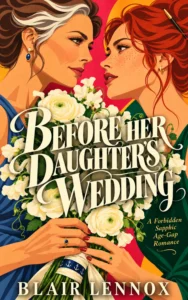
Before Her Daughter’s Wedding
Ten days at her best friend's wedding. One door between their rooms. Twenty-two buttons she sewed knowing she'd be the one to undo them.

The Guest Room Rule
Six weeks in her best friend's mother's guest room. Five rules chalked inside a chair. Every one of them is about to break.

My Ex-Husband’s Sister Wants Me
Port Sorrel After Dark
The divorce ended her marriage. It did nothing about his sister.

The Pastor’s Wife Is Leaving
She spent nine years watching the bar across the street. Now she lives above it.

My Ex’s Mother After Dark
Her daughter broke my heart. Her mother wants to show me what being chosen feels like.
Never Miss a Release
Get new release alerts, exclusive bonus content, and reader-only giveaways.